Customer Transformation: A Roadmap for Business Leaders

Customer transformation is the practice of redesigning journeys, capabilities, and operating models so every touchpoint reduces friction and earns loyalty. If you lead a team responsible for growth or service, three moves matter more than any framework: pick the single moment in the customer journey causing the most damage, assign one accountable owner to fix it, and track one KPI weekly to prove progress.
Before you build a multi-year program, start here:
- Pick the moment that matters. Find the one touchpoint (a slow onboarding step, a broken support handoff) where customers visibly lose patience.
- Assign an owner, not a committee. A named leader with authority to make changes moves faster than any cross-functional task force.
- Measure one KPI immediately. Conversion rate, resolution time, or CSAT. Pick one and start a baseline this week.
The rest of this guide covers how to scale those first moves into a governed, measurable program.
Key Takeaways
Customer transformation succeeds when leaders combine a clear customer aspiration, an agile execution approach, and strengthened analytics capability, rather than treating any single lever alone as sufficient.
| Point | Details |
|---|---|
| Start with one moment | Pick the single highest-friction touchpoint and assign one accountable owner before building a full program. |
| Combine three capabilities | People, process, and technology must work together; missing one weakens the other two. |
| Expect measurable ranges | Well-executed programs see 15 to 20 percent conversion gains and 20 to 50 percent lower service costs. |
| Govern for prioritization | A steering committee with real authority to decline low-value requests protects the roadmap’s focus. |
| Get expert execution support | Solution4guru builds journey maps and prioritized pilots that move faster than assembling an internal team from scratch. |
Table of Contents
- What Customer Transformation Actually Covers
- Why Customer Experience Transformation Cannot Wait
- The Three Capabilities Every Transformation Needs
- A Six-Step Roadmap for Executing Customer Transformation
- Common Pitfalls That Derail Customer Transformation
- Measuring Progress: KPIs and Benchmarks That Matter
- What Successful Transformations Actually Look Like
- How Solution4guru Approaches Customer Transformation Projects
- Connecting Customer Transformation to Business Strategy
- Data Privacy and Ethics in Customer Transformation
- Keeping the Transformation Alive After Launch
- Training and Culture Change That Make Transformation Stick
- Governance and Stakeholder Alignment That Keep Transformation on Track
- Sources
- FAQ
What Customer Transformation Actually Covers
Customer transformation spans the entire journey, not a single department’s project list. It covers every touchpoint a customer hits, from first ad click to renewal call, plus the internal capabilities, data systems, and governance that keep those touchpoints working together instead of independently.
That scope requires shared ownership. A typical structure includes:
- Executive sponsorship from the CEO or Chief Customer Officer, who protects budget and resolves cross-department conflicts.
- A cross-functional transformation team pulling from product, technology, support, and marketing rather than sitting inside one function.
- Frontline leads from support and sales who translate strategy into daily operations.
A standard digital project ends when the software goes live. Customer transformation does not end there. It runs on continuous feedback loops, measured against business outcomes, and it builds lasting capability inside the organization rather than delivering a one-time output.
Pro Tip: If your transformation team reports only to IT, you have a digital project, not a customer transformation. Reassign sponsorship to a business leader with direct customer accountability.
Why Customer Experience Transformation Cannot Wait
Four forces are converging at once. Customer expectations set by the best digital experiences now apply across every industry, competitors are shipping AI-personalized service faster than most incumbents can respond, customers are splitting attention across more channels than any team can manually monitor, and cost-to-serve pressure is forcing leaders to automate without degrading service quality.
- Rising baseline expectations shaped by the fastest, most personalized brands in any category
- Competitive pressure from AI-driven personalization at scale
- Channel fragmentation across web, mobile, chat, voice, and social
- Cost-to-serve pressure pushing automation into service and support
The revenue math is significant. Temkin Group’s analysis found that a moderate CX improvement produces an average revenue increase of $823 million over three years for a company with $1 billion in revenue.
Think about value in three pools: acquisition (conversion lift from smoother onboarding), retention (reduced churn from proactive service), and service efficiency (lower cost-to-serve from automation and better routing). McKinsey’s analysis of customer experience programs found typical results of 15 to 20 percent higher sales conversion and 20 to 50 percent lower service costs when transformation is done well.
The Three Capabilities Every Transformation Needs
Every durable customer transformation rests on three capability areas working together. Miss one, and the other two underperform.
People. Build cross-functional agile teams staffed with design thinking practitioners, not just engineers. Governance structures need clear decision rights, and training programs should extend past launch into ongoing skill building. HBR’s research on digital transformation makes the point bluntly: outcomes depend on people and leadership alignment as much as on the tools deployed.
Process. Journey mapping documents personas, stages, touchpoints, emotions, and pain points, turning assumptions into measurable design targets. Pair that with structured voice-of-customer loops, a prioritization framework for ranking fixes, and closed-loop actions that tell customers what changed because of their feedback.
Technology. Analytics and machine learning identify which customers are at risk before they churn. CRM and orchestration platforms connect data across channels so a service agent sees the same history a marketing system does. Automation and omnichannel platforms route requests to the right resource without manual triage.
Example use cases bring this to life:
- Predictive service scoring flags at-risk accounts for proactive outreach before they cancel.
- Automated routing sends complex issues straight to specialists, cutting resolution time.
- Personalized onboarding sequences adjust content based on a new customer’s stated goals.
Teams that work best pair a product owner with a data analyst and a frontline service lead, meeting weekly rather than quarterly.
A Six-Step Roadmap for Executing Customer Transformation
Executing transformation well means resisting the urge to fix everything simultaneously. Follow a sequence instead.
- Set the aspiration. Define, in one sentence, what “great” looks like for your customer relationship. Vague ambitions produce vague results.
- Map the journeys. Document the two or three journeys causing the most pain, capturing personas, touchpoints, and emotional highs and lows, per the journey mapping methodology that Harvard Business School Online outlines.
- Instrument the metrics. Attach a measurable KPI to every stage before you change anything, so you can prove impact later.
- Capture the why. Conversational research, increasingly run through AI-first tools, can surface root causes across thousands of customers faster than traditional interviews. Perspective AI’s 2026 playbook notes this approach compresses diagnosis timelines from months to weeks.
- Prioritize by value times feasibility. Score each fix on a simple 1 to 5 scale for customer value and a 1 to 5 scale for implementation feasibility, then multiply. Anything scoring 15 or higher goes into the next pilot.
- Pilot and scale. Launch the highest-scoring fix with a small team, measure results, then expand what works.
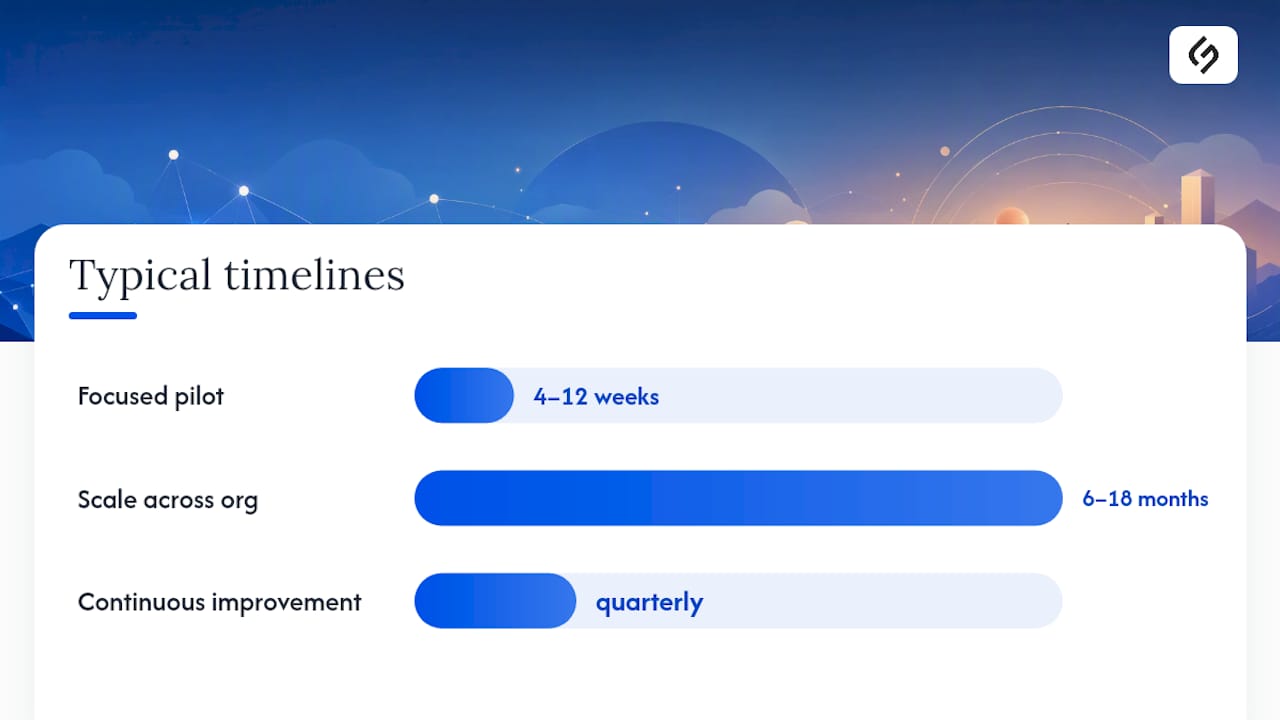
Typical timelines: a focused pilot runs 4 to 12 weeks. Scaling a proven fix across the organization takes 6 to 18 months. After that, continuous improvement should run on a standing quarterly cadence.
Structure ownership as a dedicated “CX factory,” a standing squad with a product owner, a data analyst, and rotating frontline representatives, rather than a temporary task force that disbands after launch.
Pro Tip: Protect pilot velocity by capping the pilot team’s scope to one journey and one metric. Adding a second objective mid-pilot is the fastest way to stall momentum before you have proof it works.
Common Pitfalls That Derail Customer Transformation
Most failed transformations share a small set of mistakes.
- Starting from the company’s org chart instead of the customer’s journey. Remedy: build the first roadmap entirely from customer research, not internal department priorities.
- Fixing one channel and calling it done. Remedy: map the full cross-channel journey before committing budget to a single platform.
- No single accountable owner. Remedy: name one leader with budget authority and a direct reporting line to the sponsor.
- Over-relying on technology to fix a culture problem. Remedy: pair every tech rollout with training and a change-management plan.
- Ignoring frontline employees during the redesign. Remedy: include support and sales staff in journey mapping sessions, not just customer interviews.
Avoid analysis paralysis. A rough pilot launched in six weeks beats a perfect plan still in review after six months.
Measuring Progress: KPIs and Benchmarks That Matter
Match each KPI to the business intent behind it. Acquisition efforts track conversion rate. Service quality tracks CSAT and customer effort score. Retention tracks churn, net promoter score, and customer lifetime value.
- Acquisition: conversion rate, cost per acquisition
- Service: CSAT, customer effort score, first-contact resolution
- Retention: churn rate, NPS, customer lifetime value
Instrument a small, balanced set of four to six metrics rather than a sprawling dashboard nobody checks. Set a baseline before you touch anything, then report weekly during pilots, monthly at the squad level, and quarterly to executives.
Benchmark range to expect: McKinsey’s research across roughly 900 transformation programs found 15 to 20 percent conversion increases, 20 to 50 percent service cost reductions, and 10 to 20 percent satisfaction gains when all three capability blocks are in place.
What Successful Transformations Actually Look Like
Three composite patterns show up repeatedly across well-run transformations.
- A retail brand redesigned its checkout journey after mapping revealed a single confusing step causing most cart abandonment. Conversion improved within the 15 to 20 percent range typical of well-executed fixes.
- A subscription service used predictive analytics to score churn risk and triggered proactive outreach to the highest-risk accounts, cutting service costs while improving retention.
- A financial services firm closed the loop with customers who submitted complaints, explicitly telling them what changed. That single behavior, research on CX improvement loops confirms, strengthens loyalty and validates the entire feedback program.
The common lever across all three: they started with one high-friction moment, not a full overhaul.
How Solution For Guru Approaches Customer Transformation Projects
Solution4guru runs customer transformation engagements through a structured sequence: assessment, pilot, scale, then embedded continuous improvement. Each phase produces a concrete deliverable, not just a recommendation deck.
Clients typically receive:
- A researched customer journey map covering personas, touchpoints, and pain points
- A prioritized backlog scored by value and feasibility
- A working prototype of the highest-priority fix
- A success dashboard tracking the agreed KPIs
- Training materials for the teams who will own the process after launch
Pro Tip: Ask any transformation partner to show you a prioritized backlog before they show you a technology proposal. If they lead with software, they are selling a project, not a transformation.
Clients can expect reduced friction at the moments that matter most, faster resolution times, and measurable lifts in conversion or retention within the pilot window.
Connecting Customer Transformation to Business Strategy
Customer transformation only sticks when it maps directly to the metrics your board already cares about. If your company strategy centers on margin expansion, your transformation roadmap should prioritize cost-to-serve reduction over cosmetic experience upgrades. If growth through retention is the priority, journey fixes that reduce churn deserve the first pilot slot, not the fifth.
The strongest programs treat customer transformation as an execution layer underneath strategic planning, not a parallel initiative competing for the same budget. That means the transformation roadmap gets reviewed in the same planning cycles as revenue targets and product roadmaps, with the same executive sponsor accountable for both.
Disconnected programs are easy to spot. They report customer metrics in a separate deck that nobody at the strategy table reads. Connected programs report a single number, often incremental revenue or reduced cost-to-serve, that shows up in the same quarterly business review as every other strategic initiative.
Digital infrastructure decisions reinforce this link. A company modernizing its core business processes or migrating to cloud-based systems, as outlined in AWS’s guidance on scalable digital transformation, should sequence that work around the customer journeys it will affect first. Technology decisions made in isolation from customer strategy tend to produce systems that are technically sound but operationally disconnected from where customers actually feel friction.
Data Privacy and Ethics in Customer Transformation
Personalization depends on data, and data collection carries real ethical weight. Every customer transformation program that touches personal information needs a clear position on consent, data minimization, and transparency before analytics work begins.
Practically, that means three things. First, collect only the data a specific use case requires. A recommendation engine needs purchase history; it does not need location data unless location genuinely improves the recommendation. Second, tell customers what you are collecting and why, in plain language, not buried in a lengthy terms document. Third, build access controls so customer data flows only to the systems and people who need it for a defined purpose.

Regulatory frameworks vary by jurisdiction. Companies operating across multiple regions need to map their data practices against each applicable regime rather than assuming one compliance standard covers every market. This is not just a legal exercise. Customers increasingly notice when personalization feels invasive rather than helpful, and that perception erodes trust faster than almost any other transformation misstep.
Governance should include a standing review point where the transformation team checks new data uses against its stated privacy commitments before launch, not after a customer complaint forces the review.
Keeping the Transformation Alive After Launch
A transformation that stops improving the day it launches was never really a transformation. It was a project with a longer name.
Build a standing mechanism for the loop SmartSurvey’s framework describes: listen, understand, prioritize, act, measure, repeated on a fixed cadence rather than only when someone complains loudly enough. Assign the standing CX squad from the roadmap phase to own this loop permanently, with a quarterly review where they present what changed and what is next.
Two habits separate teams that sustain improvement from teams that plateau. First, they keep collecting feedback at the same moments that mattered during the original mapping, so trends are comparable over time. Second, they close the loop publicly. Telling customers what changed because of their input, a practice research on feedback loops shows increases loyalty, reinforces that the program is real and not theater.
Set a review cadence now rather than leaving it undefined. Weekly check-ins during active pilots, monthly squad reviews once a fix is scaled, and quarterly executive reviews tied to the KPIs established during measurement. Each cycle should produce one new prioritized item for the backlog, keeping the roadmap alive instead of letting it calcify into a document nobody revisits.
Training and Culture Change That Make Transformation Stick
Technology and process changes fail without a workforce trained and motivated to use them. Employee training needs to start before launch, not after a system goes live and people are left guessing.
Effective training programs cover three layers. Tactical training teaches staff how to use new tools and follow new processes. Contextual training explains why the change matters to the customer, so frontline staff understand the reasoning behind a new workflow rather than following it mechanically. Behavioral training addresses the softer skills, empathy, judgment calls, escalation timing, that no software update can automate.
Culture change runs deeper than a training curriculum. HBR’s research on digital transformation found that organizational alignment and leadership behavior predict outcomes as much as the tools deployed. If leaders talk about customer transformation in town halls but still reward departments for hitting narrow internal metrics that conflict with the customer experience goal, employees notice the contradiction and revert to old habits.
Recognition systems need to reinforce the new behavior. If a support agent takes extra time to solve a customer’s root problem instead of closing the ticket quickly, that should count as a win in performance reviews, not a productivity miss. Culture change that isn’t reflected in how people are measured and rewarded rarely survives past the first difficult quarter.
Governance and Stakeholder Alignment That Keep Transformation on Track
Customer transformation touches every department, which means it needs governance strong enough to resolve disagreements without stalling progress. A steering committee with representatives from product, technology, marketing, and service should meet monthly to review the backlog and resolve resourcing conflicts.
Stakeholder alignment starts with a shared definition of success, written down and agreed to before the first pilot launches. Without that document, departments default to their own metrics: marketing optimizes for lead volume, service optimizes for ticket closure speed, and neither necessarily improves the customer’s actual experience.
Clear decision rights matter as much as meeting cadence. The transformation owner needs explicit authority to greenlight pilots within an agreed budget threshold, so every small experiment doesn’t require executive sign off. Escalate only genuine cross-department conflicts or budget requests above that threshold to the steering committee.
Governance also needs a mechanism for saying no. Not every stakeholder request belongs in the roadmap, and a transformation team without the authority to decline low-value requests ends up with a backlog full of pet projects instead of high-impact fixes. Protecting that prioritization discipline is one of governance’s most underrated functions.
Why Most Transformation Programs Underestimate Governance
The technical work of customer transformation, the journey maps, the analytics, the automation, gets most of the attention in planning documents. Governance gets a single slide. That’s backward.
I’d argue the biggest predictor of whether a transformation survives its second year isn’t the sophistication of its analytics stack. It’s whether the steering committee has real authority to kill low-value initiatives and protect the highest-priority ones from being diluted by competing internal agendas. Most programs that stall didn’t fail because the technology was wrong. They failed because six departments each got a small piece of the budget and nobody had the authority to say a particular request wasn’t worth pursuing. If you’re building a transformation roadmap right now, spend as much time designing who can say no as you spend designing the journey maps.
Getting Started With a Customer Transformation Partner
Solution For guru is the practical alternative to hiring a full internal transformation team from scratch, giving you journey mapping, prioritization, and pilot execution without months of internal hiring and onboarding before the first fix ships.
The engagement includes a researched journey map identifying your highest-friction moments and a prioritized backlog scored by value and feasibility, so your first pilot targets the fix most likely to move revenue or retention. Expect a working prototype and a success dashboard within the pilot window, not a strategy deck that sits unused.
If your team is deciding where to start, request a free diagnostic consultation to map your highest-impact journey and scope a pilot before committing to a larger platform rebuild. For teams whose transformation depends on rebuilding customer-facing systems, Solution4guru’s web development services can scope that work alongside the customer research so both tracks move together.
Sources
- The three building blocks of successful customer-experience transformations
- Customer journey map: a step-by-step guide
- How to improve customer experience: a practical step-by-step framework – SmartSurvey
- How to Improve Customer Experience: A 2026 Playbook | Perspective AI
- 10 Ways to Improve Customer Experience – Qualtrics
FAQ
Customer transformation is the redesign of customer journeys, capabilities, and governance so every touchpoint reduces friction and builds loyalty, combining people, process, and technology changes rather than a single software rollout.
A focused pilot typically runs 4 to 12 weeks, while scaling a proven fix across the organization takes 6 to 18 months, followed by ongoing quarterly improvement cycles.
Start with one metric per business intent: conversion rate for acquisition, CSAT or customer effort score for service, and churn or NPS for retention, rather than tracking a large dashboard from day one.
A single accountable leader with executive sponsorship, backed by a standing cross-functional squad, should own the program rather than a temporary committee that disbands after launch.
Yes. Solution For guru builds researched journey maps, prioritized backlogs, and working pilots for companies that want to move faster than assembling an internal transformation team from scratch.