Whitevision vs Moss: Which Platform Fits Your Finance Workflow Better?
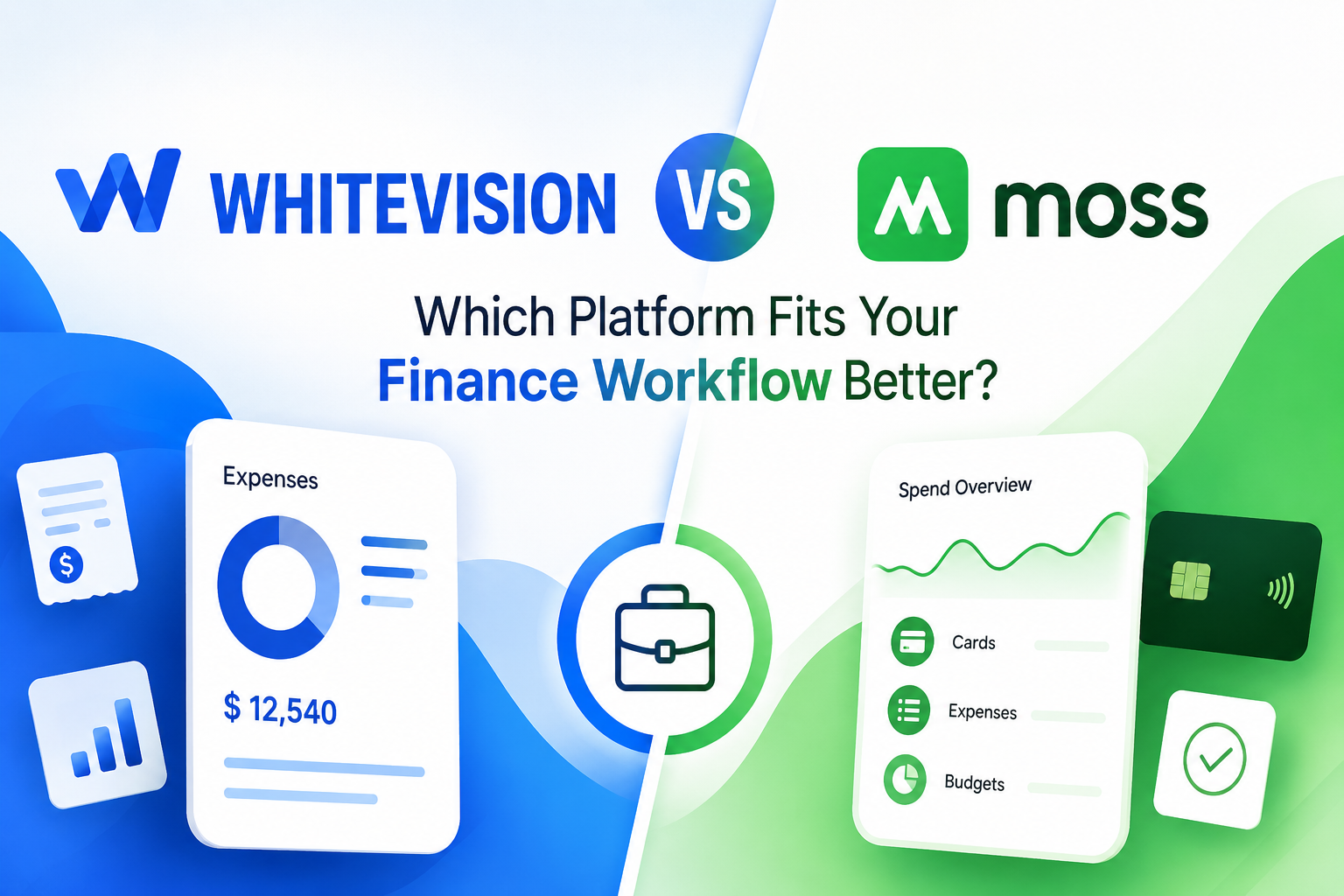
Choosing the right finance automation platform is not just a software decision; it shapes how quickly invoices get paid, how much manual data entry your team still handles, and how confident you feel about the accuracy of your books. Two names that come up frequently in this conversation are Whitevision and Moss, yet the two platforms actually solve fairly different problems, even though both promise to reduce manual finance work and free up time for higher-value analysis instead of repetitive data entry.
In this article, we will break down how Moss and Whitevision B.V. each approach automation, mobile receipt capture, approval workflows, accounting integrations, and centralized expense visibility, so you can decide which platform genuinely fits your finance team’s day-to-day needs. Since both platforms are frequently shortlisted by businesses researching finance automation tools, understanding exactly where they overlap and where they diverge will save you from choosing based on marketing claims alone. We will also cover how partnering with Solution for Guru can help you implement either platform successfully.
Table of contents
What Will You Learn in This Article?
Here is a quick summary of what this comparison covers, so you can jump straight to the section most relevant to your decision.
| Topic | What You’ll Learn |
|---|---|
| What each platform is built for | The core problem Moss and Whitevision each solve |
| Automation approach | How OCR, AI categorization, and document recognition differ |
| Mobile receipt capture | How each platform handles on-the-go expense submission |
| Approval workflows | How routing and sign-off rules compare |
| Accounting integrations | Which ERP and accounting systems each platform connects to |
| Expense visibility | How real-time spend data is presented to finance teams |
| Side-by-side comparison | A full feature table to help you decide quickly |
| Implementation | How Solution for Guru helps you roll out either platform |
How Are Moss and Whitevision Related to This Topic?
Both platforms sit in the broader finance automation space, but they approach it from different starting points, which is exactly why comparing them matters.
Moss is a spend management platform built around corporate cards, employee reimbursements, and accounts payable. It gives finance teams a single, centralized view of company spending as it happens, combining card issuance, receipt capture, and approval workflows into one system rather than requiring separate tools for each function.
Whitevision B.V., by contrast, focuses specifically on document processing. It uses OCR and AI-driven recognition to scan, interpret, and automatically prepare bookings for incoming invoices and other financial documents, then routes them through configurable approval workflows before syncing the data to an ERP system. Where Moss centers on how money leaves the business through cards and reimbursements, Whitevision centers on how incoming documents, particularly purchase invoices, get processed and booked. Understanding this distinction is the key to figuring out which platform actually fits your workflow.
What Problem Does Each Platform Set Out to Solve?
Before comparing individual features, it helps to understand the core use case each platform was originally designed around.
What Is Moss Built to Handle?
Moss combines corporate cards, accounts payable, and reimbursements into a single system, giving finance teams a unified view of spend rather than juggling separate tools. It was designed for growing small and mid-sized businesses that need to control spending at the point of purchase, through card limits and automated approvals, rather than only reconciling expenses after the fact.
What Is Whitevision Built to Handle?
Whitevision focuses on digitizing and automating the processing of incoming financial documents, invoices, purchase orders, packing slips, and expense claims. Rather than issuing cards or managing reimbursements, it solves the problem of manual data entry from paper and PDF documents, using intelligent OCR to extract line-item data and prepare a booking proposal automatically.
Why Does This Distinction Matter for Your Decision?
If your biggest pain point is controlling how employees spend money and reconciling card transactions, Moss addresses that directly. If your biggest pain point is the hours your team spends manually keying in supplier invoices, Whitevision is built specifically for that challenge. Some finance teams, particularly larger organizations with heavy invoice volume and separate card programs, may even find value in using tools like these for different parts of their workflow rather than expecting one platform to do everything.
How Does Automation Work in Each Platform?

Automation is central to both platforms, but the underlying technology and its purpose differ significantly.
How Does Moss Automate Expense Categorization?
Moss uses AI-powered pre-accounting to automatically categorize and code transactions as they occur, syncing structured, ready-to-book data directly to the connected accounting system. This means that by the time a finance team reviews a transaction, much of the coding work is already complete, reducing the manual effort typically required during month-end close.
How Does Whitevision Automate Document Recognition?
Whitevision relies on intelligent OCR combined with AI to interpret both header and line-item data on incoming documents. Unlike traditional OCR systems that rely on fixed templates per supplier, Whitevision’s recognition engine interprets documents more like a human would, learning and improving its accuracy over time without requiring manual template setup for every new vendor.
Which Approach Better Reduces Manual Data Entry?
Both platforms significantly cut down on manual entry, but in different contexts. Moss reduces manual work at the point of spending, since transactions are pre-coded as they happen. Whitevision reduces manual work at the point of receiving invoices, automatically extracting and preparing complex, multi-line documents for booking. A business dealing primarily with card spend will feel Moss’s automation more directly, while a business processing a high volume of supplier invoices will see the greater benefit from Whitevision.
How Do the Platforms Handle Mobile Receipt Capture?

Capturing receipts on the go is essential for any modern finance workflow, and both platforms offer mobile tools, though built around different types of documents.
How Does Moss Handle Receipt Capture From Employees?
Moss lets employees submit expense claims, from mileage and per-diems to out-of-pocket spending, directly through its mobile or web app. Its OCR technology automatically captures receipt details, eliminating tedious manual entry, while employees photograph receipts for taxis, hospitality, and other card-related expenses on the spot rather than saving paper receipts for later.
How Does Whitevision Handle Mobile Document Capture?
Whitevision’s mobile app allows users to import and scan documents while on the go, whether that is a supplier invoice received in the field or an expense claim tied to a project. Once captured, the system’s recognition engine prepares a proposed booking automatically, so the document does not sit unprocessed until someone returns to a desk.
Which Platform Offers a Better Fit for Field Teams?
For businesses with employees frequently making purchases in the field, such as sales teams or contractors, Moss’s mobile expense capture directly supports fast reimbursement and card reconciliation. For businesses receiving invoices from suppliers while staff are on-site, such as construction or field service companies, Whitevision’s mobile document capture and its receipt-linking capabilities for construction-specific workflows offer a more targeted fit.
How Do Approval Workflows Compare Between the Two Platforms?
Approval routing is where both platforms show clear strength, though the structure of those workflows differs based on what is being approved.
How Does Moss Structure Its Approval Workflows?
Moss offers custom, multi-step, rules-based approval workflows that finance teams can configure without relying on IT support. Transactions above a set threshold may require manager sign-off before the expense gets coded. This becomes especially useful when departments have different spending patterns and the finance team cannot review every transaction manually.
How Does Whitevision Structure Its Approval Workflows?
Whitevision includes workflow software for digitally routing, reviewing, and approving documents, bundled into all of its plan variants. Businesses can route every incoming invoice through a defined approval chain before booking it. The system also lets teams build workflows around specific business processes and individual supplier requirements.
What Should You Consider When Comparing Approval Flexibility?
Both platforms allow rules-based routing without heavy IT involvement, but the context differs. Moss typically triggers approval workflows based on spending thresholds and card usage, while Whitevision triggers them based on incoming invoice data and document type. If your approval bottleneck centers on employee spending decisions, Moss’s structure will likely feel more relevant. If your bottleneck is invoices sitting in someone’s inbox awaiting sign-off, Whitevision’s document-centric workflow is the better match.
How Do Accounting and ERP Integrations Compare?
Neither platform operates in isolation. Both are designed to sync data into a business’s existing accounting or ERP system, but the depth and focus of those integrations differ.
| Integration Area |  |  |
|---|---|---|
| Accounting software | DATEV, Xero, QuickBooks, Sage 50, Exact Online, Twinfield | Multiple ERP systems via close vendor partnerships |
| ERP systems | NetSuite, SAP Business One, Microsoft Dynamics | Deep, partnership-based ERP integrations |
| HR systems | Personio, Workday, People HR | Not a core focus area |
| Productivity tools | Microsoft 365 | Email handling via SMART E-mail handler |
| Integration count | 40+ accounting, ERP, HR, and productivity tools | Varies by ERP partnership, modular by design |
Why Does Moss Emphasize Breadth Across Categories?
Because Moss combines cards, reimbursements, and accounts payable, it needs to connect not just to accounting software but also to HR platforms, since employee data often determines card issuance and spend limits. This breadth reflects Moss’s positioning as an all-in-one spend management hub rather than a single-purpose tool.
Why Does Whitevision Emphasize Depth With ERP Partners?
Whitevision takes a more focused approach, building close partnerships with specific ERP providers to ensure far-reaching, reliable integrations rather than broad but shallow connections. This depth matters most for businesses whose entire financial process already runs through a specific ERP system and needs invoice data to flow in without friction or manual reconciliation.
What Happens If Your ERP Vendor Is Not Yet a Whitevision Partner?
Whitevision has stated that if a business’s ERP vendor is not yet part of its partner network, its team is open to meeting with both the business and the vendor to discuss building that connection. This willingness to extend partnerships suggests the platform prioritizes deep, reliable integration over simply claiming a long list of supported systems, though it also means implementation timelines can vary depending on how established a given ERP partnership already is.
How Does Each Platform Provide Centralized Expense Visibility?
Visibility into company spending is the end goal for both platforms, but the type of visibility each one prioritizes reflects its core focus.
What Kind of Visibility Does Moss Provide?
Moss gives finance teams a real-time view of all company spending, from corporate cards to invoices, in one place, with detailed spend insights across cost centers and vendor payments. Dashboards display role-based card limits and budget tracking, so managers can catch overspending before it becomes a problem rather than discovering it during a monthly review.
What Kind of Visibility Does Whitevision Provide?
Whitevision provides visibility into document status and processing accuracy, giving finance teams instant access to invoices and other documents rather than losing track of paperwork in email inboxes or physical files. Its activity dashboard and audit trail features make it straightforward to see exactly where a given invoice stands in the approval chain at any moment.
Which Type of Visibility Matters More for Your Business?
If your primary concern is understanding how much your company is spending, by department, vendor, or card, in real time, Moss’s spend-focused dashboards deliver that directly. If your primary concern is knowing exactly where every incoming invoice stands and eliminating lost documents, Whitevision’s document-centric visibility is the more direct solution to that specific pain point.
Whitevision vs Moss: Full Feature Comparison

To make the decision easier, here is a side-by-side comparison of how the two platforms stack up across the criteria that matter most to finance teams.
| Feature | | |
|---|---|---|
| Core focus | Spend management: cards, reimbursements, AP | Document automation: invoice scanning and recognition |
| Automation type | AI pre-accounting for card and reimbursement transactions | Intelligent OCR for invoice header and line-item data |
| Mobile capture | Expense claims, receipts, mileage, per-diems | Scanned documents, invoices, expense claims |
| Approval workflows | Multi-step, rules-based, triggered by spend thresholds | Configurable, document-routing based workflows |
| Corporate cards | Physical and virtual cards with real-time limits | Not offered |
| Accounting integrations | DATEV, Xero, QuickBooks, Sage, NetSuite, and more | Deep partnerships with specific ERP providers |
| Best suited for | Businesses controlling spend at the point of purchase | Businesses processing high volumes of supplier invoices |
| Region of operation | UK, Germany, Austria, Netherlands | Primarily European market with ERP partner network |
| Onboarding time | Around 30 minutes for basic setup | Typically 1 to 4 implementation days, spread over weeks |
As this table shows, Moss and Whitevision are not direct competitors so much as tools built for adjacent, sometimes complementary, parts of the finance workflow. Choosing between them depends far more on where your team’s manual work actually happens than on which platform has more features overall.
Which Businesses Benefit Most From Moss?
Moss tends to fit businesses where controlling employee spending and managing corporate cards is the central challenge.
Is Moss a Good Fit for Growing SMBs?
Yes. Moss targets growing companies with card programs that can scale from a handful of active users to much larger teams. Businesses often see the clearest value when they grow from around 20 to 80 employees, as higher spending volumes make the built-in controls more valuable and a larger number of card users can justify the per-user subscription cost.
Does Moss Work Well for Project-Based Organizations?
Agencies and consultancies that track card usage by client or cost center for pass-through expense reconciliation can benefit from Moss’s structure, which automatically tags and reports spending at that level instead of requiring manual reallocation later.
What Type of Finance Team Gets the Most Value From Moss?
Finance teams already using Xero, NetSuite, Sage Intacct, or DATEV, and looking for a single platform to unify cards, reimbursements, and accounts payable, are well positioned to benefit from Moss’s all-in-one approach.
Which Businesses Benefit Most From Whitevision?
Whitevision tends to fit organizations where the biggest bottleneck is processing a large volume of incoming paper or digital invoices accurately and quickly.
Is Whitevision a Good Fit for Businesses With High Invoice Volume?
Yes. Businesses spending hours manually breaking down cost invoices, recalculating VAT per line, or processing purchase invoices with many line items are exactly the use case Whitevision’s rule and line recognition capabilities were built to address.
Does Whitevision Work Well for Industry-Specific Needs?
Whitevision offers additional modules for specific organizational needs, such as receipt-linking functionality tailored for construction businesses, which shows the platform’s modular structure adapts to industries with unique documentation requirements rather than forcing every business into the same workflow.
What Type of Finance Team Gets the Most Value From Whitevision?
Finance teams whose ERP vendor already partners with Whitevision, and who want deep, reliable integration without building custom connectors themselves, are especially well positioned to benefit, since implementation and data accuracy improve significantly when the integration is already well established.
How Should You Decide Between Whitevision and Moss?

Rather than asking which platform is objectively better, the more useful question is which one addresses your team’s actual daily friction.
- Identify your biggest manual workload. Is it employee expense reconciliation and card management, or is it keying in supplier invoices?
- Check your existing accounting or ERP system. Confirm whether Moss or Whitevision already has a strong integration with your specific platform.
- Consider your document volume versus your spend volume. High invoice volume points toward Whitevision; high card and reimbursement activity points toward Moss.
- Think about your industry’s specific needs. Construction, field services, and other document-heavy industries may lean toward Whitevision’s specialized modules.
- Evaluate whether you need both. Larger organizations may find value in using each platform for the part of the workflow it was built to solve.
Why Does This Comparison Matter for Your Finance Workflow?
Choosing between Moss and Whitevision ultimately comes down to identifying where your finance team spends the most unnecessary manual effort today. Moss centralizes corporate cards, reimbursements, and accounts payable into one connected system, giving finance leaders real-time visibility into spend as it happens. Whitevision B.V., on the other hand, focuses specifically on automating the processing of incoming invoices and financial documents, eliminating hours of manual data entry through intelligent OCR and deep ERP integrations.
Neither platform is universally better than the other; each simply solves a different problem well. A business struggling with card sprawl and reimbursement delays will find far more direct value in Moss, while a business drowning in supplier invoices will see faster, more meaningful improvement from Whitevision. Taking the time to map your actual bottlenecks before committing to either platform will save your finance team significant frustration down the road, and it will also make any future integration or onboarding project far more straightforward to plan and budget for.
Frequently Asked Questions
Yes, in principle. Since Moss focuses on spend management through cards and reimbursements while Whitevision focuses on incoming invoice processing, some larger organizations use both platforms to cover different parts of their finance workflow, provided both can be integrated with the same underlying accounting or ERP system.
Moss generally offers a faster initial setup, with basic onboarding reported to take around 30 minutes for core features. Whitevision’s implementation typically takes longer, ranging from one to four active implementation days spread across two to eight weeks, since it involves deeper configuration around document recognition rules and ERP-specific integrations.
Yes, both platforms provide mobile apps. Moss’s mobile app focuses on submitting expense claims and managing card-related approvals from anywhere, while Whitevision’s mobile app focuses on scanning and importing documents in the field, so approvals and processing do not have to wait until someone returns to a desk. For teams that split time between client sites, job sites, or travel, this mobile-first design in both platforms significantly shortens the gap between when a cost occurs and when it actually gets recorded in the books.
How Can Solution for Guru Help You Implement Whitevision or Moss?
Selecting the right platform is only the first step. Configuring approval workflows, mapping accounting fields correctly, and integrating either system with your existing tech stack takes technical expertise that many finance teams do not have readily available in-house. This is where partnering with Solution for Guru makes a meaningful difference.
What Does Solution for Guru Bring to a Finance Automation Rollout?
Solution for Guru specializes in CRM, payroll, and project management software integration, giving them direct, practical experience connecting finance platforms with the broader systems a business already relies on. Rather than leaving default settings in place, their team helps configure approval thresholds, document routing rules, and accounting mappings around your specific operational needs.
How Does Expert Configuration Improve Results From the Start?
A poorly mapped integration between Moss or Whitevision and your accounting system can lead to miscoded transactions, delayed approvals, or inaccurate spend reporting. Working with an experienced integration partner ensures these foundational connections are set up correctly from day one, reducing the trial-and-error period that often follows a new software rollout.
What Long-Term Value Does This Partnership Provide?
As your business grows and your finance processes evolve, Solution for Guru’s broader expertise in SaaS integrations means your chosen platform, whether Moss, Whitevision, or both, can scale alongside your operations. This includes connecting additional tools, refining workflows based on real usage data, and training your team on best practices for accurate, efficient financial data entry.
Recommended:
- Key Features of HoorayHR
- Zoho Expense Review: Pros, Cons, and Key Features
- HoorayHR ROI: How Businesses Save Time with HR Automation
- How Long Does It Take to Implement HoorayHR?
- HoorayHR Review: Features, Pros, Cons, and Best Use Cases
- What Is HoorayHR? A Complete Overview
- Best Expense Automation Software: Which Platform Fits Your Business?
- What ROI Can Businesses Expect From Expense Automation Software?
- Multi-Currency Expense Management with Zoho Expense
- What Is Zoho Expense and How Does It Work?
- What Are the Biggest Challenges in Multi-Entity Expense Management?
- Whitevision vs Traditional Invoice Processing: What Changes?
- What Is Whitevision and How Does It Work?
- What Is Expense Management Software and Why Do Companies Need It?