What Is Digital Consulting? A Guide for Business Leaders

TL;DR:
- Digital consulting helps organizations use digital technologies and data to improve business performance and achieve specific goals.
- It connects technology decisions directly to measurable outcomes like revenue growth, conversion rates, and support costs through structured, phased engagements.
Digital consulting is defined as the strategic practice of guiding organizations to use digital technologies and data to improve business performance and drive growth. It answers three core questions: where to invest in technology, what changes to customer and employee journeys support those investments, and how to manage the resulting work effectively. For business owners and decision-makers, understanding this discipline is the first step toward making technology investments that produce real, measurable results rather than expensive experiments.
What is digital consulting and what does it actually cover?
Digital consulting, also called digital strategy consulting, is the practice of helping organizations decide which digital technologies to adopt and how to implement them to meet specific business goals. It differs from IT consulting, which focuses on technical infrastructure, and from traditional management consulting, which addresses broad organizational strategy. Digital consulting targets the intersection of technology and business outcomes, producing new digital capabilities rather than general operational advice.

The scope of digital consulting services is broader than most business owners expect. A consultant may assess your current digital channels, redesign customer journeys, build a technology roadmap, or advise on data governance. The work is always anchored to a specific business objective, such as increasing revenue per user or reducing the cost of customer support.
Digital governance is one area that surprises many clients. Effective governance frameworks mitigate risk, protect data integrity, and ensure compliance with regulations like GDPR and CCPA. That is not a technical detail. It is a business liability issue that digital consultants are trained to address.
Core service categories
A typical digital consulting engagement may include any combination of the following:
- Digital strategy: Defining which markets, channels, and technologies to prioritize over a 12–36 month horizon
- Technology roadmaps: Sequencing platform investments to avoid redundant tools and integration debt
- Customer journey redesign: Mapping and improving how customers find, buy from, and stay with your business
- Employee journey redesign: Reducing friction in internal workflows to cut cycle time and error rates
- Data analytics and reporting: Building dashboards and KPI frameworks that connect digital activity to revenue
- AI integration: Adding AI tools for search support, content summarization, or operational monitoring
- Process automation: Replacing manual steps with automated workflows to reduce cost and improve speed
- Digital governance: Establishing policies for data use, platform access, and regulatory compliance
Pro Tip: Ask any prospective digital consultant to name the three business metrics their work will move. If they cannot answer that question in the first meeting, the engagement will likely produce a report rather than results.
How does digital consulting drive measurable business value?
Digital consulting produces value only when it connects technology decisions to business outcomes. The most effective engagements track a small set of metrics tied directly to each phase of work, rather than reporting on every available data point. Success metrics include conversion rates, revenue per user, cost per support ticket, cycle time, and platform incident rates.
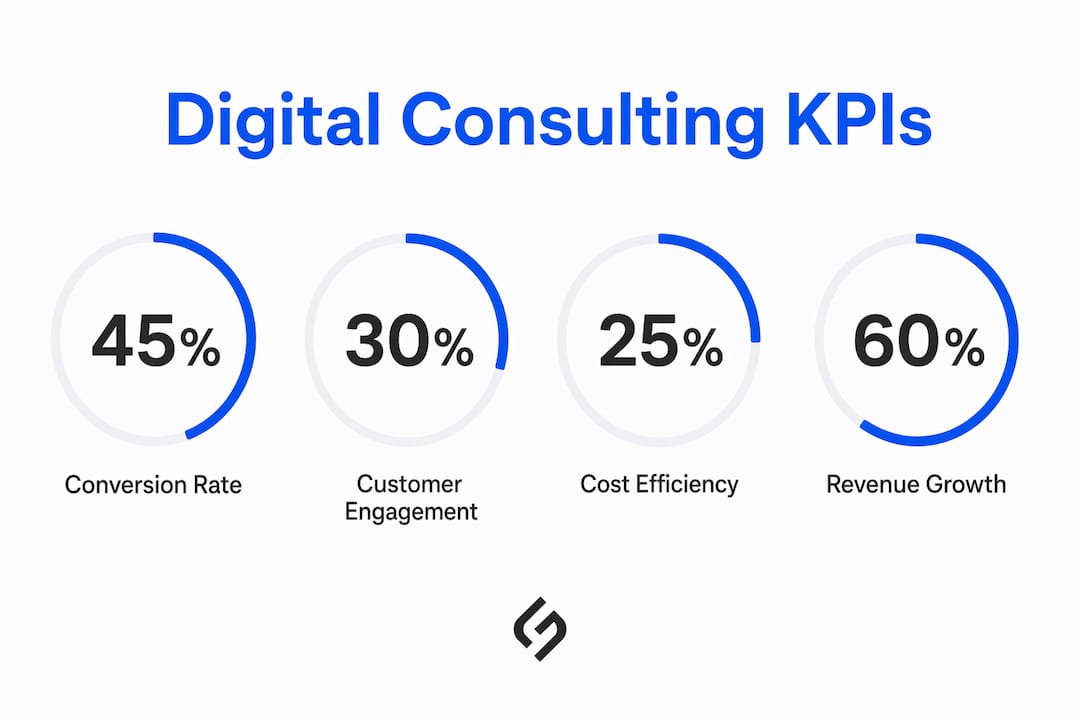
Tracking both business and technical metrics matters because each tells a different part of the story. A drop in platform incident rates is a technical win. A rise in revenue per user is a business win. When both move in the right direction simultaneously, the consulting work is producing genuine value. When only one moves, the engagement needs adjustment.
The table below shows the most common metrics used in digital consulting, what each measures, and why it matters to business leaders.
| Metric | What it measures | Why it matters |
|---|---|---|
| Conversion rate | Percentage of visitors who complete a desired action | Directly links digital investment to revenue generation |
| Revenue per user | Average revenue generated per active customer | Shows whether digital improvements increase customer value |
| Cost per ticket | Average cost to resolve one customer support request | Measures efficiency gains from automation and self-service |
| Cycle time | Time to complete a business process end to end | Indicates operational speed improvements from digitization |
| Platform incident rate | Frequency of technical failures or outages | Reflects platform stability and reliability of digital systems |
Linking digital initiatives to business targets is what separates effective consulting from expensive activity. A consultant who cannot show how a proposed platform change will affect conversion rate or cost per ticket is not yet thinking at the right level. Business owners should require this connection before approving any phase of work. You can also use a digital marketing ROI guide to build the measurement framework before the consulting engagement begins.
Is digital consulting only for large enterprises?
Digital consulting is not reserved for large enterprises. Small and mid-sized companies use digital consulting for targeted, narrower-scope projects that address specific pain points rather than company-wide transformation. The scope of the engagement simply matches the size of the opportunity and the level of risk involved.
Common focused engagements for smaller organizations include:
- Sales pipeline optimization: Identifying where leads drop out of the funnel and fixing the digital touchpoints responsible
- Customer service automation: Replacing repetitive email or phone interactions with self-service tools or chatbots
- E-commerce performance: Improving product page conversion rates and checkout completion through UX and data analysis
- Process digitization: Moving paper-based or spreadsheet-driven processes onto digital platforms to reduce errors and save time
For sustainable digital solutions for SMEs, the key is scoping the engagement to a problem that has a clear financial impact. A small retailer does not need a 12-month enterprise transformation program. It may need a six-week audit of its checkout flow and a targeted fix to recover abandoned carts.
Pro Tip: Before engaging a digital consultant, write down the one business problem you want solved and the dollar value of solving it. That number becomes your benchmark for evaluating whether the engagement delivered.
Enterprise-wide digital transformation consulting differs in scale, not in principle. Large organizations face more complex stakeholder environments, legacy system constraints, and regulatory requirements. The consulting methodology is the same. The coordination effort is significantly larger.
What does a typical digital consulting engagement look like?
Digital consulting projects follow a phased structure designed to reduce risk and allow course corrections before significant resources are committed. Phases typically last 2–6 weeks for audits and roadmap development, followed by longer modular implementation phases. Big-bang launches, where everything goes live at once, are avoided because they concentrate risk and make it difficult to identify what caused a problem when one arises.
A standard engagement follows this sequence:
- Discovery and audit (weeks 1–6): The consultant reviews existing digital channels, technology platforms, data sources, and business processes. The output is a gap analysis showing where current capabilities fall short of business goals.
- Roadmap development (weeks 3–6, overlapping with audit): The consultant prioritizes initiatives by business impact and implementation complexity. The roadmap sequences work so that high-value, lower-risk changes come first.
- Sponsor review and sign-off: Before implementation begins, the roadmap is presented to business sponsors for approval. This step prevents scope creep and ensures alignment between the consulting team and the organization’s leadership.
- Modular implementation (months 2–6+): Work proceeds in defined modules, each with its own deliverables and success metrics. Each module ends with a review before the next begins.
- Scope adjustment and iteration: After each module review, the roadmap is updated based on what was learned. Phased implementation prevents the risk of building features that are unneeded or impossible to scale.
This structure protects business owners from two common failure modes: paying for a strategy that never gets implemented, and committing to a full implementation before the strategy has been validated. Understanding digital transformation challenges before the engagement starts helps set realistic expectations for each phase.
AI is increasingly woven into these engagements even when it is not the central focus. AI tools support search, summarization, and monitoring functions that make consulting teams more effective during both the audit and implementation phases. For e-commerce businesses, AI-driven tools like Google Ads automation can be part of the digital channel optimization work a consultant recommends.
Key Takeaways
Digital consulting delivers measurable business value when it connects technology decisions to specific outcomes like conversion rate, revenue per user, and cost per ticket through a phased, milestone-driven engagement structure.
| Point | Details |
|---|---|
| Clear definition | Digital consulting guides organizations to use technology and data to achieve specific business goals. |
| Measurable outcomes | Track conversion rate, revenue per user, cost per ticket, cycle time, and incident rates for each phase. |
| Accessible to all sizes | Small and mid-sized businesses use digital consulting for focused projects, not only enterprise transformation. |
| Phased structure reduces risk | Audits last 2–6 weeks; implementation proceeds in modules with sponsor reviews between each phase. |
| AI is already part of the work | AI tools for search, summarization, and monitoring appear in most modern digital consulting engagements. |
What I have learned from watching digital consulting projects succeed and fail
The most common reason a digital consulting engagement fails is not a bad strategy. It is the absence of a clear owner on the client side. Consultants can build an excellent roadmap, but if no one inside the organization is accountable for executing it, the document sits in a shared drive and nothing changes. Every engagement needs a named internal sponsor with the authority to make decisions and the time to be involved.
The second pattern I have observed is scope inflation. An engagement starts as a checkout optimization project and gradually expands to include a full platform migration, a new CRM, and a brand refresh. Each addition feels logical in isolation. Collectively, they push the timeline from three months to eighteen months and the budget from manageable to painful. Structured milestone reviews exist precisely to catch this drift early.
On the positive side, the organizations that get the most from digital consulting are those that treat the consultant as a thinking partner rather than a vendor. They share real data, including the uncomfortable numbers. They push back on recommendations they do not understand. Also, they hold the consultant accountable to the metrics agreed at the start. That dynamic produces better work from both sides.
The growing role of AI in these engagements is real, but it is often overstated in the sales process. AI adds genuine value in specific functions: monitoring platform performance, summarizing large data sets, and supporting search functionality. It does not replace the judgment required to decide which digital investments align with a business’s actual competitive position. That judgment is still the core of what a good digital consultant provides.
How Solution For guru supports your digital consulting goals
Solution4guru works with business owners and decision-makers who are ready to move from digital strategy to digital execution. Whether you need to understand the technical foundations that underpin your consulting roadmap or implement specific digital capabilities, Solution4guru provides the expertise to close that gap.
The team at Solution4guru specializes in web development, UI/UX design, SEO, and digital marketing, which are the exact capabilities that most digital consulting roadmaps require during implementation. Start by building the technical foundation your strategy depends on with a clear look at web development basics for your business. From there, Solution4guru can help you implement the digital channels, automation workflows, and performance tracking systems that turn a consulting roadmap into measurable business results.
FAQ
Digital consulting is the practice of advising organizations on which digital technologies to adopt and how to use them to achieve specific business goals. It combines strategy, technology selection, and implementation planning into a single discipline.
IT consulting focuses on technical infrastructure such as networks, servers, and software systems. Digital consulting focuses on using technology to achieve business outcomes like higher conversion rates or lower support costs.
A digital consultant audits existing digital channels and processes, builds technology roadmaps, redesigns customer and employee journeys, and tracks metrics like revenue per user and cost per ticket to measure progress.
Audit and roadmap phases typically last 2–6 weeks, followed by modular implementation phases that can extend several months depending on scope and complexity.
Small and mid-sized businesses use digital consulting for focused projects such as sales pipeline optimization, customer service automation, and e-commerce performance improvement, scoped to match the size of the opportunity and the available budget.