Motive Pricing Plans Explained: How Much Does Motive Cost?
Figuring out exactly how much a fleet management platform costs is rarely straightforward, and Motive is no exception. As one of the leading providers featured on Motive – GPS Fleet Tracking System & Solutions, Motive has built a strong reputation among US trucking, construction, and field service fleets for its ELD compliance tools, AI-powered dashcams, and spend management features. However, unlike many software providers, Motive doesn’t publish a fixed price list on its website. Instead, quotes are tailored to each fleet based on vehicle count, selected features, and contract length, which often leaves buyers unsure what to actually expect on their invoice. This uncertainty makes it difficult to budget accurately or compare Motive fairly against competitors. In this article, we cut through that ambiguity by breaking down Motive’s estimated pricing tiers, the factors that drive costs up or down, real-world budgeting scenarios, and practical tips for negotiating a fair quote, so you can approach your own Motive pricing conversation with confidence.
Table of Contents
Quick Summary
Motive, listed on Motive – GPS Fleet Tracking System & Solutions, is one of the most widely used fleet management platforms in the United States. It combines ELD compliance, GPS tracking, AI dashcams, and spend management into a single system. However, Motive does not publish a fixed price list. Instead, costs depend on fleet size, selected modules, and contract terms. In this article, we break down what fleets typically pay, how the pricing tiers compare, what drives costs up or down, and how Motive stacks up against alternatives. We also walk through real-world budgeting scenarios, negotiation tips, and the questions to ask before signing a contract. By the end, you will have a clear, practical picture of how much Motive really costs and how to plan for it.
What Is Motive and Why Does Pricing Matter So Much?

Before diving into numbers, it helps to understand what Motive actually does. Motive, formerly known as KeepTruckin, started as an electronic logging device (ELD) provider and has since grown into a full operations platform for trucking, construction, field service, and delivery fleets.
What Core Features Does Motive Include?
Motive’s platform generally includes:
- Real-time GPS vehicle tracking
- FMCSA-certified ELD and Hours of Service (HOS) logging
- Digital Vehicle Inspection Reports (DVIR)
- IFTA fuel tax reporting
- AI-powered dashcams and driver coaching
- Fleet card and spend management tools
- Equipment monitoring for trailers and non-powered assets
- Workforce management tools, including qualifications tracking and training
Because these features are often bundled differently across plans, pricing swings quite a bit depending on which combination a fleet chooses. Consequently, the same company name can mean a very different bill for two different customers. A small owner-operator who only needs ELD compliance pays a very different amount than a 500-truck carrier running dashcams, fuel cards, and equipment monitoring across the entire fleet.
Who Typically Uses Motive, and Why Does That Affect Cost?
Motive markets itself to a wide range of industries, including trucking and logistics, construction, oil and gas, food and beverage distribution, field service, agriculture, and passenger transit. Each of these industries has different compliance obligations and operational priorities, which naturally shapes how much of the platform they end up using.
For example, a long-haul trucking company almost always needs full ELD and HOS compliance, since federal regulations require it. A construction company, on the other hand, might care more about equipment monitoring and theft prevention than about Hours of Service logging. As a result, the “average” Motive cost quoted in reviews is really an average across very different use cases, which is one reason the published range is so wide.
Why Doesn’t Motive Publish a Standard Price List?
Similarly to many enterprise SaaS providers, Motive prefers a quote-based sales model rather than posting a public price sheet. Additionally, the company’s own materials state that fleet management software costs an average of around $35 per month per vehicle, though the real number depends heavily on fleet size, hardware needs, and negotiated terms. This approach lets Motive tailor pricing to each fleet’s size and needs, but it also means prospective buyers usually need to request a quote to get exact numbers.
How Much Does Motive Cost Per Vehicle?

Although Motive does not advertise fixed prices, independent reviews and comparison sites consistently report a similar range. Third-party sources place the starting cost for core ELD and tracking features in the mid-$20s per vehicle per month, while more feature-rich configurations with cameras and advanced modules climb well beyond that.
What Do the Estimated Motive Pricing Tiers Look Like?
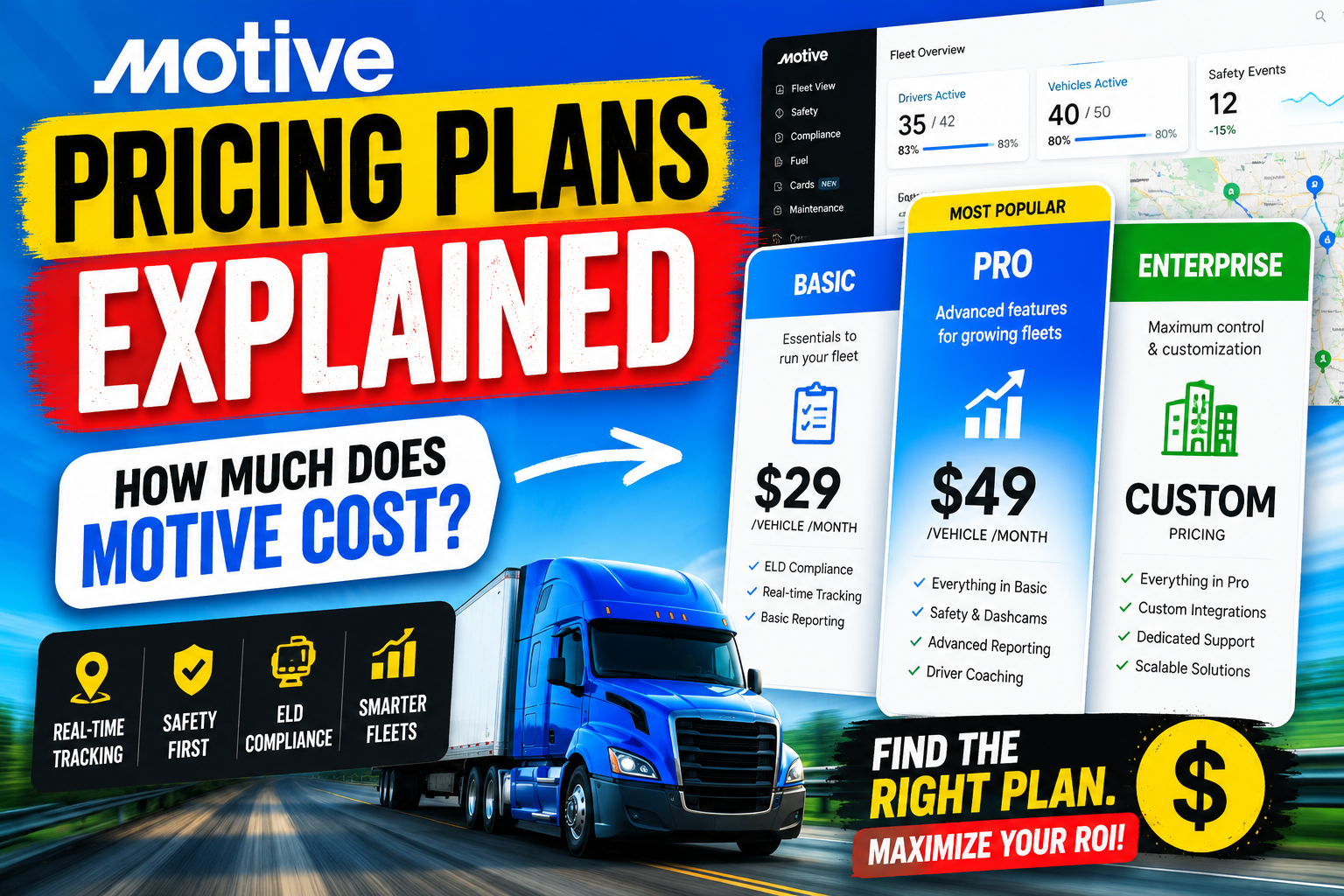
Based on publicly available third-party pricing breakdowns, Motive’s plans generally fall into three broad categories:
| Plan Tier | Estimated Monthly Cost (per vehicle) | Typical Features Included |
|---|---|---|
| ELD / Basic | $25–$35 | ELD compliance, HOS tracking, DVIR forms, basic GPS, driver app, IFTA reporting |
| Pro | $45–$55 | Everything in ELD, plus AI dashcam, real-time coaching, advanced analytics, fleet card integration |
| Enterprise | Custom quote | Everything in Pro, plus custom integrations, dedicated customer success manager, enterprise SSO, SLA guarantees |
These figures are estimates gathered from independent review platforms rather than official Motive pricing pages, so actual quotes may vary. Therefore, it makes sense to request a personalized quote before budgeting a final number.
What Pushes the Price Above the Base Rate?
Several factors typically raise the monthly cost beyond the entry-level tier:
- Adding AI dashcams or multi-camera setups
- Upgrading to advanced driver coaching and analytics
- Enrolling in the Motive fleet card program
- Choosing shorter contract terms instead of multi-year agreements
- Requesting dedicated support or custom integrations
- Scaling up equipment monitoring across trailers and non-powered assets
- Adding workforce management modules for training and qualifications tracking
On the other hand, committing to a longer contract or purchasing hardware in bulk can sometimes reduce the per-vehicle rate. Fleet size also matters quite a bit here: a 500-vehicle enterprise deal typically unlocks better per-unit pricing than a 5-vehicle order, simply because Motive’s sales team has more room to negotiate on larger contracts.
How Does Fleet Size Change the Math?
Fleet size affects Motive pricing in two ways. First, larger fleets generally qualify for volume discounts, which lower the per-vehicle rate as the vehicle count grows. Second, larger fleets are more likely to need enterprise-tier features like dedicated customer success managers, custom integrations, and service-level agreements, which push the quote toward the custom-pricing tier regardless of the discount.
To illustrate, a fleet running 5 vehicles on the basic ELD tier might pay close to the top of the per-vehicle range, since there’s little room for the vendor to negotiate on such a small deal. A fleet running 300 vehicles, by contrast, might negotiate a lower per-vehicle rate even while adding more premium features, because the total contract value justifies a steeper discount. This is a common pattern across SaaS pricing generally, not just within Motive’s model.
What Hidden Costs Should Fleets Watch For?
Monthly subscription fees are only part of the picture. Before signing a contract, fleets should also account for hardware, installation, and contract structure, since these elements often affect the total cost of ownership more than the headline subscription price.
Are There Hardware or Installation Fees?
Motive relies on its own proprietary Vehicle Gateway hardware rather than supporting third-party GPS trackers. As a result, fleets switching from another provider typically cannot reuse existing hardware, which adds an upfront cost. Installation is generally straightforward, but larger fleets should budget time and resources for onboarding many vehicles at once.
What About Contract Length and Lock-In?
Motive commonly offers contracts around one year, which is shorter than some competitors in the space. Nevertheless, once a fleet becomes embedded in Motive’s ELD ecosystem, switching providers later can be costly and time-consuming, particularly for larger operations with complex compliance needs. For this reason, it is worth reviewing renewal terms, early termination conditions, and any pilot program details in plain language before signing.
Do Add-Ons Increase the Total Bill?
Yes. Add-ons such as premium dashcams, expanded analytics, or the fleet card program are usually priced separately from the base subscription. While these features can deliver real value, for example by automating IFTA reporting or reducing fraudulent spending, they also mean the final invoice can look quite different from the entry-level quote a fleet first receives.
What Does Motive Actually Cost in Real-World Scenarios?

Numbers on a pricing page only tell part of the story. To make the figures more concrete, it helps to walk through a few realistic budgeting scenarios based on typical fleet sizes and feature needs.
How Much Would a Small Trucking Fleet Pay?
Consider a 10-truck owner-operator business that only needs core ELD compliance, basic GPS tracking, and IFTA reporting. Using the estimated ELD tier range of $25–$35 per vehicle per month, this fleet would likely pay somewhere between $250 and $350 per month, or roughly $3,000 to $4,200 per year, before any hardware or installation costs are factored in.
How Much Would a Mid-Size Regional Carrier Pay?
Now imagine a 75-truck regional carrier that wants ELD compliance plus AI dashcams and driver coaching, placing it in the Pro tier. At an estimated $45–$55 per vehicle per month, that works out to roughly $3,375 to $4,125 per month, or approximately $40,500 to $49,500 per year. Add fleet card enrollment and the total climbs further, though the fleet card can also generate savings through fraud detection and streamlined IFTA reporting.
How Much Would a Large Enterprise Fleet Pay?
Finally, picture a 500-vehicle enterprise fleet that needs custom integrations, a dedicated customer success manager, and enterprise-grade service-level agreements. This scenario falls into Motive’s custom-quote tier, where per-vehicle pricing is typically negotiated based on total contract value, feature scope, and contract length. While the per-vehicle rate may be lower than the Pro tier thanks to volume discounts, the total monthly spend is substantially higher simply due to fleet size, often reaching into the tens of thousands of dollars per month.
| Fleet Size | Estimated Plan | Estimated Monthly Cost | Estimated Annual Cost |
|---|---|---|---|
| 10 vehicles | ELD / Basic | $250–$350 | $3,000–$4,200 |
| 75 vehicles | Pro | $3,375–$4,125 | $40,500–$49,500 |
| 500 vehicles | Enterprise (custom) | Custom quote | Custom quote |
These numbers are illustrative estimates based on publicly reported per-vehicle ranges, not official Motive quotes. Even so, they offer a useful starting point for budgeting conversations before you contact sales.
What Return on Investment Can Fleets Expect from Motive?

Cost only tells half the story; value matters just as much. Fleets considering Motive should weigh the subscription price against the operational savings the platform can generate.
How Does Motive Help Reduce Operating Costs?
According to Motive’s own case studies, fleets have used the platform to cut accident-related costs and insurance premiums significantly. One cited example involved a fleet that saved more than $2 million in combined insurance and fuel costs after adopting Motive’s safety and efficiency tools. While individual results vary widely depending on fleet size and starting conditions, this illustrates the kind of savings that safety-focused telematics can unlock over time.
Which Features Tend to Deliver the Fastest Payback?
Based on how fleets typically describe their usage, a few features tend to generate the quickest return:
- AI dashcams that reduce false liability claims and lower insurance premiums
- Automated IFTA reporting that cuts down hours of manual mileage calculation
- Fuel card integration that reduces fraudulent or wasteful spending
- Predictive maintenance alerts that prevent costly, unplanned breakdowns
Because these features address expensive, recurring pain points, fleets that make full use of them often see the subscription cost offset fairly quickly, even at the higher end of Motive’s pricing range.
What Do Real Users Say About Motive’s Value for Money?
User reviews on independent platforms like G2 and GetApp generally rate Motive well for ease of use and feature completeness, with real-time monitoring, driver management, and trip logging all receiving strong marks from surveyed users. That said, some reviewers note occasional issues with connectivity, accuracy, and customer support responsiveness, along with a learning curve for mastering the platform’s more advanced features. Taken together, most reviews suggest that Motive delivers solid value for fleets that genuinely need its compliance and safety toolset, though smaller fleets without those requirements may find the price harder to justify.
How Does Motive Compare to Other Fleet Tracking Platforms?
Understanding Motive’s pricing in isolation only tells half the story. Comparing it against alternatives helps clarify whether the investment matches a fleet’s actual needs.
How Does Motive Stack Up Against Competitors?
| Provider | Approximate Monthly Cost (per vehicle) | Best Suited For |
|---|---|---|
| Motive | $25–$55+ | US trucking fleets needing ELD compliance and mature AI dashcams |
| Samsara | Custom quote | Large fleets needing broad telematics and IoT integrations |
| Verizon Connect | Custom quote | Mixed commercial fleets with existing Verizon infrastructure |
| Hardware-agnostic GPS platforms | Around $29 | Global fleets that want to reuse existing tracker hardware |
| Budget-focused GPS trackers | $9–$15 | Small service fleets that don’t need ELD compliance |
Consequently, fleets that only need basic GPS tracking without ELD compliance may find lighter, lower-cost tools more cost-effective, whereas long-haul trucking operations with strict Hours of Service requirements tend to benefit most from Motive’s compliance-first design.
What Are the Trade-Offs Between Motive and Its Competitors?
Choosing between Motive and its competitors usually comes down to a handful of trade-offs rather than price alone. Firstly, Motive uses proprietary hardware, which locks fleets into its ecosystem but also ensures tighter integration between hardware and software. Hardware-agnostic competitors, meanwhile, allow fleets to reuse existing GPS trackers, which can lower switching costs but may sacrifice some integration depth.
Secondly, Motive’s strength lies specifically in US trucking compliance. International fleets operating in Canada, Mexico, or Europe often report limited feature support, so companies with cross-border operations may need to evaluate alternatives more carefully. Thirdly, contract flexibility varies: some competitors offer month-to-month billing with no long-term commitment, while Motive typically requires at least a one-year agreement, even though that is shorter than some rivals in the space.
Finally, onboarding speed differs meaningfully. Motive’s sales-led signup process can take longer to get a fleet live, whereas some newer, self-serve platforms allow fleets to sign up and start tracking vehicles within days. For fleets that prioritize speed over deep ELD compliance, this difference can matter as much as the sticker price.
Is Motive Worth the Investment for Smaller Fleets?
For a 5-to-20-vehicle service fleet, such as plumbing, HVAC, or landscaping businesses, Motive’s ELD-heavy feature set may be more than what’s actually needed. Since these fleets typically don’t fall under FMCSA Hours of Service rules, a simpler GPS tracking tool could deliver similar day-to-day value at a lower monthly cost. Meanwhile, regulated trucking fleets generally get more value from Motive because compliance, IFTA reporting, and dashcam coaching directly address their core operational risks.
How Do You Choose the Right Motive Plan for Your Fleet?

With several tiers and add-ons available, picking the right combination can feel overwhelming. Breaking the decision down into a few clear questions makes the process much more manageable.
What Questions Should You Ask Before Choosing a Plan?
Start by answering these questions honestly for your own fleet:
- Does your fleet legally require ELD compliance under FMCSA rules?
- How many accidents or safety incidents has your fleet experienced in the past year?
- Do you currently struggle with fuel fraud or inconsistent expense reporting?
- Would your drivers benefit from proactive coaching, or would it feel intrusive?
- Do you need dedicated support and custom integrations, or would self-serve tools suffice?
Your answers will point you toward one of Motive’s three broad tiers far more reliably than price alone.
Which Fleets Should Choose the Basic ELD Tier?
The Basic ELD tier tends to fit fleets that primarily need compliance rather than advanced safety analytics. Owner-operators, small regional carriers, and fleets under tight budget constraints often start here, then upgrade later as their needs grow.
Which Fleets Should Choose the Pro Tier?
The Pro tier generally suits fleets that have experienced safety incidents, insurance rate increases, or driver behavior issues that better coaching tools could address. Because AI dashcams and analytics carry a real cost, this tier makes the most sense once a fleet is large enough, or risky enough, for the safety upside to outweigh the added expense.
Which Fleets Should Choose the Enterprise Tier?
Enterprise pricing is designed for fleets with complex operational needs: multiple business units, custom software integrations, strict uptime requirements, or a need for a dedicated point of contact. Smaller fleets rarely need this tier, but large, multi-location operations often find the added support and guarantees worth the premium.
How Can Fleets Get an Accurate Motive Quote?
Because Motive prices are negotiated rather than published, getting an accurate number requires a bit of preparation.
What Information Should You Prepare Before Requesting a Quote?
Before contacting sales, gather the following details:
- Total number of vehicles and drivers
- Whether ELD compliance is legally required for your fleet
- Desired hardware, such as dashcams or fuel cards
- Preferred contract length
- Any existing GPS hardware that might need replacing
Having this information ready speeds up the quote process and helps avoid being upsold into modules that aren’t necessary.
Should You Negotiate the Price?
Yes, absolutely. Since Motive sells through a quote-based model, there is typically room to negotiate, especially for larger fleets or multi-year commitments. Requesting quotes from a couple of competitors first can also strengthen your negotiating position and give a clearer sense of fair market pricing for your specific fleet size.
What Negotiation Tactics Tend to Work Best?
A few practical tactics can help fleets secure better terms:
- Get quotes from at least two competitors before speaking with Motive’s sales team, so you have a benchmark to reference.
- Ask specifically which features are included in the base price versus billed as add-ons, since bundling assumptions vary between sales reps.
- Request a shorter pilot period or trial before committing to a full annual or multi-year contract.
- Clarify early-termination and renewal terms in writing, not just verbally, before signing anything.
- If your fleet is growing, ask whether pricing can scale down automatically as vehicle count increases, rather than needing a fresh negotiation each time.
Ultimately, treating the quote as a starting point rather than a final number tends to produce better outcomes, particularly for fleets with 20 or more vehicles.
What Should You Confirm Before Signing a Contract?
Before signing, it is worth confirming a short checklist of details in writing:
- The exact per-vehicle rate and what it includes
- Whether hardware costs are one-time or recurring
- The length of the contract and renewal terms
- Early termination fees or conditions
- Any promotional pricing that expires after an initial period
Taking the time to confirm these details upfront can prevent unpleasant surprises once the invoices start arriving.
Summing up
Motive, featured on Motive – GPS Fleet Tracking System & Solutions, remains one of the most capable fleet management platforms available for US trucking and compliance-heavy operations. Even so, its pricing isn’t openly published, which means the real cost varies significantly based on fleet size, chosen modules, hardware, and negotiated contract terms. Based on independent reviews, most fleets can expect to pay somewhere between $25 and $55 per vehicle per month for the core tiers, with enterprise deployments requiring a custom quote that reflects fleet size, feature scope, and support requirements.
Ultimately, the right approach is to treat published estimates as a starting benchmark rather than a final answer. Map out exactly which features your fleet truly needs, whether that’s basic ELD compliance, AI-powered safety coaching, or a fully custom enterprise deployment. From there, request multiple quotes, factor in hardware and installation costs, and clarify contract length and renewal terms before signing anything. Fleets that go through this process tend to end up with pricing that reflects their actual operational needs, rather than paying for a one-size-fits-all package that includes features they will never use. Done well, this due diligence ensures you pay for the value Motive genuinely delivers rather than for capabilities that don’t match your operation.
Frequently Asked Questions
Setup costs can vary by fleet size and hardware choice. Since Motive uses proprietary Vehicle Gateway hardware, fleets migrating from another provider should expect some installation effort and potentially an upfront hardware cost, even though the day-to-day subscription itself is billed monthly or annually.
Contract terms differ by deal, but Motive commonly offers around one-year agreements, which are shorter than some competitors. That said, early termination fees or renewal conditions can apply, so it is important to review the specific contract details before signing rather than assuming standard terms will apply.
Generally, yes. Motive’s pricing reflects its broader feature set, including ELD compliance, AI dashcams, and spend management, which basic GPS-only trackers don’t offer. Fleets that don’t need ELD compliance may find lower-cost, GPS-focused alternatives more budget-friendly for their specific use case.
While Motive doesn’t publish a standard discount schedule, industry pricing patterns and fleet size generally suggest that annual commitments and larger vehicle counts unlock better per-vehicle rates than smaller, month-to-month arrangements. Because pricing is negotiated case by case, the best way to confirm available discounts is to ask directly during the quote process and to compare offers if you request pricing more than once as your fleet size changes.
Why Work with Solution for Guru When Evaluating Motive Pricing?

Comparing vendor quotes, negotiating contract terms, and figuring out which add-ons are actually worth the money can be a time-consuming process, especially for teams without a dedicated procurement specialist. This is where partnering with Solution for Guru can make a real difference. As a tech consulting and SaaS integration agency, Solution for Guru helps businesses cut through vendor sales pitches and figure out which pricing tier genuinely matches their operational needs, rather than paying for features that sound impressive but go unused.
Their team can also assist with comparing Motive against other platforms side by side, reviewing contract terms before signing, and planning the technical integration once a plan is chosen. For fleets juggling CRM, payroll, or project management tools alongside a new fleet management platform, Solution for Guru’s broader integration expertise ensures Motive fits smoothly into the rest of the tech stack, rather than becoming another disconnected system. In short, cooperating with an experienced consulting partner can turn a confusing pricing decision into a confident, well-informed investment.
Recommended
- What Is Motive Fleet Management?
- What Is the True Cost Breakdown of Fleet Tracking Systems?
- Offline Tracking: How Do Devices Store Data Without Connectivity?
- Real-Time Tracking vs Passive Tracking: What Are the Key Differences?
- How Vehicle Tracking Systems Reduce Commercial Auto Insurance Costs
- How Does GPS Tracking Work: Satellites, Signals, and Software?
- Can GPS Trackers Be Hacked? Security Risks Explained
- 4G vs 5G GPS Trackers: What’s Changing?
- AI in Fleet Tracking: How Are Predictive Maintenance and Analytics Transforming Fleet Operations?
- Tracking Requirements for Commercial Vehicles in the U.S.
- How Vehicle Maintenance Tracking Software Reduces Costs and Extends Fleet Lifespan?
- Top Benefits of GPS Vehicle Tracking Fleet Management Solutions for Modern Businesses
- Vehicle Tracking Online
- Business Vehicle Tracking: Boosting Efficiency and Accountability on the Road