Cloud Solutions for Business: Your 2026 SME Guide

TL;DR:
- Cloud solutions provide scalable computing, storage, and applications over the internet, replacing physical hardware for businesses.
- Effective cloud management involves choosing suitable service and deployment models, active cost control, and phased migration.
Cloud solutions for business are IT services delivered over the internet that give organizations scalable computing, storage, and application capabilities without owning physical hardware. The industry term for this model is cloud computing, and it has become the operational backbone for SMEs and startups that need enterprise-grade infrastructure at a fraction of the traditional cost. Pay-as-you-go pricing removes the capital expense of on-premise servers, and the flexibility to scale up or down within hours changes how fast a business can respond to market shifts. For founders and operations leaders, understanding the right cloud architecture is now a core business decision, not just an IT one.
What cloud solutions are available for businesses?
Cloud computing divides into three service models that every SME should know before signing a contract.

Infrastructure as a Service (IaaS) gives you raw computing power: virtual machines, storage, and networking. You manage the operating system and everything above it. This model suits businesses that need full control over their environment, such as software development teams running custom application stacks.
Platform as a Service (PaaS) adds a managed runtime on top of the infrastructure. Developers deploy code without worrying about servers or operating systems. Cloud platforms accelerate deployment through pre-built APIs and services, cutting time to market and reducing development costs significantly.
Software as a Service (SaaS) delivers fully managed applications through a browser. Accounting tools, CRM systems, and project management platforms all fall here. SaaS carries the lowest management burden and the fastest time to value for non-technical teams.
Beyond service models, deployment strategy matters just as much:
- Public cloud: Shared infrastructure managed by a provider. Lowest upfront cost, highest provider dependency.
- Private cloud: Dedicated infrastructure for one organization. Higher control and security, higher cost.
- Hybrid cloud: A mix of public and private environments connected by a unified management layer. Best for businesses with both sensitive data and variable workloads.
- Hosted private cloud: A dedicated environment hosted by a third party. Delivers private-cloud control at a cost closer to public cloud pricing.
| Model | Control | Security | Typical Cost |
|---|---|---|---|
| Public cloud | Low | Moderate | Lowest |
| Private cloud | High | Highest | Highest |
| Hybrid cloud | Medium-High | High | Moderate |
| Hosted private cloud | High | High | Moderate-Low |
Pro Tip: If your business handles customer payment data or health records, start with a hosted private cloud or hybrid model. The security controls justify the modest cost premium over public cloud.
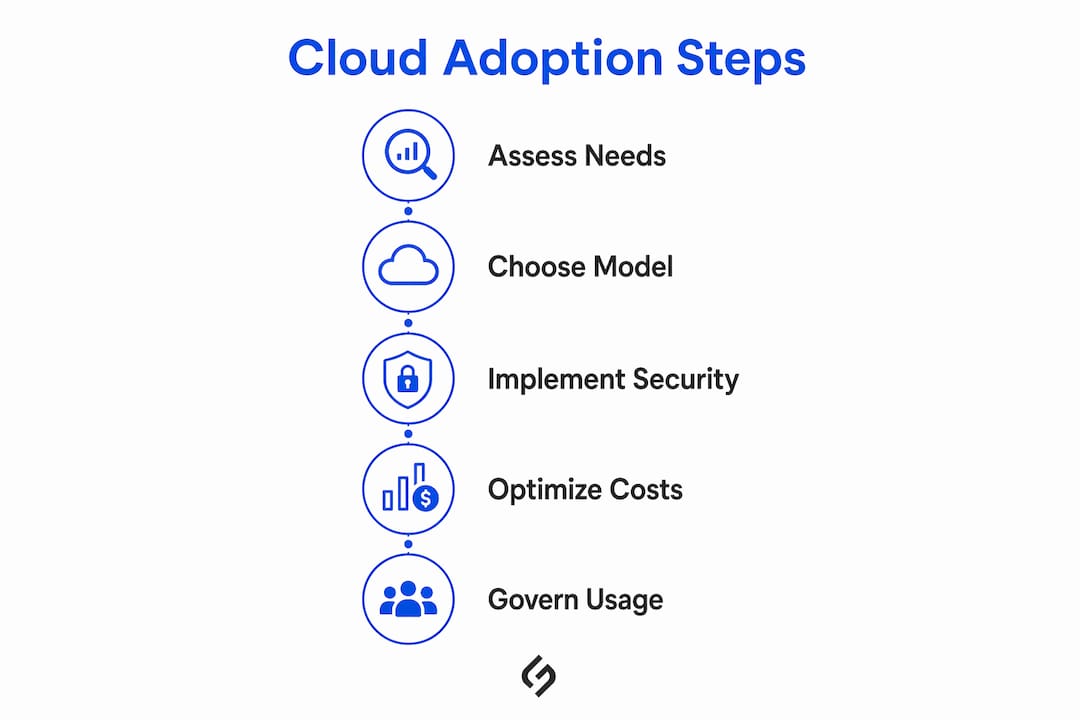
How do businesses optimize costs and manage cloud expenses?
Cloud costs are predictable only when you actively manage them. Small businesses typically spend $500 to $5,000 monthly on infrastructure and platform cloud services. That range is wide because unmanaged usage, idle resources, and over-provisioned instances drive bills far above what the workload actually requires.
The most effective cost controls fall into three categories:
- Reserved capacity: Committing to one or three years of usage in exchange for discounts of 30%–70% versus on-demand pricing. This works well for predictable baseline workloads.
- Spot or preemptible instances: Unused provider capacity sold at steep discounts. Ideal for batch processing, data analysis, or any workload that tolerates interruption.
- Right-sizing: Matching instance size to actual CPU and memory consumption. Most teams over-provision by default and never revisit the configuration.
Alternative cloud models reduce public infrastructure costs by over 80% compared to standard public cloud pricing. That figure applies specifically to hosted private cloud environments, where dedicated hardware eliminates the per-resource premium charged by hyperscale providers.
Governance is the discipline that keeps savings permanent. Without tagging policies, budget alerts, and monthly spend reviews, costs creep back up as teams spin up resources and forget them. Resource management tools that centralize visibility across departments prevent this pattern.
Pro Tip: Set a hard budget alert at 80% of your monthly cloud budget, not 100%. The alert at 100% arrives after the damage is done.
What is the phased model for transitioning business processes to the cloud?
Moving business processes to the cloud is not a single event. Cloud transition involves five stages: optimization, standardization, scaling, automation, and full digital ecosystem integration. Each stage builds on the previous one, and skipping stages creates technical debt that costs more to fix later.
- Optimization: Audit existing processes and identify inefficiencies before migrating anything. Moving a broken process to the cloud produces a faster broken process.
- Standardization: Define consistent workflows, data formats, and access policies across the organization. This is where business process digitalization frameworks become practical tools rather than theoretical concepts.
- Scaling: Expand standardized processes to additional teams, regions, or product lines. Cloud infrastructure makes this expansion a configuration change rather than a capital project.
- Automation: Apply rules-based and AI-driven automation to repetitive tasks within the now-standardized processes. Automation at this stage delivers measurable time savings because the underlying process is already clean.
- Integration: Connect cloud systems into a unified digital ecosystem. APIs link CRM, ERP, finance, and operations data so that decisions draw from a single source of truth.
Cloud technologies have evolved into fundamental enablers for new business models built on process standardization and industrialization. The practical implication is that businesses completing all five stages gain a structural speed advantage over competitors still operating fragmented, manual workflows. Operational transparency improves at each stage, and decision speed increases because data is available in real time rather than consolidated in weekly reports.
How can hybrid and multi-cloud strategies improve business agility?
Hybrid cloud is the combination of at least one public cloud environment and at least one private or on-premise environment, managed through a unified control plane. Multi-cloud extends this by using services from two or more public cloud providers simultaneously. Both models address a real problem: no single provider excels at every workload type, and vendor lock-in creates long-term pricing and flexibility risk.
Hybrid cloud operating models simplify management, strengthen governance, and unify data across environments. That governance benefit is the most underrated advantage. When data lives in one logical layer regardless of where it physically resides, compliance reporting, security auditing, and AI model training all become dramatically simpler.
Multi-cloud strategy, however, demands architectural discipline. Multi-cloud adoption requires standardizing identity management, security policies, data movement protocols, and cost governance across every provider. Without that standardization, multi-cloud becomes multi-complexity rather than multi-resilience.
Practical guidance for SMEs considering hybrid or multi-cloud:
- Establish a single identity provider (such as an enterprise directory service) that authenticates users across all cloud environments.
- Define data residency rules before choosing providers, not after. Regulatory requirements in sectors like healthcare and finance dictate where data can live.
- Use a cloud management platform that provides a unified cost dashboard. Separate provider consoles make cross-cloud cost comparison nearly impossible.
- Review cloud vs. on-premise ITSM governance models before committing to a hybrid architecture. The operational model you choose determines your long-term management overhead.
Regaining control in cloud environments requires unified hybrid models that centralize governance and data unification. For SMEs without large IT teams, this means choosing platforms that offer built-in governance tooling rather than assembling it from separate products.
Key Takeaways
The most effective cloud strategy for SMEs combines a phased adoption model, active cost governance, and a hybrid architecture that matches workload requirements to the right environment.
| Point | Details |
|---|---|
| Choose the right service model | IaaS, PaaS, and SaaS each serve different needs; match the model to your team’s technical capacity. |
| Control costs from day one | Monthly cloud spend ranges from $500 to $5,000; reserved capacity and right-sizing prevent budget overruns. |
| Adopt cloud in five stages | Move through optimization, standardization, scaling, automation, and integration in sequence to avoid technical debt. |
| Use hybrid cloud for control | Hybrid models unify governance and data across environments, reducing compliance risk for regulated industries. |
| Standardize before going multi-cloud | Multi-cloud requires consistent identity, security, and cost governance policies before adding a second provider. |
What I have learned after years of cloud adoption work
The single biggest mistake I see SMEs make is treating cloud adoption as a cost-cutting exercise rather than an operational redesign. They lift and shift existing processes to the cloud, pay roughly the same as before, and conclude that cloud is overhyped. The savings and speed gains only appear after you standardize and automate the underlying processes. The cloud is the enabler, not the fix.
My second observation is that managed services are underused by small teams. Managed cloud applications allow small teams to hand off infrastructure updates and scaling to providers, freeing internal resources for core business work. A five-person startup has no business managing its own database patching schedule. Offload that to a managed service and redirect those hours toward product and customers.
On cost governance: I have never seen a business that reviewed its cloud bill monthly and regretted it. The teams that review quarterly always find surprises. Set up automated alerts, assign a named owner to the cloud budget, and treat it like any other operating expense with a monthly close.
Finally, future-proof your architecture by keeping your data portable. Proprietary data formats and provider-specific storage services create lock-in that is expensive to undo. Use open standards where possible, document your data schemas, and test your ability to export critical data at least once a year. The business that can move its data can always negotiate better pricing.
How Solution For guru supports your cloud adoption
Solution For Guru works with SMEs and startups at every stage of cloud adoption, from initial architecture planning to full digital integration. The team brings hands-on experience in web development, automation, and technology strategy to help businesses build cloud environments that match their actual operational needs, not a generic template.
Whether you are evaluating your first cloud deployment or restructuring an existing multi-cloud setup, Solution For Guru offers free consultations to assess your current infrastructure and identify the highest-impact changes. Start with a clear foundation by reviewing web development basics as they apply to your cloud architecture, then connect with the team to map a phased adoption plan built around your growth targets.
FAQ
Cloud solutions for business are IT services delivered over the internet, including computing, storage, and software applications. They replace on-premise hardware with flexible, pay-as-you-go infrastructure that scales with business demand.
Small businesses typically spend $500 to $5,000 per month on cloud infrastructure and platform services. Reserved capacity discounts and right-sizing can reduce that figure significantly.
IaaS provides raw infrastructure, PaaS adds a managed development environment on top, and SaaS delivers fully managed applications through a browser. Each model transfers a different level of management responsibility to the provider.
A hybrid cloud combines public and private cloud environments under a unified management layer. It gives businesses the cost efficiency of public cloud for variable workloads and the security of private infrastructure for sensitive data.
The most effective controls are reserved capacity commitments, automated budget alerts, and monthly spend reviews. ITSM governance frameworks tailored for SMEs provide the policy structure needed to keep cloud costs predictable.