Zoho CRM Implementation Guide for Enterprises
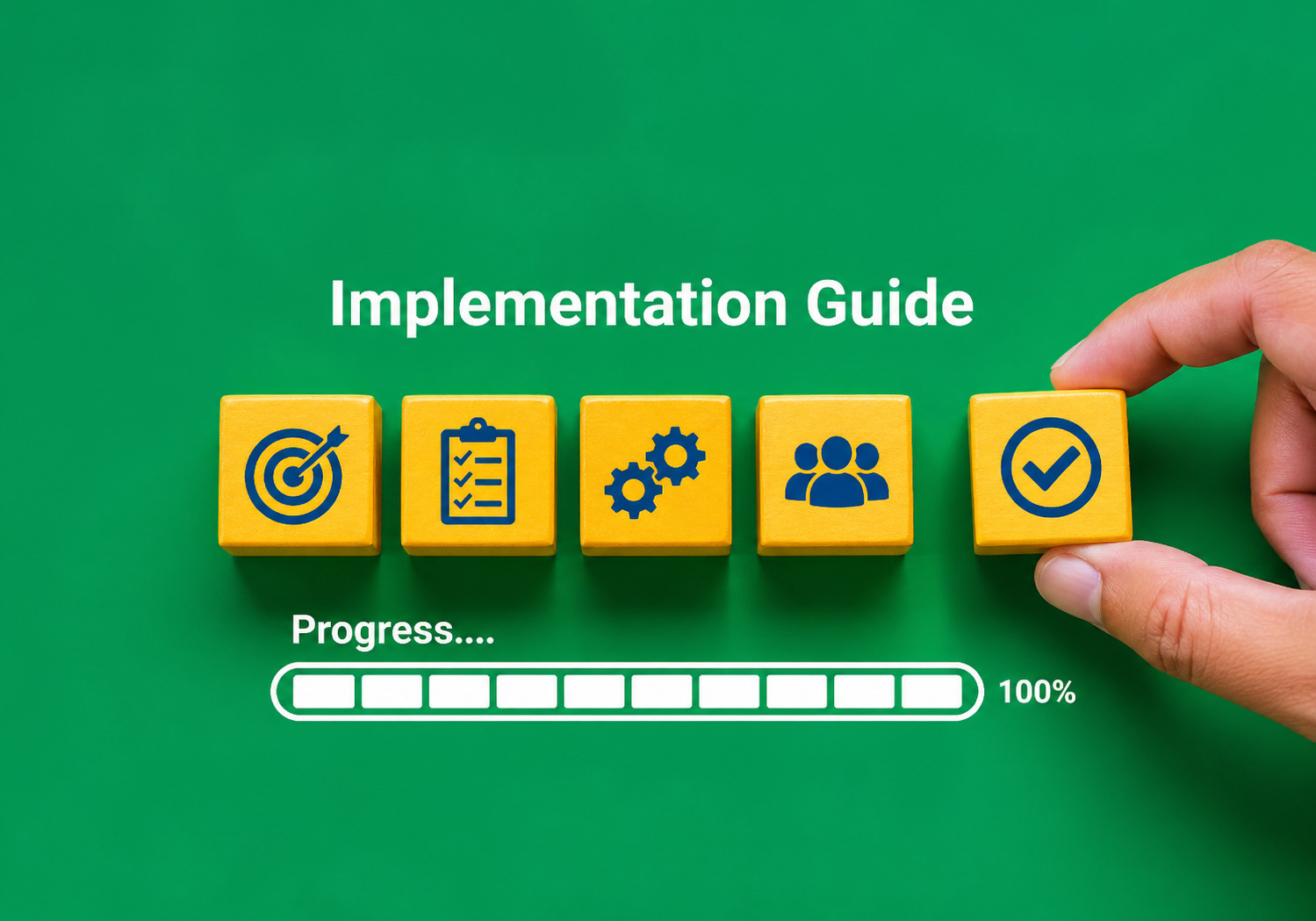
Enterprise CRM implementations rank among the most consequential technology decisions an organization makes. When executed well, a CRM rollout unifies sales, marketing, and customer service around a single source of truth — driving revenue growth, improving customer retention, and enabling data-driven decisions at every level of the business. When executed poorly, it becomes an expensive, underutilized system that frustrates employees and erodes executive confidence in technology investments. Zoho CRM stands out as one of the most powerful and flexible CRM platforms available to enterprises today — but unlocking its full potential demands a structured implementation approach. This guide walks enterprise teams through every stage of a successful Zoho CRM deployment, from planning and configuration to integration, adoption, and ongoing optimization.
Table of contents
Quick Summary
| Implementation Phase | Key Activities | Expected Outcome |
| Phase 1: Discovery & Planning | Goals, stakeholders, process mapping | Clear scope and success metrics |
| Phase 2: Configuration | Modules, custom fields, pipelines, automation | CRM mirrors your business process |
| Phase 3: Data Migration | Cleansing, mapping, import, validation | Accurate, complete data in Zoho CRM |
| Phase 4: Integration | ERP, marketing, telephony, finance tools | Unified tech stack with no data silos |
| Phase 5: Training & Adoption | Role-based training, champions, governance | High user adoption from day one |
| Phase 6: Optimization | KPI reviews, automation audits, scaling | Compounding ROI over time |
What Is Zoho CRM and Why Do Enterprises Choose It for Implementation?

Founded in 1996 and headquartered in Chennai, India, Zoho Corporation has grown into a global technology powerhouse serving more than 100 million users across 55+ business applications. Zoho CRM sits at the center of this ecosystem — a comprehensive customer relationship management platform designed to support the full customer lifecycle across sales, marketing, customer service, and operations.
Enterprises specifically choose Zoho CRM because it combines enterprise-grade capabilities with a total cost of ownership that consistently undercuts legacy CRM giants like Salesforce and Microsoft Dynamics. According to Gartner’s CRM Market research, Zoho CRM delivers competitive functionality at approximately 50–70% of the licensing cost of comparable Salesforce configurations — a significant factor for large organizations managing hundreds or thousands of CRM seats.
Beyond cost, Zoho CRM offers deep customization through its Canvas design studio, Blueprint process automation, Zia AI assistant, and extensive API architecture. Furthermore, its native integration with the broader Zoho suite — including Zoho Books, Zoho Desk, Zoho Campaigns, and Zoho Analytics — gives enterprises a cohesive business operating platform rather than a standalone sales tool. These characteristics make Zoho CRM not just a CRM choice but a strategic infrastructure decision.

Phase 1: How Should Enterprises Plan a Zoho CRM Implementation?
Every successful Zoho CRM implementation begins long before anyone logs into the platform. The planning phase determines the entire trajectory of the project — defining what success looks like, who owns it, and how the CRM will map to the organization’s actual business processes. Skipping or rushing this phase is the single most common cause of failed enterprise CRM deployments.
How Do You Define Goals and Success Metrics for a CRM Implementation?
Enterprise CRM goals must connect directly to measurable business outcomes — not software features. Before configuring a single module, implementation teams should answer three foundational questions: What business problems does this CRM need to solve? How will we measure whether it solved them? And what does success look like at 90 days, 6 months, and 12 months post-launch?
Effective goal-setting for Zoho CRM enterprise implementations typically targets metrics such as:
- Sales cycle length: Reducing average time from lead creation to deal closure by a defined percentage.
- Pipeline visibility: Achieving 95%+ of active deals tracked in Zoho CRM within 60 days of launch.
- Forecast accuracy: Improving revenue forecast accuracy to within 10% of actuals through Zoho’s weighted forecasting.
- Lead response time: Reducing average lead follow-up time from 24 hours to under 2 hours through automation.
- User adoption rate: Achieving 90%+ weekly active usage across all licensed seats within 90 days.
Who Should Be Included in the Implementation Steering Committee?
Enterprise CRM implementations that succeed treat the project as a cross-functional business initiative — not an IT project. The steering committee should include a CRM project sponsor (typically a VP of Sales or CRO), a technical lead (IT or RevOps), department champions from sales, marketing, and customer service, and end-user representatives who bring frontline perspective to configuration decisions.
Additionally, engaging Solution for Guru at this stage proves particularly valuable. Their implementation consultants bring experience from dozens of enterprise Zoho CRM deployments — helping steering committees avoid the configuration mistakes, scope creep patterns, and change management pitfalls that derail projects before they gain momentum.
| Stakeholder Role | Primary Responsibility | Implementation Phase |
| Executive Sponsor (CRO/VP Sales) | Budget, escalation, strategic alignment | All phases |
| CRM Project Manager | Timeline, tasks, cross-team coordination | All phases |
| IT / Technical Lead | Security, integrations, data migration | Phases 2, 3, 4 |
| Sales Department Champion | Process requirements, user feedback | Phases 1, 2, 5 |
| Marketing Champion | Lead flow, campaign integration requirements | Phases 1, 4, 5 |
| CS / Support Champion | Ticket integration, customer data needs | Phases 1, 4, 5 |
| Solution for Guru Consultant | CRM expertise, configuration, training | All phases |
How Do You Map Existing Sales Processes Before Configuring Zoho CRM?
Process mapping before configuration prevents the most destructive mistake in enterprise CRM projects: building the CRM around the software’s default structure rather than the organization’s actual sales process. Teams should document every stage of their sales and customer service workflows — including handoff points between teams, decision criteria at each stage, data that reps need to capture, and the activities that drive deals forward.
This documentation then serves as the blueprint for Zoho CRM‘s pipeline stages, custom fields, automation triggers, and module configuration. Consequently, when reps first encounter the configured system, it reflects the way they already work — which dramatically accelerates adoption and reduces resistance to the new platform.
Phase 2: How Do You Configure Zoho CRM for Enterprise-Scale Operations?
With goals defined and processes mapped, the configuration phase transforms Zoho CRM from a blank platform into a system that precisely reflects your enterprise’s sales and customer management operations. Zoho CRM’s configuration depth makes it uniquely suited to complex enterprise requirements — but that same depth demands a systematic approach to avoid over-building or under-utilizing the platform.
What Are the Core Zoho CRM Modules Enterprises Need to Configure?
Zoho CRM organizes customer data and sales activity across a set of core modules, each of which requires deliberate configuration for enterprise use. The primary modules include Leads, Contacts, Accounts, Deals, Activities, and Reports — but enterprise deployments typically extend far beyond these defaults.
| Zoho CRM Module | Enterprise Configuration Priority | Key Customization Actions |
| Leads | High | Custom fields, lead scoring rules, assignment automation, source tracking |
| Contacts | High | Role hierarchies, relationship mapping, contact enrichment fields |
| Accounts | High | Parent-child account structures, territory assignment, industry segmentation |
| Deals | Critical | Multi-pipeline setup, stage definitions, probability weights, custom fields |
| Activities | High | Custom activity types, logging rules, calendar sync settings |
| Products & Price Books | Medium–High | SKU library, pricing tiers, discount approval workflows |
| Reports & Dashboards | Critical | KPI dashboards per role, forecast reports, funnel analytics |
| Blueprint (Process Automation) | High | Stage transition rules, mandatory fields per stage, SLA timers |
How Does Zoho CRM’s Blueprint Feature Enforce Enterprise Sales Processes?
Zoho CRM’s Blueprint feature stands out as one of its most powerful enterprise capabilities. Unlike standard pipeline stages that reps can move deals through freely, Blueprint enforces structured process compliance — requiring reps to complete specific actions, fill mandatory fields, or obtain approvals before advancing a deal to the next stage.
For example, an enterprise software company might configure Blueprint to require that a “Technical Validation” stage cannot close until the solutions engineer logs a demo completion note, the deal value exceeds a minimum threshold, and a manager approves advancement to “Proposal.” This level of process governance ensures that pipeline data remains reliable and that deals only advance when the business criteria for advancement are genuinely met — not just when a rep decides to move them.
Furthermore, Blueprint integrates with Zoho CRM’s SLA timers, which automatically escalate stalled deals to managers when stage duration exceeds defined thresholds. Enterprise sales directors gain real process enforcement without micromanagement — the system handles the governance, freeing managers to focus on coaching and strategy.
How Should Enterprises Use Zoho CRM’s Zia AI for Sales Intelligence?
Zoho CRM’s Zia AI assistant delivers predictive intelligence that elevates enterprise sales performance beyond what manual CRM usage can achieve. Zia analyzes historical deal data, activity patterns, and communication signals to provide real-time recommendations, deal health scores, and anomaly alerts directly inside the CRM interface.
Specifically, Zia identifies the best time to contact a prospect based on historical email response patterns, predicts which deals carry the highest close probability based on activity and engagement data, and surfaces alerts when a deal’s activity drops below the baseline pattern for successful deals at that stage. Therefore, enterprise sales teams using Zia effectively operate with a data-driven coaching layer built into their daily workflow — without requiring additional analytical tools or separate business intelligence platforms.
Phase 3: How Do Enterprises Execute a Clean Data Migration to Zoho CRM?

Data migration represents the most technically complex and risk-prone phase of any enterprise CRM implementation. Enterprises typically migrate data from legacy CRM systems, spreadsheets, ERP databases, or a combination of all three — each source carrying its own data quality issues, structural inconsistencies, and field mapping challenges. A disciplined migration process protects the investment made in configuration by ensuring the CRM launches with accurate, complete, and well-organized data.
What Data Cleansing Steps Should Enterprises Complete Before Migration?
Before moving a single record into Zoho CRM, enterprises must complete a thorough data cleansing process across all source systems. This process involves five critical steps:
- Deduplication: Identify and merge duplicate contact, account, and deal records. Duplicate data inflates pipeline metrics, confuses sales reps, and undermines forecast accuracy.
- Standardization: Normalize field formats — phone number formats, country codes, date formats, and industry category labels — so they map consistently to Zoho CRM fields.
- Completeness audit: Flag records missing critical fields such as email addresses, account names, or deal values. Decide whether to enrich, remove, or import these records with flagged status.
- Relationship validation: Verify that contact-to-account associations, deal-to-contact links, and activity histories accurately reflect real relationships.
- Archiving: Separate active records from historical or inactive ones. Import only relevant active data into Zoho CRM — archive older records separately to keep the new system clean and performant.
How Does the Migration Process Work Inside Zoho CRM?
Zoho CRM provides a built-in Import Wizard that handles CSV-based data imports for all standard modules. However, enterprise migrations with complex relational data — such as hierarchical account structures, multi-currency deals, or historical activity logs — typically require a staged migration approach and validation testing before full cutover.
The staged approach involves migrating accounts first, then contacts (linked to their accounts), then deals (linked to contacts and accounts), and finally activities and notes. This sequence preserves relational data integrity throughout the import process. Each stage should conclude with a validation audit comparing record counts, field values, and relationship mappings against the source data to confirm accuracy before proceeding.
| Migration Stage | Data Type | Validation Check |
| Stage 1 | Accounts / Companies | Count match, field completeness, hierarchy structure |
| Stage 2 | Contacts | Count match, account associations, no orphaned contacts |
| Stage 3 | Deals / Opportunities | Count match, stage mapping, contact and account links |
| Stage 4 | Activities & Notes | Historical logs attached to correct deals and contacts |
| Stage 5 | Custom Module Data | Field mapping accuracy, relationship integrity |
| Stage 6 (Final) | Full data audit | Cross-module referential integrity check |
Phase 4: How Do Enterprises Integrate Zoho CRM with Their Existing Tech Stack?
Enterprise organizations run on ecosystems of interconnected tools. A Zoho CRM implementation that operates in isolation — with no connections to the ERP, marketing automation platform, telephony system, or financial software — creates data silos that undermine the very visibility the CRM was deployed to achieve. Therefore, integration planning must run in parallel with configuration, not after it.
Which Enterprise Systems Should Connect to Zoho CRM First?
Not all integrations carry equal priority. Enterprise implementation teams should sequence integrations based on the volume and business-criticality of the data flows involved. High-priority integrations typically include the systems that sales reps interact with daily — email, calendar, and communication tools — followed by the systems that feed or receive CRM data most frequently.
| Integration Category | Common Enterprise Tools | Data Flow Direction | Priority |
| Email & Calendar | Microsoft 365, Google Workspace | Bidirectional | Critical |
| Marketing Automation | Zoho Campaigns, Marketo, HubSpot | Leads flow into CRM | High |
| ERP / Finance | SAP, Oracle, Zoho Books, NetSuite | Account and order data sync | High |
| Customer Support | Zoho Desk, Zendesk, Freshdesk | Ticket history in CRM | High |
| Telephony / VoIP | Aircall, RingCentral, Twilio | Call logs auto-synced | Medium |
| Analytics / BI | Zoho Analytics, Tableau, Power BI | CRM data to dashboards | Medium |
| E-Signature | DocuSign, PandaDoc, Zoho Sign | Contract status in CRM | Medium |
| Data Enrichment | ZoomInfo, Clearbit, LinkedIn | Contact/account enrichment | Medium |
How Does Zoho CRM’s API Architecture Support Custom Enterprise Integrations?
For enterprise systems not covered by Zoho’s native integrations or Marketplace connectors, Zoho CRM provides a comprehensive REST API with support for OAuth 2.0 authentication, bulk data operations, webhook notifications, and custom function execution. This API architecture allows enterprise development teams to build bidirectional data flows between Zoho CRM and proprietary internal systems — such as custom-built order management platforms, industry-specific databases, or legacy mainframe environments.
Additionally, Zoho CRM supports Deluge scripting — Zoho’s proprietary low-code language — for building custom business logic directly inside the CRM. Integration specialists at Solution for Guru leverage Deluge extensively to build lightweight integrations and automation workflows that would otherwise require expensive middleware platforms or custom development resources.
Phase 5: How Do Enterprises Drive High User Adoption of Zoho CRM?

The most technically perfect CRM configuration delivers zero business value if employees don’t use it. Research from Forrester consistently shows that CRM adoption failures — not technical failures — account for the majority of enterprise CRM project shortfalls. Consequently, adoption planning deserves as much attention and resource investment as configuration and integration.
What Training Approach Works Best for Enterprise Zoho CRM Rollouts?
Enterprise CRM training must address three distinct user audiences simultaneously, each with different needs and usage patterns. Sales reps need hands-on, role-specific training focused on daily activities: logging calls, managing deals, using email templates, and reading their personal dashboards. Sales managers need training on pipeline reviews, forecasting tools, activity reports, and coaching workflows. Administrators and operations teams need deep technical training on configuration, automation management, and data governance.
A blended training approach consistently outperforms single-format delivery. Combining live instructor-led sessions with recorded role-based video modules, in-system guided tours, and written quick-reference guides gives employees multiple paths to competency — accommodating different learning styles and scheduling constraints across large enterprise teams.
How Do CRM Champions Accelerate Adoption Across Enterprise Teams?
The CRM champion program — where one or two power users per department receive advanced training and serve as internal advocates — consistently proves to be the most cost-effective adoption accelerator for enterprise implementations. Champions handle frontline questions that would otherwise reach the IT helpdesk, model correct CRM usage behavior for their peers, and provide ground-level feedback to administrators about friction points or configuration gaps.
Furthermore, champions give the implementation team an early warning system: if a configuration decision is creating confusion or resistance on the sales floor, champions surface that intelligence within days — not months. This enables rapid corrective action before problematic usage patterns become entrenched habits across the entire organization.
- Identify champions early: Select volunteers who are respected peers, not just technical enthusiasts.
- Train champions deeper: Give them advanced Zoho CRM training beyond standard user level.
- Empower them publicly: Introduce champions to the whole team as the go-to resource for CRM questions.
- Reward their contribution: Recognize champion efforts in team meetings and performance reviews.
- Keep them connected: Maintain a champion Slack channel or regular call with the implementation team for ongoing feedback.
Phase 6: How Should Enterprises Optimize Zoho CRM After Launch?
A Zoho CRM implementation does not end at go-live — it enters a continuous optimization cycle that compounds the platform’s value over time. Enterprises that treat launch as the finish line typically see adoption plateau, automation decay, and reporting drift within six months. Those that invest in post-launch optimization, by contrast, see increasing returns as the CRM evolves alongside their business.
What KPIs Should Enterprises Track to Measure CRM Implementation Success?
Post-launch CRM performance measurement requires both usage metrics and business outcome metrics. Tracking only one category provides an incomplete picture of implementation health.
| Metric Category | Specific KPI | Target Benchmark | Review Frequency |
| User Adoption | Weekly active users / total licensed seats | 90%+ within 90 days | Weekly |
| Data Quality | % of deals with all required fields complete | 95%+ | Monthly |
| Pipeline Health | % of deals with activity in last 14 days | 80%+ | Weekly |
| Forecast Accuracy | Forecast vs. actuals variance | Within 10% | Monthly |
| Sales Velocity | Revenue generated per day in pipeline | Trending upward | Monthly |
| Automation Performance | % of eligible triggers firing correctly | 99%+ | Monthly |
| Integration Health | API error rate across all integrations | Under 0.5% | Weekly |
How Do Enterprises Scale Zoho CRM as Their Business Grows?
Zoho CRM scales along multiple dimensions simultaneously: more users, more geographies, more product lines, and more complex sales processes. Enterprise administrators should build scalability principles into the initial configuration — using territory management, role hierarchies, and profile-based permissions that accommodate organizational growth without requiring full reconfiguration.
Additionally, Zoho CRM’s Zoho One suite — which bundles more than 50 business applications under a single license — gives enterprises a clear growth path as operational needs expand beyond pure CRM functionality into HR, project management, finance, and advanced analytics. Planning this expansion path from the start of the implementation prevents the fragmented tool sprawl that plagues many enterprise technology environments.
What Are the Key Conclusions from This Zoho CRM Enterprise Implementation Guide?
Successful enterprise Zoho CRM implementation follows a clear, disciplined sequence: plan before configuring, configure before migrating, integrate before launching, and optimize continuously after go-live. Each phase builds on the previous one, and shortcuts in any phase create compounding problems in the phases that follow.
Zoho CRM’s combination of enterprise-grade features — Blueprint process enforcement, Zia AI intelligence, multi-pipeline management, deep integration architecture, and comprehensive reporting — gives enterprises a platform capable of supporting complex, large-scale sales operations at a cost structure that outperforms legacy CRM vendors. The platform’s native integration with the broader Zoho ecosystem further extends its value as organizations grow.
At the same time, platform capability only translates into business results through rigorous implementation. The six-phase methodology outlined in this guide — covering discovery, configuration, data migration, integration, adoption, and optimization — provides enterprise teams with a proven roadmap for extracting maximum value from their Zoho CRM investment.
Finally, the decision to partner with Solution for Guru for implementation is not merely a convenience — it is a risk management and ROI acceleration strategy. Their combination of Zoho CRM platform expertise, enterprise implementation methodology, and revenue operations perspective consistently transforms what could be a 12-month struggle into a 90-day value delivery. For enterprises making a significant CRM investment, expert implementation partnership is the most reliable path from deployment to demonstrable business impact.
Frequently Asked Questions About Zoho CRM Enterprise Implementation
Timeline varies significantly based on organizational size, data complexity, and integration requirements. A mid-market enterprise with 50–150 CRM users, moderate data migration needs, and 5–10 key integrations typically completes a full implementation in 8–12 weeks when working with an experienced partner. Larger enterprises with 500+ users, complex multi-country deployments, and deep ERP integration requirements may require 16–24 weeks for a complete rollout. By contrast, self-guided enterprise implementations with no external expertise commonly extend to 9–18 months — during which the business continues operating without the pipeline visibility, automation efficiency, and reporting accuracy that Zoho CRM was deployed to deliver.
Zoho CRM provides robust multi-currency and multi-territory support built into its Enterprise and Ultimate editions. Administrators can activate up to 15 currencies simultaneously, with automatic exchange rate updates and deal values displayed in both transaction currency and home currency across all reports and forecasts. Territory management allows sales leaders to define geographic, industry, or account-size-based territories with dedicated pipelines, assigned reps, and separate forecasting — a critical capability for global enterprises managing sales across multiple regions. Additionally, Zoho CRM supports GDPR, CCPA, and other regional data privacy frameworks through its built-in data consent management, field encryption, and audit trail features — ensuring compliance requirements across different regulatory environments don’t create separate CRM instances or data governance complexity.
How Does Solution for Guru Accelerate and De-Risk Enterprise Zoho CRM Implementations?
Enterprise Zoho CRM implementations involve dozens of interrelated decisions across process design, technical configuration, data management, integration architecture, and change management. Even experienced enterprise technology teams encounter significant complexity when navigating these decisions for the first time. Solution for Guru eliminates this learning curve by bringing proven enterprise CRM implementation methodology, deep Zoho platform expertise, and hands-on project execution to every engagement.
What Makes Solution for Guru’s Zoho CRM Implementation Approach Different?
Unlike generic IT consulting firms that implement CRM as a technical project, Solution for Guru approaches Zoho CRM implementation as a revenue operations transformation. This means every configuration decision — from pipeline stage names to Blueprint transition rules — connects explicitly to the client’s sales process, revenue targets, and business model.
Solution for Guru delivers a comprehensive service portfolio covering all six implementation phases:
- Implementation Discovery: Structured workshops to map sales processes, define success metrics, and build the configuration blueprint before touching the platform.
- Full Platform Configuration: End-to-end Zoho CRM setup including modules, custom fields, Blueprint, automation, Zia configuration, and role-based dashboards.
- Data Migration Management: Source data auditing, cleansing, field mapping, staged import execution, and post-migration validation audits.
- Integration Architecture: Design and implementation of all required integrations — native Marketplace connectors, Deluge custom functions, and REST API integrations with enterprise systems.
- Adoption Program Design: Role-based training curriculum, champion program setup, quick-reference guide creation, and go-live support.
- Post-Launch Optimization: Quarterly CRM health reviews, automation audits, KPI dashboard refinement, and proactive feature adoption as Zoho releases platform updates.
What Return on Investment Do Enterprises Achieve by Working with Solution for Guru?
The ROI of working with an expert implementation partner like Solution for Guru operates on two levels. The first is speed: enterprises that implement Zoho CRM with Solution for Guru typically go live 40–60% faster than teams attempting self-guided implementations — compressing months of trial-and-error into weeks of structured delivery. Every week of faster time-to-value represents pipeline visibility, automation efficiency, and sales performance improvements that compound across the entire sales team.
The second level is completeness. Most self-guided enterprise Zoho CRM implementations activate fewer than half the platform’s relevant features within the first year. Solution for Guru ensures that Blueprint, Zia, advanced reporting, automation workflows, and integrations are all live, tested, and actively used at launch — not discovered and configured piecemeal over the following 18 months.
Combined, these benefits mean that enterprises partnering with Solution for Guru consistently achieve their stated CRM goals within the first implementation year — rather than treating year one as a learning period and year two as the real start of value delivery.
Recommended:
- 5 Essential Pipedrive CRM Features for Successful Sales
- Best HubSpot Integrations for Sales and Marketing Teams
- HubSpot CRM: What It Is and How It Works for Businesses
- Top Pipedrive Tips from the Community That Most Guides Don’t Cover
- What Is Bigin by Zoho CRM and Who Is It Best For?
- Creatio CRM Data Migration Best Practices
- Blueprint Automation in Zoho CRM: Process Engineering Approach
- Security & Compliance Considerations When Implementing Creatio
- BPM + CRM: Why Creatio Combines Both Worlds
- CRM Proficiency for Sales Teams: Turning Data into Deals
- Customer 360° View in Creatio: Benefits for Sales Teams
- The Pipedrive Gmail Add-On
- Creatio CRM Implementation Guide for U.S. Businesses
- How Does Zoho CRM Handle Multi-Pipeline Sales Architecture?
- How Does Creatio Improve Lead Management and Conversion Rates?
- Top CRM-Related Professions Every Modern Company Needs