Aligning ITSM Processes with ISO 20000 Standards
Delivering consistent, high-quality IT services has become a non-negotiable expectation for modern organizations. ISO/IEC 20000 — the international standard for IT service management — gives organizations a proven framework to formalize their ITSM processes, demonstrate service quality to customers and regulators, and drive continuous improvement. Yet aligning existing ITSM processes with ISO 20000 requirements is rarely straightforward. It demands a clear understanding of the standard itself, a candid assessment of current practices, and the right technology platform to support the processes the standard prescribes. This article walks through every critical dimension of that alignment journey and explains how leading ITSM platforms can help organizations meet — and maintain — ISO 20000 certification.
Table of contents
What Does ISO 20000 Alignment Actually Require at a Glance?
The table below summarizes the core ISO/IEC 20000-1:2018 service management system (SMS) clauses and maps them to the ITSM process areas organizations must address during alignment.
| ISO 20000 Clause | Topic Area | Key ITSM Process Requirement |
| Clause 4 | Context of the Organization | Define SMS scope, interested parties, and service boundaries |
| Clause 5 | Leadership | Top management commitment; service management policy |
| Clause 6 | Planning | Risk management; objectives and plans to achieve them |
| Clause 7 | Support | Competence, awareness, communication, documented information |
| Clause 8.2 | Service Portfolio | Plan, control, and catalog all services |
| Clause 8.3 | Relationship & Agreement | SLA management; supplier management |
| Clause 8.4 | Supply & Demand | Capacity and availability management |
| Clause 8.5 | Service Design & Transition | Change, release, configuration management |
| Clause 8.6 | Resolution & Fulfillment | Incident, service request, problem management |
| Clause 8.7 | Service Assurance | Service continuity; information security management |
| Clause 9 | Performance Evaluation | Monitoring, measurement, internal audit, management review |
| Clause 10 | Improvement | Nonconformity management; continual improvement |
As this overview shows, ISO 20000 touches virtually every dimension of ITSM — from how services are designed and transitioned, to how incidents are resolved, to how the organization measures performance and drives improvement. Achieving alignment therefore requires a systematic, organization-wide approach rather than isolated process fixes.
Which ITSM Platforms Best Support ISO 20000 Alignment?
Choosing the right ITSM platform profoundly influences how quickly and sustainably an organization aligns with ISO 20000. Two platforms stand out consistently in this context: ManageEngine ServiceDesk Plus and Freshservice. Both platforms actively support the process disciplines ISO 20000 requires, though they approach that support in distinct ways.
How Does ManageEngine ServiceDesk Plus Support ISO 20000 Compliance?

ManageEngine ServiceDesk Plus delivers a comprehensive ITIL-aligned ITSM suite that maps closely to ISO 20000’s process requirements. The platform covers incident management, problem management, change management, release management, service catalog, CMDB, and asset management — all within a single environment. This breadth makes it particularly well suited for organizations that need to demonstrate end-to-end ISO 20000 compliance across a wide range of SMS processes.
ManageEngine’s CMDB and asset discovery capabilities directly address ISO 20000 Clause 8.5 (configuration management) by maintaining an accurate, relationship-mapped inventory of configuration items. Its built-in SLA management engine supports Clause 8.3 compliance by enforcing service agreements and generating audit-ready reports. Furthermore, the platform’s on-premise deployment option gives regulated industries — such as healthcare, finance, and government — the data sovereignty control that cloud-only solutions cannot always provide.
For ISO 20000 internal audits (Clause 9.2), ManageEngine’s reporting module enables auditors to extract evidence of process adherence across all managed service areas. The platform’s workflow automation engine reduces the risk of process deviations by enforcing defined approval chains, escalation paths, and notification rules — all traceable and documentable for certification bodies.
How Does Freshservice Enable Faster ISO 20000 Alignment?

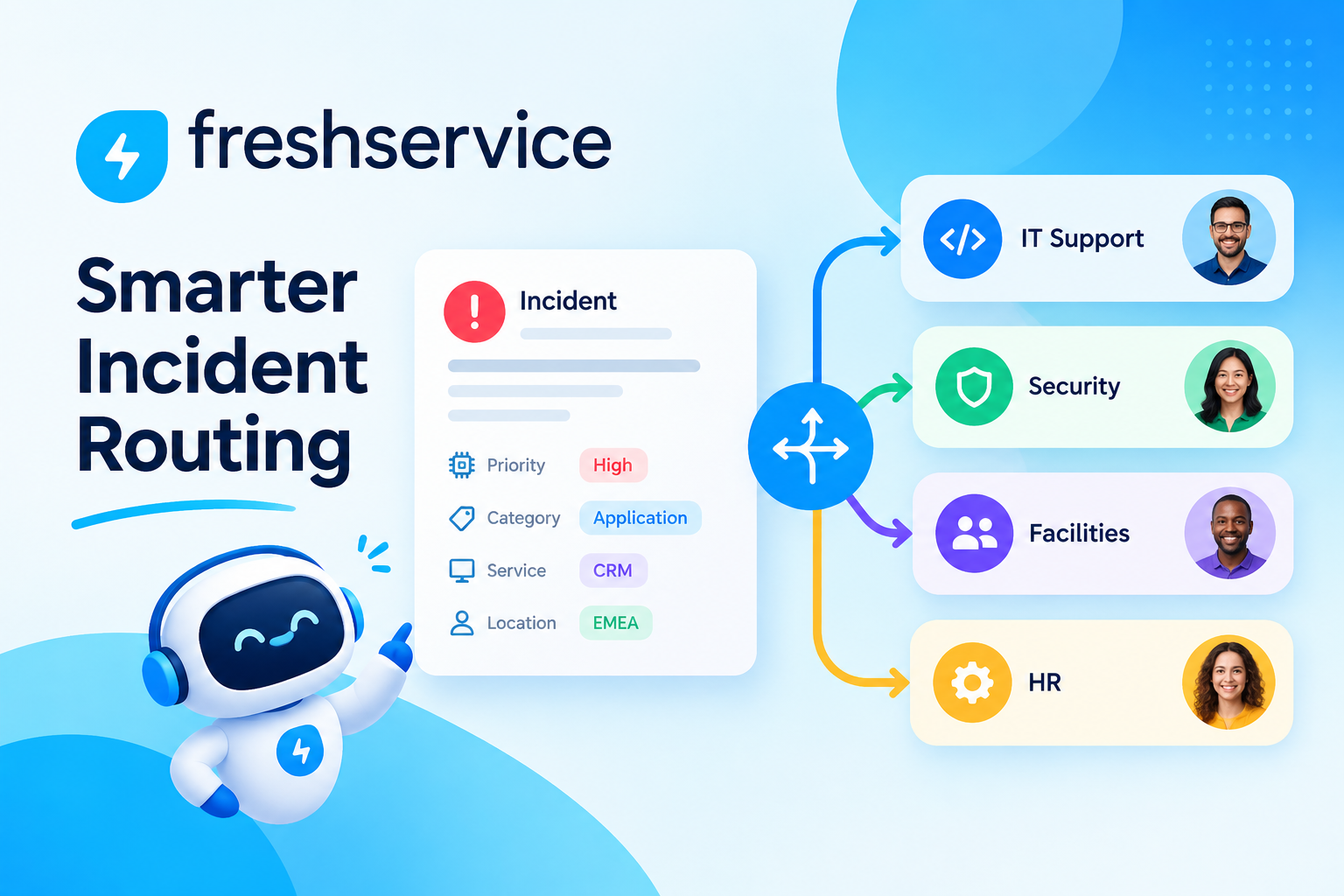
Freshservice brings a modern, cloud-native perspective to ITSM process alignment. Its ITIL 4-aligned architecture covers the key process areas ISO 20000 requires — incident management, change management, problem management, service catalog, and asset management — through an interface that teams can configure and deploy rapidly. This speed-to-value advantage matters especially for organizations with tight certification timelines.
Freshservice’s visual workflow builder enables process owners to design, document, and enforce standardized procedures without writing code — directly supporting ISO 20000’s documentation and control requirements under Clause 7 and Clause 8. Its analytics and reporting dashboards provide real-time visibility into SLA compliance, ticket volumes, resolution rates, and change success rates — precisely the performance metrics ISO 20000 Clause 9 expects organizations to monitor and review.
Moreover, Freshservice’s AI-powered features — including intelligent ticket categorization and predictive field suggestions — reduce human error in process execution, which strengthens the consistency and reliability that ISO 20000 auditors look for. The platform’s native integrations with monitoring, collaboration, and identity management tools also support the supplier and relationship management requirements of Clause 8.3.
What Are the Core ISO 20000 Process Areas Organizations Must Align?

Before mapping ITSM platforms to ISO 20000 requirements, organizations need a thorough understanding of what the standard actually demands across its core process areas. Each area presents specific alignment challenges that technology alone cannot fully solve.
How Do Incident and Service Request Processes Map to ISO 20000?
ISO 20000 Clause 8.6 requires organizations to establish documented procedures for classifying, prioritizing, escalating, resolving, and closing incidents and service requests. Additionally, organizations must demonstrate that they track and analyze incident trends to drive problem management activities.
Effective alignment in this area requires:
- Formal incident classification taxonomy with documented priority definitions
- SLA targets defined per priority level and monitored consistently
- Escalation paths documented and enforced through the ITSM platform
- Incident trend reports generated and reviewed at regular intervals
- Clear distinction between incidents (unplanned disruptions) and service requests (standard fulfillment)
Both ManageEngine and Freshservice support all of these requirements natively. ManageEngine’s SLA management module enforces priority-based response and resolution targets with automated escalations. Freshservice’s intelligent categorization and SLA policies deliver equivalent functionality with a more guided configuration experience, reducing the time needed to build a compliant incident process from scratch.
Why Is Change Management So Critical for ISO 20000 Certification?
Change management — addressed in ISO 20000 Clause 8.5 — is consistently one of the most scrutinized areas during certification audits. The standard requires organizations to assess, authorize, plan, implement, and review changes in a controlled manner. Furthermore, organizations must demonstrate that they track the relationship between changes, incidents, and problems — which demands a functioning CMDB.
Common change management gaps that auditors identify include:
- Changes implemented without formal risk assessment
- No post-implementation review (PIR) process in place
- Emergency change procedures not documented or inconsistently followed
- Weak linkage between change records and related incident records
- Change Advisory Board (CAB) meetings not documented or irregularly held
ManageEngine‘s change management module enforces multi-stage approval workflows with role-based authorization, mandatory risk assessment fields, and automated CAB notifications — directly addressing these gaps. Freshservice‘s change management workflow builder provides equally structured controls, with the added advantage of visual process maps that make audit evidence collection straightforward. Consequently, both platforms eliminate the manual process tracking that often undermines ISO 20000 change management compliance.
How Does Configuration Management Underpin ISO 20000 Compliance?
The configuration management process — and specifically the Configuration Management Database (CMDB) — forms the backbone of ISO 20000 compliance. The standard requires organizations to identify, control, maintain, and verify information about configuration items (CIs) and the relationships between them. Without an accurate CMDB, organizations cannot demonstrate effective change impact assessment, incident root cause analysis, or service dependency mapping.
Building a compliant CMDB involves:
- Defining CI types and the data attributes to capture for each
- Populating the CMDB through automated discovery tools
- Establishing reconciliation processes to keep CMDB data current
- Mapping relationships between CIs (parent-child, dependency, hosted-on)
- Integrating the CMDB with change, incident, and problem records
ManageEngine ServiceDesk Plus delivers one of the most mature CMDB implementations available in the mid-market ITSM space, with automated discovery via its agent-based and agentless scanning capabilities. Freshservice also provides a capable asset management and CMDB module, backed by agent-based discovery and network scanning. Both platforms support the CI relationship mapping that ISO 20000 auditors expect to see.
What Does ISO 20000 Require for Problem Management?
Problem management under ISO 20000 Clause 8.6 requires organizations to proactively identify and address the root causes of recurring incidents, preventing future disruptions rather than simply reacting to them. The standard distinguishes between reactive problem management (triggered by incidents) and proactive problem management (driven by trend analysis).
A compliant problem management process must include:
- Formal problem record creation with root cause analysis documentation
- Known error database (KEDB) maintained and accessible to the service desk
- Problem review meetings with documented outcomes
- Trend analysis reports linking incident patterns to underlying problems
- Workarounds documented and communicated to incident resolvers
ManageEngine supports all of these requirements through its problem management module, which links problem records to related incidents, tracks root cause investigation status, and maintains a known error database. Freshservice provides equivalent functionality with a particularly strong reporting layer that makes trend analysis — a requirement auditors examine closely — straightforward to produce and present.
How Should Organizations Structure Their ISO 20000 Alignment Journey?
Aligning ITSM processes with ISO 20000 is a structured journey that typically unfolds across several distinct phases. Understanding these phases helps organizations plan resources, set realistic timelines, and avoid the rework that comes from an uncoordinated approach.
What Does a Gap Assessment Reveal About Current ITSM Maturity?
The gap assessment is the critical first step in any ISO 20000 alignment program. During this phase, the organization systematically evaluates its current ITSM processes against every applicable ISO 20000 clause, identifying where documented procedures exist, where they are missing, and where existing practices deviate from the standard’s requirements.
A structured gap assessment produces three key outputs:
- A clause-by-clause compliance matrix showing current status (compliant, partial, non-compliant)
- A prioritized list of process gaps ranked by certification risk
- A remediation roadmap with effort estimates and ownership assignments
Organizations that conduct a rigorous gap assessment before touching their ITSM platform configuration consistently complete their ISO 20000 alignment programs faster and with less rework than those that begin platform implementation without this baseline. Engaging an experienced partner — such as Solution for Guru — at this stage significantly improves the quality and speed of the gap assessment output.
How Do Organizations Translate Gap Findings into ITSM Platform Configuration?
Once the gap assessment identifies specific process deficiencies, the organization must translate each remediation requirement into concrete platform configuration tasks. This translation is where ITSM platform expertise becomes essential — because the fastest path between a process requirement and a working platform configuration is rarely obvious without deep product knowledge.
Typical configuration tasks that emerge from ISO 20000 gap assessments include:
| ISO 20000 Gap |  | |
| No formal SLA tiers defined | Configure SLA policies per priority in SLA module | Create SLA policies with business hours in Service Management settings |
| Incident trend reports missing | Schedule automated reports from Reports module | Build analytics dashboard with volume and trend widgets |
| CMDB not populated | Run network discovery and agent deployment | Deploy Freshservice Discovery agent; run network scan |
| Change risk assessment absent | Add mandatory risk matrix fields to change template | Add risk assessment section to change workflow form |
| No known error database | Enable KEDB in Problem Management module | Create problem records with workaround and known error fields |
| Service catalog not documented | Build service catalog with categories and approval flows | Configure service items with forms, approvals, and SLAs |
| Supplier records not maintained | Use vendor management module for supplier tracking | Create vendor records and link to related assets/services |
Why Does Continual Improvement Matter Beyond Initial Certification?
ISO 20000 is not a one-time certification achievement — it requires organizations to demonstrate ongoing improvement through regular performance measurement, internal audits, management reviews, and corrective action processes. Clause 10 specifically mandates that organizations identify nonconformities, analyze their root causes, take corrective actions, and verify the effectiveness of those actions over time.
Organizations that treat ISO 20000 as a continuous operating discipline — rather than a point-in-time compliance exercise — typically find that their service quality and operational efficiency improve measurably over the years following certification. ManageEngine‘s reporting suite and Freshservice‘s analytics platform both support this discipline by providing the performance dashboards and trend data that management reviews require.
Practically, continual improvement under ISO 20000 involves:
- Monthly or quarterly service review meetings with KPI dashboards
- Annual internal audit cycles covering all SMS process areas
- Management review meetings with documented decisions and actions
- Formal improvement register tracking initiatives from idea through to outcome
How Do ManageEngine and Freshservice Compare for ISO 20000 Alignment?

Both platforms support ISO 20000 alignment effectively, but they differ in important ways that influence which organizations each suits best. The following comparison covers the dimensions most relevant to ISO 20000 certification efforts.
| Criteria | | |
| ITIL / ISO 20000 Coverage | Full ITIL v4 + ISO 20000 process coverage | Full ITIL v4 aligned; ISO 20000 process support |
| CMDB Capability | Mature CMDB with automated discovery (agent + agentless) | Agent-based discovery + network scan; strong asset mgmt |
| Change Management | Multi-stage CAB workflows, risk matrix, PIR tracking | Visual change workflow builder, risk scoring, PIR forms |
| SLA Management | Flexible SLA tiers per priority; breach alerts; escalations | SLA policies with business hours; breach notifications |
| Problem Management | Full KEDB, root cause tracking, trend linkage | Problem records with workarounds; trend reporting |
| Incident Management | Robust ticket lifecycle; priority-based routing | AI-assisted categorization; SLA-linked resolution |
| Service Catalog | Multi-tier catalog; approval workflows; SLA attachment | Drag-and-drop catalog builder; multi-stage approvals |
| Reporting for Audits | Extensive report library; scheduled delivery | Analytics dashboards; exportable audit trail reports |
| Deployment Options | On-premise, Cloud, Hybrid | Cloud (SaaS) only |
| Supplier Management | Vendor module with contract tracking | Vendor records linked to assets and service items |
| Configuration Documentation | Detailed process notes; workflow descriptions | Process descriptions embedded in workflow builder |
| Best Fit for ISO 20000 | Regulated industries; on-prem needs; complex CMDB | Cloud-first organizations; faster alignment timelines |
In summary, ManageEngine ServiceDesk Plus offers the deepest native feature set for organizations that need on-premise deployment or require a highly mature CMDB to satisfy stringent configuration management audit requirements. Freshservice, on the other hand, delivers a faster path to operational alignment for cloud-first organizations, with a particularly strong analytics and workflow documentation layer that simplifies the audit evidence collection process. The right choice ultimately depends on your deployment model, CMDB maturity requirements, and internal technical resources.
What Conclusions Should Organizations Draw About ISO 20000 Alignment?
After examining ISO 20000’s requirements in depth and mapping them to real-world ITSM processes and platform capabilities, several clear conclusions emerge for any organization planning its alignment journey.
First, ISO 20000 alignment is fundamentally a process discipline challenge — not just a technology configuration exercise. Organizations that treat certification as a platform implementation project invariably encounter audit non-conformities in the process governance, documentation, and continual improvement areas that technology alone cannot address. Successful alignment requires genuine process ownership, management commitment, and cultural investment alongside the right platform configuration.
Second, both ManageEngine ServiceDesk Plus and Freshservice provide strong foundations for ISO 20000 compliance, and the choice between them should reflect organizational context rather than a simple feature comparison. ManageEngine delivers the deepest CMDB capabilities and on-premise flexibility — advantages that matter enormously in regulated industries and complex infrastructure environments. Freshservice delivers faster time-to-value for cloud-first organizations, with analytics and workflow documentation capabilities that streamline the audit evidence process. Either platform, configured correctly, can fully support an ISO 20000-compliant SMS.
Third, the organizations that achieve and sustain ISO 20000 certification most efficiently are those that invest in expert guidance from the outset. Engaging a specialist like Solution for Guru means benefiting from pre-built templates, proven methodology, deep platform knowledge, and audit preparation support — all of which compress the alignment timeline and reduce the risk of costly rework. Furthermore, Solution for Guru’s continual improvement support ensures that the organization does not simply achieve certification but progressively strengthens its ITSM maturity over time.
Finally, ISO 20000 certification delivers benefits that extend far beyond the certificate itself. Organizations that genuinely align their ITSM processes with the standard’s requirements consistently report improved service quality, faster incident resolution, fewer repeat incidents, stronger supplier management, and greater stakeholder confidence.
Frequently Asked Questions
ITIL (IT Infrastructure Library) is a framework of best practice guidance for ITSM processes, while ISO 20000 is a certifiable international standard that specifies requirements for a service management system. ITIL tells organizations how to design and operate ITSM processes effectively; ISO 20000 defines what an organization must demonstrate to earn formal third-party certification.
Both apply to most serious ITSM programs, and they complement each other closely. Implementing ITIL-aligned processes — as supported natively by both ManageEngine ServiceDesk Plus and Freshservice — creates a strong foundation for ISO 20000 certification. However, ISO 20000 also requires governance elements (management reviews, internal audits, documented SMS scope) that go beyond ITIL process implementation. Organizations pursuing ISO 20000 certification should therefore treat ITIL alignment as a necessary but not sufficient condition.
Timeline varies significantly depending on the organization’s current ITSM maturity, size, and scope of the SMS. Organizations with mature ITIL-based processes and a well-configured ITSM platform typically need six to twelve months from gap assessment to certification audit. Organizations starting from a low ITSM maturity baseline realistically need twelve to twenty-four months, particularly if they must simultaneously build process documentation, configure their ITSM platform, train staff, and develop the governance structures ISO 20000 requires.
Partnering with an experienced implementation specialist like Solution for Guru compresses these timelines meaningfully. Pre-built process templates, structured gap assessments, and audit preparation support can reduce the time to certification-readiness by 30–40% compared to unassisted approaches. Choosing a capable ITSM platform — either ManageEngine or Freshservice — also accelerates the journey by providing built-in process controls that organizations would otherwise need to build manually.
Why Does Partnering with Solution for Guru Accelerate ISO 20000 Alignment?
Navigating ISO 20000 alignment independently is possible — but it is significantly more time-consuming, risk-prone, and costly than working with an experienced specialist. This is exactly where Solution for Guru delivers transformational value.
Solution for Guru is a specialized ITSM consultancy with deep expertise in both ManageEngine ServiceDesk Plus and Freshservice implementations, and extensive experience guiding organizations through ISO 20000 alignment and certification programs. Their team combines ITSM process expertise with hands-on platform knowledge — a combination that is genuinely rare and exceptionally valuable for ISO 20000 projects.
What Specific Benefits Does Solution for Guru Bring to ISO 20000 Projects?
Engaging Solution for Guru as your ISO 20000 alignment partner delivers concrete advantages across every phase of the program:
- Structured Gap Assessment Methodology: Solution for Guru applies a proven, clause-by-clause ISO 20000 gap assessment framework that identifies compliance risks quickly and accurately, saving weeks of internal effort and preventing the misinterpretations of standard requirements that commonly derail in-house assessments.
- Pre-configured Process Templates: Their library of ISO 20000-aligned ITSM process templates — covering incident, change, problem, configuration, and service catalog processes — gives organizations a compliant starting point rather than building from scratch. This accelerates the platform configuration phase by weeks.
- Platform-Specific Expertise: Deep knowledge of both ManageEngine and Freshservice means Solution for Guru configures each platform to its full ISO 20000-supporting potential — including CMDB design, SLA architecture, change workflow structures, and audit report configurations that many generalist implementers miss.
- Audit Readiness Preparation: Solution for Guru prepares organizations for certification body audits by running internal pre-audit reviews, identifying residual gaps, and producing the documented evidence packages that auditors expect. This dramatically reduces the risk of major non-conformities during the formal certification audit.
- Continual Improvement Support: Beyond initial certification, Solution for Guru supports organizations in building the performance measurement, management review, and improvement processes that keep ISO 20000 certification current through annual surveillance audits.
- Staff Enablement: Their training programs equip internal IT teams with both the ISO 20000 process knowledge and the platform skills needed to sustain compliance independently — reducing long-term dependency on external support.
Organizations that work with Solution for Guru on ISO 20000 alignment programs typically reach certification-readiness 30–40% faster than those pursuing in-house approaches, while simultaneously building more robust, sustainable ITSM process practices. For organizations where ISO 20000 certification directly influences customer contracts, regulatory standing, or competitive positioning, this acceleration has direct commercial value.
Recommended:
- How Long Does an ITSM Implementation Really Take? Key Factors Explained
- ManageEngine vs Freshservice
- Top ITSM Best Practices Using ManageEngine
- Improving IT Governance and Compliance with ManageEngine ITSM
- Cloud vs On-Premise ManageEngine ITSM: Which Should You Choose?
- Integrating ManageEngine with Microsoft 365
- Automating IT Approvals in ManageEngine Using Workflows
- Designing an Effective ITSM Model for Modern IT Environments
- Common Implementation Mistakes in ManageEngine ITSM (and How to Avoid Them)
- API Automation in ManageEngine: Practical Use Cases
- How ManageEngine Supports ITIL 4 Framework?
- ITSM — How to Start Implementation?
- Core ITSM Processes: A Comprehensive Guide to Service Management Excellence