Automating Software License Tracking with ITSM Solutions: How Can You Take Control?
Software license mismanagement costs organizations millions of dollars every year. Whether through over-purchasing underused tools, facing surprise audit penalties, or simply losing track of renewals, IT teams are under constant pressure to maintain compliance while controlling costs. Fortunately, modern IT Service Management (ITSM) platforms now offer robust, automated solutions that turn this complex challenge into a manageable, even strategic, advantage.
In this article, we explore how automating software license tracking through ITSM solutions — with a particular focus on ManageEngine ServiceDesk Plus and Freshservice — can transform how your organization manages software assets. We also highlight how partnering with Solution for Guru gives you the expert guidance needed to implement these platforms effectively.
Table of contents
Quick Summary
Software license tracking is a critical component of IT Asset Management (ITAM). ITSM platforms like ManageEngine ServiceDesk Plus and Freshservice automate discovery, compliance monitoring, renewal alerts, and reporting — eliminating the guesswork that comes with manual spreadsheet-based tracking. This article covers:
- Why manual license tracking fails at scale
- How ManageEngine and Freshservice address licensing challenges
- A direct comparison of both platforms
- Best practices for successful implementation
- The advantages of working with Solution for Guru
How Do ManageEngine and Freshservice Address Software License Tracking?
Before diving into individual features, it is worth understanding what makes these two platforms standout choices in the ITSM space and why both are widely recognized for their software asset management capabilities.
What Makes ManageEngine ServiceDesk Plus the Right Choice for Complex Environments?

ManageEngine ServiceDesk Plus is a comprehensive ITSM platform developed by Zoho Corporation. It combines help desk functionality with powerful IT Asset Management (ITAM) and Software Asset Management (SAM) modules. Organizations that deal with hybrid environments — mixing on-premise infrastructure with cloud workloads — consistently choose ManageEngine for its deployment flexibility and deep customization options.
ManageEngine actively tracks software installations across endpoints, maps them against purchased licenses, and flags compliance violations in real time. Its built-in normalization engine consolidates duplicate records, ensuring that your license counts remain accurate even across large, distributed networks. Furthermore, ManageEngine integrates natively with Active Directory, enabling automatic user-to-license mapping — a feature that significantly reduces administrative overhead.
You can explore ManageEngine ITSM capabilities in detail at this link.
How Does Freshservice Simplify License Management for Growing Teams?

Freshservice, built by Freshworks, approaches ITSM with a modern, user-friendly philosophy. It delivers cloud-native software license tracking through its Asset Management module, which provides clear visibility into what software runs across every device in your organization. Freshservice automatically discovers installed applications and correlates them with active license contracts, giving IT teams immediate insight into utilization rates and upcoming renewals.
What sets Freshservice apart is its intuitive interface and powerful automation engine — the Workflow Automator. Teams can set up triggers so that when a license nears expiry or utilization drops below a threshold, the system automatically notifies the relevant stakeholders and creates a service request for renewal or reallocation. This proactive approach prevents the last-minute scrambles that typically accompany license renewal cycles.
Discover the full range of Freshservice features at this link.
Why Is Manual Software License Tracking No Longer Sufficient?
What Hidden Risks Come with Spreadsheet-Based Tracking?
Many organizations still rely on spreadsheets to track software licenses, and this approach carries substantial risks. Spreadsheets require manual updates, which means they inevitably fall out of sync with the actual software landscape — especially in organizations where employees regularly install new tools or upgrade existing ones. According to the BSA Software Alliance, roughly 37% of software installed on personal computers worldwide lacks proper licensing, exposing companies to significant legal and financial risk.
Beyond compliance exposure, spreadsheet-based tracking makes it nearly impossible to correlate license consumption with actual usage. IT teams often renew licenses for software that employees stopped using months ago, wasting budget that could otherwise fund innovation. In contrast, automated ITSM-driven tracking continuously monitors real usage data, enabling data-driven decisions about renewals and reallocation.
Additionally, audits from major software vendors — including Microsoft, Adobe, and Oracle — have become increasingly common. An audit without accurate license records can result in retroactive licensing fees, penalties, and reputational damage. Therefore, transitioning to an automated solution is not simply a matter of convenience; it is a fundamental risk management strategy.
How Does ITSM Automation Eliminate License Management Gaps?
ITSM platforms address these gaps through several interconnected capabilities. First, they automate discovery — continuously scanning the network to identify every installed application. Second, they normalize the data by consolidating different versions and names of the same software into a single, trackable record. Third, they enforce compliance by comparing installed software counts against purchased licenses and alerting administrators to discrepancies.
Both ManageEngine and Freshservice take this a step further by integrating license management directly into the broader service management workflow. For instance, when a new employee onboarding request arrives, the system can automatically allocate a software license from available stock, record the assignment, and update compliance dashboards — all without human intervention. This end-to-end automation eliminates the gaps that inevitably appear when license management lives in a separate system from service delivery.
What Core Features Should You Expect from an ITSM License Tracking Solution?
Which Discovery and Inventory Capabilities Are Non-Negotiable?
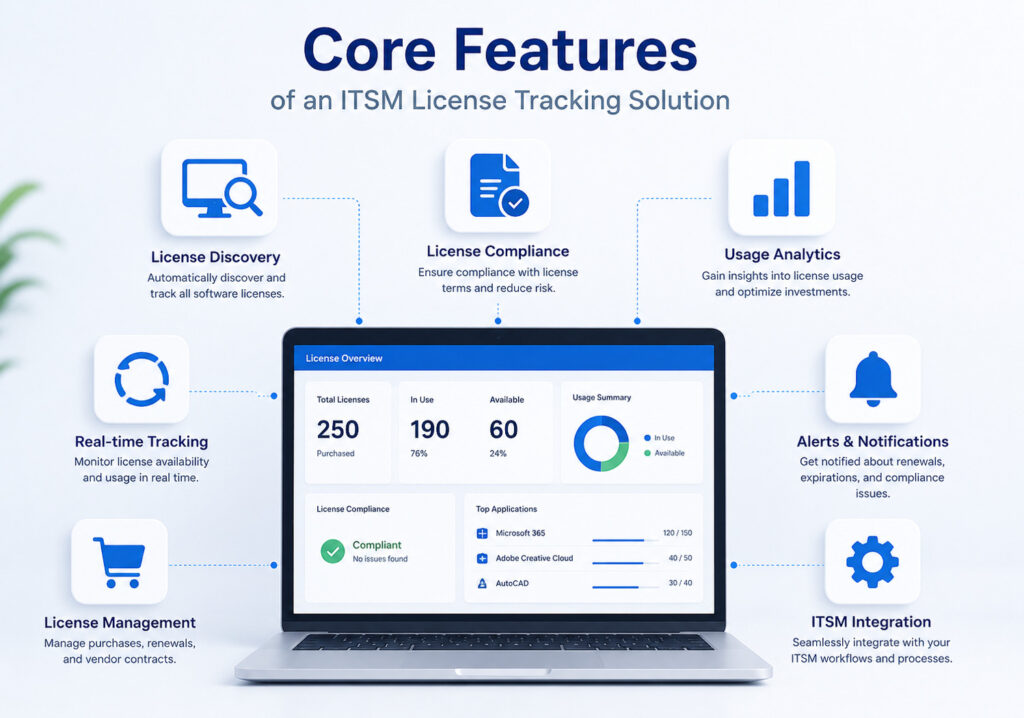
Effective software license tracking starts with comprehensive discovery. Without knowing what software runs across your environment, you cannot manage compliance or optimize spending. Both ManageEngine and Freshservice provide multi-method discovery approaches that ensure complete visibility.
ManageEngine uses a combination of agent-based and agentless discovery. The agent-based approach installs a lightweight client on endpoints and provides deep, real-time inventory data. Agentless discovery uses network scanning protocols to capture data from devices that cannot host an agent — such as printers, network switches, and certain legacy systems. Together, these methods give organizations a complete software inventory across heterogeneous environments.
Freshservice deploys its Discovery agent on Windows, macOS, and Linux endpoints to collect software inventory data. It also integrates with major MDM platforms like Jamf and Microsoft Intune, which means organizations that already manage endpoints through these tools can feed that data directly into Freshservice without deploying an additional agent. This flexibility significantly reduces the operational overhead of maintaining a current software inventory.
Key discovery capabilities to look for include:
- Automatic detection of newly installed software
- Version tracking to identify outdated or unauthorized software
- Usage frequency monitoring to identify underused licenses
- Manufacturer and publisher normalization
- Integration with endpoint management platforms
How Do License Compliance Dashboards Keep Teams Informed?
Once discovery is in place, the next critical capability is compliance reporting. ManageEngine provides purpose-built compliance dashboards that display, at a glance, the ratio of installed software to purchased licenses for every software title in the inventory. IT managers can immediately see which titles are over-deployed (creating compliance risk) and which are under-utilized (creating cost inefficiency).
Freshservice offers similar functionality through its Analytics 2.0 module. Teams can build custom dashboards that surface license utilization rates, upcoming expirations, and pending renewals. These dashboards are particularly valuable during vendor audit preparation, as they provide instant access to the data needed to demonstrate compliance — without scrambling through spreadsheets or ticketing systems.
Both platforms support scheduled reporting, enabling IT managers to automatically receive weekly or monthly license compliance summaries. This regular cadence ensures that license status never falls off the radar, even during busy periods.
What Automation Features Prevent Compliance Violations Before They Occur?
Reactive license management — fixing problems after they occur — is far more expensive than proactive management. Both ManageEngine and Freshservice deliver automation features that shift organizations from reactive to proactive postures.
ManageEngine’s business rules engine allows administrators to define conditions and corresponding actions. For example, a rule might specify: if the ratio of installed instances to purchased licenses exceeds 90%, automatically create a high-priority service request assigned to the procurement team. This triggers the renewal process before any violation occurs, rather than after an audit reveals a problem.
Freshservice’s Workflow Automator achieves similar outcomes through a visual, drag-and-drop interface. Administrators define triggers, conditions, and actions using a flowchart-style editor that requires no coding knowledge. Common automation scenarios include:
- Sending renewal reminder emails 90, 60, and 30 days before expiry
- Automatically de-provisioning licenses when an employee leaves the organization
- Creating approval workflows for new software purchase requests
- Alerting managers when a specific software title exceeds its licensed seat count
- Generating monthly compliance reports and distributing them to stakeholders
How Do ManageEngine and Freshservice Compare Head-to-Head?
Choosing between ManageEngine and Freshservice depends on your organization’s size, technical complexity, and specific license management requirements. The following comparison table provides a structured overview of how both platforms perform across key evaluation criteria.
| Feature / Criterion |  | |
|---|---|---|
| Deployment Options | Cloud & On-Premise | Cloud-only (SaaS) |
| SAM Module | Built-in Software Asset Management | Asset & License Management add-on |
| License Tracking | Advanced: compliance dashboards, normalization | Visual license tracking, utilization alerts |
| ITIL Alignment | Full ITIL v3/v4 certified | Full ITIL-aligned workflows |
| Discovery & Inventory | Agent-based + agentless network discovery | Freshservice Discovery agent + integrations |
| Integration Ecosystem | 500+ integrations, strong Microsoft stack | 1,000+ integrations via Freshworks marketplace |
| Automation | Business rules, scheduled tasks, workflows | Workflow Automator, AI-powered suggestions |
| Reporting & Analytics | Customizable dashboards, built-in BI | Analytics 2.0 with drag-and-drop reports |
| Pricing Model | Per-technician or per-node tiers | Per-agent tiered plans (Starter to Enterprise) |
| Best Suited For | Mid-size to large enterprises, complex environments | Fast-growing SMBs and agile enterprise teams |
| Support Quality | 24/7 phone, email, community portal | 24/7 chat, email, dedicated CSM (higher tiers) |
As the table illustrates, ManageEngine ServiceDesk Plus tends to excel in environments requiring on-premise deployment, deep ITIL customization, and complex network discovery across heterogeneous infrastructure. Freshservice, on the other hand, delivers superior usability and faster time-to-value for cloud-first organizations and growing teams that prioritize agility over deep customization.
It is also worth noting that both platforms regularly release updates that expand their capabilities. Therefore, evaluating the current roadmap and vendor support quality is equally important alongside feature comparisons.
What Best Practices Maximize the Value of ITSM License Tracking?

How Should You Structure Your Software Asset Management Policy?
Technology alone does not solve license management challenges. A well-defined Software Asset Management (SAM) policy creates the governance framework within which your ITSM platform operates. Without clear policies, even the most sophisticated tracking system will produce data that no one acts on.
An effective SAM policy should define the following elements:
- Software request and approval process: Specify who can request new software, who approves requests, and how approved software gets provisioned.
- License ownership: Assign responsibility for each software contract to a named owner who monitors compliance and manages renewals.
- Acceptable use standards: Define which software titles are approved for organizational use and which are prohibited.
- Audit schedule: Establish quarterly or semi-annual internal audits to verify that license data in the ITSM platform remains accurate.
- Offboarding procedure: Document the process for reclaiming licenses when employees leave or change roles.
ManageEngine and Freshservice both support policy enforcement by allowing administrators to flag unauthorized software installations and automatically generate alerts when prohibited applications appear in the inventory.
How Can You Integrate License Tracking with Your Broader ITSM Workflows?
Software license tracking delivers maximum value when it integrates seamlessly with other ITSM workflows — particularly incident management, change management, and procurement. For example, linking license tracking to the change management process ensures that every software deployment or upgrade automatically updates the license inventory.
ManageEngine achieves this integration natively, since all ITSM functions (service desk, asset management, change management, problem management) share a single database. Consequently, a change request for a new software rollout automatically triggers a check against available licenses before approval proceeds.
Freshservice similarly integrates asset management with its change management and procurement modules. When a purchase order for new licenses gets raised, the system can automatically import the new license allocation into the asset inventory, update compliance dashboards, and close the associated service request — creating an end-to-end audit trail with minimal manual effort.
What Are the Financial Benefits of Automating License Tracking?
How Does Automation Reduce Software Spending?
One of the most tangible financial benefits of automated license tracking is the ability to identify and eliminate shelfware — software licenses that organizations pay for but rarely or never use. Gartner research consistently finds that organizations waste between 15% and 25% of their software budgets on underused or unused licenses. For large enterprises, this often represents millions of dollars in avoidable spending.
By continuously monitoring usage frequency — a capability built into both ManageEngine and Freshservice — IT teams can identify which software titles have low adoption rates and initiate conversations with business units before renewal time. Often, teams discover that a department stopped using a tool months ago but continued renewing licenses out of habit. Automated tracking turns these invisible costs into visible, actionable insights.
Beyond eliminating shelfware, automated tracking also reduces the administrative labor associated with license management. Eliminating manual spreadsheet updates, ad-hoc compliance checks, and time-consuming audit preparations frees IT staff to focus on higher-value activities. According to Flexera’s State of ITAM Report, organizations with mature SAM practices reduce their software audit costs by up to 30% and achieve an average ROI of 350% on their ITAM investments.
How Does Compliance Management Protect Organizations from Financial Risk?

Software vendors conduct audits with increasing frequency, and the financial consequences of non-compliance can be severe. Microsoft, for instance, typically requires organizations found to be under-licensed to purchase the missing licenses at retail prices — with no discounts — and may impose additional penalties. Oracle audits are notoriously complex and can result in seven-figure settlements for enterprises that fail to track database licenses accurately.
ManageEngine and Freshservice both reduce audit risk by maintaining continuously updated, accurate license records. When a vendor audit notice arrives, IT teams can generate compliance reports directly from the platform, demonstrating exactly which licenses are in use, how many are owned, and when each contract expires. This readiness not only protects against penalties but also strengthens the organization’s negotiating position during renewal discussions.
What Conclusions Can We Draw About Automating Software License Tracking?
Software license management has moved well beyond spreadsheets and manual processes. Today’s organizations face audit risks, budget pressures, and operational complexity that demand an automated, integrated approach — and ITSM platforms deliver exactly that.
ManageEngine ServiceDesk Plus stands out for organizations that need on-premise deployment flexibility, deep ITIL alignment, and robust software asset management across complex, heterogeneous environments. Its built-in normalization engine, Active Directory integration, and compliance dashboards make it a powerful choice for mid-size to large enterprises with sophisticated tracking requirements.
Freshservice excels in cloud-first environments where speed of deployment, ease of use, and powerful automation are top priorities. Its Workflow Automator and modern analytics capabilities enable growing organizations to implement mature license management practices without the complexity typically associated with enterprise ITSM tools.
Both platforms deliver the same fundamental outcome: complete visibility into your software landscape, proactive compliance management, and data-driven insights that reduce costs and eliminate audit risk. The choice between them ultimately comes down to your infrastructure strategy, team capabilities, and specific compliance requirements.
Most importantly, the return on investment from automated license tracking is well-documented. Organizations that invest in ITSM-driven SAM programs consistently reduce software spending, avoid costly audit penalties, and free IT teams to focus on strategic work rather than administrative overhead.
To maximize the value of your ITSM investment, consider partnering with Solution for Guru. Their certified expertise in both ManageEngine and Freshservice ensures that your implementation is fast, accurate, and aligned with your organization’s specific license management goals. With the right platform and the right partner, automating software license tracking transforms from a daunting challenge into a clear competitive advantage.
Frequently Asked Questions
IT Asset Management (ITAM) covers the full lifecycle of all IT assets — hardware, software, and cloud resources. Software Asset Management (SAM) is a specialized subset of ITAM focused specifically on software licenses, compliance, and optimization. Both ManageEngine ServiceDesk Plus and Freshservice support SAM within their broader ITAM modules, allowing organizations to manage hardware and software assets within a single, unified platform. In practice, SAM provides the compliance and financial controls, while ITAM provides the broader operational context.
Implementation timelines vary depending on the size of the organization, the complexity of the existing software environment, and the level of customization required. For a mid-size organization deploying Freshservice with standard configurations, an initial implementation can be completed in four to eight weeks. ManageEngine deployments in large, complex environments may take two to four months, particularly when integrating with on-premise directory services, multiple discovery agents, and custom compliance workflows. Partnering with an experienced implementation provider like Solution for Guru significantly reduces these timelines by eliminating common configuration pitfalls.
Yes — both ManageEngine and Freshservice have expanded their asset management capabilities to include SaaS license tracking. ManageEngine integrates with major SaaS platforms to pull license utilization data directly into the compliance dashboard. Freshservice offers SaaS Management capabilities that track spending, utilization, and renewal dates for cloud subscriptions alongside traditional on-premise software. As SaaS adoption continues to grow, this capability is increasingly important for organizations seeking a complete view of their software landscape — and both platforms are actively investing in expanding their SaaS tracking features.
How Can Solution for Guru Help You Implement ITSM License Tracking Successfully?
Selecting the right ITSM platform is only the first step. Successful implementation requires deep expertise in platform configuration, data migration, workflow design, and user adoption — areas where many organizations struggle without specialist support.
Solution for Guru is a certified ITSM implementation partner with extensive experience deploying both ManageEngine ServiceDesk Plus and Freshservice for organizations across a wide range of industries. Their team of certified consultants brings hands-on expertise in software asset management, ITIL process design, and ITSM platform optimization.
What Specific Benefits Does Solution for Guru Deliver?
Partnering with Solution for Guru delivers tangible advantages at every stage of your ITSM journey:
- Needs Assessment and Platform Selection: Solution for Guru consultants conduct a thorough analysis of your existing infrastructure, team size, compliance requirements, and budget to recommend the most suitable platform — whether that is ManageEngine, Freshservice, or another solution entirely.
- Rapid Implementation: Their proven implementation methodology minimizes deployment time, reducing the risk of disruption to ongoing IT operations. Rather than navigating configuration challenges independently, you benefit from a team that has completed dozens of similar deployments.
- Custom Workflow Design: Generic out-of-the-box configurations rarely align perfectly with organizational processes. Solution for Guru customizes automation workflows, approval chains, and compliance dashboards to match your specific license management requirements.
- Data Migration Support: Migrating existing license data from spreadsheets or legacy systems into a new ITSM platform is a common source of project delays. Solution for Guru handles data cleansing, normalization, and migration to ensure your new system starts with accurate, complete records.
- Training and Adoption: Technology investments only deliver value when users adopt them effectively. Solution for Guru provides tailored training programs for IT administrators and end users, ensuring that your team can confidently manage and evolve the platform.
- Ongoing Optimization: As your organization grows and software needs change, Solution for Guru offers continuous support to optimize license tracking workflows, integrate new tools, and ensure that your ITSM platform evolves alongside your business.
Recommended:
- Best Microsoft 365 Integrations for ManageEngine and Freshservice
- Integrating Endpoint Management Tools with ITSM Systems
- Aligning ITSM Processes with ISO 20000 Standards
- How Long Does an ITSM Implementation Really Take? Key Factors Explained
- ManageEngine vs Freshservice
- Top ITSM Best Practices Using ManageEngine
- Improving IT Governance and Compliance with ManageEngine ITSM
- Cloud vs On-Premise ManageEngine ITSM: Which Should You Choose?
- Integrating ManageEngine with Microsoft 365
- Automating IT Approvals in ManageEngine Using Workflows
- Designing an Effective ITSM Model for Modern IT Environments
- Common Implementation Mistakes in ManageEngine ITSM (and How to Avoid Them)
- API Automation in ManageEngine: Practical Use Cases