How to Build a Digital Transformation Data Strategy

The single highest-impact move any executive team can make right now is to establish a business-aligned data “North Star” and launch two to three revenue or efficiency pilots within 90 days. BCG’s North Star approach sequences use cases, data assets, and architecture decisions together so every investment has a direct business linkage, cutting the “data-IT disconnect” that kills most programs before they scale. McKinsey’s 2030 enterprise research adds a second imperative: build capability pathways, clusters of reusable technology components, rather than bespoke tools for each problem. Together, these two moves compress time to value and reduce the risk of expensive system-wide overhauls.
First actions your leadership team should take this quarter:
- Assign a named executive sponsor with budget authority and a mandate to resolve cross-functional blockers.
- Select two to three pilot use cases tied to measurable revenue, cost, or cycle-time outcomes.
- Define KPIs for each pilot early to ensure clarity on expected outcomes.
- Secure budget and calendar time for a 60–90 day North Star exercise that aligns business and IT on prioritized use cases and architecture sequencing.
- Designate business-side data product owners who will be accountable for data quality and reuse.
Timeline: Run the North Star exercise in the first 60–90 days, launch pilots immediately after, and target a companywide roadmap by month six.
Pro Tip: Do not wait for a perfect data platform before starting pilots. The pilot itself reveals which data assets and architecture choices actually matter, saving months of speculative infrastructure work.
Key Takeaways
A digital transformation data strategy succeeds when executive ownership, a sequenced pilot-to-scale roadmap, and a governed data product layer are in place before significant platform investment begins.
| Point | Details |
|---|---|
| Start with a North Star exercise | Run a 60–90 day exercise to align business and IT on prioritized use cases and architecture before any major platform spend. |
| Pilot first, platform second | Launch two to three high-impact pilots with named sponsors and 90-day KPIs; let pilot requirements drive architecture decisions. |
| Govern data as a product | Assign business-side data product owners accountable for quality, documentation, and reuse rates across the enterprise. |
| Measure financial outcomes | Report revenue impact, cost reduction, and cycle-time improvement to the executive committee monthly, not just data metrics. |
| Solution4guru for implementation | Solution4guru delivers pilot selection, governance setup, and data platform integration to move programs from strategy to production within 90 days. |
Table of Contents
- What is a digital transformation data strategy, and how does it differ from a generic digital strategy?
- Why data is the engine of digital transformation, not just a supporting asset
- Seven core components every effective data strategy must include
- A practical three-phase roadmap from pilot to enterprise scale
- How to choose your data architecture without falling for vendor hype
- How to govern data as an enterprise capability, not an IT project
- How to measure ROI and prove the value of your data program
- Common pitfalls that derail data-driven transformations, and how to avoid them
- What the research says: best practices from BCG, McKinsey, MIT Sloan, and Databricks
- What actually works in enterprise data transformations: lessons from the field
- Solution4guru accelerates your data strategy from pilot to production
- Sources
- FAQ
What is a digital transformation data strategy, and how does it differ from a generic digital strategy?
A digital transformation data strategy is an enterprise plan that defines how data assets will be governed, structured, and deployed to produce measurable business outcomes, specifically revenue growth, cost reduction, or service improvement, as part of a broader digital change program. It is not a technology roadmap, and it is not the same as IT modernization.
Three things belong inside a data strategy that typically fall outside a generic digital strategy:
- Scope: Which data domains, sources, and products the organization will prioritize, and in what sequence.
- Primary outcomes: Quantified business targets, such as a 15% reduction in customer churn or a two-day compression in order fulfillment cycle time, that data investments are expected to deliver.
- Ownership: A named CDO or equivalent executive, plus business-side data product owners who are accountable for quality and reuse, not just IT.
The contrast with adjacent concepts is worth making explicit:
| Concept | Primary purpose | Who owns it | Success metric |
|---|---|---|---|
| Digital strategy | Business model and channel transformation | CEO / Chief Strategy Officer | Revenue, market share |
| IT modernization | Infrastructure reliability and cost | CIO / IT | Uptime, cost per transaction |
| Data strategy | Data-driven business outcomes | CDO / Business product owners | Revenue impact, data reuse rate |
A concrete example: a retailer that builds a customer-360 data product can reduce churn by surfacing at-risk segments to the marketing team in near real time. That outcome requires a data strategy, specifically governance rules, an integration architecture, and an analytics layer. A digital strategy alone would identify “personalization” as a priority but would not specify how to build the data capability that makes personalization possible.
Solution For guru works with organizations at exactly this definition stage, helping leadership teams scope their data strategy before a single platform decision is made.
Why data is the engine of digital transformation, not just a supporting asset
Data is not one component of digital transformation among many. It is the mechanism by which every other transformation investment, process redesign, AI deployment, customer experience upgrade, produces a measurable return. Without a data strategy, digital programs generate activity rather than outcomes.
The primary value levers:
- Revenue growth: Personalization, dynamic pricing, and next-best-offer models all depend on clean, accessible customer and transaction data.
- Margin expansion: Predictive maintenance, demand forecasting, and supplier risk scoring reduce waste and unplanned costs.
- Operational efficiency: Real-time data access shortens decision cycles. Process automation built on reliable data feeds reduces manual intervention.
- Risk reduction: Fraud detection, compliance monitoring, and credit scoring models require governed, auditable data pipelines.
- Faster innovation: Teams that can access trusted data products without waiting for IT tickets move from hypothesis to tested insight in days, not quarters.
The risks of proceeding without a data strategy are equally concrete. “Pilot purgatory” is the most common failure mode: organizations run dozens of disconnected proofs of concept, none of which scale, because there is no shared data foundation or governance model to build on. Data silos, where each business unit maintains its own definitions and pipelines, create conflicting reports and erode executive trust in analytics. Over-investing in infrastructure before use cases are defined is a third trap; it produces expensive platforms that sit underutilized while business teams wait for value.
A Statista survey of top IT technology initiative priorities confirms that real-time data access and analytics consistently rank among the highest priorities for IT leaders, reflecting how central data capability has become to enterprise competitiveness.
What to fund first, in priority order:
- Two to three high-value pilots with clear business sponsors and defined KPIs.
- The governance and data product layer that makes pilot outputs reusable across the enterprise.
- Architecture and platform investments, sized to the pilots’ actual requirements, not a speculative future state.
Seven core components every effective data strategy must include
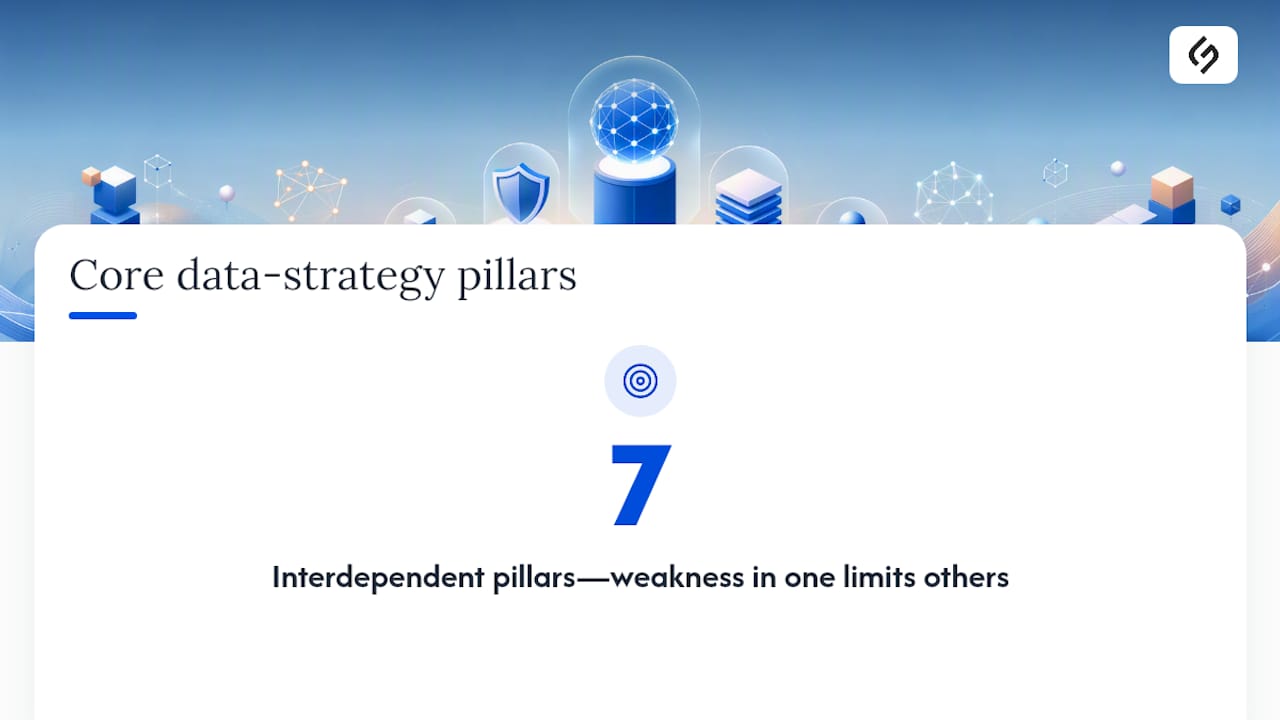
An effective digital transformation data strategy is built on seven interdependent pillars. Weakness in any one of them limits the others.
1. Vision and business alignment
The data strategy must trace directly to business objectives. Every data product, every governance policy, and every architecture decision should be justifiable by reference to a named business outcome. Without this alignment, data programs drift toward technical excellence with no commercial impact.
2. Data governance and stewardship
Governance defines who owns data, who can access it, and what quality standards apply. This includes data ownership policies, access controls, data classification, and privacy and compliance frameworks such as GDPR and CCPA. A practical example of governance in action is access control in CRM platforms, where role-based permissions determine which teams can read, write, or export customer records.
3. Data architecture and platforms
Architecture choices determine how data flows from source systems to analytics and AI applications. The key decisions cover ingestion patterns, storage models (data lakehouse, data mesh, or hybrid cloud), and integration approaches. Architecture should be chosen to enable prioritized capability pathways, not to match vendor marketing.
4. Analytics and machine learning capabilities
This pillar covers the tools, models, and processes that convert raw data into decisions. It ranges from descriptive dashboards to predictive models and generative AI applications. Understanding the future of AI in business is increasingly a prerequisite for leaders setting analytics ambitions, given how rapidly the capability floor is rising.
5. Data products and product management
A data product is a governed, documented, and reusable data asset, such as a customer-360 view or a real-time inventory feed, that multiple teams can consume without rebuilding it from scratch. McKinsey recommends focusing on five to fifteen high-value data products rather than attempting to monetize every dataset at once. This constraint forces prioritization and accelerates reuse.
6. Operations and deployment
Data pipelines, model deployment, monitoring, and incident response belong here. Operational maturity means data products have defined SLAs, are monitored for drift and quality degradation, and have clear escalation paths when something breaks.
7. People, culture, and data literacy
Dataversity’s research is direct: data strategy must include change management and data literacy programs to shift culture and enable adoption across business units. Technical capability without cultural adoption produces dashboards that no one uses. Training programs, data literacy curricula, and communities of practice are not optional extras.
Pro Tip: Prioritize data products that unlock multiple use cases simultaneously. A single customer-360 product can power personalization, churn prediction, and support routing, generating three times the return on the same governance and engineering investment.
Readiness checklist for each pillar (score yes/no):
- Is there a named business outcome linked to this pillar?
- Is there a named owner accountable for quality and delivery?
- Are there defined KPIs that measure the pillar’s contribution?
- Has the team identified the top two to three use cases this pillar enables?
A practical three-phase roadmap from pilot to enterprise scale
The three phases are: pilot for value, create the enterprise roadmap, and industrialize capabilities. Each phase has a distinct objective, a different risk profile, and a different budget conversation.
Phase summary:
- Phase 1 (months 1–4): Pilot for value. Deliver two to three high-impact use cases fast. Prove ROI. Generate organizational momentum and executive confidence.
- Phase 2 (months 4–9): Build the enterprise roadmap. Use pilot learnings to sequence the full program. Define architecture, governance, and data product priorities for scale.
- Phase 3 (months 9–24+): Industrialize. Build reusable capability pathways, scale data products, and embed data-driven decision-making across business units.
BCG’s pilot-to-scale approach is explicit: companies that start with pilots and focus on incremental, sustainable transformation see faster returns and avoid costly system-wide overhauls.
How to pick the right pilots
A good pilot has four characteristics: a named business sponsor, a measurable outcome achievable within 90 days, a data asset that already exists or can be accessed quickly, and a team small enough to move fast. Customer churn prediction, demand forecasting, and real-time fulfillment tracking are common starting points because the data is usually available and the business value is easy to quantify. For customer-focused use cases, AI-driven customer insights offer a practical template for turning existing CRM data into analytics-driven actions.
Pilot execution checklist:
- Business sponsor identified and committed.
- Success metric defined and baselined before the pilot starts.
- Data access confirmed (no waiting for new integrations).
- Timeline capped at 90 days with a go/no-go decision gate.
- Reuse potential assessed: can this data product serve other use cases?
Roadmap table:
| Phase | Objective | Timeline | Owners | Budget ballpark |
|---|---|---|---|---|
| Pilot for value | Prove ROI on 2–3 use cases | Months 1–4 | Business sponsor, data team | Low (team time + existing tools) |
| Enterprise roadmap | Sequence full program | Months 4–9 | CDO, CIO, business leads | Moderate (architecture design, governance setup) |
| Industrialize | Scale data products, embed culture | Months 9–24+ | CDO, data product owners, HR | Higher (platform, training, hiring) |

Pro Tip: Invest in architecture only after pilots have revealed which data flows and latency requirements actually matter. Speculative platform decisions made before pilots are the single largest source of wasted budget in data programs.
Architecture vs. use-case sequencing decision checklist:
- Do you have two to three pilots with proven ROI? If yes, begin architecture investment.
- Are your governance policies defined and tested on pilot data? If yes, extend to enterprise scope.
- Do you have reusable data products from the pilot phase? If yes, industrialize those products before building new ones.
How to choose your data architecture without falling for vendor hype
Choose architecture to enable your prioritized capability pathways, not because a vendor’s conference keynote made a particular pattern sound inevitable. The right architecture for a 500-person manufacturer is not the right architecture for a 50,000-person financial services firm.
Architecture trade-offs:
| Pattern | Governance | Speed to value | Reuse potential | Cost profile | Skill requirements |
|---|---|---|---|---|---|
| Centralized lakehouse | High, centrally enforced | Moderate | High | Moderate upfront, lower at scale | Centralized data engineering team |
| Data mesh (federated) | Distributed, domain-owned | Fast per domain | High if standards enforced | Higher coordination cost | Domain-level data engineers |
| Hybrid cloud | Flexible, policy-based | Variable | Moderate | Variable, depends on integration | Broad: cloud, integration, governance |
The centralized lakehouse suits organizations with strong central IT, high governance requirements, and use cases that span multiple domains. A data mesh fits organizations where business domains are autonomous and can own their data products end to end. Hybrid cloud is often the pragmatic choice for enterprises with existing on-premises investments and a multi-cloud strategy.
McKinsey’s capability-pathway model argues that by 2030, firms need an AI-first mindset and should cluster reusable technology components into pathways rather than building bespoke tools for each problem. That principle applies directly to architecture: a well-designed lakehouse or mesh should serve ten use cases, not one.
For organizations dealing with large volumes of unstructured documents, ingestion tools such as Docupow AI can accelerate the data extraction and normalization work that precedes any analytics layer.
Architecture decision checklist:
- What are the latency requirements of your top five use cases?
- How many business domains need to own and publish their own data products?
- What are your security and compliance constraints (HIPAA, SOC 2, CCPA)?
- What is your total cost of ownership tolerance over a three-year horizon?
- Does your team have the skills to operate the chosen pattern, or will you need to hire or train?
Technology selection criteria:
- Integration footprint: how many source systems does it connect to natively?
- Data reuse metrics: does the platform track how often data products are consumed?
- Governance tooling: does it support data lineage, access controls, and quality monitoring?
- Total cost of ownership: licensing, compute, storage, and operational overhead combined.
Pro Tip: Ask every platform vendor for their data reuse metric, specifically, how many downstream consumers the average data product has in their customer base. A platform that cannot answer that question has not been designed with reuse as a first-class concern.
How to govern data as an enterprise capability, not an IT project
Governance must enable reuse, speed, and trust. When governance slows projects down, it is usually because policies were written for compliance rather than for business velocity. The goal is a model where central policy sets the rules and federated domain teams execute within them.
Operating model sketch:
- Central data office (CDO-led): Sets data standards, owns the data catalog, defines access policies, and manages cross-domain data products.
- Domain data product owners (business-side): Own the quality, documentation, and SLAs for data products within their domain. Accountable for reuse metrics.
- Data stewards: Embedded in business units, responsible for day-to-day data quality monitoring and issue escalation.
- IT/data engineering: Builds and operates the pipelines, platforms, and monitoring infrastructure.
RACI for core data governance decisions:
| Decision | CDO | Business product owner | Data steward | IT/Engineering |
|---|---|---|---|---|
| Data classification policy | Accountable | Consulted | Informed | Informed |
| Data product SLA definition | Consulted | Accountable | Informed | Responsible |
| Access control enforcement | Accountable | Consulted | Responsible | Responsible |
| Data quality remediation | Informed | Accountable | Responsible | Consulted |
MIT Sloan’s research is clear that assigning business-side data product owners, rather than leaving ownership with IT, materially improves data quality and reuse outcomes. When a business owner’s performance is tied to the quality of the data product their team produces, quality improves.
Governance policy checklist:
- Data ownership policy: every data domain has a named owner.
- Access control policy: role-based permissions documented and audited quarterly.
- Data product SLAs: freshness, completeness, and availability targets defined.
- Privacy and compliance: CCPA, HIPAA, or sector-specific rules mapped to data domains.
- Data quality standards: acceptable thresholds defined per domain and monitored automatically.
Pro Tip: Tie data product KPIs directly to business outcomes and make business owners accountable for reuse rates. A data product that is consumed by five downstream teams is worth five times more than one consumed by one. Track reuse as a first-class metric in your governance dashboard.
How to measure ROI and prove the value of your data program
Pick outcomes first, then map to leading and lagging KPIs. The most common mistake is measuring data program activity, number of dashboards built, data sets cataloged, rather than business impact.
KPI mapping template:
| Business objective | Leading metric | Lagging metric | Dashboard cadence |
|---|---|---|---|
| Reduce customer churn | At-risk segment size, model accuracy | Churn rate (monthly) | Weekly model review, monthly business review |
| Improve demand forecasting | Forecast error rate | Inventory carrying cost | Weekly operational, monthly financial |
| Accelerate order fulfillment | Data pipeline latency | Order cycle time | Daily operational, weekly executive |
| Reduce fraud losses | Alert precision and recall | Fraud loss rate | Daily operational, monthly financial |
Measurement sequence:
- Baseline: Measure the current state of the target metric before the pilot begins. No baseline means no attribution.
- Experiment design: Define the control group or counterfactual. What would have happened without the data intervention?
- Attribution: Isolate the data program’s contribution from other concurrent changes. Use A/B testing where possible.
- Executive reporting: Report leading metrics weekly during the pilot and lagging metrics monthly. Translate data metrics into financial terms (revenue saved, cost avoided, cycle time reduced) for the executive committee.
Databricks’ enterprise data strategy framework connects data assets to measurable business outcomes through governance, architecture, and analytics frameworks, and explicitly uses a phased pilot-to-scale roadmap to sequence those connections.
Demonstrating near-term financial impact: During the pilot phase, calculate the annualized value of the outcome metric improvement and compare it to the fully loaded cost of the pilot team and tools. A pilot that reduces churn by 0.5 percentage points in a $100M revenue business generates $500,000 in retained revenue annually. That number funds the next phase of the program.
Common pitfalls that derail data-driven transformations, and how to avoid them
Most data programs do not fail because of bad technology. They fail because of predictable organizational and planning mistakes that compound over time.
Red flag 1: Boil-the-ocean planning.
The program tries to govern all data, build all platforms, and solve all use cases simultaneously. Nothing ships.
Mitigation: Cap the initial scope to two to three use cases. Use the BCG North Star exercise to force prioritization before any platform investment.
Red flag 2: Missing executive ownership.
The program is sponsored by a mid-level IT manager with no authority to resolve cross-functional data access disputes.
Mitigation: Require a C-suite sponsor with budget authority before the program launches. MIT Sloan’s position is unambiguous: data transformation is the CEO’s business, not IT’s.
Red flag 3: Pilot purgatory.
The organization runs ten pilots, none of which scale, because there is no shared data foundation or governance model connecting them.
Mitigation: After the first pilot, immediately build the governance and data product layer that makes the output reusable. Scale the second pilot on top of that foundation.
Red flag 4: Data quality debt.
Pilots are built on uncleaned, undocumented data. Models produce unreliable outputs. Business teams lose confidence in analytics.
Mitigation: Define data quality standards and assign stewardship before the pilot begins.
Red flag 5: Architecture sprawl.
Each team builds its own pipeline and storage layer. Integration costs compound. Reuse is impossible.
Mitigation: Enforce a shared data product layer from the start. Any new data asset must be registered in the catalog and meet minimum documentation standards before it can be consumed.
For a broader view of the organizational obstacles that accompany these technical pitfalls, understanding digital transformation challenges covers the change management dimension in detail.
When to escalate to the executive steering committee:
- A pilot has been running for more than 90 days with no measurable outcome.
- A data access dispute between business units has been unresolved for more than two weeks.
- The program has consumed more than 30% of its annual budget without a single production-ready data product.
What the research says: best practices from BCG, McKinsey, MIT Sloan, and Databricks
The most credible research on data-driven transformation converges on a short list of high-confidence practices. Each source contributes a distinct, actionable idea.
BCG (North Star and pilot-to-scale): The 60–90 day North Star exercise aligns business and IT on prioritized use cases, data assets, and architecture sequencing before any significant platform investment. The core insight is that the “data-IT disconnect” is the primary cause of program failure, and the North Star exercise is the most direct fix.
McKinsey (capability pathways and AI-first): By 2030, the competitive advantage will belong to firms that build capability pathways rather than one-off architectures. Focusing on five to fifteen high-value data products, rather than attempting to monetize every dataset, is the recommended scaling discipline.
MIT Sloan (CEO ownership): Data transformation is the CEO’s business. Programs succeed when CEOs set concrete targets, assign executive ownership, and create cross-functional data teams. Programs fail when they are delegated entirely to IT.
Databricks (architecture and outcomes linkage): A well-designed enterprise data strategy connects data assets to measurable business outcomes through governance, architecture, and analytics frameworks. The phased roadmap, pilot to enterprise scale, is the structural mechanism that keeps investments tied to value.
Six best-practice bullets distilled from the research:
- Start with two to three pilots that have named sponsors and 90-day success metrics.
- Build a shared data product layer after the first pilot, not before.
- Assign business-side data product owners who are accountable for reuse and quality.
- Use capability pathways to cluster reusable components and avoid one-off architectures.
- Treat data literacy and change management as program deliverables, not afterthoughts.
- Report financial impact (revenue, cost, cycle time) to the executive committee monthly, not just data metrics.
For additional perspective on aligning AI strategy with business objectives, Monobot’s AI business strategy guide offers a practical third-party framework that complements the research above.
What actually works in enterprise data transformations: lessons from the field
The pattern that separates successful data programs from stalled ones is not the sophistication of the technology. It is the discipline of the sequencing.
The most common mistake seen in enterprise transformations is treating the data platform as the product. Teams spend six to twelve months selecting, procuring, and configuring a cloud data platform, and then discover that business units are not ready to consume what it produces. The platform is live. The use cases are not. The executive sponsor loses patience. The program stalls.
The corrective is to invert the sequence: define the use case and its business outcome first, identify the minimum data and architecture required to deliver it, and build only that. The platform grows to fit the use cases, not the other way around.
Three concrete lessons shape this view:
Speed versus reuse. Pilots built for speed, using ad hoc pipelines and undocumented data, deliver fast results but create technical debt that blocks scaling. The right trade-off is to build each pilot’s data output as a documented, governed data product from day one, even if it adds two weeks to the timeline. That investment pays back on the second use case.
Centralization versus autonomy. Fully centralized data teams become bottlenecks. Fully autonomous domain teams produce incompatible data products. The federated model, central policy with domain-level execution, resolves this tension when governance standards are enforced at the data product layer rather than at the pipeline layer.
Change management as a program deliverable. Data literacy programs, executive dashboards, and business unit training are not soft activities. They are the mechanism by which data products get used. A churn model that the marketing team does not trust or understand will not reduce churn, regardless of its technical accuracy. Winning adoption requires embedding data champions in each business unit and tying their performance metrics to data product consumption.
Solution For Guru accelerates your data strategy from pilot to production
Most organizations know what they need to do with data. The gap is execution: translating a strategy document into a running pilot, a governed data product, and a measurable business outcome within a quarter. That is the gap Solution For guru closes.
Solution4guru’s digital transformation practice covers the full implementation sequence: data strategy workshops that produce a prioritized pilot list and a North Star document, pilot implementation using your existing data assets and platforms, data platform integration across CRM, ERP, and cloud environments, governance setup including data ownership policies and access controls, and data literacy training for business teams. The approach is designed to deliver a production-ready data product and a measurable KPI within 90 days of engagement start, not a slide deck.
Clients working with Solution4guru on data-driven marketing and analytics programs have moved from disconnected reporting to unified customer analytics within a single quarter. Organizations that have engaged the team for digital strategy and technology implementation report faster pilot-to-scale cycles because governance and architecture decisions are made at the start, not retrofitted later.
The next step is a free consultation to scope your pilot, identify your highest-value data assets, and define the KPIs that will prove ROI to your executive committee. Request your consultation at Solution4guru.
Sources
The sources below are the primary research references used throughout this article. Each entry includes a one-sentence note on what to read and why it matters for implementation teams.
- Charting a path to the data- and AI-driven enterprise of 2030
- Data Transformation Is the CEO’s Business
- The Importance of Data Strategy in Digital Transformation
FAQ
A digital data strategy is an enterprise plan that defines how data assets will be governed, structured, and used to deliver measurable business outcomes as part of a digital transformation program. It differs from a generic digital strategy by specifying data ownership, architecture choices, and KPIs tied to revenue or cost targets.
What are the five pillars of data strategy?
Common frameworks cite five core areas: data architecture, data governance, analytics capabilities, organizational culture and data literacy, and cross-functional collaboration. The seven-pillar model used in this article expands those into vision and alignment, governance, architecture, analytics and ML, data products, operations, and people.
Digital transformation strategies are enterprise-wide programs that combine technology infrastructure, data and analytics, business process redesign, and organizational culture change to improve business performance. BCG’s research identifies these four pillars as the consistent structural elements across successful programs.
BCG identifies technology infrastructure, data and analytics, business process re-engineering, and organizational culture as the four foundational pillars. Data and analytics sits at the center because it is the mechanism that converts the other three investments into measurable business outcomes.
A focused pilot delivering a measurable business outcome typically takes 60–90 days. Building the enterprise roadmap and governance model takes four to nine months. Full industrialization, scaling data products across business units, runs from nine months to two or more years depending on organizational complexity and scope.