What Is Content Marketing? A 2026 Guide for SMBs

TL;DR:
- Content marketing involves creating valuable content to attract and engage specific audiences, building trust and authority. It uses multiple formats aligned with the buyer journey to generate measurable business results over time. Most SMBs mistakenly treat calendars as strategies, which weakens brand authority and content effectiveness.
Content marketing is defined as the strategic creation and distribution of valuable, relevant content designed to attract and engage a clearly defined audience, building brand authority and trust over time rather than interrupting prospects with direct advertising. Unlike traditional outbound tactics, this inbound approach pulls customers toward your business by solving their problems first. The Content Marketing Institute recognizes it as one of the most cost-effective growth channels available to small and medium-sized businesses. When executed with clear objectives and consistent delivery, content marketing becomes a measurable revenue channel, not just a publishing exercise.
What is content marketing and what forms does it take?
Content marketing is an inbound marketing technique that attracts customers by sharing useful information rather than pushing ads. The goal is to become the go-to source in your category, so prospects find you when they are actively searching for solutions. This is the core distinction between content marketing and traditional advertising: one earns attention, the other buys it.
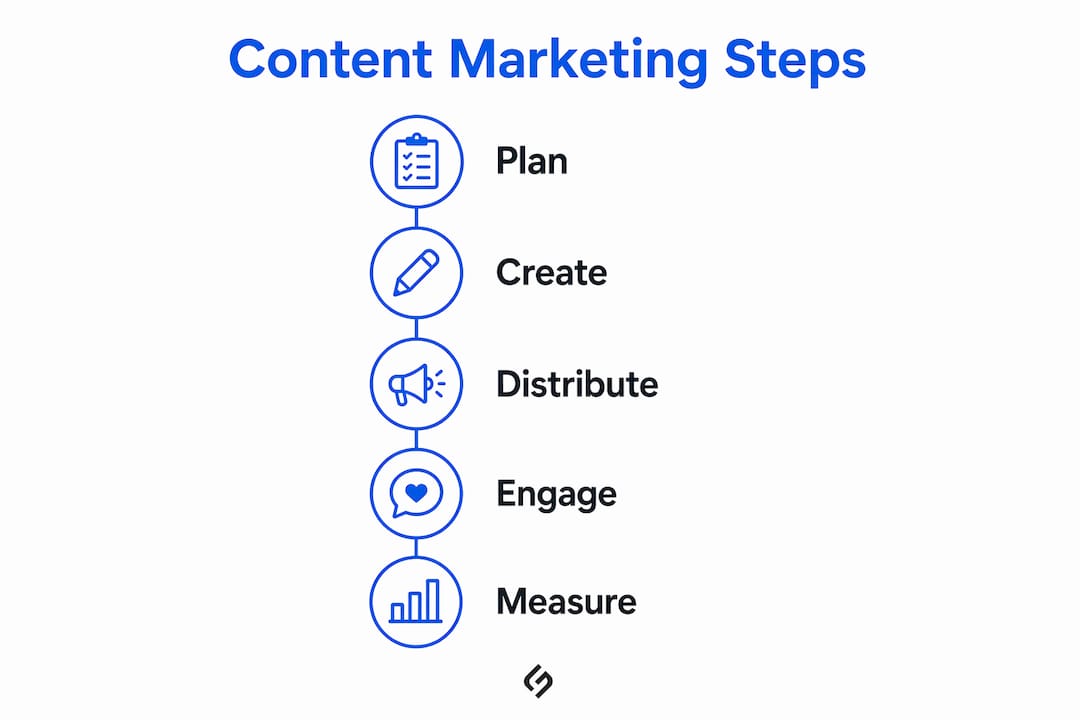
The practice spans a wide range of formats and digital marketing channels. Campaigns are typically multi-channel and personalized to reach audiences where they already spend time. A single topic can be repurposed across several formats to maximize reach without creating entirely new content each time.
Common content asset types include:
- Blog posts and articles: The backbone of most SEO-driven content programs, designed to rank for specific search queries.
- Videos: High-engagement assets suited for product demonstrations, tutorials, and brand storytelling.
- Email newsletters: Direct-to-inbox content that nurtures existing subscribers through the buyer journey.
- Podcasts: Long-form audio content that builds authority and loyalty among niche audiences.
- Infographics: Visual summaries that simplify complex data for quick consumption and social sharing.
- Ebooks and whitepapers: Gated assets that generate qualified leads in exchange for contact information.
- Case studies: Proof-of-concept content that converts prospects already evaluating your solution.
Each format serves a different stage of the buyer journey. Blog posts attract cold audiences through organic search. Case studies close warm prospects who need proof. Email campaigns keep existing customers engaged and reduce churn. Choosing the right format for the right stage is where most SMBs gain a real edge over competitors who publish without a plan.
How does content marketing build brand authority and customer trust?

Content marketing builds trust by consistently delivering value before asking for anything in return. Strategic content shifts the brand from reactive publisher to a recognized authority in its field. That shift takes time, but it compounds: each piece of content adds to a library that works for the business around the clock.
The buyer journey framework is the most practical tool for aligning content with trust-building. At the awareness stage, prospects need education, not sales pitches. At the consideration stage, they need comparisons and proof. At the decision stage, they need confidence-builders like testimonials and case studies. Matching content type to journey stage is what separates a content program that converts from one that just generates traffic.
Consistency matters as much as quality. A business that publishes one well-researched article per week outperforms one that publishes ten shallow posts and then goes silent for a month. Audiences and search algorithms both reward predictability. Building brand credibility through blogs requires sustained output, not sporadic bursts.
Pro Tip: Map every content asset you create to a specific buyer journey stage before you publish it. If you cannot answer “who is this for and what decision does it help them make,” the content is not ready.
What are proven content marketing strategies for small to medium businesses?
A purposeful content framework defines who the content is for, what problems it solves, and how it connects to business pipeline goals. Without that foundation, even high-quality content fails to generate measurable results. The eight-step content marketing lifecycle gives SMBs a repeatable process to follow.
- Set clear objectives. Define what success looks like: organic traffic growth, lead generation, customer retention, or brand awareness. Each goal requires a different content mix.
- Identify your audience. Build specific audience segments based on job role, industry, pain points, and buying stage. Generic content for everyone converts no one.
- Audit existing content. Catalog what you already have. Identify gaps, outdated pieces, and high-performers worth updating or expanding.
- Research your category. Understand what questions your audience asks, what topics competitors cover, and where genuine gaps exist that your expertise can fill.
- Build a content calendar. Schedule topics, formats, and publishing dates at least 60 days in advance. A calendar is not a strategy, but it makes strategy executable.
- Create and optimize assets. Produce content that answers specific questions with depth and accuracy. Apply SEO content best practices to every written piece.
- Distribute across channels. Publish on your website, share via email, and promote through social media. Repurpose long-form content into shorter formats for each channel.
- Measure and improve. Review performance data monthly. Cut what does not work, double down on what does, and refine your audience targeting continuously.
SMBs should balance blog SEO content with gated assets like ebooks. Blog posts drive organic traffic from cold audiences. Ebooks and guides capture contact information from prospects who are ready to engage more deeply. Running both in parallel creates a pipeline that feeds itself: organic traffic fills the top, gated assets qualify the middle, and nurture sequences close the bottom.
Audience segmentation is the step most SMBs skip. Publishing one article for “everyone” means it resonates with no one. Segment by industry, company size, or buying stage, then tailor the message accordingly. CRM tools that personalize customer journeys make this segmentation practical even for small teams without dedicated marketing staff.
How is content marketing effectiveness measured in 2026?
Measuring content marketing now requires tracking performance on two separate search surfaces: traditional organic search and AI-driven platforms. Effective measurement combines clicks, conversions, and keyword rankings from Google with citation frequency and sentiment tracking from platforms like ChatGPT and Perplexity. Treating these as separate disciplines is the key shift for 2026.
Traditional SEO metrics should be reviewed monthly. AI visibility indicators require a different cadence: run consistent prompt sets each month and track whether your brand appears, how often, and with what sentiment. Monitoring LLM visibility with fixed prompts over time reveals citation trends that single snapshots miss entirely.
Topical depth now matters more than backlink volume for AI citation. A brand that covers a subject thoroughly across multiple interconnected articles earns citations from AI platforms more reliably than one with a single high-authority page. This changes how SMBs should plan their content clusters.
| Metric category | Traditional SEO | AI/LLM visibility |
|---|---|---|
| Primary signal | Keyword rankings, organic clicks | Citation frequency in AI responses |
| Review cadence | Monthly | Monthly with fixed prompt sets |
| Sentiment tracking | Not applicable | Positive, neutral, or negative framing |
| Authority indicator | Backlinks and domain authority | Topical depth and content breadth |
| Conversion tracking | Goal completions, form fills | Prompt-to-site referral tracking |
Content marketing measurement must integrate both metric sets for a complete performance view. Businesses that track only Google rankings are missing a growing share of how their audience discovers them. AI-assisted search is not replacing traditional search yet, but it is adding a second scoreboard that rewards different behaviors.
Key Takeaways
Content marketing succeeds when every asset connects to a specific audience need, a defined buyer journey stage, and a measurable business objective.
| Point | Details |
|---|---|
| Definition clarity | Content marketing is an inbound strategy that attracts audiences through value, not advertising. |
| Format selection | Match content type to buyer journey stage: blogs for awareness, case studies for decisions. |
| Eight-step lifecycle | Follow objective setting through measurement to build a repeatable, improving content program. |
| Dual measurement | Track both traditional SEO metrics monthly and AI citation frequency with fixed prompt sets. |
| Topical depth wins | Deep, interconnected content clusters earn AI citations more reliably than isolated high-authority pages. |
Why most SMBs confuse a calendar with a strategy
The most common mistake I see SMBs make is treating an editorial calendar as a content strategy. A calendar tells you when to publish. A strategy tells you why, for whom, and toward what business outcome. Those are completely different documents, and confusing them is why most content programs plateau after six months.
Real brand authority requires knowing what your business genuinely excels at and communicating that expertise clearly to both human readers and AI systems. Brand authority in the AI era is not built by publishing frequently. It is built by publishing with precision on topics where your knowledge is demonstrably deeper than the generic content already ranking.
The SMBs I have seen succeed with content marketing all started the same way: they listed the three to five topics where their team had genuine, hard-won expertise. Then they built content clusters around those topics before touching anything else. That focus is uncomfortable for businesses that want to cover everything, but it is the only approach that produces reliable results in a crowded content environment.
Reactive content, publishing whatever feels timely or trending, creates a fragmented library that serves no audience well. The buyer journey hijacking problem is real: if your content does not guide prospects deliberately from awareness to decision, a competitor’s content will. Strategy is what keeps your audience moving toward your solution instead of someone else’s.
— Vadim
How Solution4guru helps SMBs build effective digital marketing programs
Content marketing does not operate in isolation. It connects directly to SEO, email, social media, and conversion rate performance across your entire digital presence. SMBs that treat content as one piece of an integrated digital marketing strategy consistently outperform those running content as a standalone effort.
Solution4guru works with small and medium-sized businesses to build digital marketing programs that connect content creation to measurable business outcomes. From SEO and content planning to web development and analytics integration, the team at Solution4guru provides the technical and strategic foundation that makes content marketing produce real pipeline results. If your business is ready to move from publishing to performing, Solution4guru offers a free consultation to map out the right approach for your goals and industry.
FAQ
What is the simplest definition of content marketing?
Content marketing is the practice of creating and distributing valuable, relevant content to attract and retain a defined audience, with the goal of driving profitable customer action rather than direct advertising.
How does content marketing differ from traditional marketing?
Traditional marketing interrupts audiences with ads. Content marketing earns attention by solving problems first, building trust before asking for a purchase.
What content types work best for small businesses?
Blog posts drive organic traffic, email newsletters nurture existing contacts, and gated assets like ebooks generate qualified leads. Starting with one format done well beats spreading effort across all formats at once.
How long does content marketing take to show results?
Content marketing is a long-term strategy. Organic search results typically take three to six months to build, while brand authority and AI citation presence develop over a longer sustained period of consistent, high-quality publishing.
What is the biggest mistake in content marketing strategy?
Confusing an editorial calendar with a strategy is the most common error. A true content strategy defines the audience, the problems being solved, and the pipeline stage each asset targets, not just the publishing schedule.