Why Branding Is Important for Business Growth

TL;DR:
- Strong branding builds trust and loyalty, enabling small businesses to command higher prices and stabilize revenue.
- Consistent brand identity enhances marketing effectiveness, reducing customer acquisition costs and differentiation challenges.
Branding is defined as the strategic practice of shaping how customers perceive a business through trust, recognition, and emotional connection. It goes far beyond a logo or color palette. Strong branding is an intangible asset that drives purchasing decisions, commands premium pricing, and creates loyalty that sustains a business through market downturns. For small and medium-sized business owners, understanding why branding is important is not optional. It is the foundation on which every marketing effort, sales conversation, and customer relationship is built.
Why branding is important for customer trust and sales
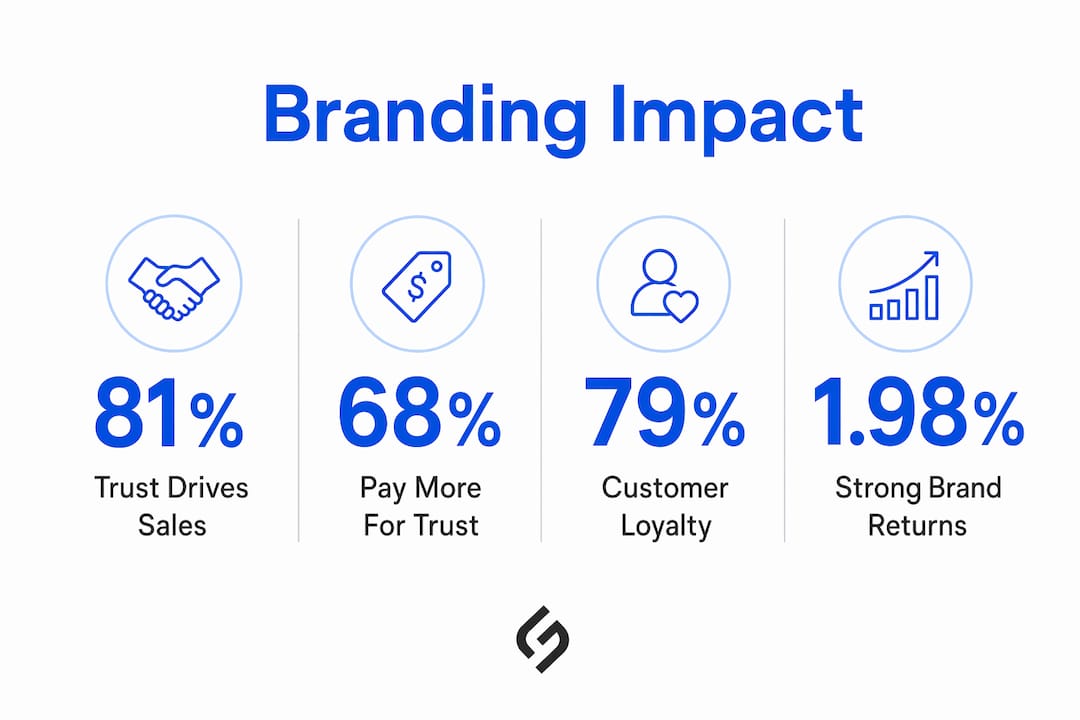
Trust is the single most powerful driver of purchase decisions. 81% of consumers need to trust a brand before they will buy from it. That figure means most potential customers are already evaluating your credibility before they ever read your product description or pricing page.
Trusted brands also command higher prices. 68% of consumers are willing to pay more for a brand they trust. This is the pricing power that separates businesses competing on value from those trapped in a race to the bottom on price.
Branding also functions as a mental shortcut. When a customer recognizes your brand, they skip the research phase and move directly toward purchase. That shortcut reduces your cost of acquisition and accelerates the sales cycle. Consistent branding across every touchpoint, from your website to your email signature, reinforces that recognition every time a customer encounters your business.
The emotional dimension matters just as much as the functional one. 79% of shoppers buy from brands whose values align with their own. Customers are not just buying a product. They are choosing a business that reflects who they are or who they want to be.
- Trust precedes purchase. Customers research your brand before they contact you. Your brand must communicate credibility at every stage.
- Value alignment drives loyalty. Customers who share your values return more often and refer others.
- Recognition reduces friction. A familiar brand removes hesitation and speeds up the decision to buy.
- Premium pricing requires trust. You cannot charge above-market rates without a brand that justifies the difference.
Pro Tip: Audit your brand from the customer’s perspective. Search your own business name, read your website homepage, and check your social profiles. Ask yourself whether a first-time visitor would immediately understand what you do, who you serve, and why you are trustworthy.
How does branding improve marketing effectiveness?
A recognized brand makes every marketing campaign cheaper and more effective. Brand awareness leads to measurable marketing effectiveness and differentiation across channels. When your audience already knows your name, your ads require less explanation and your content earns more engagement.

Brand personality and visual identity are the tools that make differentiation possible. Two businesses can sell identical products at identical prices. The one with a clear, consistent brand identity will attract more customers. Buyers use brand signals, including tone of voice, visual style, and perceived values, to decide which business feels right for them.
Consistency is the mechanism that makes brand identity work. A business that uses the same tone, colors, and messaging across its website, social media, and email campaigns builds recognition faster than one that shifts its style with every campaign. Effective brand identity includes tone, design, mission, and values communicated consistently across all channels.
The table below shows how branding affects marketing performance across key dimensions:
| Marketing dimension | Without strong branding | With strong branding |
|---|---|---|
| Ad recognition | Low; requires heavy explanation | High; audience connects quickly |
| Content engagement | Inconsistent; no clear voice | Consistent; audience knows what to expect |
| Customer acquisition cost | Higher; trust must be built from scratch | Lower; recognition reduces friction |
| Competitive differentiation | Weak; price becomes the only lever | Strong; brand identity creates preference |
Pro Tip: Build a one-page brand guide that defines your logo usage, primary colors, font choices, and tone of voice. Share it with every team member and contractor who creates content for your business. Consistency at this level compounds over time.
What is the strategic business value of strong branding?
Branding is a primary intangible asset. High brand equity leads to improved cash flow and profitability over the long term. Physical equipment depreciates. A strong brand appreciates as it accumulates recognition, loyalty, and market trust.
The financial evidence is direct. Strong-brand portfolios yielded average monthly returns of 1.98% compared to 1.34% for benchmark portfolios. That gap reflects the market’s recognition that brand equity translates into more predictable revenue and lower investor risk.
Branding also acts as a financial buffer during economic downturns. Strong brands create financial shock absorbers, retaining loyal customers when competitors lose theirs. Loyal customers reduce demand volatility. That stability matters enormously to investors, lenders, and partners evaluating your business.
The internal value of branding is equally significant. Strong brands align employees under a unified mission, which improves culture, recruitment, and organizational resilience. Employees who understand and believe in a brand’s values make better decisions, communicate more consistently with customers, and stay longer. A clear brand also attracts better talent. Candidates choose employers whose identity and values resonate with them, just as customers do.
| Strategic benefit | Business impact |
|---|---|
| Brand equity as an asset | Improves cash flow, profitability, and company valuation |
| Financial resilience | Loyal customers stabilize revenue during market downturns |
| Employee alignment | Shared brand values improve culture and reduce turnover |
| Talent attraction | Strong brand identity draws candidates who share company values |
| Investor confidence | Recognized brands reduce perceived risk for investors and lenders |
How can small and medium businesses build branding for growth?
Small and medium businesses often assume branding is a luxury reserved for large corporations with large budgets. That assumption is wrong. Branding aligns functional benefits with emotional values, creating an identity that competitors find hard to replicate, regardless of company size.
The process of building a brand for an SME follows a clear sequence:
- Define your mission and values. Write a one-sentence mission statement that explains what you do, who you serve, and why it matters. This becomes the filter for every brand decision you make.
- Identify your ideal customer. Describe the specific person most likely to buy from you. Understand their goals, frustrations, and the language they use. Your brand voice should speak directly to that person.
- Develop your visual identity. Choose a logo, a primary color palette, and two fonts. Apply them consistently across your website, social media, and printed materials. Visual consistency builds recognition faster than any single campaign.
- Define your brand voice. Decide whether your tone is formal or conversational, technical or plain-spoken, serious or light. Write three to five sample sentences that capture your voice. Use them as a reference when creating content.
- Align your team. Share your brand guide with every person who communicates on behalf of your business. Internal alignment is what makes external consistency possible.
- Audit your customer touchpoints. Review your website, email templates, social profiles, and any physical materials. Remove anything that contradicts your brand identity.
Authenticity is the factor that separates brands customers trust from those they ignore. 73% of consumers say trust rises when brands align with their cultural values. For an SME, authenticity is a competitive advantage. You can tell a genuine story about why you started your business, who you serve, and what you stand for. Large corporations often struggle to do that convincingly.
Sustainable growth for an SME depends on a brand that customers recognize, trust, and recommend. You can read more about SME growth strategies that connect branding to long-term market positioning.
Key Takeaways
Strong branding is the single most reliable driver of customer trust, pricing power, and long-term business resilience for small and medium-sized businesses.
| Point | Details |
|---|---|
| Trust drives purchase decisions | 81% of consumers must trust a brand before buying; trust is built through consistent identity. |
| Branding commands premium pricing | 68% of consumers pay more for trusted brands, removing price as the only competitive lever. |
| Brand equity is a financial asset | Strong brands outperform market benchmarks and stabilize revenue during economic downturns. |
| Internal alignment amplifies brand strength | Employees who share brand values communicate more consistently and stay longer. |
| Authenticity accelerates SME growth | Value-aligned branding builds loyalty faster than any paid campaign for small businesses. |
Branding is a long-term asset, not a line item
After working with dozens of small and medium-sized businesses, I have noticed a consistent pattern. The owners who treat branding as a one-time expense, a logo design or a website refresh, rarely see the results they expect. The owners who treat branding as an ongoing investment in how their business is perceived, internally and externally, build something that compounds over time.
The most common mistake I see is inconsistency. A business will invest in a professional logo, then use a completely different tone on social media, a different color scheme in their email campaigns, and a generic template on their invoices. Customers notice the disconnect, even when they cannot articulate it. It erodes the trust that branding is supposed to build.
The second mistake is underestimating the internal value of branding. A clear brand identity tells your employees what decisions to make when you are not in the room. It tells them how to handle a difficult customer, how to describe your services, and what kind of work to say no to. That clarity is worth more than most business owners realize.
Authentic brand storytelling is the tool that makes all of this work. Your origin story, your values, and your customer relationships are things no competitor can copy. The businesses I have seen grow most consistently are the ones that tell that story clearly and repeat it without apology across every channel.
How Solution For guru helps businesses build a brand that performs
Building a brand that earns trust and drives growth requires more than a good logo. It requires a digital presence that communicates your identity clearly, consistently, and to the right audience.
Solution4guru works with small and medium-sized businesses to build the digital foundation that makes branding effective. From digital marketing for startups to web development and UX design, the team at Solution4guru connects brand strategy to the platforms where your customers actually find you. A strong brand without a strong website is a missed opportunity. Understanding web development basics is the first step toward making sure your online presence reflects the brand you have worked to build. Reach out to Solution4guru for a free consultation and put your brand to work.
FAQ
Branding builds the trust that drives purchasing decisions. For small businesses, a clear and consistent brand identity creates credibility that levels the playing field against larger competitors.
Customers who trust a brand and share its values return more often and refer others. Research shows 79% of shoppers buy from brands whose values align with their own, making value alignment a direct driver of loyalty.
Brand equity is the financial and reputational value a brand adds to a business beyond its physical assets. High brand equity improves cash flow, supports premium pricing, and stabilizes revenue during economic downturns.
A recognized brand reduces the cost of customer acquisition because audiences require less persuasion. Consistent brand identity across channels builds recognition that makes every campaign more effective.
Strong brands attract candidates who share company values, which improves hiring quality and reduces turnover. Internal brand alignment also helps existing employees make better decisions and communicate more consistently with customers.