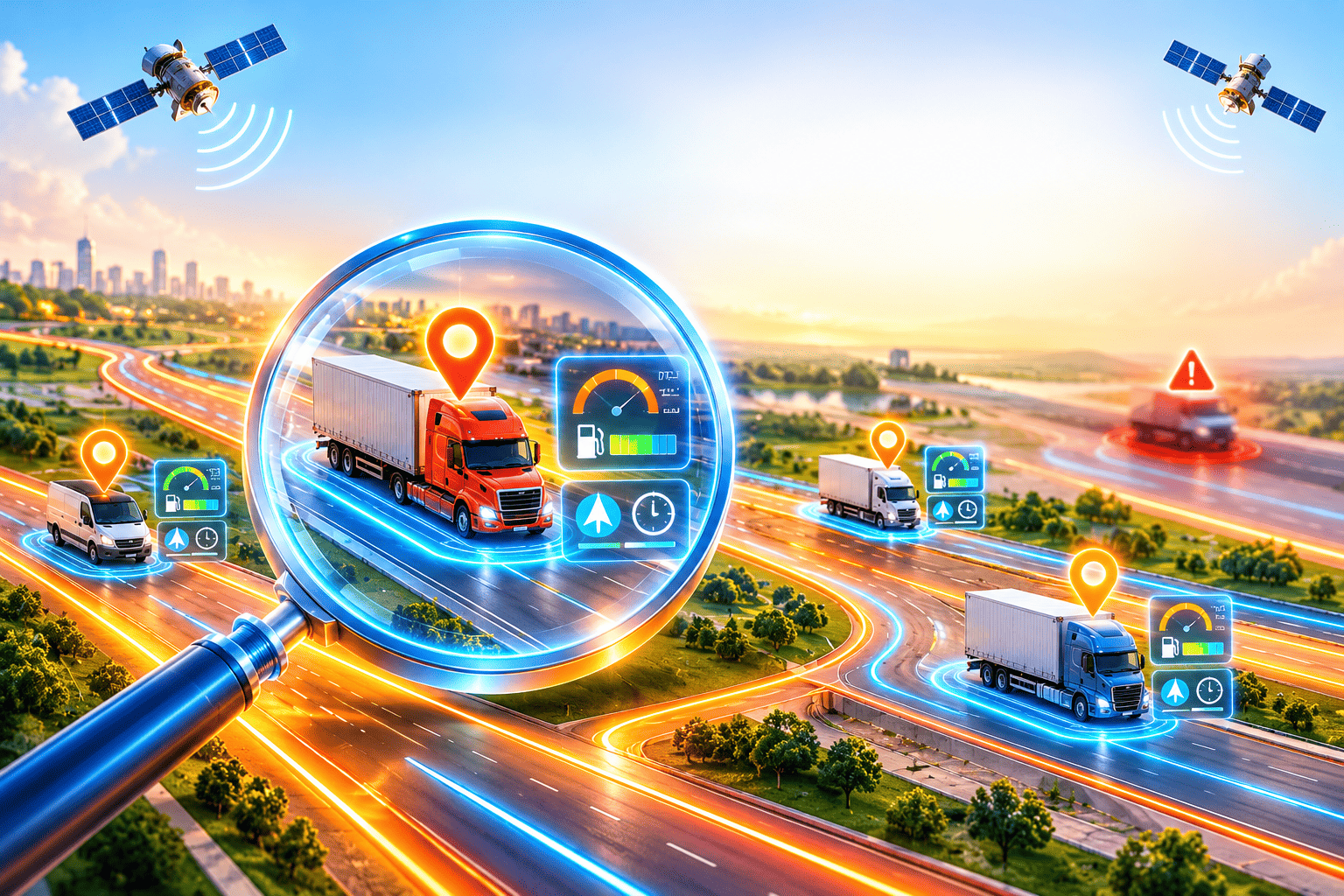
How Does Motive Real-Time Fleet Tracking Work?
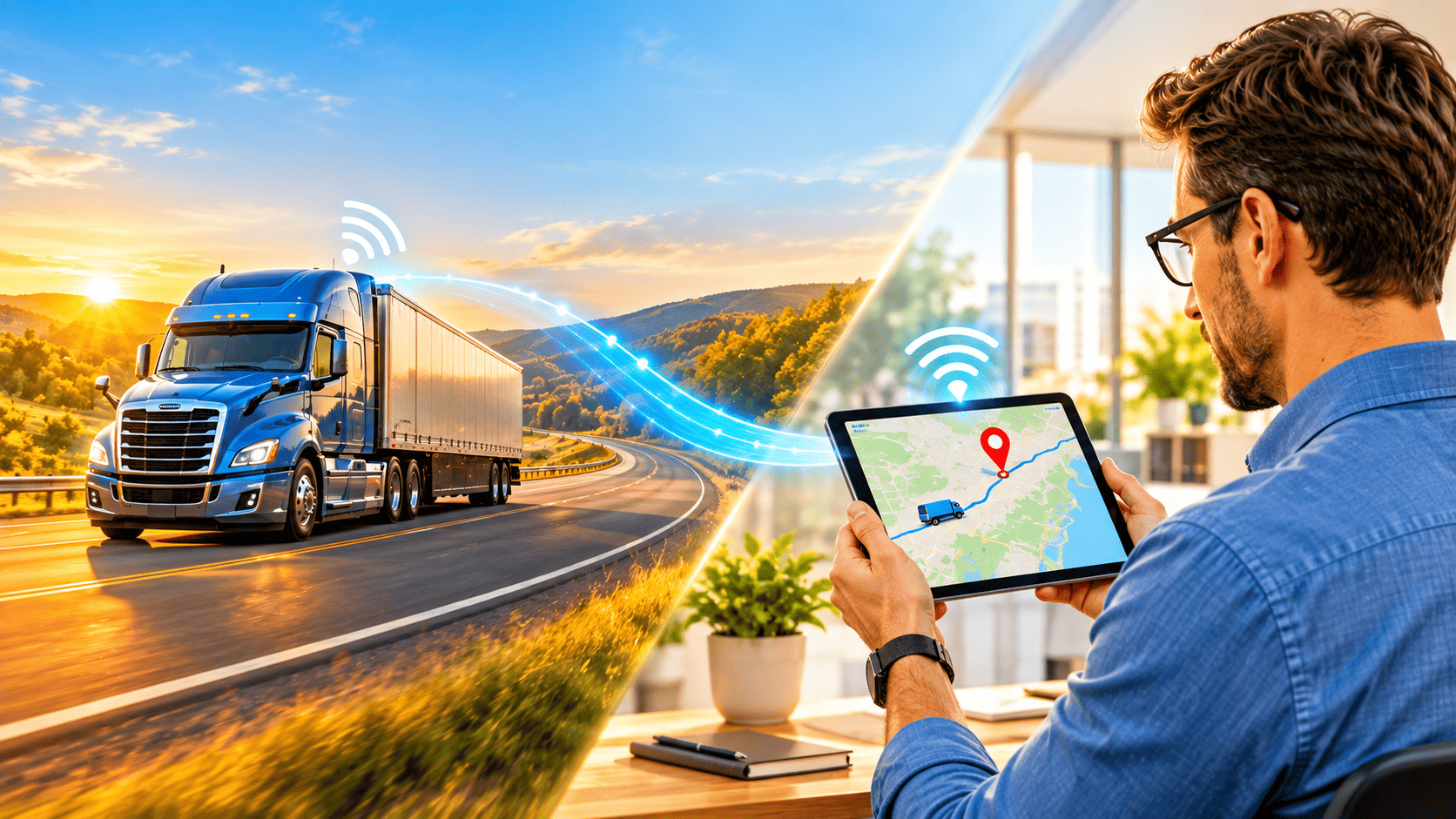
Every dispatcher needs one answer fast: where is my truck right now? Motive real-time fleet tracking answers that question within seconds. The platform pairs a cellular GPS device with a cloud dashboard, so managers see live vehicle positions without a single check-in call. This guide explains how the technology works, from the satellite signal to the map on your screen.
Table of contents
Quick Summary
Motive tracks vehicles with a GPS chip inside its Vehicle Gateway. The device sends location, speed, direction, and fault codes over a built-in cellular connection to the Motive cloud. Managers then watch the data on the Fleet Dashboard or the Fleet App. Update speed: Vehicle locations refresh as fast as every two seconds while the vehicle moves.Slowest refresh: Motive reports a 30-second maximum interval in areas with weak network coverage.Compliance: The same gateway works as an FMCSA-registered electronic logging device (ELD).Assets: The Asset Gateway Mini tracks trailers and equipment without an engine.Automation: Geofences, alerts, and dynamic ETAs run on top of the live location feed.

Motive – GPS Fleet Tracking System & Solutions sits at the center of this workflow. It combines hardware, software, and compliance tools in one platform. This article explains how the system turns raw satellite signals into live fleet visibility and what fleets gain in return.
What Is Real-Time Fleet Tracking?
How does GPS fleet tracking work in general?
GPS fleet tracking uses satellite positioning to monitor where vehicles go. Each vehicle carries a device with a GPS receiver. The receiver listens to signals from several satellites, measures how long each signal takes to arrive, and calculates its own position. Motive explains in its public guide that the United States operates 31 GPS satellites within the broader Global Navigation Satellite Systems that serve the international community.
A tracking system then adds communication. The device transmits its coordinates, along with speed and direction, to a central server. Managers open a web dashboard or mobile app and see each vehicle as a moving icon on a map. Therefore, the “real-time” part depends on two things: how often the device calculates a position, and how quickly it sends that position onward.
Why does real-time visibility matter to fleet managers?
Delayed location data creates guesswork. A dispatcher who cannot see the nearest truck often assigns the wrong one. Likewise, a customer who asks for an arrival time receives a vague estimate. Live data removes both problems. It also supports theft recovery, incident review, and accurate billing because the system keeps a searchable history of where each vehicle traveled.
What Hardware Powers Motive Real-Time Tracking?
What does the Motive Vehicle Gateway do?
The Motive Vehicle Gateway is the core in-cab device. According to the Motive Help Center, it connects drivers, vehicles, and the platform, and it continuously syncs driver and fleet data with the Driver App and the Dashboard. The unit includes a GPS chip, built-in cellular connectivity, and an in-cab Wi-Fi hotspot. It also offers installation options for both light-duty and heavy-duty vehicles.
Motive – GPS Fleet Tracking System & Solutions designs the gateway to work independently of the driver. Motive states that the cellular-enabled device keeps sending GPS and vehicle data to the Fleet Dashboard even when the driver has not connected to the Driver App. As a result, dispatchers still see a parked or moving truck when the driver forgets to log in.
How does the Asset Gateway Mini track trailers and equipment?
Trailers, generators, and construction equipment have no engine to power a standard gateway. The Asset Gateway Mini fills that gap. Motive describes it as a GPS tracker for trailers, equipment, and other assets, and it runs on battery or cable power. When GPS signals drop, the device pings for location and relies on cell tower and Bluetooth signals instead. Furthermore, Motive notes that the Asset Gateways work as fully independent products, with or without a Vehicle Gateway.
Can drivers share location through the Driver App alone?
Yes. Drivers who use the Motive Driver App without a Vehicle Gateway send location from their smartphones. Motive supports Android 10.0 and above and iOS 12.0 and above. This option helps small crews and mixed fleets, though a hardwired gateway delivers the fastest, most consistent updates.
Choosing the right device depends on what you track. The table compares the three tracking options side by side.
| Option | Best For | Power Source | Key Strength |
| Vehicle Gateway | Trucks, vans, and other powered vehicles | Vehicle power | Fastest updates, ELD compliance, in-cab Wi-Fi hotspot |
| Asset Gateway Mini | Trailers, equipment, and other assets | Battery or cable | Cell tower and Bluetooth fallback when GPS drops |
| Driver App only | Small crews and mixed fleets | Driver smartphone | No hardware to install |
How Does Location Data Travel From the Vehicle to the Dashboard?
The journey from satellite to screen follows a repeatable path. Each stage happens in seconds, which explains why the map feels live.
- Positioning: The GPS chip inside the gateway receives satellite signals and calculates latitude and longitude.
- Vehicle data capture: The gateway reads engine and telematics information, including speed, direction, and fault codes.
- Cellular transmission: The built-in cellular modem uploads the package to the Motive cloud.
- Cloud processing: The platform stores the record, matches it to the correct driver and vehicle, and applies rules such as geofences.
- Display and alerts: The Fleet Dashboard and Fleet App refresh the map, and the system triggers any matching notifications.
Motive – GPS Fleet Tracking System & Solutions also stores data locally on its devices as a backup. Motive says its durable hardware works in extreme weather and carries a five-year warranty. Consequently, a brief network outage does not erase the trail, because the device holds the breadcrumbs until it reconnects.
Which telematics signals travel with the GPS position?
Motive reports that its platform can collect and analyze more than 200 telematics signals. Location is only the starting point. Fuel use, idling, harsh driving events, and diagnostic fault codes all travel through the same pipeline. Because everything lands in one interface, managers avoid switching between separate tools to piece together a single trip.
How Often Does Motive Update Vehicle Locations?
Update frequency determines how “real-time” a tracker truly feels. Motive publishes several figures that depend on the device and the conditions. The table below summarizes them.
| Device or Condition | Reported Update Interval | What It Means in Practice |
| Vehicle Gateway, vehicle in motion | As fast as every 2 seconds | The map icon follows the truck smoothly along the road. |
| Vehicle Gateway, typical operation | Typically every 1 to 3 seconds | Dispatchers see near-continuous movement. |
| Vehicle Gateway, weak network area | Slowest interval of 30 seconds | The icon jumps, but the position stays current. |
| Asset Gateway, cable powered | About every 1 minute | Trailers update often enough for yard and route decisions. |
| Asset Gateway, battery-powered | Varies by settings and power source | Check Motive’s current documentation for exact intervals. |
Managers should note one more detail. Motive states that live GPS vehicle tracking and telematics updates begin in its Starter plan. Therefore, fleets do not need a premium tier just to reach the fastest refresh rate. To see updates at that pace, a manager selects Live View from the Fleet View Map.
What Can Managers See on the Fleet Dashboard and Fleet App?

How does the Fleet View Map present live data?
The Fleet View Map displays every vehicle, driver, and tracked asset in one place. Motive automatically pairs vehicles, assets, and drivers, so a truck and its trailer travel together on the map. Managers can also layer real-time traffic and weather overlays onto the view, helping them warn drivers before delays spread.
What is Vehicle Follow Mode and location history?
Vehicle Follow Mode keeps the map centered on a chosen vehicle as it moves. That feature helps dispatchers monitor a high-priority delivery or a vehicle that left its route. In addition, the platform keeps historical records. Motive notes that managers can review location history for the period a driver used the app and for the time the gateway stayed installed in the vehicle.
Can managers track the fleet from a phone?
Yes. The Motive Fleet App, available on Google Play and the Apple App Store, gives managers live tracking, notifications, and reporting on mobile devices. Motive – GPS Fleet Tracking System & Solutions lets supervisors answer customer calls from the field using the same map they would see at a desk.
How Does Motive Tracking Support ELD Compliance?
What do FMCSA rules require from location data?
The Federal Motor Carrier Safety Administration (FMCSA) published its final ELD rule in December 2015, and the mandate took effect in December 2017. Under the rule, an ELD records location when the vehicle moves at 60-minute intervals. It also records location when the engine starts or stops, when the duty status changes, and when the driver indicates personal use or a yard move. The location must be within one mile of the truck’s actual position, and the log must show the approximate distance and direction from an identifiable city or town.
Does GPS alone satisfy the ELD mandate?
No. FMCSA guidance states that a GPS cannot substitute for the engine control module data that an ELD must capture. The device must connect to the vehicle engine to accurately log driving time. The Motive Vehicle Gateway meets that requirement because it plugs into the vehicle and also carries the GPS chip. Motive describes the unit as an FMCSA-registered ELD for regulated fleets in the US and Canada.
This dual role matters for budgets. One device records hours of service, tracks live location, and feeds telematics to the dashboard. Motive – GPS Fleet Tracking System & Solutions therefore reduces the number of boxes in the cab and keeps compliance and location data in sync.
How Do Geofencing, Alerts, and Dynamic ETAs Use Live Location?
Live coordinates become more valuable when software acts on them. Motive highlights three location-based automations on its tracking pages: geofencing, automated vehicle pairing, and dynamic ETAs.
- Geofencing: Managers draw virtual boundaries around yards, job sites, or customer locations. The platform logs entries and exits, and it can alert managers when an asset leaves a secured area.
- Automated vehicle pairing: The system links vehicles, trailers, and drivers without manual entry, which keeps dispatch records clean.
- Dynamic ETAs: The platform recalculates arrival estimates as conditions change, so dispatchers update customers with confidence.
- Theft prevention: Live and historical location data helps fleets spot unauthorized movement and recover equipment.
Geofences also support billing accuracy. For example, a fleet can prove exactly when a truck arrived at a customer site and when it left. That evidence quickly resolves disputes about wait times and service windows.
What Happens When GPS or Cellular Coverage Drops?
No tracking system works perfectly everywhere. Tunnels, dense urban canyons, and remote rural roads can weaken satellite or cellular signals. Motive addresses this in several ways. The gateway stores data locally, so it uploads the missed breadcrumbs once connectivity returns. The slowest reported refresh interval in weak coverage stays at 30 seconds, according to Motive. Meanwhile, the Asset Gateway Mini switches to cell tower and Bluetooth signals when GPS becomes unavailable.
Managers should still plan for gaps. They should place gateways according to the installation guide, test coverage along common routes, and review location history for missing segments. Motive – GPS Fleet Tracking System & Solutions supports this process with help articles and dedicated account support for installation questions.
What Business Results Can Real-Time Tracking Deliver?

Motive reports that customers spend 48 percent less time tracking vehicles and assets, and 25 percent less time assigning work. Those figures come from the company’s own marketing materials, so fleets should treat them as vendor claims and validate them in a pilot. Independent evidence also supports the broader value of telematics. G2, for example, awarded Motive a leader position across segments in its Summer reports for fleet management, according to Motive.
| Operational Area | How Live Tracking Helps | Typical Outcome |
| Dispatch | Dispatchers see the closest available vehicle and assign it. | Faster response to ad-hoc loads |
| Customer service | Teams share live location and dynamic ETAs. | Fewer “where is my driver?” calls |
| Security | Geofences and location history flag unauthorized movement. | Quicker theft recovery |
| Billing | Arrival and departure timestamps document service. | Fewer invoice disputes |
| Asset utilization | Asset Gateways show where equipment sits and how teams use it. | Less equipment sitting idle |
How Should Fleets Handle Driver Privacy With Live Tracking?
Constant location data raises fair questions from drivers. FMCSA rules address part of that concern. When a driver records personal conveyance, the ELD reduces location precision to protect privacy, and the regulation limits what ordinary log entries reveal. Fleet managers should still set clear internal policies.
- Explain the purpose: Tell drivers that tracking supports safety, compliance, and dispatch, not constant surveillance.
- Define off-duty rules: Spell out when the company reviews location data and when it does not.
- Limit access: Give dashboard permissions only to the people who need them.
- Share the benefits: Point out that location history often protects drivers during disputes, as the Cordy Environmental example below shows.
Teams that communicate openly usually see smoother adoption. Motive – GPS Fleet Tracking System & Solutions supports that approach because drivers can review their own records in the Driver App, which builds trust in the data.
Which Types of Fleets Benefit Most From Real-Time Tracking?

Motive lists several applications for GPS tracking, including taxi services, commercial fleets, freight trucks, and waste management. The same logic extends to any business that moves people, goods, or equipment between locations.
- Freight and trucking carriers: Dispatchers match loads to the closest truck and share live ETAs with shippers.
- Construction and field services: Managers locate trailers, generators, and heavy equipment across job sites.
- Waste and utility fleets: Supervisors verify route completion and service stops.
- Local delivery businesses: Teams update customers quickly when traffic changes the plan.
Fleets with mixed assets gain the most, because one platform covers both powered vehicles and unpowered equipment.
What Do Case Studies Reveal About Motive Real-Time Tracking?
Real fleets give the clearest picture of how tracking performs. The following case studies come from Motive‘s published customer stories. Each company describes its own results, so readers should weigh them accordingly. Nevertheless, the stories share a pattern: fleets that replaced slow, fragmented tracking with one live platform gained faster dispatch, better evidence in disputes, and savings on tools and repairs. The four examples below cover a freight carrier, a materials supplier, a tree services company, and an environmental services firm, which shows how widely the technology applies.
How did Mohawk Materials replace slow location refreshes?
Mohawk Materials previously used PeopleNet, which refreshed locations every 30 minutes and required separate tools. The company switched to Motive – GPS Fleet Tracking System & Solutions, which consolidated tracking, safety, and compliance on one platform. Mohawk received GPS updates as fast as every two seconds, eliminating a separate $500 per month tracking service. The published case study also reports $6,000 per month in savings.
How did Roadco Transportation recover a stolen truck?
Roadco, a Chicago-area general freight carrier with 50 trucks, struggled with unreliable software from a previous provider. After switching to Motive, dispatchers sent the closest truck to ad hoc loads. The carrier also recovered a stolen vehicle in about four hours, and it used fault codes to avoid costly roadside repairs, including $3,000 technician calls.
How did Rancho Tree Services improve asset utilization?
Rancho Tree Services used GPS, Asset Gateways, Beacons, and geofencing to see where specialized equipment sat and how crews used it. The company reports 93 percent asset utilization and $2 million saved in litigation fees. Rancho also reports a 50 percent time savings with Motive Analytics.
How did Cordy Environmental protect its drivers?
Cordy Environmental deployed the Vehicle Gateway with geofencing to capture real-time location and location history. When customers or others accused employees of wrongdoing, the records proved where drivers actually were. Cordy reports multiple driver exonerations and streamlined billing as a result.
How Do You Get Started With Motive Real-Time Tracking?
Most fleets follow a simple rollout path. Planning each stage prevents delays and helps drivers adjust to the change.
- Audit the fleet: List every vehicle, trailer, and piece of equipment that needs tracking, and note which ones fall under the ELD mandate.
- Choose the hardware: Pick Vehicle Gateways for powered vehicles and Asset Gateway Minis for trailers and equipment.
- Install the devices: Follow the Help Center installation guide for each vehicle type, and pair each gateway with its vehicle.
- Train drivers and dispatchers: Show drivers the Driver App, and teach dispatchers the Fleet View Map, Live View, and Vehicle Follow Mode.
- Set up rules: Create geofences, alert thresholds, and reports before the first full week of operation.
- Review and refine: Compare dashboard data with your baseline, then adjust alerts and workflows monthly.
Software rollout often takes more than hardware. Teams must connect the platform to dispatch, accounting, and compliance workflows. That work benefits from an implementation partner who knows both fleet operations and business systems.
The Bottom Line
Motive real-time fleet tracking works through a straightforward chain. A GPS chip calculates position, a cellular gateway transmits it, the cloud processes it, and dashboards display it within seconds. Updates arrive as fast as every two seconds, and the system keeps a history that supports compliance, security, and billing. The Asset Gateway Mini extends the same visibility to trailers and equipment.
Motive – GPS Fleet Tracking System & Solutions also unifies tracking with ELD logging, telematics, and automation in a single platform. Fleets that want live visibility should pilot the system on a small group of vehicles, measure results against their own baseline, and then scale. With a capable implementation partner such as Solution for Guru, the rollout moves faster and delivers value sooner.
Frequently Asked
Motive reports updates as fast as every two seconds while a vehicle moves, and it typically collects data every one to three seconds. In areas with weak network connectivity, the slowest interval reaches 30 seconds.
No. The cellular-enabled Vehicle Gateway keeps sending GPS and vehicle data to the Fleet Dashboard even when the driver has not connected to the Driver App. Drivers without a gateway can still share location through the app on a compatible smartphone.
Yes. The Asset Gateway Mini tracks trailers, equipment, and other assets on battery or cable power. It works independently of the Vehicle Gateway, and it falls back to cell tower and Bluetooth signals when GPS is unavailable.
What Are the Benefits of Cooperating With Solution for Guru?
Solution for Guru is a consultancy that helps businesses select, configure, and integrate CRM and business software. The team works with companies that want to extract more value from platforms such as fleet management, CRM, accounting, and IT service tools. A partner like this closes the gap between buying software and using it well.
| Common Implementation Gap | How Solution for Guru Helps |
| Unclear requirements before purchase | Consultants map your processes and recommend fitting configurations. |
| Slow or inconsistent rollout | The team plans phased deployment and keeps stakeholders aligned. |
| Disconnected systems | Specialists integrate tracking data with CRM, accounting, and dispatch tools. |
| Low user adoption | Trainers show drivers and managers how to use the features that matter. |
| Unused features after launch | Advisors review usage and suggest improvements over time. |
For fleet operators, this support has practical value. A consultant can connect Motive – GPS Fleet Tracking System & Solutions to existing business systems, so location data informs customer communication and billing. To explore a tailored plan, visit Solution for Guru and describe your fleet and software goals.
Recommended
- How does Motive’s real-time visibility improve fleet operations?
- How Do Delivery Companies Improve Routes With Motive?
- Verizon Connect for Landscaping Companies
- Verizon Connect Mobile App Overview
- How Does Motive Support Business Growth?
- Why Do Construction Companies Choose Motive?
- Driver Safety Monitoring with Azuga: How Can Fleets Reduce Risk and Build Safer Habits?
- Benefits of Using Samsara for Fleet Management
- How Verizon Connect Helps Reduce Insurance Premiums
- How Motive Helps Reduce Insurance Costs
- How Verizon Connect Improves Fleet Productivity
- How Motive Detects Distracted Driving
- Managing Mixed Fleets with Verizon Connect
- How Verizon Connect Improves Driver Accountability
- How Motive Helps Schedule Preventive Maintenance
- How Samsara Improves Fleet Productivity
- How Fleet Managers Use Motive for Compliance Reporting
- How Motive Improves Dispatcher Efficiency
- How Motive Helps Reduce Fleet Operating Costs