Traditional CRM vs Social CRM: Which Approach Wins in 2026?
Customer relationships have fundamentally changed. Not long ago, businesses managed every customer interaction through phone calls, emails, and in-person meetings — structured, predictable channels that fed neatly into a database. Today, customers tweet about their frustrations, post questions in Facebook comments, and share purchase experiences on Instagram before a support ticket ever gets filed.
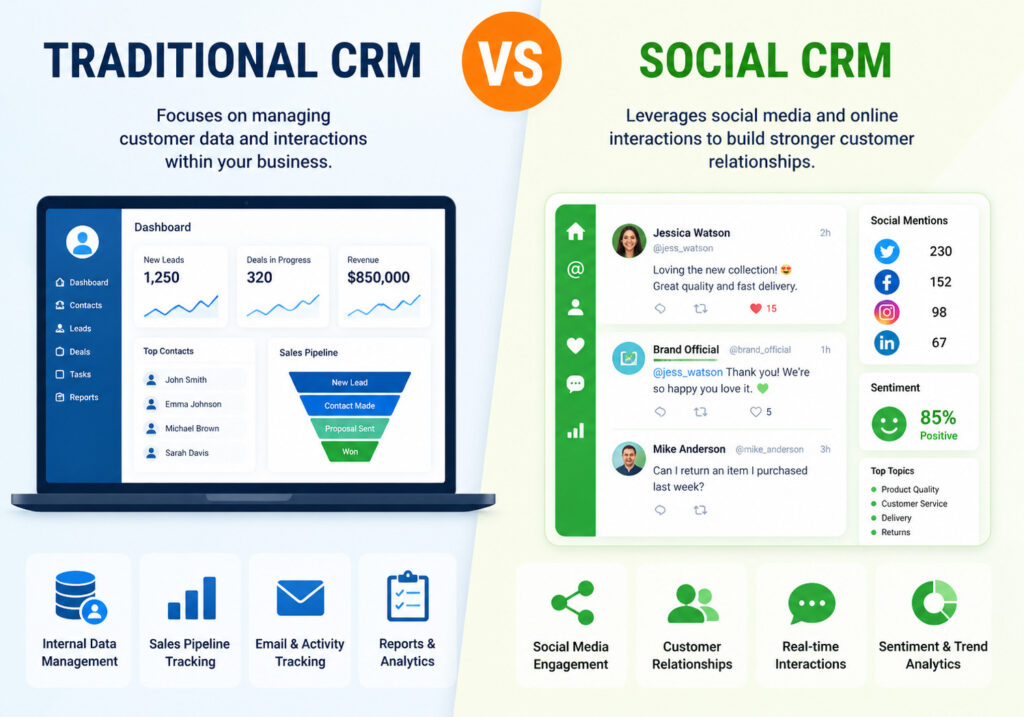
This shift has created a decisive split in the CRM world: traditional CRM — built for structured data management and internal process optimization — versus social CRM, which extends relationship management into the real-time, public, and conversational world of social media. Understanding this distinction isn’t just academic. The approach your business chooses directly shapes how you capture leads, serve customers, and build long-term loyalty.
In this guide, we explore the core differences between traditional and social CRM, examine how today’s leading platforms — Pipedrive CRM, Bigin by Zoho CRM, Salesforce, Creatio, Zoho CRM, HubSpot CRM, and monday.com CRM — bridge or balance these two worlds, and how partnering with Solution for Guru helps businesses implement the right approach.
Quick Summary
| Dimension | Traditional CRM | Social CRM |
|---|---|---|
| Primary Focus | Data storage, pipeline management, internal process | Social engagement, community building, real-time interaction |
| Data Sources | Email, phone, forms, transactions | Social media, mentions, reviews, behavioral signals |
| Communication Style | Business-controlled, scheduled, private | Customer-driven, public, conversational |
| Key Metrics | Revenue, pipeline velocity, conversion rates | Engagement rate, brand mentions, social reach, sentiment |
| Main Users | Sales and service teams | Marketing, sales, and customer success |
| Best For | Structured B2B sales, enterprise workflows | B2C brands, community-driven companies, high-volume social engagement |
| AI Role | Predictive scoring, deal forecasting | Sentiment analysis, social listening, real-time personalization |
What Are Traditional CRM and Social CRM — and How Do They Differ?
Before diving into specific platforms, it helps to understand exactly what separates these two CRM philosophies and why that distinction matters for your business strategy.
What Does Traditional CRM Actually Do?
Traditional CRM systems serve as centralized repositories for customer data — contact details, purchase history, sales pipeline stages, support tickets, and communication logs. According to TechTarget, traditional CRM focuses on “collecting and managing current customer data,” using direct outreach to boost sales and automating customer service interactions for consistency and efficiency.
The key characteristic of traditional CRM is that the business controls the communication flow. Sales reps initiate contact through email or phone. Support teams respond through ticketed systems. Marketing sends scheduled campaigns to defined segments. Everything operates within predictable, structured channels that feed clean, organized data back into the system.
This approach works exceptionally well for:
- Complex B2B sales with long cycles and multiple decision-makers
- Internal process management and cross-team coordination
- Revenue forecasting and pipeline reporting
- Customer service ticketing and SLA management
How Does Social CRM Change the Game?
Social CRM extends traditional relationship management into the conversational, real-time environment of social media. As Brandwatch defines it, Social CRM is “a strategy and toolkit that helps you engage customers on their preferred networks, provide timely support, and build better relationships.” The critical difference is that customers lead the conversation — they comment publicly, share experiences, and expect real-time responses on platforms they choose.
According to Wikipedia’s definition of Social CRM, the approach adds “a deeper layer of information onto traditional CRM by adding data derived from social networks like Facebook, Twitter, LinkedIn or any other social network where a user publicly shares information.” Furthermore, Social CRM allows companies to track a customer’s social influence and source data from conversations occurring entirely outside formal, direct communication channels.
The practical capabilities Social CRM adds include:
- Social listening and monitoring — tracking brand mentions, hashtags, and sentiment across platforms in real time
- Unified customer profiles — combining social interaction data with purchase history and service records
- Social lead capture — converting followers, commenters, and ad respondents into CRM leads automatically
- Community-driven engagement — responding to public comments and building brand advocacy at scale
- Social customer service — managing inbound queries, complaints, and praise posted publicly on social channels
As research published through ResearchGate confirms, the fundamental shift between the two approaches is this: Traditional CRM is driven by customer management activities focused on transactions, while Social CRM is driven by customer engagement focused on people.
How Do Leading CRM Platforms Bridge Traditional and Social CRM?
The most important insight for modern businesses is that Social CRM isn’t about replacing traditional CRM — it’s about extending it. As the CRM consulting firm Oktopost notes, “Social CRM doesn’t supplant the traditional kind, nor is it just an add-on. It’s a hybrid CRM that is more customer-centric and requires a different strategic approach.” Let’s examine how today’s leading platforms handle this spectrum.
How Does Pipedrive CRM Handle the Social CRM Spectrum?

Pipedrive CRM sits firmly at the traditional CRM end of the spectrum, designed by salespeople for salespeople. Its strengths lie in visual pipeline management, activity-based selling, and deal tracking — all hallmarks of structured, process-driven CRM.
However, Pipedrive recognizes the social dimension through integrations. The platform connects to LinkedIn for prospecting, supports email campaign tools via its Campaigns add-on, and links to social platforms through its marketplace of 500+ third-party applications, including Zapier. Additionally, Pipedrive’s AI Sales Assistant prioritizes deals by close probability and surfaces actionable insights — traditionally a transactional function, but increasingly informed by behavioral and engagement data.
Consequently, Pipedrive works best for teams that want a clean, sales-first CRM with selective social capability through integrations, rather than a natively social platform. Starting from $14/user/month, it delivers exceptional value for SMBs and mid-market teams running structured pipelines.
What Social CRM Features Does Bigin by Zoho CRM Offer?
Bigin by Zoho CRM serves small businesses that want a lightweight, pipeline-centric CRM without the complexity of enterprise platforms. As part of the broader Zoho ecosystem, Bigin gains significant social capability through its native compatibility with Zoho Social — a dedicated social media management and CRM integration tool.
Through this ecosystem connection, Bigin users can track social leads without complex setup, convert social media followers into CRM contacts, and manage basic social engagement alongside their sales pipeline. As noted in Zoho’s own documentation on Bigin and Zoho Social, “Not every business needs a full CRM. That’s where Bigin comes in. It’s a lightweight CRM built for small teams. When paired with Zoho Social, you can track social leads without a complex setup.”
Furthermore, Bigin supports integration with email, phone, and web forms, giving small teams a solid traditional CRM foundation they can extend into social channels as they grow. This makes Bigin an excellent entry point for businesses beginning their social CRM journey without overinvesting in infrastructure.
How Does Salesforce Support Social CRM at Enterprise Scale?
Salesforce — the world’s largest CRM platform — approaches social CRM through a combination of its own Social Studio (now partially transitioned to Marketing Cloud) and deep integrations with social listening tools like Brandwatch, which natively connects to Salesforce to inject social media data and analytics into the CRM environment.
At the enterprise level, Salesforce’s Customer 360 platform creates unified customer profiles that combine transactional CRM data with social engagement signals, marketing cloud interactions, and service histories. Its Einstein AI layer adds predictive scoring, lead qualification, and sentiment analysis — enabling truly intelligent, social-aware customer engagement at massive scale.
Additionally, Salesforce’s AppExchange marketplace offers thousands of third-party social integrations, giving enterprises the flexibility to build precisely the social CRM stack their use case demands. While its pricing — starting at $165/user/month for enterprise plans — reflects its positioning, the depth of social and traditional CRM capability it delivers is unmatched in the market.
Does Creatio CRM Support Social CRM Alongside Traditional Workflows?

Creatio CRM represents the most sophisticated integration of traditional and social CRM philosophy on this list. As a Gartner Leader in B2B Marketing Automation for the fifth consecutive year (2025), Creatio combines AI-native workflow automation with omnichannel customer engagement — bridging both CRM worlds on a single no-code platform.
Creatio captures leads from LinkedIn, Facebook, web forms, and landing pages automatically. Its AI agents monitor intent signals, score leads based on behavioral and social data, and orchestrate personalized multi-channel plays that include digital ads, email, and SMS alongside traditional sales pipeline management. Furthermore, through its Zapier connector and 700+ native integrations, Creatio connects to virtually any social media management tool in the market.
What sets Creatio apart from a social CRM perspective is its agentic AI — autonomous agents that continuously adapt marketing and engagement strategies based on real-time signals, including social interactions. This moves beyond simply tracking social data into actively using it to drive decisions. For mid-market and enterprise organizations that want the full spectrum of traditional pipeline management plus intelligent social engagement, Creatio delivers both without compromise.
How Does Zoho CRM Integrate with Social Media?
Zoho CRM stands out as one of the strongest native social CRM platforms among mainstream CRM providers. Its built-in Zoho Social integration connects Facebook, LinkedIn, Instagram, and X (Twitter) directly to the CRM dashboard, enabling sales and marketing teams to monitor brand mentions, respond to social interactions, capture leads from social ads, and enrich customer profiles with social data — all without leaving the CRM.
As Zoho’s own social CRM documentation explains, the platform allows businesses to “monitor conversations, engage prospects, track brand mentions, and convert followers into qualified leads in just a few clicks.” The Facebook Lead Ads integration automatically imports leads from Facebook campaigns directly into Zoho CRM workflows, triggering automated follow-up sequences immediately.
Moreover, Zoho CRM’s AI assistant, Zia, provides predictive analytics, lead scoring, and email sentiment analysis — capabilities that become significantly more powerful when combined with the behavioral signals flowing in from social channels. For growing businesses that want genuine social CRM without purchasing separate tools, Zoho CRM offers one of the most integrated and affordable solutions on the market.
What Social CRM Capabilities Does HubSpot CRM Offer?
HubSpot CRM positions itself as an all-in-one inbound marketing and sales platform — a philosophy that naturally aligns with Social CRM’s customer-led engagement approach. HubSpot’s Marketing Hub includes native social media management tools for publishing, monitoring, and tracking engagement across Facebook, Instagram, LinkedIn, and Twitter, with all social interactions automatically connected to CRM contact records.
HubSpot’s Breeze AI platform adds sentiment analysis, lead scoring, and content generation capabilities to this social data layer — enabling teams to personalize outreach based on both traditional CRM data and social engagement history. Additionally, HubSpot’s 1,700+ app integrations include deep connections to specialized social listening tools, ad platforms, and community management software.
Furthermore, HubSpot’s universal inbox centralizes messages from email, live chat, and social media channels, enabling support and sales teams to manage all customer conversations from a single interface. This unified communication view — a core feature of mature Social CRM implementations — makes HubSpot particularly well-suited for B2C companies and SMBs where marketing, sales, and service overlap significantly.
How Does monday.com CRM Balance Traditional and Social Features?
monday.com CRM takes a distinctive work-operating-system approach to CRM — one that prioritizes flexibility, visual workflow management, and team collaboration over deep out-of-the-box CRM specialization. Its social CRM capabilities come primarily through integrations rather than native social features.
Through its marketplace and Zapier connectivity, monday.com CRM connects to social media platforms, enabling teams to capture leads from social campaigns, track engagement, and build custom workflows that respond to social triggers. Its highly customizable no-code automations let teams design social engagement workflows without developer involvement — a significant advantage for growing businesses.
Moreover, monday.com CRM’s AI capabilities include email drafting, deal summarization, and pipeline intelligence, which teams combine with social integration data to build comprehensive customer views. For teams that prioritize workflow flexibility and visual project management alongside CRM, monday.com represents an innovative bridge between operational management and customer relationship work.
Platform Comparison: Traditional vs. Social CRM Capabilities
The following table compares all seven platforms across the dimensions that matter most when evaluating traditional versus social CRM capability:
| Platform | Traditional CRM Strength | Social CRM Capability | Native Social Integration | AI Features | Best For | Starting Price |
|---|---|---|---|---|---|---|
 | ★★★★★ | ★★☆☆☆ | Via marketplace/Zapier | AI Sales Assistant | Sales-first SMBs | $14/user/mo |
 | ★★★☆☆ | ★★★☆☆ | Via Zoho Social ecosystem | Basic Zia AI | Small businesses starting CRM | From free |
 | ★★★★★ | ★★★★☆ | Via Marketing Cloud + partners | Einstein AI | Large enterprises | $165/user/mo |
 | ★★★★★ | ★★★★☆ | Via native connectors + Zapier | Agentic AI agents | Mid-market to enterprise | ~$40/user/mo |
 | ★★★★☆ | ★★★★★ | Native Zoho Social integration | Zia AI full suite | Growing SMBs and mid-market | From free |
 | ★★★★☆ | ★★★★☆ | Native social publishing + tracking | Breeze AI | Inbound-focused, B2C, SMBs | Free tier available |
 | ★★★☆☆ | ★★★☆☆ | Via marketplace/Zapier | Deal AI + automation | Flexible teams, ops-heavy businesses | $15/user/mo |
What Are the Core Differences Between Traditional and Social CRM in Practice?
Understanding the philosophical differences helps, but business leaders need to understand how these distinctions play out in real day-to-day operations.
How Do Data Sources and Customer Profiles Differ?
Traditional CRM builds customer profiles from structured, internal data: contact details entered manually or imported, email communication logs, phone call notes, support ticket records, and transaction history. The profile reflects what the business knows about the customer from its own systems.
Social CRM enriches these profiles with unstructured, external data: social media behavior, public comments and reviews, brand mentions, follower status, content engagement patterns, and sentiment signals. Importantly, this data reflects what customers say about themselves and your brand in public — often more revealing than what they share in direct interactions.
For example, when a prospect tweets a question about a product problem your company solves, a Social CRM system like Zoho CRM or HubSpot captures that signal and surfaces it to a sales or marketing team member who can respond with relevant, personalized outreach. A traditional-only CRM would miss this opportunity entirely.
How Does Communication Style Change Between the Two Approaches?
Traditional CRM supports one-to-one, private, business-controlled communications. A sales rep calls a prospect, logs the call, sends a follow-up email, and updates the pipeline stage. This cycle is efficient, measurable, and well-suited to complex B2B selling environments where privacy and structure matter.
Social CRM, by contrast, operates in a many-to-many, public, customer-led environment. A brand’s response to a customer complaint on Twitter is visible to thousands of followers. A satisfied customer’s LinkedIn post about your product becomes organic marketing. These public interactions require speed, authenticity, and a different kind of relationship-building skill.
Consequently, companies implementing Social CRM need not only the right technology but also organizational alignment — marketing, sales, and customer service teams must coordinate their social presence and response strategies under shared guidelines.
What Metrics Do Traditional and Social CRM Each Prioritize?
Traditional CRM metrics center on pipeline and revenue outcomes: deal conversion rates, pipeline velocity, average deal value, customer lifetime value, churn rates, and support resolution time. These metrics connect directly to financial performance and integrate cleanly into executive reporting.
Social CRM introduces a second tier of engagement and influence metrics: brand mention volume, sentiment score, social reach, follower growth, engagement rates per post, response time on social channels, and social lead conversion rates. As TechTarget notes, Social CRM specifically measures “traffic and conversion rates from social media platforms,” “user engagement,” “level of followers,” and “brand mentions” — metrics that traditional CRM systems weren’t designed to track.
The most sophisticated implementations — like those available through Salesforce, Creatio, and Zoho CRM — connect both metric sets, enabling organizations to see how social engagement ultimately translates into pipeline activity and revenue.
When Should Your Business Choose Traditional CRM, Social CRM, or Both?
This is the question that matters most for business decision-makers, and the answer depends on several key factors.
When Does a Traditional CRM Approach Suffice?
Traditional CRM remains the right primary strategy when:
- Your business operates primarily in B2B markets with long, complex sales cycles involving multiple stakeholders
- Your customers don’t actively use social media for brand engagement or purchase research
- Your primary interactions happen through email, phone, and in-person meetings
- Your team needs deep pipeline reporting and forecast accuracy above social engagement metrics
- Your marketing operates through email campaigns, events, and direct outreach rather than social content
In these scenarios, platforms like Pipedrive CRM (for its clean, sales-first experience) and Salesforce (for enterprise-scale pipeline complexity) deliver the most value.
When Does Social CRM Become Essential?
Social CRM moves from optional to essential when:
- Your business sells to consumers (B2C) who actively research, discuss, and recommend products on social platforms
- Brand reputation and community building drive significant portions of your customer acquisition
- Your customers expect real-time responses to queries and complaints posted on social channels
- You rely on social advertising (Facebook, Instagram, LinkedIn) as a primary lead generation channel
- Influencer marketing or user-generated content contributes to your marketing strategy
For these use cases, Zoho CRM (with its native social integration), HubSpot CRM (with its inbound marketing philosophy), and Creatio (with its agentic AI that monitors social intent signals) provide the strongest capabilities.
Why Do Most Modern Businesses Actually Need Both?
The research is clear: neither approach alone serves the full spectrum of modern customer engagement. According to a study referenced by ResearchGate, combining an integrated CRM system with social media activities “can increase the efficiency and personalization of communication with potential customers.” Furthermore, MoEngage research shows that 73% of retail shoppers use an average of six touchpoints — both digital/social and traditional — before making a purchase.
The practical solution for most businesses is a unified platform that handles traditional CRM workflows natively while also supporting social engagement either natively or through close integrations. All seven platforms covered in this article offer some version of this unified approach — the difference lies in depth, native integration quality, AI sophistication, and pricing.
Conclusion: Traditional CRM or Social CRM — Which Should You Choose?
The answer, for nearly every business operating in today’s market, is both — integrated intelligently into a single customer engagement strategy.
Traditional CRM capabilities — delivered brilliantly by Pipedrive for sales teams, Salesforce for enterprises, and Creatio for those prioritizing AI-native automation — remain essential for managing pipelines, forecasting revenue, coordinating internal teams, and delivering structured customer service.
Social CRM capabilities — led natively by Zoho CRM with its built-in Zoho Social integration, and supported strongly by HubSpot CRM with its inbound philosophy and social publishing tools — add the real-time, conversational engagement layer that modern customers increasingly expect.
Meanwhile, Bigin by Zoho CRM gives small businesses a frictionless entry point into combined traditional and social CRM, while monday.com CRM serves teams that need maximum workflow flexibility alongside their CRM capabilities.
Furthermore, the competitive case for Social CRM is compelling: brands with robust omnichannel engagement retain 89% of customers versus just 33% for those with weak cross-channel strategies. Omnichannel consumers spend 30% more over their lifetime and drive 27% of retail sales. These numbers make clear that social CRM isn’t a marketing trend — it’s a revenue strategy.
The path forward runs through expert implementation. Solution for Guru helps businesses evaluate, deploy, and optimize the right CRM approach — traditional, social, or integrated — ensuring that every platform capability translates into genuine customer engagement improvement and measurable ROI.
Frequently Asked Questions
The biggest difference lies in the direction of communication and the sources of customer data. Traditional CRM gives businesses control over when and how they communicate with customers — through scheduled emails, phone calls, and structured service interactions. Social CRM shifts this dynamic: customers initiate conversations publicly on social platforms, and businesses must monitor, respond to, and learn from these interactions in real time. Consequently, traditional CRM excels at managing structured data and internal processes, while Social CRM focuses on engagement, sentiment, and relationship-building in the public digital space. Most businesses today benefit from both approaches working together, rather than choosing one exclusively.
Among the platforms covered in this article, Zoho CRM leads for native social CRM capabilities, thanks to its deeply integrated Zoho Social module that connects Facebook, LinkedIn, Instagram, and X (Twitter) directly to CRM records without third-party tools. HubSpot CRM follows closely with its social publishing, monitoring, and universal inbox features built into the platform. Creatio stands out for the most sophisticated AI-driven approach, with agentic AI that monitors social intent signals and autonomously adapts engagement strategies. Salesforce delivers the deepest enterprise-scale social CRM through its Marketing Cloud and ecosystem integrations. Pipedrive, Bigin, and monday.com CRM support social CRM primarily through third-party integrations rather than native features.
Why Should You Work with Solution for Guru for Your CRM Strategy?
Choosing between traditional and social CRM approaches — and then selecting and implementing the right platform — involves strategic decisions that directly impact revenue, customer satisfaction, and operational efficiency. Solution for Guru helps businesses navigate this complexity with expert guidance, technical depth, and a long-term partnership mindset.
What Makes Solution for Guru the Right CRM Implementation Partner?
Solution for Guru is a technology solutions company specializing in CRM, payroll, and project management software development and integration. The company works with platforms across the spectrum covered in this article — including Creatio, Zoho CRM, and others — bringing comparative insight and hands-on experience to every client engagement.
Specifically, Solution for Guru delivers value across every phase of a CRM strategy project:
Strategic Assessment and Platform Selection Solution for Guru begins by understanding your current customer engagement model, your marketing and sales processes, and where social media fits in your customer acquisition strategy. From this foundation, the team provides objective platform recommendations — whether that’s the sales simplicity of Pipedrive, the social depth of Zoho CRM, the all-in-one power of HubSpot, the enterprise scale of Salesforce, the agentic AI of Creatio, the flexibility of monday.com, or the lightweight entry point of Bigin — matched to your specific business context.
CRM Integration and Social Channel Setup Whether connecting Zoho Social to Zoho CRM, configuring HubSpot‘s social publishing tools, or integrating Creatio with Facebook and LinkedIn lead capture, Solution for Guru handles the technical implementation that turns a CRM license into a functioning social CRM ecosystem.
Workflow Design and Automation The team designs lead management workflows that capture social leads, route them through qualification processes, and hand them to sales teams with full context — social history, engagement score, intent signals, and contact record — all in one view.
Data Governance and Profile Unification Building a true unified customer profile — one that merges traditional CRM data with social interaction history — requires careful data architecture. Solution for Guru establishes the data structures, integration mappings, and governance practices that make this unification accurate and maintainable over time.
Training, Adoption, and Ongoing Support Through training programs, documentation, and ongoing advisory services, Solution for Guru ensures that sales, marketing, and customer service teams actually leverage the social CRM capabilities available to them — rather than defaulting to the familiar habits of traditional CRM usage.
In summary, Solution for Guru transforms a CRM platform decision into a complete customer engagement strategy — bridging traditional and social CRM approaches in a way that delivers measurable business impact from day one.
Recommended:
- How Does Creatio Support Omnichannel Marketing Automation?
- What Are the Best Integrations for Creatio CRM in the U.S. Tech Stack?
- Troubleshooting and Common Issues in monday.com CRM
- How Do You Set Up Salesforce and Outlook Integration the Right Way?
- Zoho CRM Implementation Guide for Enterprises
- 5 Essential Pipedrive CRM Features for Successful Sales
- Best HubSpot Integrations for Sales and Marketing Teams
- HubSpot CRM: What It Is and How It Works for Businesses
- Top Pipedrive Tips from the Community That Most Guides Don’t Cover
- What Is Bigin by Zoho CRM and Who Is It Best For?
- Creatio CRM Data Migration Best Practices
- Blueprint Automation in Zoho CRM: Process Engineering Approach
- Security & Compliance Considerations When Implementing Creatio
- BPM + CRM: Why Creatio Combines Both Worlds
- CRM Proficiency for Sales Teams: Turning Data into Deals
- Customer 360° View in Creatio: Benefits for Sales Teams