Integrating Whitevision with Accounts Payable Software
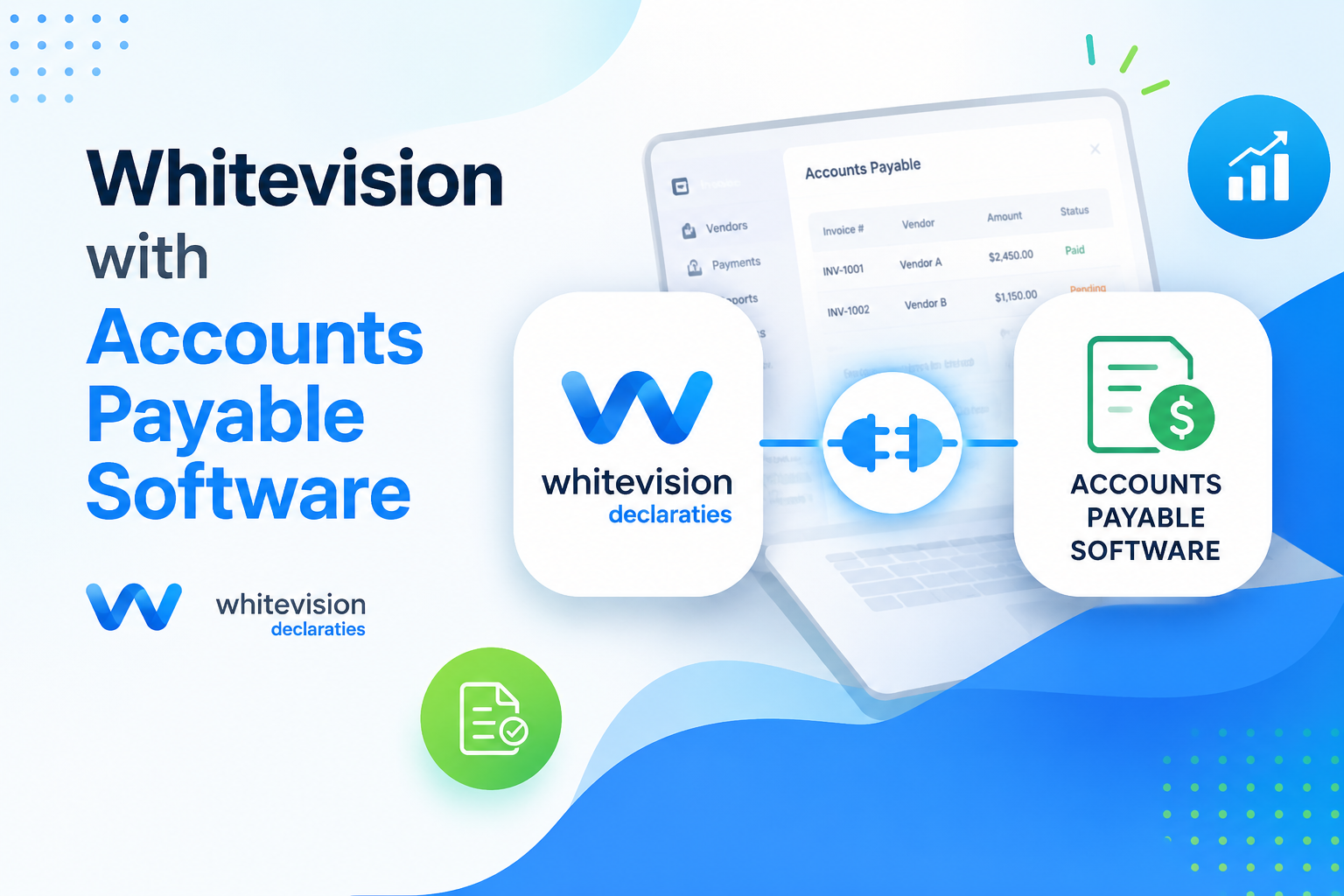
An invoice processing tool that cannot talk to the accounts payable system is only solving half the problem. Extracting data from a PDF invoice accurately means little if that data still has to be manually re-typed into the accounting ledger, matched against the correct creditor by hand, and reconciled separately against outstanding purchase orders. Whitevision B.V. closes exactly this gap, connecting its automated document recognition directly into the accounts payable software a business already relies on, so processed invoice data lands correctly the first time.
This article explains what it actually takes to integrate Whitevision with accounts payable software, which platforms it connects to natively, how the connection handles creditor matching and complex booking logic, and how a technology partner can help configure the integration correctly. Along the way, it draws on Whitevision’s own documented integration approach and publicly available platform details, since the specifics of how an integration handles creditor records, booking rules, and document matching matter far more in practice than a generic marketing claim about “seamless connectivity.”
Table of contents
Quick Summary
Here is a brief overview of what this article covers:
- The core problem: extracting invoice data accurately still leaves a gap if that data cannot flow directly into the accounts payable ledger without manual re-entry.
- The Whitevision approach: native, maintained integrations with major ERP and accounting platforms retrieve the accounts payable file directly, linking every invoice to the correct creditor automatically.
- The supported ecosystem: Whitevision connects with AFAS, Twinfield, Exact, 4PS Construct, PROACTIS, and several other financial systems, each through a tailored rather than generic interface.
- The advanced capability: beyond basic data transfer, Whitevision supports complex booking logic, three-way matching, and automatic creditor creation within the connected AP system.
- The maintenance advantage: Whitevision keeps these integrations continuously updated, even when a connected accounting platform releases a new version.
- The partner angle: working with a specialist like Solution for Guru helps businesses configure the AP integration correctly and handle any custom requirements.
How Does Whitevision Relate to Accounts Payable Integration?

Whitevision B.V. sits at the center of this topic because its entire value proposition depends on connecting cleanly into the accounts payable software a business already uses, rather than functioning as an isolated document scanner that leaves the actual accounting work to someone else. Whitevision is an AI-driven Intelligent Document Processing platform that emphasizes automation, mobile receipt capture, configurable approval workflows, deep accounting integrations, and centralized expense visibility, and that combination only delivers real value when the processed data actually reaches the accounts payable ledger correctly.
This matters directly to the topic of AP integration because a financial system is rarely generic. Whitevision explicitly avoids offering a standard, one-size-fits-all interface, instead building unique connections tailored to each supported accounting or ERP platform, recognizing that every financial system is industry-specific and structured differently. The sections below walk through exactly how this integration works, which platforms it supports, and what specific accounts payable functions it automates once connected.
Why Does a Generic Integration Fail to Solve the Accounts Payable Problem?
Before exploring Whitevision’s specific integration approach, it helps to understand why a shallow, generic connection between a document processing tool and an accounts payable system rarely works well in practice.
What Goes Wrong With a Basic Data Export and Import Process?
A generic integration often amounts to little more than exporting recognized invoice data as a flat file and importing it into the accounting system separately, a process that frequently breaks down the moment a creditor record does not already exist, a booking code does not match, or a purchase order reference gets misread. Without a genuinely deep connection into the accounts payable system’s own logic, this kind of surface-level integration still requires a staff member to manually resolve these mismatches, undermining much of the automation the document processing tool was supposed to provide in the first place.
Why Does Whitevision Approach Integration Differently?
Whitevision retrieves the accounts payable file directly from a connected system like AFAS, ensuring every invoice links automatically to the correct creditor rather than requiring a separate lookup or manual matching step. This direct retrieval approach means the integration works with the accounts payable system’s actual live data, rather than a periodically exported snapshot that can quickly become outdated as new creditors get added or existing records change.
Which Accounts Payable and ERP Platforms Does Whitevision Support Natively?
Whitevision maintains a broad and continuously updated list of native integrations spanning several major accounting and ERP platforms commonly used across different industries.
| Platform | Type | Notable Integration Capability |
|---|---|---|
| AFAS Profit | ERP and accounting | Direct accounts payable file retrieval, complex booking logic |
| Twinfield | Cloud accounting | Streamlined invoice processing with simplicity as the core focus |
| Exact Online / Exact Globe / Exact for Finance | Accounting and ERP | Automated recognition and administration assignment |
| 4PS Construct | Construction-specific ERP | Industry-tailored document and invoice processing |
| PROACTIS | Spend management | Integration supporting broader procurement workflows |
| AccountView | Accounting | Automated invoice and document processing |
| Syntess Atrium | ERP | Industry-specific financial document handling |
Why Does Whitevision Maintain So Many Distinct Integrations Rather Than One Universal Connector?
Because Whitevision focuses on both specific industries and specific accounting solutions, these unique interfaces exist as standard offerings rather than custom projects built from scratch for each client. This approach reflects the reality that a construction company running 4PS Construct has fundamentally different accounts payable needs than a services firm running Twinfield, and a single generic connector would inevitably compromise on depth for at least one of these very different use cases.
How Does Whitevision Keep These Integrations Current Over Time?
Whitevision continuously keeps its integrations up to date, even when a connected accounting or ERP provider releases a new software version. This ongoing maintenance matters enormously for accounts payable integration specifically, since a broken connection at this stage of the financial process does not just cause an inconvenience; it can delay vendor payments, disrupt cash flow visibility, and create a backlog of unprocessed invoices that someone eventually has to clear manually.
How Does the AFAS Integration Handle Creditor Matching Specifically?
Because AFAS represents one of Whitevision’s most detailed native integrations, it offers a useful example of exactly how deep this kind of accounts payable connection actually goes.
How Does Whitevision Link Invoices to the Correct Creditor Automatically?
Whitevision retrieves the accounts payable file directly from AFAS, ensuring invoices are always linked to the correct creditor without requiring manual lookup. After a document arrives, it gets automatically recognized and assigned to the correct administration, which speeds up processing considerably while also reducing the kind of manual matching errors that occur when a staff member has to identify the right creditor record among potentially hundreds of similar entries.
What Happens When an Invoice Arrives From a Brand-New Vendor?
Beyond matching against existing creditor records, Whitevision‘s integration supports checking master data and creating a new creditor automatically when an invoice arrives from a vendor not yet present in the accounts payable system. This capability matters significantly for growing businesses that regularly onboard new suppliers, since it removes yet another manual step that would otherwise require someone to pause the automated workflow and manually set up a new creditor record before processing could continue.
What Complex Booking Logic Does the Integration Support?
The AFAS integration supports complex booking logic beyond basic invoice entry, and combined with fully automatic matching against purchase orders and automatic routing for approval, this creates a genuinely comprehensive accounts payable automation rather than a partial solution that still requires significant manual cleanup. Because this booking logic is built specifically around AFAS’s own structure, invoices post correctly the first time rather than requiring adjustment after the fact.
How Does the Twinfield Integration Emphasize Simplicity?
While the AFAS integration showcases depth and complexity handling, Whitevision’s approach to Twinfield illustrates a different but equally important integration principle: keeping the actual user experience simple despite the underlying automation complexity.
Whitevision’s streamlined integration with Twinfield puts simplicity at the center of processing every incoming document within an organization. For accounts payable teams already comfortable with Twinfield’s cloud accounting interface, this integration approach means adopting Whitevision does not require learning an entirely new, complicated system layered awkwardly on top of their existing accounting software. Instead, invoices flow through the automated recognition and approval process, then land inside Twinfield in a way that feels like a natural extension of the accounting platform rather than a bolted-on third-party tool.
What Does Three-Way Matching Look Like Once Whitevision Connects to an AP System?
A recurring theme across Whitevision‘s accounts payable integrations involves automated three-way matching, comparing an invoice against its corresponding purchase order and goods receipt without requiring manual cross-referencing.
At three-way matching, an invoice gets automatically compared with the corresponding order and receipt, a process that prevents errors, saves time, and ensures reliable administration. Because this matching happens directly against live data retrieved from the connected accounts payable system, rather than a separate, potentially outdated dataset, discrepancies surface immediately and accurately, giving finance staff genuine confidence that a flagged mismatch reflects a real issue rather than a data synchronization problem between two disconnected systems.
The specific accounts payable functions this kind of deep integration typically automates include:
- Automatic creditor linkage, matching every invoice to the correct existing supplier record.
- New creditor creation, setting up master data automatically when a genuinely new vendor appears.
- Purchase order matching, comparing invoiced amounts and quantities against what was actually ordered.
- Goods receipt verification, confirming that invoiced items were actually delivered before payment proceeds.
- Complex booking rule application, applying the correct general ledger codes and cost allocations automatically.
Because these functions all operate directly against the connected accounts payable system’s live data, the resulting automation genuinely reduces manual accounting work rather than simply shifting that work from data entry into data verification and correction.
How Does Email and Document Handling Feed Into the AP Integration?

Before an invoice ever reaches the accounts payable matching and booking stage, it typically arrives through email, and Whitevision‘s handling of this initial intake stage directly affects how smoothly the downstream AP integration performs.
What Problem Does the SMART E-mail Handler Actually Solve?
Businesses dealing with an overwhelming flow of incoming invoice emails often lose significant time simply sorting through messages to identify which ones actually contain purchase invoices requiring processing. The SMART E-mail handler takes this preliminary work off a business’s hands, automatically splitting, combining, and moving attachments or digital purchase invoices as they arrive, ensuring only genuine invoice documents proceed into the recognition and accounts payable matching pipeline.
Why Does Clean Intake Handling Matter for Accurate AP Integration?
If invoice intake handling is sloppy, with irrelevant attachments or improperly split multi-invoice emails flowing into the recognition engine, the resulting data quality problems eventually surface downstream in the accounts payable system itself, either as failed matches, incorrectly split invoices, or creditor mismatches that require manual correction. By solving this problem at the intake stage, Whitevision ensures the accounts payable integration downstream receives clean, properly structured documents to work with in the first place.
What Options Exist When a Business Runs an Accounts Payable System Outside Whitevision’s Native List?
Not every accounts payable platform has a pre-built, tailored Whitevision integration, and businesses running a less common or highly customized system need a different path toward the same automated outcome.
How Does the Whitevision API Support Custom Connections?
Whitevision offers a public API specifically designed for businesses that need to integrate data streams into their own software system rather than relying on one of the pre-built native connectors. This API-based approach allows a business’s development team, or an implementation partner, to build a tailored connection between Whitevision’s document recognition and matching engine and virtually any accounts payable or financial system, even one not represented among Whitevision’s extensive list of native integrations.
When Does a Custom API Integration Make More Sense Than Waiting for a Native Connector?
A custom API integration generally makes sense for businesses running a niche or heavily customized accounts payable system, or those requiring specific data flows beyond what a standard native integration provides. While building a custom connection requires more upfront development effort than activating an existing native integration, it still delivers the same fundamental benefit: eliminating the manual re-entry and matching work that would otherwise fall entirely on accounts payable staff.
How Should a Business Decide Between Requesting a New Native Integration and Building a Custom One?
Because Whitevision continues expanding its list of supported industry-specific and platform-specific integrations, a business running a less common system should first check whether a native connection already exists or is in active development before committing resources to a fully custom API build. For businesses with a genuinely unique accounts payable setup, however, the API route offers a reliable fallback that ensures the lack of a pre-built connector does not become a permanent barrier to automating the invoice-to-payment process.
What Financial and Operational Benefits Come From a Deep Accounts Payable Integration?

Beyond the technical mechanics of how the integration works, it is worth examining the concrete business benefits that come specifically from choosing a deep, native connection over a shallow, generic one.
How Does Accurate Creditor Matching Reduce Duplicate Payment Risk?
When invoices link automatically and accurately to the correct creditor record, a business significantly reduces the risk of duplicate payments, a costly and surprisingly common error that occurs when the same invoice gets processed twice under slightly different vendor name variations. Because Whitevision’s integration works directly against live accounts payable data rather than a static export, it catches these potential duplicates far more reliably than a manual review process relying on staff recognizing a familiar vendor name.
How Does Faster, More Accurate Processing Affect Vendor Relationships?
Vendors notice when a business consistently pays on time and without payment disputes caused by data entry errors, and a deep accounts payable integration directly supports this kind of reliability by reducing the errors and delays that a manual or shallow integration process would otherwise introduce. Over time, this reliability can translate into better payment terms or early payment discounts, since suppliers generally prefer working with customers whose accounts payable process runs smoothly and predictably.
What Does This Mean for Financial Reporting Accuracy?
Because a deep accounts payable integration applies complex booking logic correctly and consistently, financial reports generated from the connected accounting system reflect accurate, properly coded transactions rather than requiring manual correction after the fact. This accuracy matters significantly during month-end close and year-end audits, when a finance team needs to trust that the underlying transaction data was recorded correctly the first time, rather than discovering booking errors that require time-consuming correction before financial statements can be finalized.
How Should a Business Approach Setting Up This Integration?

Given everything covered above, a few practical considerations help a business get its Whitevision-to-AP integration configured correctly from the start.
- Confirm which specific accounts payable platform the business runs, since Whitevision’s integration depth and available features vary based on the specific connected system.
- Review existing creditor master data, ensuring records are reasonably clean before automated matching begins, since existing data quality issues can complicate the initial rollout.
- Map booking rules and general ledger codes clearly, particularly for businesses running complex, multi-entity accounting structures within platforms like AFAS.
- Test the email intake process with real invoice samples, confirming the SMART E-mail handler correctly identifies and routes actual invoices before relying on it for production volume.
- Validate three-way matching against a sample of real purchase orders, ensuring the connected AP system’s purchase order data aligns correctly with what Whitevision retrieves.
Following this kind of structured setup process helps a business avoid the kind of early integration issues that can otherwise erode staff confidence in the automated system before it has a chance to demonstrate its real value.
Conclusion
An invoice processing tool only delivers its full value once the data it extracts actually lands correctly inside the accounts payable system a business depends on every day. Whitevision B.V. addresses this directly through deep, continuously maintained integrations with platforms like AFAS, Twinfield, Exact, and 4PS Construct, retrieving live accounts payable data, matching invoices to the correct creditor automatically, and supporting the complex booking logic that a generic connector could never handle properly. For finance teams evaluating how to genuinely automate their invoice-to-payment process rather than simply digitizing part of it, the depth and specificity of Whitevision’s accounts payable integrations make the difference between a partial automation and a truly end-to-end workflow.
Frequently Asked Questions
Yes, Whitevision‘s integration checks master data and can automatically create a new creditor record when an invoice arrives from a vendor not yet present in the connected accounts payable system, such as AFAS. This removes the need for a staff member to manually pause the automated workflow and set up a new supplier record before invoice processing can continue.
Whitevision continuously maintains its integrations, keeping them up to date even when a connected accounting or ERP provider releases a new version of their software. This ongoing maintenance means businesses generally do not need to worry about their accounts payable integration breaking or requiring manual reconfiguration every time their underlying accounting platform updates.
Yes, Whitevision automates three-way matching by comparing an invoice against its corresponding purchase order and goods receipt directly using data retrieved from the connected accounts payable system. This automated comparison prevents errors, saves significant staff time compared to manual line-by-line verification, and ensures more reliable financial administration overall.
What Are the Benefits of Partnering With Solution for Guru?
Configuring Whitevision‘s accounts payable integration correctly, particularly around creditor matching rules, complex booking logic, and email intake handling, benefits significantly from specialized expertise, and this is where Solution for Guru adds real value.
Solution for Guru specializes in SaaS and system integrations, which means the team can help a business configure the specific accounts payable connection its accounting platform requires, whether that involves AFAS’s complex booking rules, Twinfield’s streamlined workflow, or another supported ERP system. Beyond initial setup, the team can help resolve edge cases in creditor matching, refine three-way matching thresholds, and ensure the SMART E-mail handler correctly routes incoming documents from day one.
Working with Solution for Guru offers several concrete advantages:
- Correct initial configuration of the AP integration, tailored to a business’s specific accounting or ERP platform.
- Creditor master data cleanup, ensuring existing records are structured correctly before automated matching goes live.
- Custom booking rule setup, particularly for businesses with complex, multi-entity accounting structures.
- Migration support for businesses transitioning from manual accounts payable processes into a fully integrated Whitevision workflow.
- Ongoing optimization, refining matching rules and exception handling as the business’s invoice volume and vendor base grow.
Because every business runs a different accounts payable system with its own specific rules and structures, a tailored integration setup consistently produces more reliable results than a generic, self-managed configuration. Partnering with a team that understands both the technical integration work and the underlying accounts payable processes helps a business get its Whitevision integration right the first time.
Recommended:
- Whitevision AI Document Processing: Common Business Use Cases
- What KPIs Should You Track in Expense Management?
- Zoho Expense Pricing Explained: Plans, Features, and Costs
- Whitevision vs Moss: Which Platform Fits Your Finance Workflow Better?
- Key Features of HoorayHR
- Zoho Expense Review: Pros, Cons, and Key Features
- HoorayHR ROI: How Businesses Save Time with HR Automation
- How Long Does It Take to Implement HoorayHR?
- HoorayHR Review: Features, Pros, Cons, and Best Use Cases
- What Is HoorayHR? A Complete Overview
- Best Expense Automation Software: Which Platform Fits Your Business?
- What ROI Can Businesses Expect From Expense Automation Software?
- Multi-Currency Expense Management with Zoho Expense
- What Is Zoho Expense and How Does It Work?
- What Are the Biggest Challenges in Multi-Entity Expense Management?
- Whitevision vs Traditional Invoice Processing: What Changes?
- What Is Whitevision and How Does It Work?
- What Is Expense Management Software and Why Do Companies Need It?