Account-Based Marketing Strategies with Creatio: How to Target High-Value Accounts and Drive Revenue Growth
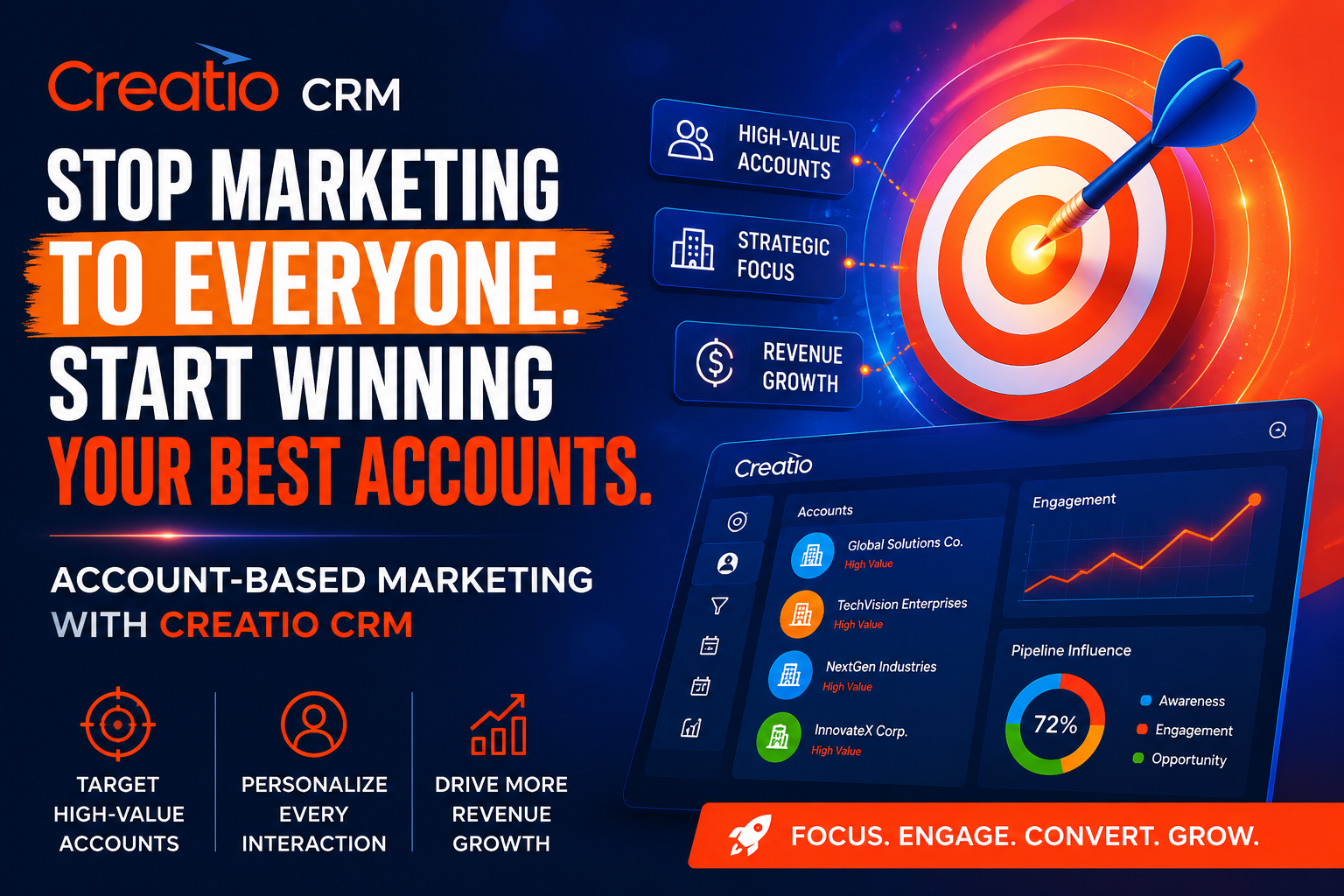
In today’s competitive B2B landscape, generic marketing campaigns no longer deliver the results businesses need. Account-Based Marketing (ABM) has emerged as one of the most powerful go-to-market strategies, allowing sales and marketing teams to align their efforts around specific high-value target accounts. Furthermore, when businesses combine ABM with a robust CRM platform like Creatio, the results can be transformational. This article explores proven ABM strategies, how Creatio empowers teams to execute them, and why partnering with Solution for Guru amplifies your success.
Table of contents
Quick Summary: What Will You Learn in This Article?
| Topic | Key Takeaway |
| What is ABM? | A focused B2B strategy that aligns sales and marketing around specific target accounts. |
| Why Creatio? | Creatio CRM delivers no-code automation, unified data, and AI-driven insights for ABM execution. |
| Core ABM strategies | Account selection, personalization, multi-channel engagement, and sales-marketing alignment. |
| Measuring ABM success | Pipeline velocity, account engagement score, win rate, and ROI metrics. |
How Does Creatio CRM Connect to Account-Based Marketing?

Account-Based Marketing demands precision — precise targeting, precise personalization, and precise measurement. Without the right technology, even the most well-crafted ABM strategy collapses under the weight of fragmented data and manual processes. This is exactly where Creatio CRM steps in as a game-changer.
Creatio is a unified, no-code CRM and business process automation platform designed for marketing, sales, and service teams. Unlike traditional CRMs that simply store contact information, Creatio actively orchestrates the entire customer journey — from first touch to closed deal and beyond. Its intelligent automation engine, AI-powered analytics, and 360-degree account views make it an ideal backbone for sophisticated ABM programs.
Specifically, Creatio enables teams to build detailed Ideal Customer Profiles (ICPs), segment accounts by firmographic and behavioral data, automate personalized outreach sequences, and track engagement across every touchpoint. Additionally, Creatio’s open API and pre-built integrations connect seamlessly with marketing tools, data enrichment platforms, and intent data providers — giving ABM practitioners a complete ecosystem rather than isolated point solutions.
In short, Creatio transforms ABM from a strategy on a whiteboard into a scalable, data-driven revenue engine that your entire organization can operate and optimize continuously.
What Is Account-Based Marketing and Why Does It Matter?

How Did Account-Based Marketing Evolve in B2B Sales?
Account-Based Marketing is not a new concept — strategic account selling has existed for decades. However, the modern ABM movement gained serious momentum in the early 2010s as B2B marketers began to question the effectiveness of broad inbound campaigns for complex, high-value deals. Research from the Information Technology Services Marketing Association (ITSMA) first formalized ABM as a distinct discipline, noting that it consistently delivers higher ROI than any other B2B marketing approach.
Today, ABM has expanded into three primary models. First, one-to-one ABM (Strategic ABM) targets a small number of named accounts with fully customized programs. Second, one-to-few ABM (ABM Lite) applies tailored campaigns to clusters of five to fifteen similar accounts. Third, one-to-many ABM (Programmatic ABM) uses technology — like Creatio — to scale personalization across hundreds or thousands of accounts simultaneously.
Why Is ABM More Effective Than Traditional Demand Generation?
Traditional demand generation casts a wide net and waits for leads to self-qualify through the funnel. Consequently, sales teams frequently waste time on low-fit prospects while the best-fit accounts receive generic, impersonal outreach. ABM reverses this model entirely.
Instead of measuring success by lead volume, ABM teams focus on account engagement depth, pipeline quality, and revenue impact. According to Demandbase’s State of ABM report, 87% of B2B marketers say ABM outperforms other marketing investments. Moreover, companies that deploy mature ABM programs see 208% higher marketing revenue contributions compared to those using traditional approaches (SiriusDecisions).
| Metric | Traditional Demand Gen | Account-Based Marketing |
| Focus | Lead volume | Target account engagement |
| Personalization | Segment-level | Account- and persona-level |
| Sales-Marketing Alignment | Often siloed | Deeply integrated |
| ROI Measurement | Cost per lead | Pipeline and revenue impact |
| Typical Sales Cycle | Variable | Shorter due to better fit |
| Technology Requirement | Marketing automation | CRM + ABM orchestration platform |
How Do You Build a Winning ABM Strategy from the Ground Up?

How Do You Identify and Prioritize Your Ideal Target Accounts?
The foundation of any successful ABM program rests on selecting the right accounts. Therefore, teams must develop a rigorous Ideal Customer Profile (ICP) before they contact a single prospect. An ICP combines firmographic, technographic, and behavioral signals to define which accounts are most likely to buy, expand, and stay.
Creatio CRM accelerates this process by consolidating historical win/loss data, average deal size, industry vertical, company size, and technology usage patterns into a unified account intelligence layer. Furthermore, teams can integrate third-party intent data providers directly into Creatio to identify accounts that are actively researching solutions in your category right now — turning reactive selling into proactive, timely outreach.
Key criteria for building your ICP with Creatio include:
- Annual Revenue: Target accounts within a revenue band where your solution delivers measurable ROI.
- Industry Vertical: Focus on verticals where you have proven case studies and domain expertise.
- Technology Stack: Use technographic data to identify accounts using complementary or competing technologies.
- Growth Signals: Prioritize accounts showing hiring surges, funding rounds, or geographic expansion.
- Behavioral Intent: Leverage Creatio’s integrated intent data to surface accounts actively consuming relevant content.
- Existing Relationships: Identify accounts where you already have warm contacts or prior business interactions.
How Does Account Segmentation Improve ABM Campaign Performance?
Once you define your ICP, the next step involves segmenting your target account list into tiers that reflect both strategic value and sales readiness. Creatio’s dynamic segmentation engine allows marketing and sales teams to create account segments that update automatically as new data flows in — ensuring your campaigns always reach the right accounts at the right moment.
Tier 1 accounts receive the highest investment: fully bespoke content, executive-level outreach, custom microsites, and dedicated sales resources. Tier 2 accounts receive industry-specific campaigns with moderate personalization. Finally, Tier 3 accounts benefit from Creatio’s automated, programmatic campaigns that scale personalization efficiently across a large account universe.
| Tier | Account Count | Personalization Level | Creatio Feature Used |
| Tier 1 — Strategic | 5–20 accounts | Fully bespoke | Account Plans, 360 View, Custom Journeys |
| Tier 2 — Scale ABM | 20–100 accounts | Industry/persona-level | Dynamic Segments, Workflow Automation |
| Tier 3 — Programmatic | 100–1,000+ accounts | Role-based templates | Email Campaigns, Lead Scoring, AI Insights |
What Are the Most Effective ABM Tactics for Engaging Target Accounts?
How Do You Personalize Content at Scale for ABM Campaigns?
Personalization stands as the defining characteristic of ABM — and also its greatest operational challenge. Consequently, teams that try to build fully custom content for every account quickly burn out and lose momentum. The solution lies in building a modular content architecture that Creatio can assemble and deploy dynamically.
With Creatio’s marketing automation capabilities, teams construct content blocks — industry-specific pain point narratives, persona-relevant case studies, relevant ROI calculators — and combine them programmatically based on account segment attributes. As a result, an account in the financial services sector receives emails, landing pages, and sales decks that speak directly to compliance, risk management, and regulatory efficiency, while a manufacturing account receives content focused on supply chain optimization and operational throughput.
Effective content types for ABM programs include:
- Executive Briefing Documents: One-page strategic overviews tailored to C-suite stakeholders at Tier 1 accounts.
- Industry Benchmark Reports: Data-rich reports positioning your brand as a thought leader within the target vertical.
- ROI Calculators: Interactive tools (integrated with Creatio) that quantify the financial impact of your solution.
- Custom Microsites: Dedicated landing pages built for individual target accounts, featuring their logo, pain points, and success metrics.
- Video Testimonials: Short-form video featuring customers from the same industry as the target account.
- Personalized Email Sequences: Automated, behavior-triggered sequences managed and tracked within Creatio CRM.
How Do You Execute Multi-Channel ABM Engagement with Creatio?
Modern buyers do not follow a single linear path. Instead, buying committees — which typically include six to ten stakeholders in complex B2B deals (Gartner, 2025) — engage across multiple channels simultaneously. Therefore, effective ABM demands coordinated, synchronized outreach across every channel your target accounts use.
Creatio unifies all these channels within a single platform, enabling teams to orchestrate email, phone, LinkedIn outreach, paid advertising, webinars, and in-person events from one campaign console. Moreover, Creatio‘s real-time activity feed ensures that sales reps always know the latest engagement signal before picking up the phone — eliminating the cold call and replacing it with timely, contextually relevant conversations.
A proven multi-channel ABM engagement sequence with Creatio:
- Week 1-2: Account Intelligence Gathering — Creatio aggregates intent signals, contact data, and existing relationship history.
- Week 3: LinkedIn Engagement — Sales reps connect with key stakeholders; marketing runs targeted LinkedIn ads to the account.
- Week 4-5: Personalized Email Outreach — Creatio triggers a tailored email sequence based on the account’s industry and pain points.
- Week 6: Direct Mail or Executive Gift — High-value Tier 1 accounts receive a physical outreach piece tied to the campaign theme.
- Week 7-8: Phone Outreach — SDRs call with full Creatio context: what the account read, clicked, and engaged with.
- Week 9: Webinar or Executive Roundtable Invite — Invite key stakeholders to an exclusive, industry-specific event.
- Week 10+: Continuous Nurture — Creatio maintains engagement with content and outreach calibrated to buying stage.
How Do You Align Sales and Marketing Teams Around ABM with Creatio?
One of the most persistent challenges in B2B organizations is the misalignment between sales and marketing teams. ABM, by design, requires these teams to operate as a single, coordinated unit. Fortunately, Creatio‘s unified platform dissolves traditional silos by giving both teams access to the same account data, engagement history, and pipeline visibility.
Within Creatio, marketing teams build and launch campaigns while sales teams track account responses, log calls, and update opportunity stages — all in the same system. Consequently, there are no data handoff delays, no duplicate contact records, and no blind spots in account coverage. Furthermore, Creatio’s collaborative account planning tools allow sales and marketing leaders to co-develop account strategies, set shared KPIs, and review progress in real time during joint pipeline reviews.
Key practices for sales-marketing alignment in Creatio:
- Shared Account Lists: Both teams access the same target account list with unified firmographic and engagement data.
- Service Level Agreements (SLAs): Define response time expectations between marketing (leads delivered) and sales (follow-up commitments) within Creatio workflows.
- Weekly Pipeline Reviews: Use Creatio’s built-in dashboards to conduct joint reviews of account engagement, pipeline stage, and campaign performance.
- Opportunity-Campaign Linking: Connect marketing campaign touches directly to CRM opportunities to measure true marketing-sourced and marketing-influenced revenue.
- Account Scoring Consensus: Agree on account scoring thresholds within Creatio that trigger sales action, preventing premature or delayed handoffs.
How Do You Measure the ROI of Your ABM Program?

What Metrics Should You Track to Evaluate ABM Effectiveness?
Measuring ABM success requires a fundamentally different approach than traditional marketing metrics. Volume-based metrics — impressions, MQL counts, email open rates — tell you very little about ABM program health. Instead, account-level engagement metrics and revenue impact measurements reveal whether your program is truly working.
Creatio’s analytics and reporting suite gives ABM teams full visibility into account-level metrics across the entire funnel. Teams can build custom dashboards that surface the exact data they need, from first account touch to closed-won revenue and beyond. Additionally, Creatio’s AI-powered forecasting engine uses historical patterns to predict which accounts are most likely to convert within a given time period — enabling smarter prioritization.
| ABM Metric | What It Measures | Creatio Feature |
| Account Engagement Score | Depth of interaction across channels | Lead/Account Scoring Engine |
| Pipeline Velocity | Speed at which accounts move through stages | Opportunity Analytics |
| Win Rate by Account Tier | Conversion success for each ABM tier | Custom Reports & Dashboards |
| Average Deal Size | Revenue per closed account | Opportunity & Revenue Tracking |
| Marketing-Influenced Revenue | Revenue touched by marketing campaigns | Campaign Attribution |
| Account Coverage | % of target accounts with active engagement | Account 360 View |
| Time to Close | Sales cycle length for ABM vs. non-ABM accounts | Pipeline Duration Analytics |
How Do You Continuously Optimize Your ABM Program Over Time?
ABM is not a set-and-forget strategy. Rather, successful ABM programs operate on a continuous improvement cycle: plan, execute, measure, learn, and refine. Creatio supports this cycle through its process designer, which lets teams modify campaign workflows, update account scoring models, and adjust outreach sequences without writing a single line of code.
Moreover, Creatio’s machine learning capabilities analyze historical engagement data to surface patterns that human analysts might miss — such as identifying the optimal send time for outreach to accounts in a specific industry, or flagging accounts that show early disengagement signals before they go dark. As a result, ABM teams using Creatio consistently improve their program efficiency quarter over quarter, rather than plateauing after initial deployment.
Optimization levers available within Creatio:
- A/B testing of email subject lines and content blocks within campaign workflows.
- Dynamic account score recalibration based on actual win/loss outcomes.
- Automated disengagement alerts that prompt sales reps to re-engage dormant accounts.
- Campaign attribution modeling to identify the highest-performing channels and content types.
- Quarterly ICP refresh using updated win/loss data and market intelligence.
What Advanced ABM Capabilities Does Creatio Offer?
How Does Creatio’s AI Engine Enhance ABM Decision-Making?
Artificial intelligence has become a critical differentiator in ABM, and Creatio embeds AI across its entire platform rather than treating it as an add-on feature. Creatio’s AI engine — built on machine learning models trained on CRM behavioral data — assists ABM teams with predictive account scoring, next-best-action recommendations, and churn risk identification.
For example, Creatio‘s predictive scoring model analyzes dozens of behavioral signals — website visits, email engagement, event attendance, content downloads — and assigns each target account a dynamic score that updates in real time. Sales reps see these scores directly in their account views, enabling them to prioritize their daily outreach based on actual buying signals rather than intuition alone. Furthermore, Creatio’s generative AI features assist with content personalization, helping reps draft tailored outreach messages that reference the account’s specific industry challenges and recent activities.
How Does Creatio’s No-Code Platform Accelerate ABM Program Deployment?
One of the most significant barriers to ABM adoption is implementation speed. Traditional CRM customization projects take months and require expensive developer resources. Creatio’s no-code Studio platform eliminates this barrier entirely, enabling marketing operations and revenue operations teams to build, customize, and launch ABM workflows without waiting on IT.
Teams can design complex account nurture journeys, build custom account scoring models, create personalized email templates, and configure multi-channel campaign sequences all through Creatio’s visual, drag-and-drop interface. Additionally, Creatio’s extensive marketplace of pre-built connectors integrates with leading ABM tools — including Bombora for intent data, LinkedIn for social engagement, and 6sense for predictive analytics — creating a fully integrated ABM technology stack that deploys in weeks, not months.
What Are the Key Takeaways from This ABM Strategy Guide?
Account-Based Marketing represents the most effective approach B2B organizations can take to focus their sales and marketing resources on the accounts most likely to generate significant, long-term revenue. As we have explored throughout this guide, ABM success depends on three interconnected pillars: strategic account selection, personalized multi-channel engagement, and rigorous measurement.
Creatio CRM serves as the technological nerve center for all three pillars. Its unified data architecture ensures that every team member — from marketing campaign managers to field sales reps — works from the same account intelligence. Its no-code automation engine enables rapid program deployment and continuous optimization without developer dependency. And its AI-powered analytics give ABM teams the predictive intelligence they need to prioritize the right accounts at the right time with the right message.
Furthermore, the partnership with Solution for Guru dramatically accelerates the path from ABM strategy to measurable revenue outcomes. Their combination of Creatio platform expertise and ABM strategic knowledge removes the most common implementation barriers, enabling organizations to launch high-performing programs faster and optimize them more effectively over time.
Ultimately, organizations that invest in a well-designed ABM program, powered by Creatio and guided by Solution for Guru, position themselves to win more of the high-value accounts they care about most — while building a scalable revenue engine that grows stronger with every campaign cycle.
Frequently Asked Questions
Most organizations begin to see meaningful engagement signals — such as increased account activity scores, more qualified meetings booked, and shorter sales cycles — within the first sixty to ninety days of launching a well-configured Creatio ABM program. However, full pipeline and revenue impact typically materializes within six to nine months, depending on your average sales cycle length and the maturity of your target account data. Solution for Guru’s phased implementation approach is specifically designed to generate early wins within the first pilot cohort — building internal confidence and program momentum before the full-scale rollout.
Yes. Creatio‘s open API architecture and pre-built connector marketplace support integrations with the leading ABM technology platforms, including Bombora, 6sense, Demandbase, LinkedIn Sales Navigator, ZoomInfo, and many others. Solution for Guru manages the technical integration work as part of their Creatio implementation service, ensuring that your existing tools connect cleanly with Creatio — giving your ABM team a single, unified view of account intelligence without requiring your team to switch between multiple platforms.
Why Should You Partner with Solution for Guru to Implement Creatio for ABM?
What Does Solution for Guru Offer That Sets Them Apart?
While Creatio provides the technology foundation, successful ABM implementation requires deep platform expertise, strategic guidance, and hands-on support. Solution for Guru is a certified Creatio partner that specializes in helping B2B organizations design, deploy, and optimize their ABM programs on the Creatio platform.
Unlike generic CRM consultants, Solution for Guru brings a rare combination of CRM technical expertise and ABM strategic knowledge. Their consultants have worked with dozens of B2B organizations across industries including technology, manufacturing, professional services, and financial services — building ABM programs that consistently deliver measurable revenue impact.
The key benefits of working with Solution for Guru include:
- ABM Program Design: Solution for Guru helps you define your ICP, build your target account list, and design your tiered ABM program structure before a single campaign launches.
- Creatio Implementation: The team handles the full Creatio deployment — data migration, workflow configuration, integration setup, and user training — so your team reaches full productivity faster.
- Custom Workflow Development: Solution for Guru builds bespoke Creatio workflows tailored to your specific ABM motion, whether that is outbound prospecting, account expansion, or partner-led growth.
- Ongoing Optimization: Beyond implementation, Solution for Guru provides ongoing program optimization services — analyzing performance data, refining account scoring models, and evolving your ABM playbooks as your market changes.
- Team Enablement: Solution for Guru trains your sales and marketing teams on ABM best practices and Creatio platform usage, ensuring high adoption and sustainable program performance.
- ROI Accountability: Solution for Guru defines clear success metrics at the outset and provides regular performance reviews tied to pipeline and revenue outcomes.
How Does Solution for Guru Accelerate Time-to-Value for Creatio ABM Programs?
Speed matters enormously in ABM. Every month your program takes to deploy is a month your competitors are engaging your target accounts. Solution for Guru’s proven implementation methodology — built specifically for Creatio ABM deployments — compresses the typical twelve-to-eighteen-month program ramp to as little as eight to ten weeks for initial program launch.
Their phased approach begins with a discovery sprint that maps your current account data, technology stack, and team processes to the capabilities of Creatio CRM. Next, Solution for Guru configures and tests the Creatio environment in a sandbox, incorporating your specific ABM workflows, account scoring logic, and campaign templates. Finally, they execute a controlled program launch with a pilot set of Tier 1 and Tier 2 accounts — generating early wins and refining the program before scaling to the full target account universe.
| Phase | Duration | Solution for Guru Deliverable |
| Discovery & Strategy | Weeks 1-2 | ICP definition, ABM tier structure, KPI framework |
| Creatio Configuration | Weeks 3-5 | Platform setup, workflow builds, data migration, integrations |
| Pilot Launch | Weeks 6-8 | Launch with 20-30 target accounts, real-time monitoring |
| Full Rollout | Weeks 9-10 | Scale to full target account list with refined playbooks |
| Optimization Cycle | Ongoing | Monthly performance reviews, workflow enhancements, ICP refresh |
Recommended:
- Modern CRM Teams: How Are Roles Evolving in the Digital Era?
- CRM Automation for Logistics Companies Using Creatio
- Using Creatio Dashboards for Executive Decision-Making
- Pipedrive Compliance: How Does Pipedrive Handle Data Protection, Privacy, and Security Standards?
- What Is the Pipedrive Mobile App and How Can It Transform Your Sales on the Go?
- Creatio for Healthcare Organizations: The Complete Guide
- Creatio CRM for Financial Services in the U.S.: Is It the Right Platform for Your Firm?
- Pipedrive for Sales Managers: How to Use Forecasting and Team Performance Reporting
- Extending Creatio with Marketplace Apps
- Zoho CRM API: Complete Guide for Developers
- How Do You Successfully Migrate Your CRM from Salesforce to Zoho CRM?
- How Does Pipedrive Smart Docs Transform Proposals and Contracts with Dynamic CRM Fields?
- Best CRM Mobile Apps in 2026
- CRM Functionality: Top CRM Features in 2026
- Pipedrive AI Sales Assistant
- Pipedrive Campaigns Add-on vs Dedicated Email Marketing Tools
- Pipedrive for B2B vs B2C
- Pipedrive CRM Onboarding and Staff Training: How to Achieve 90%+ Adoption Rates
- Calculating the ROI of Pipedrive CRM