How ITSM Platforms Support IT Compliance and Audit Readiness
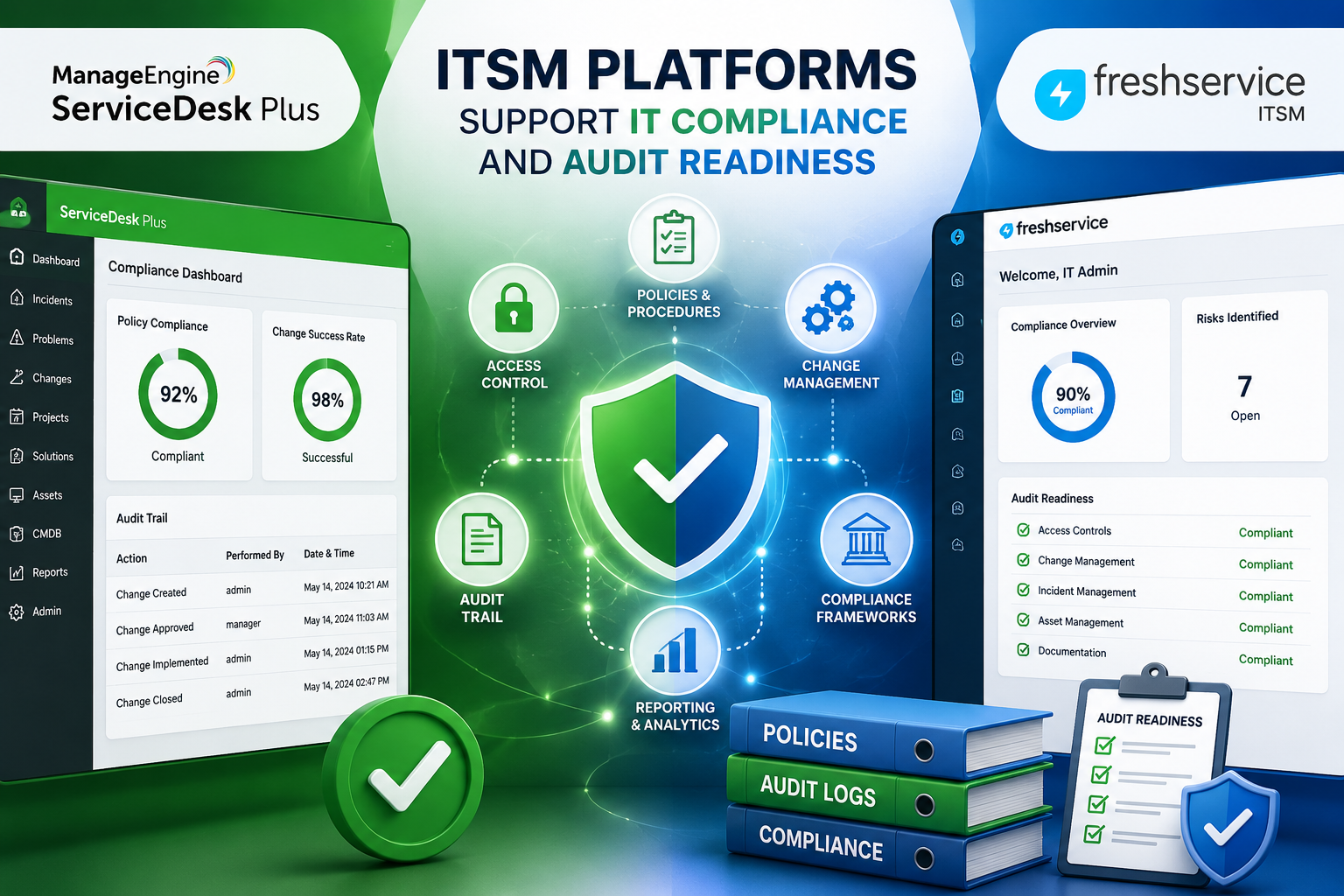
IT compliance no longer lives in a quarterly checklist that IT teams scramble to complete before an audit. Regulators, customers, and internal risk committees now expect proof, not promises, that IT controls access, changes, and incidents responsibly. That is where IT service management platforms step in. Tools such as ManageEngine ITSM and Freshservice turn routine IT operations into a running record of evidence, showing who did what, when, and with whose approval.
Instead of assembling documentation the week before an audit, teams running a modern ITSM platform stay audit-ready as a byproduct of daily work. This article explains why compliance has grown harder to manage, how ITSM platforms close that gap, and how the two platforms compare when audit readiness is the priority. Along the way, it also looks at the frameworks these platforms most commonly support and the practices that keep a compliance program strong between audits, rather than only during them.
Table of contents
Quick Summary
ITSM platforms generate structured, timestamped records of every change, access request, incident, and asset — precisely the evidence auditors request. ManageEngine ITSM embeds encryption, access controls, and audit trails directly into service workflows, supporting ISO 27001, HIPAA, NIST, and PCI DSS principles. Freshservice layers immutable audit trails and workflow automation over an approachable interface, easing SOC 2 and GDPR-oriented reporting.Change, access, incident, and asset management modules each map to a distinct compliance requirement rather than working in isolation.The right platform choice depends on organization size, regulatory scope, and integration needs.Working with an implementation partner such as Solution for Guru shortens the distance between buying an ITSM tool and running audit-ready operations.
How Do ManageEngine ITSM and Freshservice Fit Into IT Compliance?
Compliance frameworks rarely name specific software, yet nearly all of them demand the same underlying capability: proof of control. ManageEngine ITSM and Freshservice both address this need, though each approaches it from a slightly different angle.
ManageEngine ITSM, delivered primarily through its ServiceDesk Plus product line, unifies incident, change, asset, and request management inside a single console. Because compliance depends on connecting these processes rather than running them separately, that unification carries real weight. Every approval, configuration change, and access grant leaves a linked, timestamped record that stands ready for review.
Freshservice, on the other hand, built its reputation on an approachable interface layered with meaningful compliance depth underneath. Behind that simplicity sit immutable audit trails, granular role-based access, and workflow automation that removes the manual steps most prone to human error — the same manual steps auditors flag most often.
Neither platform replaces a dedicated governance, risk, and compliance suite. Instead, both feed structured evidence into whatever compliance program an organization already runs, narrowing the gap between daily IT work and audit demonstration.
What Makes IT Compliance and Audit Readiness So Challenging Today?

Why Do Regulatory Frameworks Keep Expanding?
Organizations rarely answer to just one standard anymore. A single mid-sized company might need to demonstrate SOC 2 controls to enterprise customers, ISO 27001 alignment to European partners, HIPAA safeguards for health data, and PCI DSS discipline for payment processing, often all at once. Each framework asks for slightly different evidence, even when the underlying control, such as access review, is the same. Consequently, IT teams end up duplicating effort across frameworks unless their tools can produce evidence once and map it to multiple standards.
Why Does Evidence Scattered Across Spreadsheets Slow Audits Down?
Before ITSM platforms became standard, many IT teams tracked changes and approvals through email threads and spreadsheets. That approach works until an auditor asks for a complete change history spanning eighteen months. Reconstructing that trail manually consumes days of staff time and frequently produces gaps auditors interpret as control failures. Furthermore, spreadsheets offer no tamper-evidence: anyone with edit access can alter a row without leaving a trace, which undermines the very credibility an audit is meant to confirm.
Why Does Employee Turnover Complicate Access Reviews?
Every new hire, promotion, transfer, and departure changes what a person should be able to access, yet many organizations only review permissions once a year, if at all. During that gap, former employees can retain active credentials, and promoted staff can accumulate access left over from a previous role. Auditors specifically test for this kind of access creep because it represents one of the most common paths to a data breach. Without a system that ties access changes to employment events, IT teams have no reliable way to prove permissions match current roles.
How Do ITSM Platforms Build Compliance Into Daily IT Operations?
Rather than treating compliance as a separate project, mature ITSM platforms fold it into the modules IT teams already use every day. Four modules in particular do most of the work: change management, access management, asset and configuration management, and incident management.
How Does Change Management Create an Audit Trail?
Every change ticket captures who requested the change, who approved it, what the rollback plan was, and when the change went live. Auditors reviewing change control maturity under SOC 2 or ISO 27001 look for exactly this chain of custody. Because the record generates automatically as staff complete their normal workflow, teams do not need to build a separate documentation process just to satisfy auditors.
How Does Access Management Prove Least-Privilege Controls?
Access request tickets record who asked for a system, what they requested, and who granted it. Over time, this becomes the evidence base for demonstrating least-privilege access, a core requirement across nearly every compliance framework. Joiner-mover-leaver workflows, in particular, show auditors that access expands and shrinks in step with an employee’s role, rather than accumulating indefinitely.
How Does Asset and Configuration Management Support Compliance?
A configuration management database, paired with asset records, shows that an organization actually knows what hardware, software, and licenses it operates. Auditors checking inventory and configuration requirements rely on this data to confirm the environment is managed rather than assumed. Consequently, asset visibility also supports license compliance, reducing exposure to unbudgeted renewal costs or unlicensed software.
How Does Incident Management Demonstrate Risk Response?
Incident records document how issues were identified, escalated, and resolved, alongside the timeline for each step. Several compliance frameworks require organizations to prove they can detect and respond to problems within a defined window. A well-maintained incident log, tied to service level agreement data, gives auditors exactly that proof without requiring a separate reporting exercise.
How Do Reporting Dashboards Help Communicate With Auditors?
Raw ticket data only helps an audit if someone can present it clearly. Reporting dashboards translate change, access, incident, and asset records into charts and exportable reports that map to specific compliance requirements. Instead of pulling data manually for every request, compliance teams can generate a report on demand, whether an auditor wants a twelve-month change history or a snapshot of currently open access requests. This capability also benefits internal stakeholders, since leadership can review compliance posture between formal audits rather than waiting for a yearly summary.
How Does ITSM Extend Compliance to Vendors and Third Parties?
Compliance obligations rarely stop at an organization’s own staff. Contractors, managed service providers, and software vendors often touch the same systems and data internal employees do, yet they fall outside standard HR-driven access reviews. ITSM platforms address this by routing vendor access requests through the same ticketing and approval workflow used internally, so third-party accounts get the same audit trail, expiration rules, and review cadence. Given how often breaches originate through a vendor’s compromised credentials, treating third-party access as a first-class ITSM workflow, rather than an exception handled outside the system, closes a gap many compliance programs otherwise leave open.
How Does ManageEngine ITSM Strengthen Compliance and Audit Readiness?
ManageEngine ITSM approaches compliance by embedding controls directly into the platform rather than treating them as an add-on. Its ServiceDesk Plus foundation lets administrators configure how personal and sensitive information moves through the system, aligning encryption, access controls, and auditability with the requirements of regulations such as GDPR and HIPAA.
Many of the compliance standards IT teams care about most, including ISO/IEC 27001, the NIST Cybersecurity Framework, HIPAA, and PCI DSS, share a common foundation in confidentiality, integrity, and availability. ManageEngine ITSM operationalizes these principles through everyday workflows: access control rules keep information available only to authorized users, change and release management reduce the risk of disruptive incidents, and asset management provides ongoing visibility into the IT environment.
Because the platform brings incident, request, asset, and change management together on one console, security and compliance teams gain a single source of truth rather than piecing evidence together from separate systems. For organizations that need to show regulators a coherent, unified operating model, that consolidation often matters as much as any individual feature.
Day to day, that consolidation shows up in specific features: a self-service portal that logs every request at the source, service level agreement tracking that ties resolution times to contractual or regulatory commitments, and AI-driven ticketing that classifies and routes issues without leaving compliance-relevant metadata behind. For IT teams managing a large or complex environment, ManageEngine ITSM‘s willingness to expose deep configuration options, rather than locking teams into rigid defaults, often makes the difference between a workflow that merely looks compliant and one that actually enforces the control an auditor expects to see.
How Does Freshservice Strengthen Compliance and Audit Readiness?

Freshservice takes a different route to the same destination, pairing an intuitive interface with compliance features that operate quietly in the background. At the center of this approach sits its audit trail system: accurate, immutable records of key activities such as ticket updates, approvals, and configuration changes, so nothing gets altered without a trace.
Role-based access controls and automated workflows further reduce the manual steps that typically introduce compliance risk. Rather than relying on staff to remember every documentation step, Freshservice automation captures the record as part of completing the task itself. That matters especially for organizations pursuing SOC 2 attestation, where consistent, repeatable process evidence carries as much weight as the controls themselves.
Freshservice also supports organizations managing multi-framework requirements by centralizing policies, procedures, and historical records in one searchable location. Instead of hunting through email archives before an audit, compliance teams can pull a complete history directly from the platform, shortening preparation time and reducing the likelihood of gaps.
That same design philosophy extends to onboarding and offboarding. Freshservice’s employee lifecycle workflows trigger access provisioning and deprovisioning automatically based on HR events, closing the exact gap that turnover-related access creep tends to exploit. Orchestration capabilities connect Freshservice to identity providers and cloud platforms, so a single approval can cascade into the correct set of access changes across multiple systems, each one logged as it happens rather than reconstructed after the fact.
How Do ManageEngine ITSM and Freshservice Compare for Compliance-Focused Teams?
While both platforms deliver strong compliance foundations, the right fit depends on organization size, existing tech stack, and how much configuration flexibility a team needs. The table below breaks down where each platform stands out.
| Compliance Capability | ManageEngine ITSM | Freshservice |
| Audit Trail Depth | Detailed, linked records across incident, change, asset, and request modules | Immutable, activity-level audit trails with strong tamper-evidence |
| Access Control | Granular role-based controls with joiner-mover-leaver workflow support | Role-based access with automated provisioning and deprovisioning |
| Framework Alignment | Strong fit for ISO 27001, NIST CSF, HIPAA, and PCI DSS | Strong fit for SOC 2, GDPR, and multi-framework reporting |
| Interface & Adoption | Feature-dense console suited to teams wanting deep configurability | Streamlined, intuitive interface suited to fast onboarding |
| Automation | AI-driven ticketing and compliance checks | Workflow automation that removes manual documentation steps |
| Best Fit For | Enterprises needing unified ITSM, asset, and security workflows | Mid-market and growing teams prioritizing ease of use with compliance depth |
In practice, the choice often comes down to how much configuration effort a team is willing to invest up front. Organizations with dedicated IT administrators and complex, multi-department environments tend to get more long-term value from ManageEngine ITSM‘s configurability. Smaller or fast-growing IT teams, on the other hand, often reach audit-ready workflows faster with Freshservice, simply because there is less to configure before the platform starts producing usable evidence.
Why Does Compliance Matter Beyond Passing an Audit?
Treating compliance purely as a box to check before an auditor arrives misses the point. Organizations that maintain disciplined change control, access review, and incident response tend to experience fewer breaches in the first place, not just cleaner paperwork afterward. A missed patch, an over-privileged account, or an undocumented change are the same weaknesses attackers look for and auditors flag. In that sense, an ITSM platform’s compliance value and its security value come from the same underlying discipline.
There is also a reputational and commercial angle. Enterprise customers increasingly ask vendors to prove SOC 2 or ISO 27001 status before signing a contract, and failing a compliance audit can mean fines, revoked licenses, or lost deals rather than just a stern memo from legal. Viewed this way, ManageEngine ITSM and Freshservice both function as risk-reduction tools first, with audit readiness as one visible, measurable outcome of running IT operations well.
Cost matters here too, though not in the way many teams expect. The upfront price of an ITSM license is easy to compare; the cost of a failed audit, a stalled enterprise deal, or a breach traced back to an unreviewed access grant is much harder to see coming and typically far larger. Budgeting for proper implementation and ongoing workflow maintenance, rather than treating the platform as a one-time purchase, is what actually determines whether ManageEngine ITSM or Freshservice delivers on its compliance potential.
Which Compliance Frameworks Can ITSM Platforms Help Support?
ITSM platforms rarely certify an organization on their own, but they generate much of the evidence a compliance program needs. Common frameworks that ManageEngine ITSM and Freshservice both help support include the following:
- SOC 2: Demonstrates trust-service criteria around security, availability, and confidentiality through documented controls and monitoring.
- ISO/IEC 27001: Requires a structured information security management system, supported by change, access, and asset records.
- HIPAA: Demands safeguards for protected health information, reinforced by access controls and audit logging.
- GDPR: Requires organizations to show how personal data is accessed, processed, and protected.
- PCI DSS: Governs how organizations handle payment card data, relying heavily on access control and change management evidence.
Most organizations do not need to pick just one framework. Because ManageEngine ITSM and Freshservice both record evidence at the ticket level rather than the framework level, the same change record or access log can support several audits at once. That overlap is precisely what shortens preparation time once a program matures beyond its first certification.
What Best Practices Help IT Teams Stay Audit-Ready Year-Round?

Audit readiness works best as an ongoing habit rather than a pre-audit sprint. IT teams running either platform can strengthen their position by following a few consistent practices:
- Configure change management workflows so every change requires documented approval before deployment.
- Review access permissions on a fixed schedule, not only when an employee joins or leaves.
- Keep the configuration management database current through automated discovery rather than manual updates.
- Tie incident response timelines to defined service level agreements, then monitor them continuously.
- Export compliance reports regularly, rather than generating them for the first time when an auditor requests them.
- Automate joiner-mover-leaver workflows so access changes trigger from HR events instead of manual tickets.
- Run a mock audit internally at least once a year to catch documentation gaps before a real assessor does.
None of these practices require exotic tooling. They simply ask IT teams to use the modules ManageEngine ITSM and Freshservice already provide with enough consistency that evidence accumulates on its own, rather than needing to be assembled retroactively.
What Should IT Teams Take Away About ITSM and Compliance?
Compliance and audit readiness increasingly depend on how well daily IT operations generate their own evidence. ManageEngine ITSM and Freshservice both answer that need, though from different starting points. ManageEngine ITSM suits organizations wanting deep configurability and a unified console spanning incident, change, asset, and access workflows, particularly where ISO 27001, HIPAA, or PCI DSS alignment matters most. Freshservice suits teams that want compliance depth without a steep learning curve, backed by immutable audit trails and automation that removes manual documentation work, a strong match for SOC 2 and GDPR-focused programs.
Neither platform eliminates the need for a broader compliance strategy, but both remove the scramble that used to precede every audit. Combined with disciplined practices around change approval, access review, and asset tracking, ManageEngine ITSM and Freshservice each turn routine IT work into a continuous, defensible record. Organizations that pair either platform with an experienced implementation partner, such as Solution for Guru, typically reach audit-ready operations faster and with fewer configuration gaps than teams working through setup alone.
What Do IT Teams Commonly Ask About ITSM and Compliance?
No platform grants certification by itself. ManageEngine ITSM and Freshservice generate the evidence, such as audit trails, access records, and incident logs, that auditors evaluate, but certification still requires a broader compliance program, documented policies, and often a third-party assessor. Think of the ITSM platform as the record-keeping engine that makes an assessor’s job faster, rather than a substitute for the policies and risk assessments a certification actually requires.
Timelines vary by organization size and framework, but most teams see meaningful improvement within the first quarter of consistent use, since audit trails accumulate automatically as staff complete routine tickets. Full readiness across every framework typically takes longer and benefits from implementation support, particularly for organizations migrating historical records from spreadsheets or a legacy ticketing tool.
Yes, in many cases. Because ITSM platforms automate evidence collection, smaller teams can maintain audit readiness without a dedicated compliance function, especially when workflows are configured correctly from the start, an area where a partner like Solution for Guru often adds the most value.
Migration takes planning, but it is manageable. Historical tickets, change records, and asset data can typically be exported and imported to preserve continuity, though organizations should confirm retention requirements before decommissioning the old system. Involving an implementation partner during migration reduces the risk of losing evidence auditors may still request for prior periods.
What Are the Benefits of Partnering With Solution for Guru for ITSM Implementation?
Choosing a compliance-capable platform is only the first step. Configuring ManageEngine ITSM or Freshservice to actually reflect an organization’s regulatory obligations takes implementation expertise many internal IT teams do not have time to develop.
Solution for Guru specializes in exactly that gap. As a CRM and software implementation consultancy, the team configures workflows, access rules, and reporting structures around the specific frameworks an organization needs to satisfy, rather than relying on default settings that may leave evidence gaps. This reduces the risk of discovering, mid-audit, that a workflow was never actually enforcing the control it appeared to enforce.
Beyond initial setup, Solution for Guru supports ongoing optimization as regulatory requirements evolve and organizations grow. That includes refining approval chains, tightening access review cycles, and ensuring integrations between ITSM platforms and other business systems keep evidence flowing without manual intervention. For organizations weighing ManageEngine ITSM against Freshservice, an experienced implementation partner also helps translate platform features into an actual compliance outcome, rather than leaving that translation to trial and error.
In practice, that support tends to cover a consistent set of engagements, regardless of which platform an organization chooses:
- Mapping regulatory requirements to specific ManageEngine ITSM or Freshservice modules before configuration begins.
- Building change, access, and incident workflows that enforce approvals rather than merely recommending them.
- Connecting ITSM platforms to identity providers, HR systems, and asset discovery tools so evidence collects automatically.
- Training internal teams to maintain workflows correctly after go-live, rather than leaving configuration knowledge with a single consultant.
- Reviewing configurations periodically as regulatory requirements and organizational structure change.
Recommended:
- How ITSM Tools Support Internal IT Risk Management
- How AI Is Changing ITSM Workflows in Freshservice?
- How ITSM Platforms Like Freshservice Support Digital Transformation
- Freshservice CMDB Explained: Structure, Relationships, and Best Practices
- Freshservice for Remote and Hybrid Work Environments
- Automating Employee Onboarding and Offboarding with Freshservice
- ManageEngine ServiceDesk Plus for Mid-Size Business: Is It the Right ITSM Fit?
- ManageEngine ITSM: Standard vs Professional vs Enterprise — Which Edition Fits Your Team?
- ManageEngine SLA Management: How Does It Help IT Teams Meet Every Deadline?
- Freshservice for Growing Companies: When Is the Right Time to Upgrade ITSM?
- Freshservice Change Management: Real-World Configuration Strategies
- What Are the Best Automation Use Cases for ITSM Platforms in Growing Businesses?
- How Does Freshservice Support Compliance and Audit Readiness?
- Freshservice vs Traditional Help Desk Systems: What Has Changed?
- What Reporting and Dashboard Strategies Do High-Performing ITSM Leadership Teams Actually Use?
- What Are ITSM KPIs and Why Do They Matter for Your IT Organization?
- What Is a Self-Service Portal in ITSM and Why Does Your Business Need One?
- ESM vs ITSM: What Is the Difference and Which One Does Your Business Need?