Building Scalable ITSM Processes for Global IT Teams: A Complete Strategic Guide

Global IT teams operate under relentless pressure: service requests arrive from dozens of time zones simultaneously, infrastructure incidents ripple across continents, and compliance requirements shift from one country to the next. Without mature, scalable IT Service Management (ITSM) processes, even the most talented IT professionals spend their days firefighting rather than driving strategic value. The good news is that the right ITSM framework — backed by the right technology — transforms this chaos into a predictable, high-performing service engine. This article explores exactly how to build ITSM processes that scale globally, and how leading platforms ManageEngine and Freshservice make that transformation achievable for organizations of every size.
Table of contents
Quick Summary
| Topic | Key Insight |
| What is scalable ITSM? | A framework of processes, governance structures, and tools that maintain consistent service quality as IT teams and infrastructure grow globally. |
| Core ITSM processes for global teams | Incident, problem, change, asset, and service request management — all requiring global standardization with local flexibility. |
| ManageEngine ServiceDesk Plus | An enterprise-grade ITSM suite combining ITIL-aligned workflows, AI automation, and deep asset management for complex global environments. |
| Freshservice | A cloud-native ITSM platform delivering intuitive interfaces, rapid deployment, and strong AI capabilities for fast-growing global IT teams. |
| Platform comparison | Side-by-side evaluation of both platforms across eight critical dimensions. |
How Do ManageEngine and Freshservice Relate to Building Scalable ITSM Processes?
Scaling ITSM processes across a global IT organization requires more than good intentions — it demands technology that can enforce consistent process standards, automate repetitive workflows, surface real-time performance data, and adapt to the unique requirements of different geographies and business units. Both ManageEngine and Freshservice were engineered specifically to meet these demands, though they approach the challenge from distinctly different angles.
How Does ManageEngine ITSM Support Global IT Operations at Scale?
ManageEngine ServiceDesk Plus is an enterprise-grade ITSM platform developed by Zoho Corporation, currently serving over 100,000 organizations across 185 countries. ManageEngine addresses global ITSM scalability through a comprehensive suite of ITIL-aligned modules — covering incident, problem, change, release, asset, and project management — all within a single, unified platform. Its multi-site architecture allows global IT teams to configure region-specific workflows, support hours, escalation paths, and SLA policies while maintaining centralized governance and reporting visibility. Furthermore, ManageEngine’s deep integration with the broader ManageEngine ecosystem — including network monitoring (OpManager), endpoint management (Desktop Central), and security analytics (Log360) — gives global IT organizations a genuinely unified IT operations platform rather than a collection of disconnected point tools.
How Does Freshservice Enable Rapid ITSM Scaling for Growing Global Teams?

Freshservice is a cloud-native ITSM platform from Freshworks, recognized by Gartner as a Visionary in the 2023 Magic Quadrant for ITSM Tools. Freshservice takes a modern, employee-experience-first approach to IT service management, combining ITIL-aligned processes with an intuitive consumer-grade interface that dramatically reduces training time and drives faster adoption across geographically distributed teams. Its AI-powered features — including Freddy AI for ticket classification, suggested solutions, and workflow automation — enable global IT teams to scale their service capacity without proportionally scaling their headcount. Additionally, Freshservice’s marketplace of 1,000+ integrations and its robust API layer allow organizations to embed ITSM workflows into the broader enterprise technology ecosystem, from Microsoft Teams and Slack to Jira, Salesforce, and Azure DevOps.
What Does It Mean to Build Truly Scalable ITSM Processes?

Why Do Traditional ITSM Approaches Fail Global IT Teams?
Many organizations deploy ITSM tools and processes that work adequately for a single-site team of twenty IT professionals — then struggle enormously when those teams grow to five hundred people across fifteen countries. The root cause is almost always the same: processes designed for local simplicity rather than global scalability.
Traditional ITSM failures in global contexts typically manifest in several predictable patterns. First, inconsistent ticket categorization across regions makes reporting meaningless at the enterprise level — when Tokyo classifies an email outage as a “network incident” while London logs it as an “application issue,” global trend analysis becomes impossible. Second, SLA policies that ignore time zone realities create systematic SLA breaches for geographically distant teams. Third, change management processes that lack multi-stakeholder approval workflows across regions expose organizations to compliance risk and uncoordinated infrastructure changes.
Both ManageEngine and Freshservice address these failure patterns directly. ManageEngine’s multi-instance and multi-site configuration options allow organizations to standardize the taxonomy, categories, and escalation logic that matter for global reporting, while still giving regional teams the flexibility to configure local workflows. Freshservice’s workspace feature similarly enables global IT organizations to operate separate, regionally customized service desks that still roll up into unified enterprise-level dashboards for global IT leadership.
What Are the Core ITSM Processes Every Global IT Team Must Master?
ITIL 4 — the current industry-standard ITSM framework, maintained by AXELOS — defines a comprehensive set of service management practices that global IT teams must master to deliver consistent, high-quality services. While the full ITIL library contains over thirty practices, five processes form the operational backbone of any scalable global ITSM program.
| ITSM Process | Business Purpose | Global Scalability Challenge | ManageEngine Capability | Freshservice Capability |
| Incident Management | Restore normal service as quickly as possible | Multi-timezone escalation and 24/7 coverage | Multi-site SLAs, AI-suggested resolutions | Freddy AI classification, smart escalation |
| Problem Management | Identify and eliminate root causes of incidents | Correlating incidents across global sites | Root cause analysis workflows, trend reports | Problem analytics, AI-linked incident clusters |
| Change Management | Control IT changes to minimize service risk | Multi-region CAB approvals and compliance | Multi-stage approval workflows, CAB scheduling | Change calendar, automated risk assessment |
| Asset Management | Track and optimize IT asset lifecycle globally | Hardware/software inventory across geographies | CMDB, discovery, software license management | Asset discovery, integrated CMDB |
| Service Request Management | Fulfill standard IT requests efficiently at scale | Consistent self-service across all regions | Multilingual portal, approval workflows | Employee portal, AI-powered suggestions |
How Do You Design Incident and Problem Management Processes That Scale Globally?
How Should Global IT Teams Structure Incident Management for 24/7 Coverage?
Effective global incident management requires a follow-the-sun model — where incident queues transfer seamlessly between regional teams as business hours move around the globe. Without the right ITSM tooling, this handover process creates dangerous gaps: incidents fall through the cracks during shift transitions, context gets lost between teams, and resolution times balloon.
ManageEngine ServiceDesk Plus addresses this through its sophisticated SLA engine, which allows IT leaders to define separate service hours and escalation rules for each geographic region while maintaining global visibility through a unified dashboard. Its business hour definitions account for regional holidays, local working hours, and time-zone-specific response requirements. As a result, a P1 incident raised in Singapore at 11pm automatically routes to the APAC on-call team, escalates to the global incident manager if unacknowledged within fifteen minutes, and updates stakeholders across all regions with a single notification workflow.
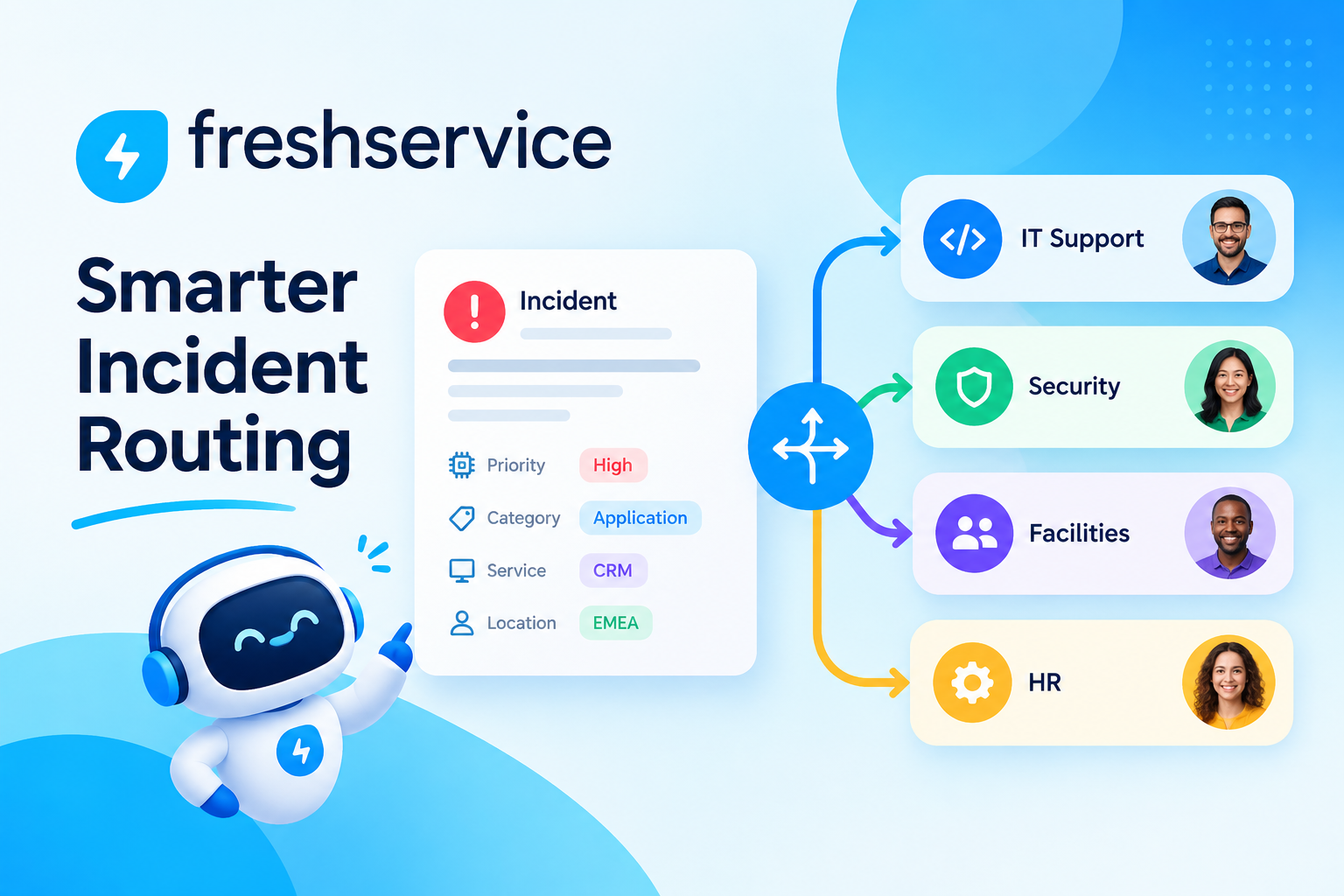
Freshservice achieves similar outcomes through its intelligent routing engine and Freddy AI’s automatic ticket classification. When a new incident arrives, Freddy AI analyzes the ticket content, assigns it to the correct category and priority tier, routes it to the appropriate regional team, and suggests relevant knowledge base articles — all within seconds of ticket creation. Furthermore, Freshservice’s on-call scheduling module integrates directly with PagerDuty and Opsgenie, giving global teams enterprise-grade incident alerting without building a separate escalation tool from scratch.
How Do ManageEngine and Freshservice Support Structured Problem Management?
Problem management remains one of the most underdeveloped ITSM practices in global IT organizations, primarily because it requires analytical discipline that daily firefighting constantly interrupts. However, research from Gartner shows that organizations with mature problem management practices reduce their major incident volume by 30–50% within eighteen months of program implementation — a compelling efficiency case for investing in this practice.
ManageEngine’s problem management module links directly to its incident management records, enabling IT teams to identify patterns across incident histories, create formal problem records with root cause analysis documentation, and track known error workarounds in a centralized knowledge base. Its reporting engine can surface the top recurring incident categories across all global sites simultaneously, giving problem managers the cross-regional visibility they need to prioritize root cause investigations effectively.
Freshservice enhances problem management with AI-powered incident clustering, which automatically groups related incidents and suggests problem record creation when a pattern reaches a defined threshold. This feature reduces the analytical workload on problem managers significantly — instead of manually scanning hundreds of ticket records, they receive AI-generated problem candidates with supporting evidence already compiled. Additionally, Freshservice’s problem analytics dashboard tracks known error status, workaround adoption rates, and permanent fix timelines — providing the governance visibility that global IT leadership needs.
How Do You Build a Global Change Management Process That Minimizes Risk?
Why Is Change Management Especially Complex for Global IT Organizations?
Change management in global IT environments involves a level of coordination complexity that far exceeds what single-site organizations face. A single infrastructure change — such as a core network upgrade or an ERP patch deployment — may require approval from stakeholders in multiple countries, compliance review against regulations in different jurisdictions, and impact assessment across dozens of interdependent systems spanning multiple data centers.
Without a structured, tool-enforced change management process, global IT teams face three critical risks. First, unauthorized changes — implemented without proper testing or approval — cause 80% of all unplanned IT downtime (Gartner). Second, poorly communicated changes disrupt business operations in regions that were not adequately notified. Third, changes that bypass compliance review expose organizations to regulatory penalties, particularly in heavily regulated industries such as financial services and healthcare.
How Do ManageEngine and Freshservice Enforce Rigorous Change Management Workflows?
ManageEngine ServiceDesk Plus delivers one of the most comprehensive change management modules in the mid-market ITSM space. Its change workflow engine supports all three ITIL change types — standard, normal, and emergency — with configurable multi-stage approval workflows that can route requests to regional stakeholders, global Change Advisory Boards (CABs), and technical review teams simultaneously or sequentially depending on change risk level.
Specifically, ManageEngine’s change calendar provides global visibility into all scheduled changes across every site and region, enabling change managers to identify scheduling conflicts, blackout period violations, and overlapping changes before they create incidents. Furthermore, ManageEngine’s CMDB integration means that every change record automatically maps to the configuration items it affects — giving approvers a clear picture of downstream impact before they grant authorization.
Freshservice’s change management module takes a more streamlined approach that emphasizes speed and usability alongside rigor. Its automated risk assessment engine scores each change request based on historical data and configuration item relationships, helping change managers prioritize their review effort. Freshservice’s change calendar integrates with Microsoft Outlook and Google Calendar, reducing the friction of CAB scheduling for globally distributed approval teams. Moreover, Freshservice’s pre-built change workflows for common scenarios — such as cloud infrastructure updates and SaaS application rollouts — accelerate time-to-deployment for routine changes while maintaining full audit trails.
How Do You Scale IT Asset and Configuration Management Across Global Sites?
What Makes Global IT Asset Management So Challenging?
Managing IT assets across a global organization involves tracking thousands — sometimes hundreds of thousands — of hardware and software assets distributed across dozens of offices, data centers, and remote work environments on multiple continents. Without accurate, real-time asset data, IT teams cannot enforce software license compliance, plan hardware refresh cycles effectively, or understand the full impact of configuration changes on their service environment.
Research from Snow Software indicates that the average enterprise wastes 30% of its software license spend on unused or redundant licenses — a direct consequence of poor global asset visibility. Furthermore, hardware assets without clear lifecycle tracking frequently remain in service well past their end-of-support dates, creating security vulnerabilities that threat actors actively exploit.
How Do ManageEngine and Freshservice Handle Global Asset Discovery and CMDB Management?
ManageEngine ServiceDesk Plus arguably delivers the strongest asset management capabilities of any mid-market ITSM platform, reflecting its origin as part of the ManageEngine IT management ecosystem. Its automated asset discovery engine uses agent-based and agentless scanning to identify and inventory hardware and software assets across the entire global network — including remote endpoints, cloud workloads, and IoT devices. ManageEngine’s CMDB maps the relationships between configuration items at a level of detail that rivals enterprise tools costing significantly more.
Additionally, ManageEngine’s software asset management module tracks license entitlements against actual installations across all global sites, generates compliance reports, and alerts license managers when installations approach or exceed contracted volumes. This capability alone typically delivers ROI that exceeds the platform’s annual cost within the first year of deployment.
Freshservice’s asset management module, while somewhat less feature-rich than ManageEngine’s in the deepest enterprise scenarios, excels through its ease of configuration and its native cloud asset discovery capabilities. Freshservice’s integration with major cloud platforms — AWS, Azure, and Google Cloud — enables automatic discovery and tracking of cloud resources alongside on-premises assets in a unified inventory. Furthermore, Freshservice’s asset lifecycle workflows automate the procurement, deployment, maintenance, and decommissioning stages for hardware assets, reducing the manual coordination burden on IT asset managers significantly.
How Do ManageEngine and Freshservice Compare Head to Head?

Both ManageEngine and Freshservice offer compelling ITSM capabilities for global IT teams, but they target different organizational profiles and prioritize different dimensions of the ITSM experience. The comparison below evaluates both platforms across the dimensions most critical to global ITSM scalability.
| Evaluation Dimension |  | |
| Deployment Model | On-premise, cloud, or hybrid | Cloud-native SaaS only |
| Best Fit Organization | Mid-market to large enterprise; complex multi-site environments | Fast-growing SMB to mid-market; cloud-first organizations |
| ITIL Alignment | Comprehensive ITIL 4 coverage across all modules | Strong ITIL 4 alignment with modern UX focus |
| Ease of Implementation | Moderate — powerful but requires configuration investment | High — intuitive setup with guided onboarding |
| AI/Automation Capabilities | AI-assisted routing, auto-categorization, predictive analytics | Freddy AI for classification, auto-resolution, workflow automation |
| Asset & CMDB Management | Industry-leading: deep CMDB, hardware/software discovery, compliance tracking | Strong cloud-native asset management; lighter on-premise depth |
| Change Management | Advanced multi-stage CAB workflows, risk assessment, change calendar | Streamlined workflows, automated risk scoring, integrated calendar |
| Multi-Site / Global Support | Excellent: multi-instance, regional SLAs, timezone-aware workflows | Strong: workspace model, regional portals, global dashboards |
| Native Integrations | 400+ including ManageEngine ecosystem tools | 1,000+ marketplace integrations |
| Self-Service Portal | Multilingual portal with AI-suggested solutions | Modern employee portal with Freddy AI chatbot |
| Pricing Model | Per-technician licensing; perpetual and subscription options | Per-agent subscription; tiered plans by feature set |
| Starting Price (approx.) | ~$10/technician/month (cloud) | ~$19/agent/month (Starter plan) |
| Free Trial | 30-day free trial | 21-day free trial |
| Support for On-Premise | Yes — full-featured on-premise deployment available | No — cloud-only |
| Reporting & Analytics | Extensive built-in reports; custom report builder; BI integration | Strong analytics; Freshservice Analytics; third-party BI connectors |
How Do You Drive ITSM Tool Adoption Across Geographically Distributed Teams?
Why Does ITSM Tool Adoption Fail — and How Do You Prevent It?
Deploying a world-class ITSM platform like ManageEngine or Freshservice guarantees nothing if the people who need to use it resist adoption. Research from HDI (Help Desk Institute) shows that ITSM tool adoption failures stem from three root causes in the vast majority of cases: insufficient end-user training, processes that do not reflect how teams actually work, and a lack of visible management commitment to the new system.
Global IT teams face an additional adoption challenge that single-site organizations do not: cultural and linguistic diversity. An ITSM portal designed exclusively in English with workflow logic built around North American business practices will generate friction — and therefore low adoption — among IT teams in non-English-speaking regions or those operating under different working culture norms.
ManageEngine addresses this through its multilingual self-service portal, which supports over thirty languages and allows regional IT teams to configure locally relevant service catalogs, category structures, and knowledge base content. Freshservice’s modern, consumer-grade interface significantly reduces the training barrier for end users globally, while its Freddy AI chatbot provides guided, conversational ticket creation that requires virtually no formal training — users simply describe their issue in plain language and the AI handles categorization, routing, and resolution suggestion automatically.
What Governance Structures Support Scalable Global ITSM Programs?
Technology alone cannot sustain a scalable ITSM program. Global IT organizations need more than just tools like ManageEngine or Freshservice. They also need strong governance structures. These structures should define clear accountability for teams and processes. They should enforce consistent standards across all regions. They should also support continuous improvement throughout the organization.
The most effective governance structures for global ITSM programs include:
- Global ITSM Process Owners: Designate process owners for each core ITSM practice (incident, problem, change, asset) who hold global accountability for process design, performance standards, and continuous improvement — regardless of where they sit geographically.
- Regional ITSM Coordinators: Appoint regional coordinators who translate global standards into local implementation and serve as the primary escalation point for regional ITSM issues.
- Global ITSM Steering Committee: Establish a quarterly governance forum that reviews global ITSM performance data from ManageEngine or Freshservice dashboards, approves process changes, and sets strategic priorities.
- Standardized Service Catalog: Maintain a globally consistent service catalog structure — even if regional teams add local service items — so that reporting across regions remains comparable.
- Unified SLA Framework: Define global SLA tiers by priority level, then allow regional teams to configure local business hours within those global parameters — as both ManageEngine and Freshservice support natively.
- Regular Process Audits: Conduct semi-annual ITSM process maturity assessments against ITIL 4 benchmarks, using both platforms’ reporting data to identify gaps and improvement priorities.
How Do You Measure ITSM Performance and Drive Continuous Improvement?
Which KPIs Best Reflect ITSM Scalability and Efficiency for Global Teams?

Measuring ITSM performance in a global context requires metrics that capture both the efficiency of individual process execution and the consistency of service quality across regions. Neither ManageEngine nor Freshservice can improve your ITSM program automatically — but both provide the measurement infrastructure that enables continuous improvement when IT leaders commit to a data-driven management approach.
| KPI | What It Measures | Global Benchmark | Platform Feature |
| Mean Time to Resolve (MTTR) | Average incident resolution speed | <4 hours (P1); <24 hours (P2) | Both: SLA tracking dashboards |
| First Contact Resolution Rate | % of tickets resolved on first contact | >70% for Tier 1 teams | Both: FCR reporting |
| SLA Compliance Rate | % of tickets resolved within SLA | >95% target | Both: SLA dashboards |
| Change Success Rate | % of changes implemented without incidents | >95% | Both: Change analytics |
| Self-Service Adoption Rate | % of tickets submitted via portal (not email/phone) | >60% for mature ITSM programs | Both: Channel analytics |
| Problem Closure Rate | % of open problems closed per quarter | >80% quarterly | Both: Problem management reports |
| Asset Discovery Coverage | % of known assets discovered automatically | >98% of managed endpoints | ManageEngine: stronger on-premise; Freshservice: stronger cloud |
| Technician Utilization Rate | Avg ticket load vs. team capacity | 75–85% target | Both: Workload dashboards |
How Do ManageEngine and Freshservice Support Continuous ITSM Improvement?
Both platforms provide the reporting and analytics infrastructure needed to run a mature continuous improvement cycle. ManageEngine’s reporting suite includes over 150 pre-built reports covering every ITSM module, plus a custom report builder that allows IT managers to construct bespoke analyses without database expertise. Its trend analysis capabilities surface patterns across incident categories, change volumes, and SLA performance over time — giving problem managers and process owners the data they need to identify root causes of chronic performance gaps.
Freshservice’s analytics platform offers equally powerful insight generation with a more modern, visual interface. Its Curated Insights feature automatically identifies the most important performance anomalies. For example, it can detect a sudden increase in P1 incidents from a specific region. It can also highlight a decline in self-service adoption after a portal redesign. These insights are surfaced automatically, so analysts do not need to create custom reports for every possible scenario. Furthermore, Freshservice’s integration with business intelligence tools such as Power BI and Tableau enables global IT leaders to incorporate ITSM performance data into enterprise-wide operational dashboards for board-level reporting.
What Are the Key Conclusions About Building Scalable ITSM Processes for Global IT Teams?
Building scalable ITSM processes for global IT teams is not a technology problem alone — it is a strategic challenge that requires the right combination of process frameworks, governance structures, cultural change management, and purpose-built technology. As this guide has demonstrated, the organizations that build truly scalable ITSM programs share three common characteristics: they standardize core processes globally while preserving local flexibility, they invest in technology that automates the repetitive and enforces the essential, and they treat ITSM as a continuous improvement discipline rather than a one-time deployment project.
ManageEngine ServiceDesk Plus and Freshservice represent the two strongest ITSM platforms for global IT organizations operating at different points on the complexity and scale spectrum. ManageEngine delivers unmatched depth in asset management, CMDB configuration, and on-premise deployment flexibility — making it the preferred choice for large enterprises, highly regulated industries, and organizations with complex multi-site infrastructure environments. Also, ManageEngine offers comprehensive support for ITIL 4 practices. It also integrates deeply with the broader ManageEngine IT operations ecosystem. Together, these capabilities provide end-to-end visibility across IT services and infrastructure. Global IT leaders gain greater control over service delivery and performance. This makes it easier to maintain consistent service quality across dozens of countries at the same tim
Freshservice, meanwhile, excels through its cloud-native architecture, exceptional user experience, and AI-powered automation capabilities — making it the strongest choice for fast-growing global IT teams that prioritize rapid deployment, high adoption rates, and modern employee service experiences. Its Freddy AI capabilities reduce the cognitive load on both technicians and end users, while its 1,000+ integration marketplace ensures seamless connection with the enterprise tools global teams already use every day.
Frequently Asked Questions About Scalable ITSM for Global IT Teams
Implementation timelines vary significantly depending on organizational size, process complexity, data migration requirements, and integration scope. For a mid-sized global IT team (fifty to two hundred technicians across three to five regions), a well-managed Freshservice implementation typically reaches a production-ready state within six to ten weeks for core modules. ManageEngine implementations for the same organizational profile typically run eight to fourteen weeks, reflecting the additional configuration depth available in its asset management, CMDB, and reporting modules. Enterprise-scale deployments with complex multi-region configurations, legacy data migration, and deep system integrations commonly run sixteen to twenty-four weeks. Partnering with Solution for Guru consistently reduces these timelines by thirty to fifty percent compared to self-led implementations, because their pre-built configuration templates, proven methodology, and platform expertise eliminate the trial-and-error cycles that consume the most time in self-directed projects.
Yes, both platforms have invested significantly in compliance and data residency capabilities, though they approach this differently given their deployment model differences. ManageEngine ServiceDesk Plus supports full on-premise deployment, giving organizations with the strictest data sovereignty requirements — such as government agencies, defence contractors, and financial institutions in certain jurisdictions — complete control over where their ITSM data resides and who can access it. ManageEngine also offers cloud deployments with data centre options in multiple regions, including the US, EU, Australia, India, and Japan. Freshservice, as a cloud-native platform, offers data residency options across multiple geographic regions and maintains compliance certifications including SOC 2 Type II, ISO 27001, GDPR, HIPAA, and FedRAMP (for US government customers).
Why Should You Partner with Solution for Guru for Your ITSM Implementation?
What Makes Solution for Guru a Trusted ITSM Implementation Partner?
Deploying ManageEngine or Freshservice successfully requires far more than purchasing a licence and pressing install. Every organization’s ITSM requirements are unique — shaped by their industry, regulatory environment, existing technology stack, team culture, and maturity level. Solution for Guru brings the specialized expertise to translate those unique requirements into high-performing ITSM configurations on both ManageEngine and Freshservice platforms.
Solution for Guru is a certified implementation partner for both ManageEngine and Freshservice, with a track record of successful ITSM deployments across global IT organizations in industries including financial services, manufacturing, technology, healthcare, and professional services. Unlike generalist IT consultancies, Solution for Guru focuses exclusively on ITSM and CRM technology, bringing depth of expertise rather than breadth of distraction to every client engagement.
What Specific Benefits Does Solution for Guru Deliver to ITSM Programs?
Partnering with Solution for Guru delivers measurable benefits across every phase of your ITSM journey — from initial platform selection through ongoing program maturity development.
- Platform Selection Support: Solution for Guru conducts a structured ITSM needs assessment and provides an objective recommendation between ManageEngine and Freshservice — or other platforms — based on your organizational size, process complexity, budget, and growth trajectory.
- Rapid Implementation: Their proven deployment methodology delivers fully configured, live ITSM environments in ManageEngine or Freshservice significantly faster than self-implementation — reducing time-to-value and minimizing business disruption during the transition period.
- Process Design Expertise: Solution for Guru‘s ITIL-certified consultants help organizations design incident, problem, change, asset, and request management processes that align with ITIL 4 best practices while reflecting their specific operational realities.
- CMDB Architecture: For organizations deploying ManageEngine’s advanced CMDB capabilities, Solution for Guru architects the configuration item taxonomy, relationship mapping, and discovery integration strategy that maximizes data accuracy from the outset.
- Workflow Automation Development: Their technical team builds custom automation workflows in both ManageEngine and Freshservice that eliminate the specific manual processes consuming your team’s time — from intelligent ticket routing to automated SLA escalation and cross-tool integrations.
- Multi-Region Deployment: Solution for Guru designs and implements multi-site ITSM configurations — including regional SLA policies, localized service catalogs, timezone-aware escalation paths, and multilingual portal setup — that support truly global IT operations.
- Training and Adoption Programs: Solution for Guru delivers role-specific training programs for ITSM administrators, technicians, and end users across all global sites, driving the adoption rates that separate successful ITSM programs from expensive shelfware.
- Ongoing Optimization: Beyond initial deployment, Solution for Guru provides continuous improvement services — quarterly performance reviews, new automation builds, platform upgrades, and ITSM maturity assessments — ensuring your ITSM program grows stronger as your organization evolves.
Recommended:
- What Are the Best Automation Use Cases for ITSM Platforms in Growing Businesses?
- How Does Freshservice Support Compliance and Audit Readiness?
- Freshservice vs Traditional Help Desk Systems: What Has Changed?
- What Reporting and Dashboard Strategies Do High-Performing ITSM Leadership Teams Actually Use?
- What Are ITSM KPIs and Why Do They Matter for Your IT Organization?
- What Is a Self-Service Portal in ITSM and Why Does Your Business Need One?
- ESM vs ITSM: What Is the Difference and Which One Does Your Business Need?
- Freshservice for Non-IT Departments: HR, Facilities, Finance, and Operations
- Can Freshservice Reduce IT Operational Costs?
- ITSM Workflow Optimization Strategies for Hybrid Work Environments
- Breaking Down the ITSM Model: What Are the Core Processes, Roles, and Value Streams?
- Common ITSM Deployment Mistakes Businesses Make — and How to Avoid Them
- ITSM for DevOps Teams: Bridging Agile and Service Management
- Event-Driven ITSM: How Do You Connect Monitoring Alerts to Automated Ticketing?
- Integrating Monitoring Tools with ManageEngine or Freshservice for Proactive Support
- Freshservice Asset Management vs ManageEngine Asset Discovery
- On-Premise vs Cloud ITSM: Choosing Between ManageEngine and Freshservice Architectures