Breaking Down the ITSM Model: What Are the Core Processes, Roles, and Value Streams?
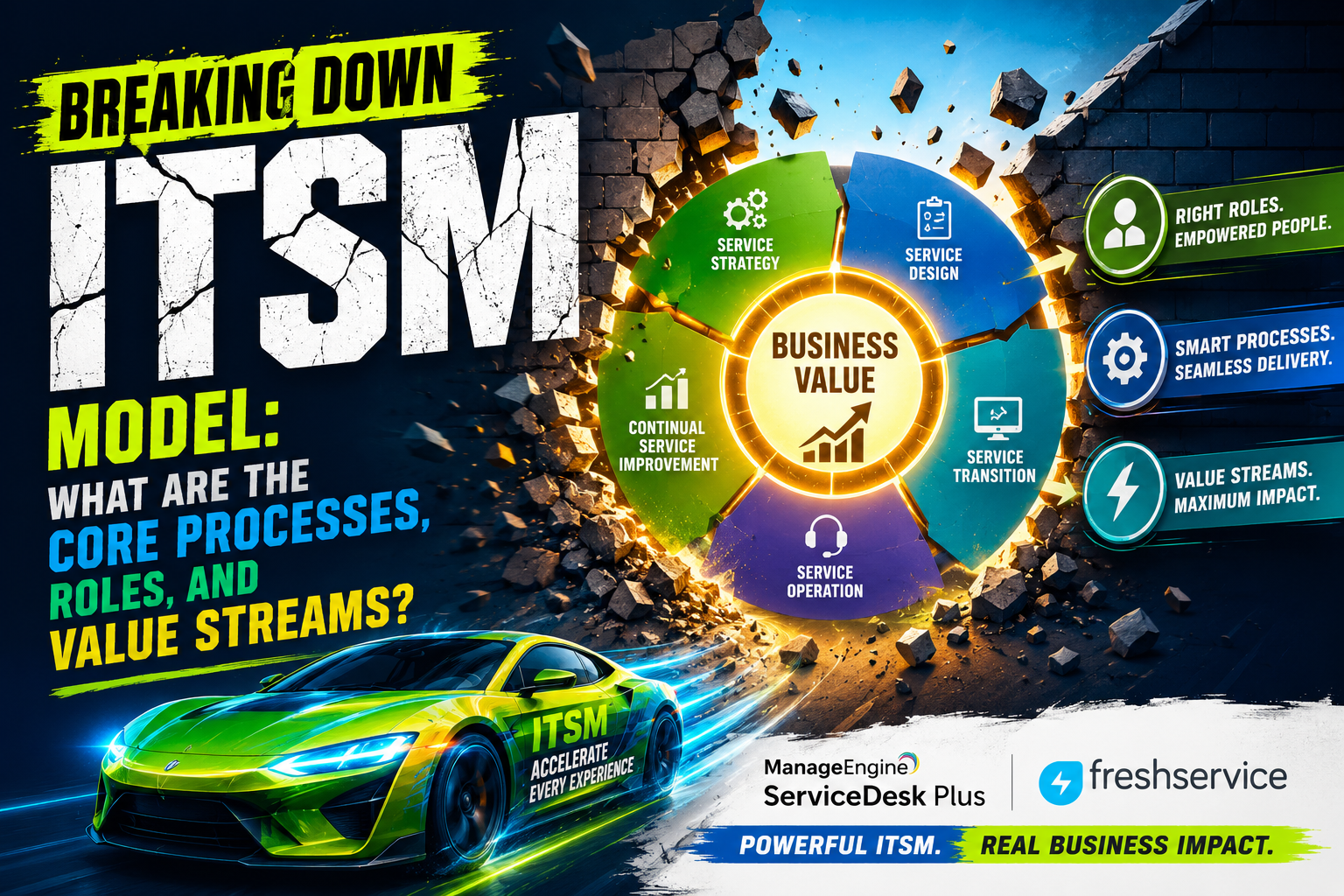
IT Service Management (ITSM) sits at the heart of every well-functioning IT organization. It defines how teams plan, deliver, manage, and continuously improve the IT services that keep businesses running. Yet despite its widespread adoption, many organizations still struggle to articulate what ITSM actually consists of — beyond a collection of tickets and workflows.
This article breaks down the ITSM model in practical terms: the key processes that structure service delivery, the roles that make those processes work, and the value streams that connect IT activities directly to business outcomes. Furthermore, we examine how leading ITSM platforms — ManageEngine ServiceDesk Plus and Freshservice — implement these concepts in practice. Finally, we explain why partnering with Solution for Guru accelerates your ITSM journey.
Table of contents
What Does This Guide Cover? — Quick Summary
Here is a concise overview of the topics this article addresses:
- A clear definition of the ITSM model and its foundational frameworks
- The seven core ITSM processes every organization needs
- Key ITSM roles and their responsibilities
- How value streams connect ITSM processes to business outcomes
- How ManageEngine ServiceDesk Plus and Freshservice implement ITSM
- A head-to-head comparison of both platforms
- The benefits of working with Solution for Guru
- Frequently Asked Questions
Which ITSM Platforms Best Implement the ITSM Model?
How Does ManageEngine ServiceDesk Plus Approach ITSM?

ManageEngine ServiceDesk Plus is an enterprise-grade ITSM platform developed by ManageEngine — a division of Zoho Corporation trusted by over 180,000 organizations worldwide. The platform delivers full ITIL v4-aligned service management across incident, problem, change, asset, and service catalog management, all within a single unified console.
What makes ManageEngine particularly powerful is its flexibility. Organizations can deploy it on-premise, in the cloud, or in a hybrid configuration — a critical advantage for regulated industries and enterprises with strict data residency requirements. Moreover, ManageEngine integrates deeply with the broader ManageEngine and Zoho ecosystem, enabling seamless connectivity across IT operations, network monitoring, endpoint management, and business applications.
ManageEngine ServiceDesk Plus also incorporates Zia, an AI-powered assistant that automates ticket categorization, suggests resolutions from the knowledge base, and flags anomalies in service delivery — directly reducing mean time to resolution (MTTR).
How Does Freshservice Bring the ITSM Model to Life?

Freshservice, developed by Freshworks, represents the modern cloud-native approach to ITSM. Built from the ground up as a SaaS platform, Freshservice delivers enterprise ITSM capabilities through an intuitive, consumer-grade interface that teams adopt quickly — typically without extensive training.
Freshservice aligns fully with ITIL v4, covering all major service management processes while adding a strong layer of AI-powered automation through its Freddy AI engine. Freddy handles ticket routing, sentiment analysis, and resolution suggestions, helping service desks operate more efficiently as ticket volumes grow. Additionally, Freshservice offers native integrations with collaboration tools like Slack and Microsoft Teams, bringing service management directly into the environments where employees already work.
Freshservice suits fast-growing companies and cloud-first organizations that need powerful ITSM without the complexity of on-premise infrastructure.
What Is the ITSM Model and Why Does It Matter?
How Do We Define IT Service Management?
IT Service Management refers to the entirety of activities, policies, and processes that an organization uses to design, deliver, manage, and improve IT services for its customers and employees. Rather than treating IT as a collection of technologies, ITSM treats IT as a service — one that must align with business goals, meet user expectations, and deliver measurable value.
The ITSM model draws its structure from established frameworks, most notably ITIL (IT Infrastructure Library), which the UK government originally developed and which Axelos now maintains under ITIL 4. According to Axelos, ITIL 4 defines a service management system built around four dimensions: organizations and people, information and technology, partners and suppliers, and value streams and processes. Together, these dimensions ensure that ITSM delivers not just technical outcomes but genuine business value.
Why Does Every Organization Need a Defined ITSM Model?
Organizations without a structured ITSM model typically experience repeated incidents, unclear accountability, slow change processes, and frustrated users. In contrast, organizations that implement ITSM frameworks consistently report faster resolution times, higher user satisfaction scores, lower IT costs, and greater alignment between IT and business strategy.
Furthermore, regulatory environments increasingly require documented IT processes. Industries such as healthcare, finance, and government must demonstrate controlled IT change management and incident response as part of compliance audits. An ITSM model provides exactly this structure — transforming ad-hoc IT activity into a documented, auditable, and continuously improving system.
What Are the Core Processes Within the ITSM Model?
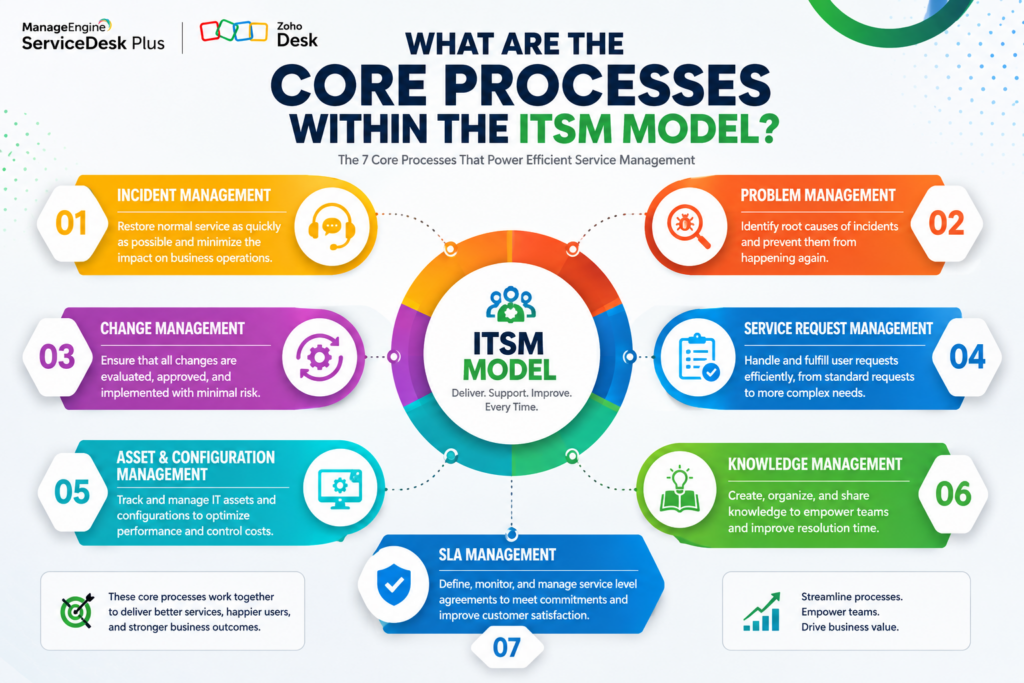
The ITSM model organizes IT activities into defined processes, each with a specific purpose, inputs, outputs, and owners. The table below summarizes the seven most critical ITSM processes before we explore each in detail:
| ITSM Process | Primary Goal | Key Output |
|---|---|---|
| Incident Management | Restore normal service as fast as possible | Resolved incidents, reduced downtime |
| Problem Management | Identify and eliminate root causes | Known error database, permanent fixes |
| Change Management | Control risk during changes to IT services | Authorized, tested, documented changes |
| Service Request Management | Fulfill standard user requests efficiently | Completed requests, satisfied users |
| Asset & Configuration Mgmt | Track and manage IT assets and relationships | Accurate CMDB, optimized asset lifecycle |
| Knowledge Management | Capture and share IT knowledge organization-wide | Knowledge base, faster resolution times |
| SLA Management | Meet agreed service levels consistently | SLA compliance reports, accountability |
How Does Incident Management Restore Business Operations?
Incident management focuses on restoring normal service operation as quickly as possible after an unplanned disruption. An incident is any event that interrupts or degrades an IT service — from a server outage to a failed login. The primary goal is minimizing business impact, not necessarily finding the root cause (that falls under problem management).
Both ManageEngine and Freshservice excel here. ManageEngine ServiceDesk Plus uses SLA-driven workflows that automatically escalate incidents based on priority, ensuring critical issues never get lost in the queue. Freshservice applies Freddy AI to categorize and route incoming incidents automatically, reducing manual triage time and accelerating assignment to the right technician. Consequently, both platforms help teams achieve faster MTTR and higher first-call resolution rates.
What Role Does Problem Management Play in Long-Term Stability?
While incident management reacts to disruptions, problem management takes a proactive approach. Problem managers investigate the root causes behind recurring incidents, document findings in a known error database (KEDB), and implement permanent fixes that prevent recurrence. This process transforms reactive firefighting into strategic stability.
ManageEngine ServiceDesk Plus links problems directly to associated incidents and CIs (configuration items) within its CMDB, giving problem managers complete visibility into the affected infrastructure. Freshservice similarly connects problems to incident records and provides trend analysis that highlights which systems generate the most incidents — enabling prioritization of root cause investigations based on business impact.
How Does Change Management Reduce Risk During IT Transitions?
Change management controls the lifecycle of all changes to IT infrastructure and services, from minor patches to major system migrations. Its purpose is to maximize the number of successful changes while minimizing disruption to ongoing services. Poorly managed changes account for a significant share of major incidents — research from ITIL practitioners suggests that up to 80% of unplanned outages stem from human error during change implementation.
ManageEngine ServiceDesk Plus supports a full Change Advisory Board (CAB) workflow, complete with risk assessment templates, approval chains, and post-implementation review tracking. Freshservice offers a visual change calendar that gives stakeholders a clear picture of scheduled changes, alongside automated conflict detection that flags overlapping changes before they create problems. Both platforms therefore give organizations the governance structure needed to drive change confidently.
How Does Service Request Management Improve the Employee Experience?
Service request management handles standard, pre-approved requests from users — such as software installations, access provisioning, hardware requests, or password resets. Unlike incidents, service requests follow defined fulfillment workflows that teams execute consistently, without requiring escalation or emergency response.
A well-designed service catalog sits at the center of this process. ManageEngine ServiceDesk Plus offers a highly configurable multi-tier service catalog where IT teams define request templates, approval workflows, and SLAs for each service type. Freshservice provides a drag-and-drop catalog builder that non-technical managers can update independently, democratizing service catalog management and reducing bottlenecks. Together, these capabilities transform service request fulfillment from a manual, inconsistent process into a reliable, self-service experience.
How Do Asset and Knowledge Management Strengthen the ITSM Model?
Why Does Asset and Configuration Management Matter?
IT asset management (ITAM) and configuration management provide the foundational data layer that underpins every other ITSM process. Without accurate knowledge of what assets exist, how they are configured, and how they relate to each other, incident resolution slows, change risk increases, and compliance audits become nightmares.
The configuration management database (CMDB) serves as the authoritative record of all IT assets and their relationships. ManageEngine ServiceDesk Plus includes a powerful CMDB with auto-discovery capabilities, allowing IT teams to automatically detect and catalog devices, software, and their interdependencies across the network. Freshservice‘s CMDB similarly uses agent-based and agentless discovery to maintain an up-to-date asset inventory, with visual dependency mapping that shows exactly how configuration items relate to one another — invaluable during incident and change management.
How Does Knowledge Management Accelerate Resolution Times?

Knowledge management captures the collective expertise of the IT team and makes it accessible to both technicians and end users. A well-maintained knowledge base reduces repeat incident resolution time, enables self-service problem solving, and preserves institutional knowledge even as team members change.
ManageEngine ServiceDesk Plus integrates its knowledge base directly into the incident management workflow. When technicians log an incident, the platform automatically suggests relevant knowledge articles — reducing resolution time without requiring manual searching. Freshservice takes a similar approach, with Freddy AI proactively surfacing relevant articles during ticket creation and presenting them to end users through the self-service portal before they even submit a ticket. As a result, both platforms drive down ticket volume while improving the quality of resolutions.
What ITSM Roles Drive Successful Service Delivery?
Processes alone do not deliver results — people do. The ITSM model defines specific roles that carry accountability for each process. The table below outlines the key roles, their responsibilities, and how ManageEngine and Freshservice support each:
| ITSM Role | Responsibilities | Tools Used |
|---|---|---|
| Service Desk Agent | Log, triage, and resolve incidents and requests | ManageEngine, Freshservice ticketing module |
| Incident Manager | Oversee incident lifecycle, coordinate escalations | ManageEngine SDP, Freshservice analytics |
| Problem Manager | Investigate root causes, manage known errors | CMDB, problem records in both platforms |
| Change Manager | Evaluate, approve, and schedule changes | CAB module in ManageEngine, Change Calendar in Freshservice |
| IT Asset Manager | Manage asset inventory, lifecycle, compliance | ManageEngine AssetExplorer, Freshservice CMDB |
| Knowledge Manager | Curate and maintain the knowledge base | Self-service portals in both platforms |
| Service Owner | Accountable for end-to-end service quality | SLA dashboards, management reports |
How Do Service Desk Agents Use ManageEngine and Freshservice Daily?
Service desk agents form the frontline of ITSM delivery. They receive, log, prioritize, and resolve incidents and service requests — acting as the primary point of contact between IT and the rest of the organization. Both ManageEngine and Freshservice provide agents with intelligent, unified workspaces that consolidate all relevant information: ticket history, asset details, related incidents, and suggested resolutions.
ManageEngine’s agent workspace includes a powerful remote support integration, enabling agents to connect to a user’s device directly from within a ticket — eliminating the need to switch between tools. Freshservice offers a similarly streamlined experience with its Freshdesk Omnichannel integration, allowing agents to handle tickets arriving via email, chat, phone, and the self-service portal from a single interface.
What Makes the Change Manager Role Critical to ITSM Success?
The change manager bears responsibility for one of the highest-risk ITSM processes. This role evaluates change requests for risk and impact, coordinates CAB reviews, schedules changes to minimize service disruption, and ensures post-implementation reviews capture lessons learned. Without a dedicated change manager applying consistent governance, organizations accumulate technical debt and experience avoidable outages.
Both ManageEngine and Freshservice give change managers the tools they need. ManageEngine’s change management module includes customizable risk matrices, multi-level approval workflows, and automatic linking of changes to related incidents and problems. Freshservice’s change calendar provides a visual timeline of all scheduled changes, with automated notifications to relevant stakeholders — ensuring that change managers maintain oversight without micromanaging every approval step.
What Are ITSM Value Streams and How Do They Connect IT to Business Outcomes?
How Does ITIL 4 Define Value Streams?
ITIL 4 introduced the concept of value streams as a central organizing principle of modern ITSM. A value stream describes the specific combination of activities an organization performs to create and deliver value to a customer or user. Rather than viewing ITSM as a collection of isolated processes, value streams connect those processes end-to-end — from user demand through to service fulfillment and improvement.
ITIL 4 identifies two primary value stream archetypes: one focused on developing and delivering new services, and another focused on restoring services when they fail. In practice, most organizations operate multiple overlapping value streams simultaneously — each optimized for a specific service type or user segment. Understanding these streams helps IT leaders identify bottlenecks, eliminate waste, and prioritize improvement initiatives based on their impact on business value rather than internal IT metrics.
How Do ManageEngine and Freshservice Support Value Stream Thinking?
Both platforms support value stream thinking through their workflow automation, reporting, and continuous improvement capabilities. ManageEngine ServiceDesk Plus allows IT leaders to map complete service workflows visually, identify where tickets stall, measure time-in-state for each process step, and automate transitions to eliminate manual handoffs. This visibility gives organizations the data they need to optimize value delivery continuously.
Freshservice approaches value stream optimization through its analytics module, which provides real-time dashboards showing ticket flow, SLA performance, agent productivity, and customer satisfaction scores across every stage of the service lifecycle. Furthermore, Freshservice’s scenario automation feature lets teams define complex multi-step automation rules that trigger based on any combination of ticket attributes — effectively encoding value stream logic directly into the platform.
Why Does Value Stream Alignment Transform IT From a Cost Center to a Value Driver?
Organizations that align their ITSM processes with clearly defined value streams stop measuring IT success solely by uptime percentages and ticket closure rates. Instead, they measure outcomes that business leaders care about: employee productivity, service availability, time-to-market for new capabilities, and customer satisfaction.
This shift in perspective transforms IT from a reactive cost center into a proactive value driver. According to HDI’s 2023 State of the Service Desk report, organizations with mature ITSM practices report 25% higher employee satisfaction scores and 30% lower IT operating costs compared to those with informal IT processes. ManageEngine and Freshservice both provide the measurement infrastructure needed to track these outcomes and demonstrate IT’s contribution to business performance.
How Do ManageEngine and Freshservice Compare as ITSM Platforms?

Both ManageEngine ServiceDesk Plus and Freshservice implement the ITSM model comprehensively, but they approach it from different angles. The comparison table below breaks down their key differences to help organizations choose the right fit:
| Feature / Criteria |  | Freshservice |
|---|---|---|
| Deployment | On-premise, cloud, or hybrid | Cloud-only (SaaS) |
| ITIL Alignment | Full ITIL v3 & v4 aligned | Full ITIL v3 & v4 aligned |
| Incident Management | Advanced automation, SLA management | AI-powered categorization & routing |
| Change Management | CAB workflow, risk assessment, rollback | Change calendar, risk analysis, rollback |
| Asset Management | CMDB, auto-discovery, hardware/software | Agent-based discovery, CMDB, lifecycle tracking |
| Service Catalog | Customizable multi-tier catalog | Drag-and-drop catalog builder |
| AI / Automation | Zia AI assistant, workflow automation | Freddy AI, scenario automations |
| Self-Service Portal | Branded portal, knowledge base | Intuitive portal, conversational bots |
| Integrations | 500+ integrations, Zoho ecosystem | 300+ integrations, native Slack/Teams |
| Reporting & Analytics | Custom dashboards, scheduled reports | Real-time analytics, pre-built templates |
| Pricing Model | Perpetual license or subscription | Subscription only (free trial available) |
| Best For | Enterprises, regulated industries, on-premise needs | SMBs, fast-growing companies, cloud-first teams |
In short, ManageEngine ServiceDesk Plus suits organizations that need deep IT management integration, flexible deployment, and comprehensive enterprise controls. Freshservice excels for cloud-first organizations that prioritize ease of use, fast onboarding, and strong AI-driven automation. Both platforms are available for evaluation through AppWiki, and Solution for Guru can guide your selection process with platform-specific expertise.
What Are the Key Conclusions About the ITSM Model?
The ITSM model provides organizations with a structured, proven approach to delivering IT services that genuinely support business goals. By organizing IT activities into well-defined processes — incident management, problem management, change management, service request management, asset management, and knowledge management — ITSM transforms reactive IT firefighting into proactive, measurable service delivery.
Equally important are the roles that bring these processes to life. Service desk agents, change managers, problem managers, and knowledge managers each carry specific accountability that ensures no process falls through the cracks. And when organizations align their ITSM processes with value streams that connect IT activity directly to business outcomes, IT shifts its identity from a cost center to a strategic value driver.
ManageEngine ServiceDesk Plus and Freshservice both deliver the tooling organizations need to implement this model effectively. ManageEngine’s depth, flexibility, and integration with the broader IT management ecosystem make it the platform of choice for complex enterprise environments. Freshservice‘s cloud-native simplicity, AI-powered automation, and consumer-grade user experience make it ideal for agile, fast-growing organizations. Regardless of which platform you choose, both embed ITIL best practices directly into their workflows, accelerating your path to ITSM maturity.
Furthermore, the organizations that extract the most value from ITSM platforms are those that invest in proper implementation, process design, and continuous improvement — not just technology deployment. This is precisely why partnering with Solution for Guru makes such a measurable difference. With expert guidance, your ITSM investment delivers the processes, roles, and value streams that transform IT service delivery from a reactive burden into a competitive advantage.
Frequently Asked Questions About the ITSM Model
ITSM (IT Service Management) is the discipline — the practice of managing IT services in a structured, service-oriented way. ITIL (IT Infrastructure Library) is a framework — a set of best practices and guidelines that organizations use to implement ITSM. In other words, ITSM defines what organizations need to do, while ITIL describes how they can do it.
ITIL is not the only ITSM framework. Others include COBIT (focused on IT governance), ISO/IEC 20000 (an international standard for ITSM), and DevOps practices that integrate service management with software development. However, ITIL remains the most widely adopted ITSM framework globally, with millions of certified practitioners and a rich ecosystem of tools — including both ManageEngine ServiceDesk Plus and Freshservice — designed to support its implementation.
Implementation timelines vary significantly depending on organizational size, process complexity, and the level of customization required. However, most organizations can deploy a functional ITSM environment with core processes — incident, request, and change management — within four to twelve weeks using either platform. Freshservice generally achieves faster initial deployment due to its SaaS architecture and intuitive configuration interface. ManageEngine ServiceDesk Plus implementations may take longer for on-premise deployments or complex integrations, but Solution for Guru’s structured implementation methodology significantly compresses these timelines.
Organizations measure ITSM success through a combination of operational metrics and business outcome indicators. Key operational metrics include Mean Time to Resolve (MTTR), First Contact Resolution Rate (FCR), SLA compliance percentage, Change Success Rate, and Self-Service Adoption Rate. These metrics tell IT leaders how efficiently their processes operate. However, mature ITSM organizations go beyond operational metrics to measure business outcomes: employee productivity impact, service availability, cost per ticket, and user satisfaction scores (often captured through CSAT surveys built into tools like ManageEngine and Freshservice). Both platforms provide native reporting and analytics that track these metrics continuously, enabling organizations to connect ITSM performance to the business value streams it supports.
Why Does Partnering With Solution for Guru Accelerate Your ITSM Success?
What Does Solution for Guru Bring to ITSM Implementations?
Implementing an ITSM model is not simply a technology project — it is an organizational transformation. Configuring ManageEngine or Freshservice to reflect your specific processes, roles, and value streams requires deep ITSM expertise combined with hands-on platform knowledge. Solution for Guru provides exactly this combination.
Solution for Guru is a specialized IT consultancy that helps organizations design, deploy, and continuously improve their ITSM environments. The team brings certified expertise across both ManageEngine and Freshservice, enabling them to guide organizations through platform selection, implementation, process design, and ongoing optimization — regardless of where they are on their ITSM maturity journey.
What Specific Benefits Do Organizations Gain From Working With Solution for Guru?
- Expert Platform Implementation: Solution for Guru handles end-to-end deployment of ManageEngine ServiceDesk Plus and Freshservice, configuring processes, workflows, and integrations according to ITIL best practices.
- ITSM Process Design: The team works with your organization to map existing IT processes, identify gaps, and design ITIL-aligned workflows that reflect your real operational context — not generic templates.
- CMDB and Asset Management Setup: Building an accurate CMDB from scratch is one of the most challenging ITSM tasks. Solution for Guru provides structured methodologies for discovery, data quality, and ongoing CMDB governance.
- Role Definition and Training: Solution for Guru helps organizations define ITSM roles clearly, establish accountability structures, and train staff to perform their roles confidently within the chosen platform.
- Value Stream Mapping: The team facilitates value stream mapping workshops that translate ITIL 4 concepts into practical, documented workflows tailored to your business environment.
- Ongoing Optimization and Support: After go-live, Solution for Guru provides continuous improvement support, helping organizations measure ITSM performance, address bottlenecks, and evolve their processes as the business grows.
Working with Solution for Guru means your ITSM investment delivers results faster, with fewer implementation risks and a team of experts ensuring your platform configuration aligns with your operational reality.
Recommended:
- Common ITSM Deployment Mistakes Businesses Make — and How to Avoid Them
- ITSM for DevOps Teams: Bridging Agile and Service Management
- Event-Driven ITSM: How Do You Connect Monitoring Alerts to Automated Ticketing?
- Integrating Monitoring Tools with ManageEngine or Freshservice for Proactive Support
- Freshservice Asset Management vs ManageEngine Asset Discovery
- On-Premise vs Cloud ITSM: Choosing Between ManageEngine and Freshservice Architectures
- Freshservice for Internal IT Support: What Problems Does It Solve?
- How Does Freshservice Simplify IT Service Management for Modern Organizations?
- How Do Businesses Integrate Slack and Microsoft Teams with ITSM Platforms?
- Automating Software License Tracking with ITSM Solutions: How Can You Take Control?
- Best Microsoft 365 Integrations for ManageEngine and Freshservice
- Integrating Endpoint Management Tools with ITSM Systems
- Aligning ITSM Processes with ISO 20000 Standards
- How Long Does an ITSM Implementation Really Take? Key Factors Explained
- ManageEngine vs Freshservice
- Top ITSM Best Practices Using ManageEngine