Choosing and Implementing the Right ITSM Model for Your IT Team

Most IT teams are already operating inside some kind of IT service management approach, whether they’ve formally named it or not. The real challenge isn’t deciding whether to have a model; it’s figuring out which one actually fits your organization’s size, maturity, and goals, and then choosing a platform capable of turning that model into daily practice. Get this decision right, and IT stops feeling like a bottleneck and starts operating as a genuine business partner. Get it wrong, and your team ends up buried in rigid processes that don’t match how the work actually gets done.
This article walks through the major ITSM models available today, explains how to evaluate which one suits your team, and shows how two widely used platforms, ManageEngine ServiceDesk Plus and Freshservice, bring these frameworks to life in practice.
Table of contents
Quick Summary
- ITSM models, such as ITIL 4, COBIT, Lean IT, and lightweight frameworks like FitSM, each suit different organizational goals, from operational efficiency to regulatory compliance.
- Choosing the right model depends on your business goals, existing culture, available resources, and how much process overhead your team can realistically sustain.
- ManageEngine ServiceDesk Plus offers deep ITIL-certified coverage across incident, problem, change, and asset management, making it a strong fit for organizations that need comprehensive process support and flexible on-premises or cloud deployment.
- Freshservice emphasizes fast time-to-value with a clean interface and AI-assisted automation, appealing to mid-market teams that want ITIL-aligned practices without heavy configuration overhead.
- Successful ITSM implementation depends as much on people and pilot programs as it does on the software itself.
- Partnering with a digital transformation specialist like Solution For Guru helps IT teams configure, customize, and roll out their chosen ITSM model correctly the first time.
How Do ManageEngine ServiceDesk Plus and Freshservice Relate to Choosing an ITSM Model?
Selecting an ITSM model is only half the equation. Without the right software to operationalize that model, even the best-designed framework remains a document nobody follows. This is exactly where ManageEngine ServiceDesk Plus and Freshservice enter the conversation, since both platforms translate ITSM theory into daily, practical workflows for IT teams.
ManageEngine ServiceDesk Plus has built its reputation on deep ITIL alignment. The platform is ITIL-certified for 14 practices and covers incident, problem, change, release, and configuration management, giving organizations that need comprehensive process coverage a single system capable of supporting nearly every core ITSM discipline. Because it’s available in both cloud and on-premises deployments, it also appeals to organizations in regulated industries where self-hosting remains a requirement.
Freshservice, on the other hand, takes a different approach by prioritizing speed and usability. Rather than requiring extensive configuration before teams see value, Freshservice delivers ITIL-aligned incident, problem, change, and service request management with a clean interface and AI-assisted automation baked in from the start. This makes it particularly attractive to mid-market IT teams that want structured, ITIL-informed processes without the implementation overhead typically associated with enterprise-grade tools.
Consequently, these two platforms represent two legitimate but distinct paths toward the same goal: implementing a working ITSM model. One favors depth and configurability; the other favors speed and simplicity. Understanding this distinction sets the stage for the rest of this article, since the “right” ITSM model ultimately depends not just on frameworks but on the platform capable of delivering it.
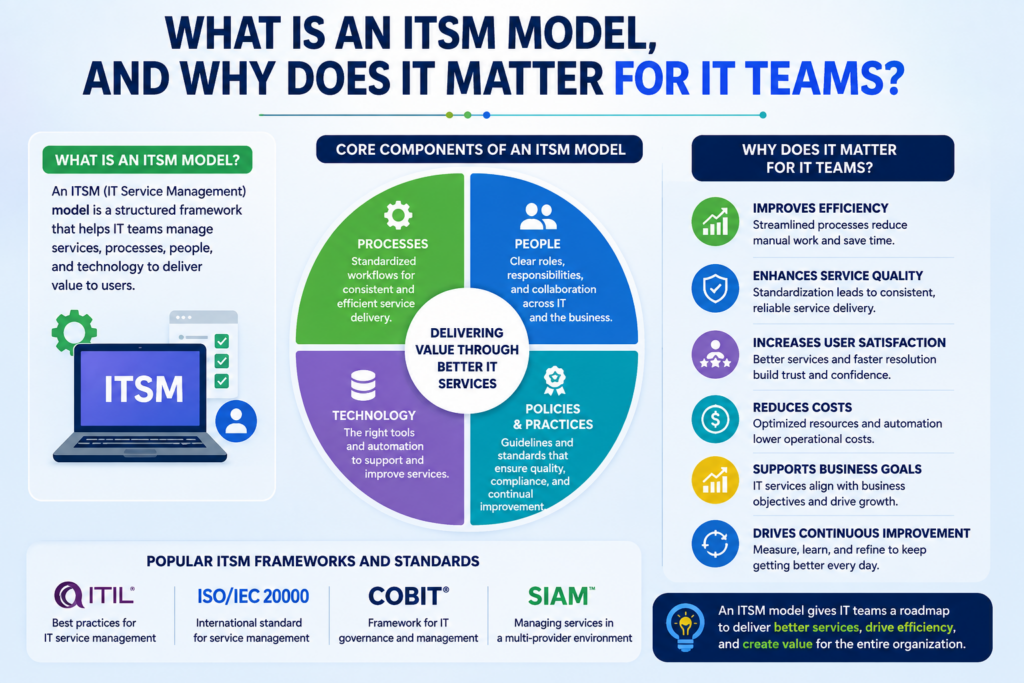
What Is an ITSM Model, and Why Does It Matter for IT Teams?
How Does ITSM Differ From a Specific Framework Like ITIL?
IT service management, or ITSM, refers to all the activities an organization plans, delivers, operates, and controls to provide IT services to its stakeholders. ITSM describes the “what”: the overall discipline of managing IT as a service rather than a collection of disconnected tools and tickets. Frameworks like ITIL, by contrast, describe the “how,” offering specific guidance and best practices for executing that discipline consistently.
Why Does Choosing the Right Model Matter So Much?
Without a defined model, IT departments tend to operate reactively, responding to whatever issue is loudest rather than following a consistent, prioritized process. This reactive pattern creates inconsistent service quality, unpredictable resolution times, and frustrated end users. A well-chosen ITSM model solves this by giving the team a shared structure for handling incidents, requests, changes, and problems, which in turn builds trust with the rest of the business.
How Does Model Choice Affect Long-Term Scalability?
Furthermore, the model you choose today shapes how easily your IT function can scale tomorrow. A framework that’s too heavyweight for a small team creates unnecessary friction and slows down basic requests. Conversely, an approach that’s too lightweight for a growing, complex organization leaves gaps in governance, especially around change management and compliance. Getting this balance right from the start prevents a painful, disruptive framework migration later.
What Are the Major ITSM Frameworks Available Today?
What Makes ITIL 4 the Default Starting Point for Most Teams?
For most organizations, ITIL 4 remains the right default starting point. It’s the most comprehensive, the most widely supported by tooling and training, and the most current in its approach to modern IT environments, including cloud services and DevOps integration. Both ManageEngine ServiceDesk Plus and Freshservice build their core workflows around ITIL practices, which is precisely why so many teams start their ITSM journey with this framework.
When Should Teams Consider COBIT or ISO/IEC 20000?
Organizations in regulated industries, such as finance, healthcare, or government, often layer COBIT over their ITIL foundation for stronger governance, risk management, and audit readiness. Similarly, ISO/IEC 20000 supports organizations that need formal, certifiable conformity to an international service management standard. These frameworks don’t replace ITIL so much as add structure on top of it for compliance-heavy environments.
What About Lightweight or Agile-Oriented Approaches?
Not every organization needs, or can sustain, a comprehensive framework. FitSM keeps things intentionally lightweight for smaller teams that need just enough structure without heavy documentation demands. Meanwhile, DevOps and Lean IT principles bring speed and continuous improvement into the mix, which matters for organizations whose engineering teams already operate in fast, iterative delivery cycles. Below is a quick reference comparing these approaches.
| Framework | Best For | Key Focus |
|---|---|---|
| ITIL 4 | Most organizations, any size | Comprehensive, end-to-end service management |
| COBIT | Regulated industries (finance, healthcare, government) | Governance, risk, and compliance |
| ISO/IEC 20000 | Organizations needing formal certification | International conformity standard |
| FitSM | Small teams, resource-constrained IT | Lightweight, minimal overhead |
| DevOps / Lean IT | Engineering-driven, agile organizations | Speed, automation, continuous improvement |
How Do You Assess Which ITSM Model Fits Your Organization?
What Role Do Business Goals Play in the Decision?
Start by defining your primary objective. If compliance and risk management top the list, a framework like COBIT deserves serious consideration. If operational efficiency and service consistency matter more, ITIL 4 is typically the better fit. Being explicit about this goal early prevents teams from adopting a framework simply because it’s popular rather than because it addresses an actual business need.
How Should Organizational Culture Influence the Choice?
The model you select should also match your existing culture and working style. A team already comfortable with structured, process-driven work will adapt naturally to ITIL, while a quality-focused organization may find a maturity model like CMMI resonates more closely with how it already thinks about improvement. Forcing an unfamiliar framework onto a team that isn’t culturally ready for it often generates more resistance than results.
How Much Do Resources and Timelines Actually Matter?
Comprehensive frameworks demand more documentation, training, and ongoing maintenance than simpler models. Before committing, honestly assess your team’s capacity for improvement activities. A resource-constrained team gains more from a streamlined approach that delivers quick, visible wins than from an ambitious framework that stalls halfway through implementation due to lack of bandwidth.
Why Should You Involve Stakeholders From Across the Business?
Finally, involve service desk leaders, operations, security, and business stakeholders in the decision itself. ITSM implementations frequently fail when they’re designed in a vacuum, since the people actually doing the work will route around a process they had no hand in shaping. Gathering this input early leads to a model people actually follow, rather than one that exists only on paper.
What Role Does ITSM Software Play in Making a Framework Operational?
Why Isn’t Choosing a Framework Enough on Its Own?
Frameworks live in the people and systems that carry them out, not in documents and diagrams. Choosing ITIL 4, for example, is only the first step; making it operational requires a platform that supports the specific practices you’re implementing, including incident logging, change approval workflows, and knowledge management. Without that operational layer, even a well-designed framework remains theoretical.
What Should IT Teams Look for in ITSM Software?
When evaluating platforms, look for built-in support for incident and problem management, structured change workflows, and self-service capabilities that reduce the burden on your service desk. A clean, intuitive self-service portal that lets employees request help, search for knowledge, and track progress independently is especially valuable, since it directly reduces ticket volume for routine requests.
How Do ManageEngine and Freshservice Fit Into This Requirement?
This is exactly the gap that ManageEngine ServiceDesk Plus and Freshservice are built to fill. Both platforms translate framework-level guidance into concrete, day-to-day functionality: ticket routing, SLA tracking, automated workflows, and reporting dashboards that give IT leaders visibility into how well the chosen model is actually performing in practice.
How Does ManageEngine ServiceDesk Plus Support ITSM Implementation?
What Makes ManageEngine’s ITIL Coverage So Comprehensive?
ManageEngine ServiceDesk Plus stands out for the breadth of its ITIL alignment. The platform holds PinkVERIFY certification across seven ITSM practices, including incident, problem, change, release, and configuration management, and is ITIL-certified for 14 practices overall in its Enterprise tier. This depth means organizations can implement a comprehensive ITIL 4 rollout largely within a single platform, without stitching together multiple point solutions.
How Does Deployment Flexibility Benefit Certain Organizations?
Unlike many newer, cloud-only competitors, ManageEngine offers both cloud and on-premises deployment options. This flexibility matters significantly for organizations in regulated industries or those with strict data residency requirements, since self-hosting remains off the table for many cloud-native alternatives. Additionally, organizations already using other Zoho or ManageEngine products often find the integration story particularly compelling, since these tools share a common ecosystem.
What Trade-Offs Should Teams Expect With ManageEngine?
That said, comprehensive coverage comes with a learning curve. Setup and configuration in ManageEngine ServiceDesk Plus can be time-consuming, and teams without a dedicated IT administrator to manage the deployment often find the process steeper than expected. In other words, the platform rewards organizations willing to invest setup time in exchange for depth and long-term flexibility.
How Does Freshservice Support ITSM Implementation?

What Makes Freshservice Appealing for Fast-Moving Teams?
Freshservice is built for mid-market organizations that want ITIL-aligned service desk capabilities without the implementation overhead of enterprise tools. Its clean, modern interface and self-service cloud setup mean teams can typically get up and running within days to two weeks, a timeline comparable to ManageEngine but achieved through simpler initial configuration rather than deep customization.
How Does AI Factor Into Freshservice’s Approach?
A defining feature of Freshservice is its Freddy AI suite, which includes an AI Agent, AI Copilot, and AI Insights component. These tools assist with solution articles, automated ticket summaries, and personalized chat responses, reducing the manual workload on service desk agents. For teams that want AI-augmented automation without heavy technical configuration resources, this baked-in intelligence layer offers a meaningful head start compared to platforms that treat AI as a bolt-on afterthought.
What Should Teams Weigh Before Choosing Freshservice?
However, Freshservice‘s emphasis on simplicity comes with certain trade-offs. Its asset management capabilities are generally considered thinner than more established platforms, and the absence of an on-premises deployment option rules it out entirely for organizations in industries where cloud hosting isn’t permitted. Advanced AI features, such as the Freddy AI Copilot, also require add-on pricing on Pro and Enterprise tiers, which can increase total cost of ownership as usage scales.
How Do ManageEngine ServiceDesk Plus and Freshservice Compare Side by Side?
The table below summarizes the core differences between these two platforms to help IT leaders match features to their organization’s priorities.
| Factor |  | |
|---|---|---|
| ITIL certification depth | Certified for 14 practices (Enterprise tier) | ITIL-aligned incident, problem, change, request management |
| Deployment options | Cloud and on-premises | Cloud only |
| Setup complexity | Higher, benefits from a dedicated admin | Lower, self-service cloud setup |
| AI capabilities | OpenAI integration, dependent on other modules | Freddy AI Agent, Copilot, and Insights built in |
| Asset management | Robust CMDB and lifecycle management | Comparatively lighter asset tracking |
| Integration ecosystem | ~300+ integrations, strong within Zoho/ManageEngine stack | 750+ integrations, broad third-party marketplace |
| Best suited for | Organizations needing deep ITIL coverage and on-prem flexibility | Mid-market teams wanting fast time-to-value and modern UX |
Ultimately, the right choice between these two platforms mirrors the broader ITSM model decision: depth and control versus speed and simplicity. Some organizations will find that ManageEngine ServiceDesk Plus‘s comprehensive process coverage justifies its steeper setup curve, while others will prioritize Freshservice‘s faster path to daily usability.
What Steps Should IT Teams Follow to Implement an ITSM Model Successfully?
Choosing a model and a platform is only the beginning. The following steps outline a practical path toward successful implementation.
- Assess your current state. Document existing processes, pain points, and your team’s current ITSM maturity level before selecting a framework.
- Define clear requirements. Identify the specific features and processes needed to improve operational efficiency, rather than adopting features simply because they exist.
- Select your framework and platform together. Choose an ITSM model, then evaluate platforms like ManageEngine ServiceDesk Plus or Freshservice based on how well they support that specific framework.
- Run a pilot program. Apply the new model to one service, one team, or one practice area first, then measure results before a full-scale rollout.
- Involve cross-functional stakeholders. Bring in service desk leaders, security, and business representatives to shape workflows they’ll actually use.
- Train your team thoroughly. Ensure agents and end users understand both the new process and the software supporting it.
- Monitor and adjust continuously. Treat implementation as an ongoing process rather than a one-time project, refining workflows as real usage data comes in.
Following this sequence reduces risk considerably compared to a single, organization-wide rollout, since pilot programs surface problems early when they’re still cheap to fix.
What Common Mistakes Should IT Teams Avoid During ITSM Implementation?

Why Does Over-Engineering the Process Cause Problems?
One of the most frequent mistakes is adopting a framework more comprehensive than the organization actually needs. A five-person IT team implementing full COBIT governance structures, for instance, often ends up drowning in documentation rather than solving real service delivery problems. Matching framework complexity to actual organizational size and maturity avoids this trap entirely.
How Does Ignoring Team Input Undermine Adoption?
Designing a new ITSM process without involving the people who will use it daily is another common pitfall. If the workflow doesn’t reflect how agents actually resolve tickets or how end users actually request help, they’ll quietly work around it, undermining the entire initiative regardless of how well the framework was chosen on paper.
What Happens When Organizations Skip Pilot Testing?
Rolling out a new model organization-wide without first testing it on a smaller scale is a costly mistake. Pilot programs, focused on a single team or service, let organizations catch configuration issues, workflow gaps, and training needs before they affect the entire company. Skipping this step often means discovering critical flaws only after they’ve already disrupted operations broadly.
How Do You Measure Success After Implementing an ITSM Model?

What Metrics Actually Indicate a Successful Rollout?
Once your chosen model and platform, whether ManageEngine ServiceDesk Plus or Freshservice, are live, tracking the right metrics tells you whether the implementation is actually working. Key indicators include average resolution time, first-contact resolution rate, SLA compliance percentage, and end-user satisfaction scores. A meaningful improvement in these numbers over the first few months signals that the new model is delivering real value, not just theoretical structure.
How Should Teams Use Dashboards and Reporting?
Both platforms provide live dashboards that give managers real-time visibility into ticket volume, incident spikes, and technician workload. Reviewing these dashboards regularly, rather than only during quarterly reviews, helps IT leaders catch emerging problems early and demonstrate the tangible business value of the ITSM investment to stakeholders outside the IT department.
Why Does Continuous Improvement Matter More Than a One-Time Launch?
Successful ITSM implementation doesn’t end at go-live. As your organization’s needs evolve, whether that means added compliance requirements, growing headcount, or new service categories, your model and platform configuration should evolve alongside them. Treating the rollout as the finish line rather than the starting point is one of the most common reasons ITSM initiatives lose momentum after the initial excitement fades.
Conclusion: What’s the Bottom Line for IT Teams Choosing an ITSM Model?
Choosing the right ITSM model isn’t about picking the most popular or most comprehensive framework available; it’s about matching your organization’s business goals, culture, and resources to an approach your team can realistically sustain. ITIL 4 remains the sensible default for most organizations, with COBIT, ISO/IEC 20000, and lightweight frameworks like FitSM offering targeted alternatives for specific needs.
Once you’ve selected a model, the platform you choose to operationalize it matters just as much. ManageEngine ServiceDesk Plus offers deep, ITIL-certified process coverage and deployment flexibility for organizations willing to invest in setup complexity, while Freshservice delivers a faster, AI-augmented path to ITIL-aligned service management for mid-market teams prioritizing speed and usability. Neither platform is universally “better”; the right choice depends entirely on your organization’s specific priorities.
Regardless of which model and platform you ultimately choose, successful implementation depends on pilot testing, stakeholder involvement, and continuous measurement rather than a single, one-time rollout. Partnering with an experienced team like Solution For Guru helps ensure your chosen ITSM model, delivered through a platform like ManageEngine ServiceDesk Plus or Freshservice, actually becomes the daily operating reality for your IT team rather than another document gathering dust.
Frequently Asked Questions
No. While ITIL 4 remains the most widely adopted and comprehensive framework, it isn’t the right fit for every organization. Regulated industries often layer COBIT on top of ITIL for stronger governance, while smaller or resource-constrained teams may find lightweight frameworks like FitSM more sustainable. The right framework depends on your specific business goals and available resources, not on which option is most popular.
Yes, though migrating between ITSM platforms takes planning, since it involves transferring historical ticket data, reconfiguring workflows, and retraining staff. Many organizations start with one platform and migrate as their needs change, for example, moving from Freshservice‘s fast, simple setup to ManageEngine’s deeper ITIL coverage as compliance requirements grow, or the reverse when an organization wants to reduce configuration overhead. Planning this transition carefully, ideally with experienced implementation support, minimizes disruption during the switch.
Timelines vary based on framework complexity and organizational size, but initial platform setup for both ManageEngine ServiceDesk Plus and Freshservice typically takes anywhere from a few days to two weeks. However, full ITSM maturity, including refined workflows, comprehensive training, and stable adoption across the organization, usually takes several months of iterative improvement following the initial rollout, particularly if the team follows a pilot-first approach rather than a single, organization-wide launch.
What Are the Benefits of Partnering With Solution For Guru for ITSM Implementation?
Selecting the right ITSM model and platform is a meaningful first step, but configuring that platform correctly, training your team, and integrating it with the rest of your technology stack takes specialized expertise many IT teams don’t have readily available in-house. This is where an experienced digital solutions partner such as Solution For Guru becomes genuinely valuable.
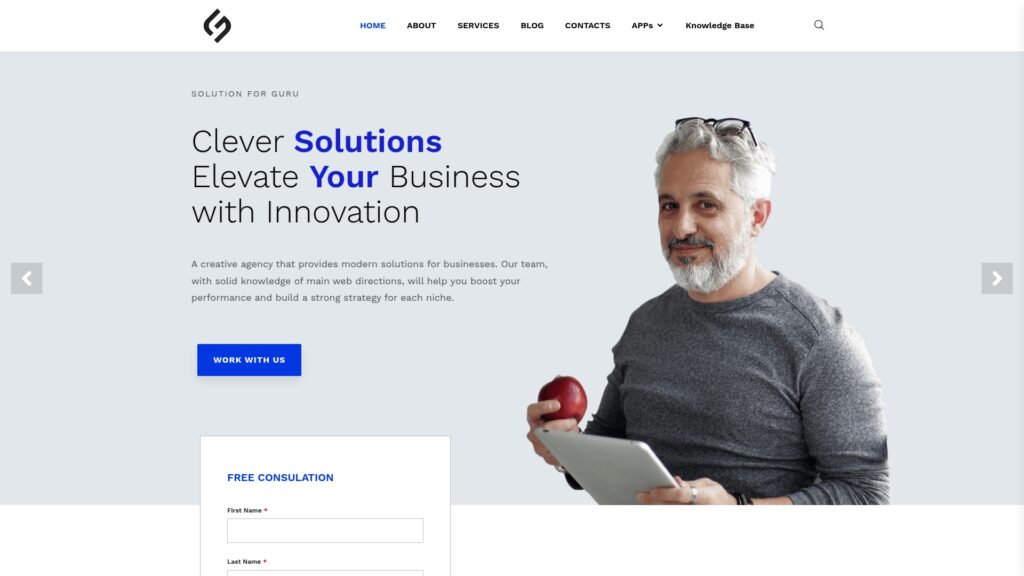
Solution For Guru specializes in web development, automation, and AI integration, giving it a practical, hands-on perspective on connecting ITSM platforms like ManageEngine ServiceDesk Plus or Freshservice to the broader digital ecosystem your business relies on. Partnering with a team like this offers several concrete advantages:
- Tailored framework and platform configuration: Instead of a generic, out-of-the-box setup, Solution For Guru configures your chosen ITSM model around your organization’s actual processes, whether that means deep ITIL customization in ManageEngine or streamlined automation in Freshservice.
- Faster, smoother rollout: With direct experience guiding organizations through digital transformation, Solution For Guru helps IT teams move from framework selection to a fully operational service desk more quickly than trial-and-error implementation.
- Seamless integrations: Whether connecting your ITSM platform to existing business systems, automation tools, or AI-driven support features, Solution For Guru’s cross-disciplinary expertise ensures these systems work together cleanly rather than existing as disconnected silos.
- Reduced risk through structured pilot programs: Solution For Guru’s process-oriented approach supports the kind of measured, pilot-first rollout that minimizes disruption while still delivering measurable results.
- Ongoing optimization: As your organization’s ITSM maturity grows, Solution For Guru provides continued support to refine workflows, expand automation, and keep your service desk aligned with evolving business needs.
In short, ManageEngine ServiceDesk Plus and Freshservice provide the engine for structured, ITIL-aligned service management, while a partner like Solution For Guru ensures that engine is configured, integrated, and optimized correctly from day one.
Recommended:
- Best Practices for IT Asset Lifecycle Management Using ITSM Platforms
- How to Measure ITSM Success After Implementing Freshservice
- How Automation in Freshservice Helps Prevent IT Bottlenecks
- Multi-Tenant ITSM Architectures: What MSPs Should Know
- How Role-Based Access Control Improves ITSM Security
- How Self-Service Portals Improve Employee Experience in Freshservice
- ERP and ITSM Integration: Improving Operational Visibility Across Departments
- Integrating Endpoint Management Tools with Freshservice
- ManageEngine Asset Management (ITAM): Why Businesses Trust It to Control Their IT Assets
- Why Mid-Sized Companies Choose Freshservice Over Enterprise ITSM Platforms
- Best Reporting and Analytics Dashboards for IT Operations Teams in Freshservice
- How ITSM Platforms Support IT Compliance and Audit Readiness
- How ITSM Tools Support Internal IT Risk Management
- How AI Is Changing ITSM Workflows in Freshservice?
- How ITSM Platforms Like Freshservice Support Digital Transformation
- Freshservice CMDB Explained: Structure, Relationships, and Best Practices
- Freshservice for Remote and Hybrid Work Environments
- Automating Employee Onboarding and Offboarding with Freshservice
- ManageEngine ServiceDesk Plus for Mid-Size Business: Is It the Right ITSM Fit?
- ManageEngine ITSM: Standard vs Professional vs Enterprise — Which Edition Fits Your Team?
- ManageEngine SLA Management: How Does It Help IT Teams Meet Every Deadline?