Snapshot ProView: Can Telematics Really Lower Commercial Auto Premiums?
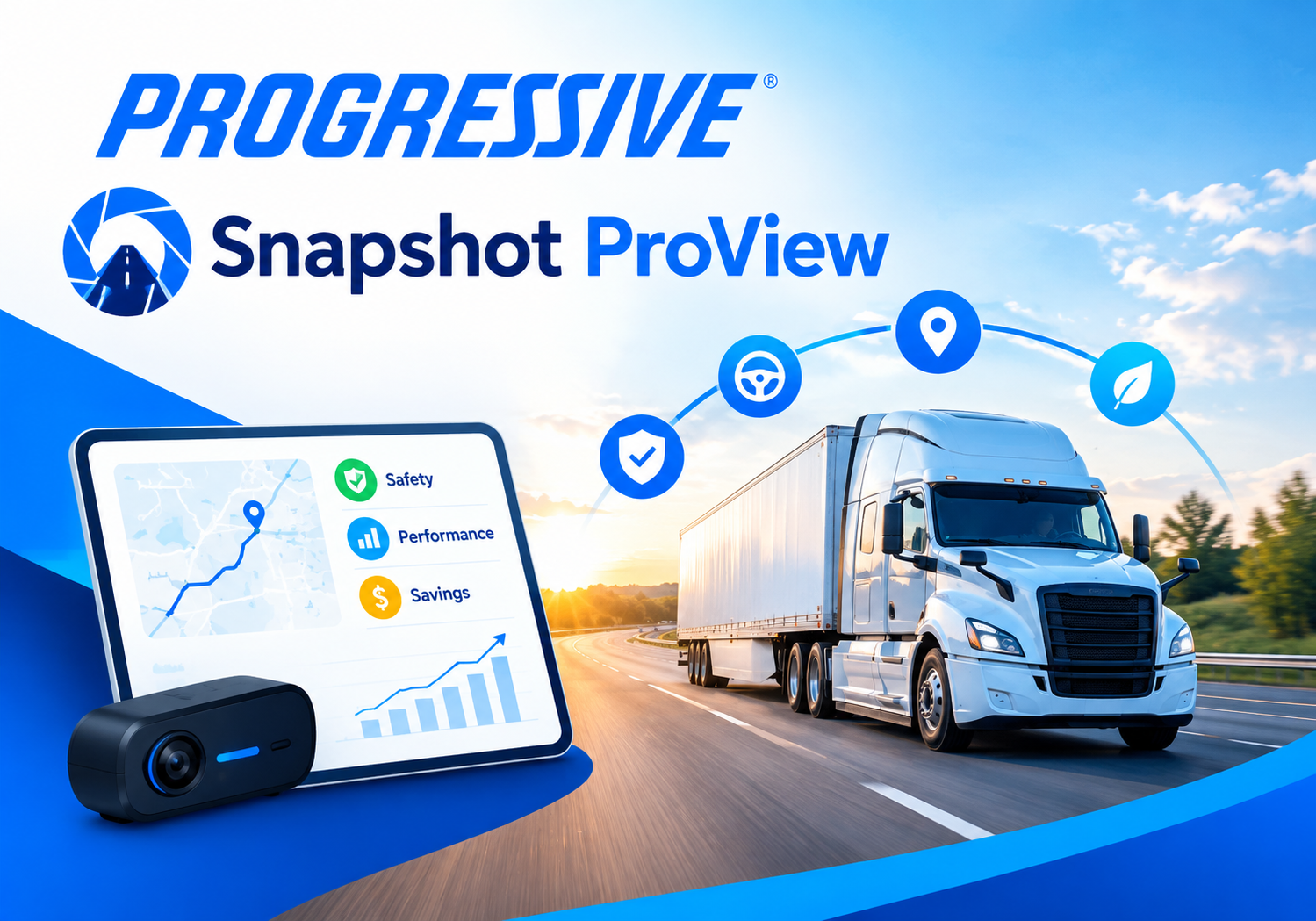
Commercial auto premiums have climbed sharply over the past several years, and small business owners increasingly look for tools that reward safe driving instead of simply absorbing rate hikes. Telematics programs promise exactly that: they collect real driving data and convert it into a more personalized premium. Progressive – Auto Insurance US built Snapshot ProView specifically to answer this need for commercial auto customers. The program installs a small plug-in device, tracks how a fleet actually drives, and turns that behavior into a discount. This article breaks down how Snapshot ProView works, what savings businesses can realistically expect, which behaviors the program monitors, and where telematics falls short of the marketing promise. Along the way, it also compares Snapshot ProView with competing carrier programs so a business owner can judge the offer against the wider market rather than in isolation.
Table of contents
Quick Summary
| Aspect | Detail |
| Enrollment discount | Minimum 5% at sign-up, applied instantly |
| Average first-term savings | 9% for new customers |
| Renewal savings range | 8%-20%, with some cases reaching 18% |
| Hardware cost | Free plug-in device shipped by Progressive |
| Free fleet dashboard | Included for fleets with 3+ enrolled vehicles |
| Data tracked | Speed, location, mileage, time of day, hard braking/acceleration |
| Renewal risk | Premium can also increase, depending on driving data |
| Eligible vehicles | Business auto, contractor, tow, and non-ELD for-hire specialty vehicles |
Progressive – Auto Insurance US

Progressive – Auto Insurance US ranks among the largest commercial auto insurers in the country, and it built its reputation on usage-based insurance (UBI) years before most competitors treated telematics as anything more than a marketing feature. The company’s personal-auto Snapshot program pioneered pay-how-you-drive pricing, and Progressive later applied the same data science to small business fleets through Snapshot ProView. This product sits at the center of the question this article asks, because it is one of the most mature, widely documented telematics discount programs available to commercial policyholders today.
Progressive designed Snapshot ProView for businesses that operate light and medium commercial vehicles that fall outside federal ELD mandates – think contractors, delivery services, tow operators, and specialty haulers. Because the program combines an instant enrollment discount with ongoing fleet management tools, it offers a concrete, real-world case study for evaluating whether telematics genuinely lowers commercial auto premiums or simply shifts risk pricing in the insurer’s favor.
Independent insurance reviewers, not just Progressive’s own marketing, have separately estimated Snapshot ProView’s potential savings at 8% to 20%, which lines up closely with the carrier’s published figures. That kind of third-party confirmation matters, since it means a business isn’t relying solely on the insurer’s promotional numbers when deciding whether the program is worth adopting.
What Is Telematics-Based Commercial Auto Insurance?
Telematics-based commercial auto insurance uses connected devices or mobile apps to record how, when, and how much a vehicle travels. Traditional underwriting relies on static factors instead – vehicle class, driver age, garaging zip code, and claims history – and it updates those factors only once a year. Telematics changes this approach by feeding continuous behavioral data into the pricing model, so the insurer rates the business closer to its actual risk rather than an industry average.
Adoption has accelerated quickly: roughly 82% of commercial insurers now incorporate telematics data into underwriting, up from 65% just two years earlier. As a result, the industry is moving away from pooled risk assumptions and toward individualized scoring, which explains why insurers increasingly treat telematics enrollment as a baseline expectation rather than an optional perk. For a small business, this shift means the difference between paying a rate built for the average fleet in its class and paying one built around its own, verifiable driving record.
Why Are Insurers Prioritizing Driving Data Now?
Rising loss costs push carriers toward telematics as a pricing tool rather than a novelty. Commercial auto loss ratios have exceeded 100% for 12 of the past 13 years, meaning insurers routinely pay out more in claims than they collect in premium for this line. Verdicts against trucking and fleet defendants have also grown sharply, with nuclear verdicts averaging $27.5 million. Consequently, carriers increasingly reward businesses that can prove lower risk with data, while pricing more conservatively for fleets that provide no behavioral evidence at all.
What Broader Trends Are Shaping the Telematics Insurance Market?
The shift toward telematics is not a Progressive-specific trend but a market-wide restructuring of how commercial auto risk gets priced. The usage-based insurance market overall is expanding at close to 28.85% annually, and industry watchers project roughly 278 million active telematics insurance policies in 2026. Meanwhile, the share of commercial fleet carriers offering some form of usage-based or telematics discount has grown from just 28% in 2019 to 73% today. This pace of adoption signals more than a passing marketing trend; it reflects a structural change in how insurers underwrite. Fleets that decline to share data are no longer treated as a neutral, average risk. Instead, underwriters increasingly read the absence of behavioral data itself as a signal, since a fleet with nothing to show has no way to prove it manages risk proactively.
Is Enrollment in Snapshot ProView Mandatory?
No. Progressive built Snapshot ProView as a voluntary usage-based insurance option, so no business is required to enroll to keep an existing Commercial Auto policy. But as the market shifts, businesses that opt out may find that generic, actuarial-table pricing looks less competitive with every renewal cycle. Because the pool of businesses that share data grows every year, insurers increasingly build their base rates around the assumption that most competitive customers already participate. Choosing not to enroll doesn’t trigger a penalty by itself, but it does mean a business gives up the chance to prove its risk runs lower than that assumption.
How Does Progressive’s Snapshot ProView Program Actually Work?
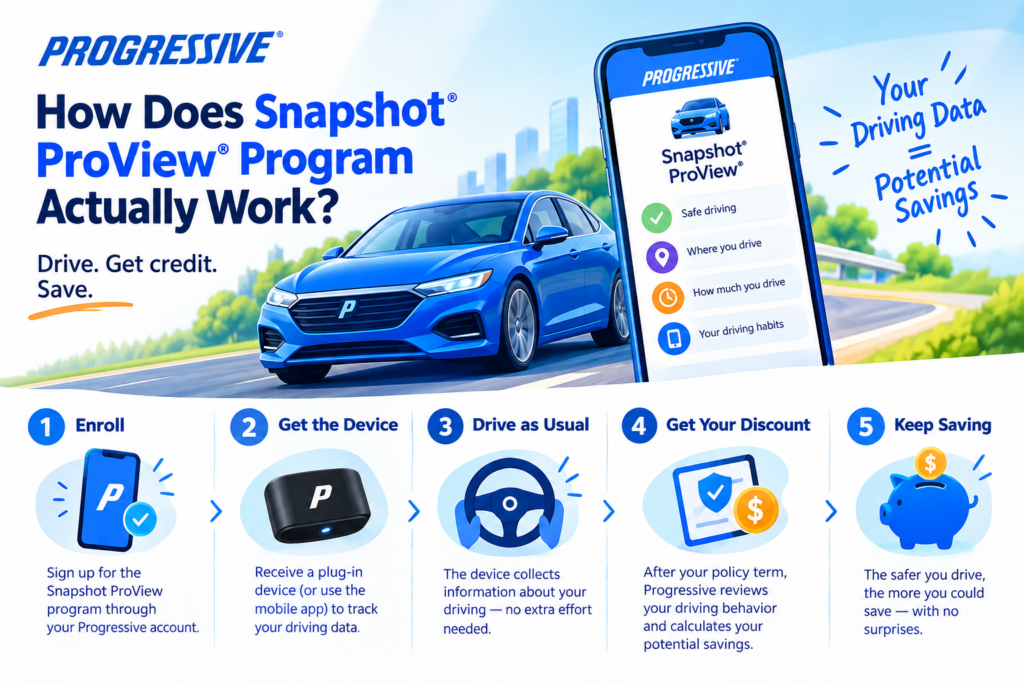
Enrolling in Snapshot ProView begins with a phone call to Progressive or a request through an agent. Once a business signs up, Progressive ships a small plug-in device that connects to each eligible vehicle’s diagnostic port. The device starts recording driving data immediately, and the business receives its enrollment discount before any data collection even begins. Progressive built the process to require minimal setup: no hardwiring, no professional installation, and no upfront hardware cost. However, the business must plug the device into every eligible vehicle to remain fully enrolled, since gaps in device coverage limit how much data Progressive can use to personalize the fleet’s rate at renewal.
What Happens After the Device Ships?
Once installed, the plug-in device continuously tracks driving activity, and Progressive uses that data to build a rolling picture of each vehicle’s habits. This data feeds a fleet dashboard that gives the business near real-time vehicle tracking and individual safety scorecards. At renewal, Progressive recalculates the premium using this accumulated driving history rather than static rating factors alone, which can move the discount higher or, less commonly, reduce it. Businesses that check the dashboard only once a year miss the chance to correct a bad trend before it affects pricing, so treating it as a monthly habit pays off more than treating it as a renewal-time formality.
How Much Can Businesses Actually Save With Snapshot ProView?

Snapshot ProView guarantees a minimum 5% discount the moment a business enrolls, and Progressive reports that new customers save an average of 9% during their first term. Some businesses see considerably more: potential renewal savings run between 8% and 20%, and Progressive has publicly cited cases reaching up to 18% depending on vehicle type and how the business uses its vehicles. These figures line up closely with what the broader telematics market reports. Independent fleet-safety research shows telematics-equipped fleets across the industry capturing 15% to 30% premium reductions, while insurers overall now offer 5% to 15% premium credits for qualifying telematics and dash cam systems. In short, Snapshot ProView’s numbers sit squarely inside that range rather than dramatically outperforming it.
| Discount Stage | Snapshot ProView | Industry-Wide Telematics Average |
| Enrollment (instant) | Minimum 5% | Not always offered |
| First-term average | 9% | 5%-15% |
| Renewal (top range) | 8%-20% | 15%-30% |
What Determines Whether a Business Gets the Higher End of the Range?
The size of the eventual discount depends on more than simply owning the device. Progressive bases the renewal adjustment on where, when, and how often each vehicle travels, so businesses that drive during safer hours, avoid hard braking, and keep mileage predictable tend to land closer to the top of the range. Fleet-safety researchers note a similar pattern industry-wide: the fleets earning the largest discounts are not necessarily the ones with the newest hardware, but the ones that show a clean, consistent safety trend over multiple months rather than a single good stretch. Typically, a six-month history is the minimum needed to build a trend that underwriters trust.
What Driving Behaviors Does Snapshot ProView Track?
Snapshot ProView measures a defined set of driving inputs rather than a vague safety score. Progressive states plainly that the program evaluates where, when, and how much a fleet drives, and the plug-in device captures each of these factors automatically without requiring any manual input from drivers.
| Metric Tracked | What It Reveals | Why It Matters to Underwriters |
| Vehicle speed | Compliance with posted limits | Speeding contributes to a significant share of fatal crashes |
| Location | Where vehicles operate | Some regions carry higher accident and theft risk |
| Mileage | How much a vehicle travels | More miles generally means more exposure to loss |
| Time of day | When vehicles are on the road | Late-night and rush-hour driving carry different risk profiles |
| Hard braking/acceleration | Driving smoothness | Correlates strongly with collision risk |
Does the Program Track Individual Drivers or Just Vehicles?
Snapshot ProView centers on the vehicle rather than a single named driver, which matters for fleets where multiple employees share the same truck or van. The plug-in device records whatever activity happens while it is connected, regardless of who sits behind the wheel. This differs from Progressive’s personal-auto Snapshot program, which also factors in phone handling while driving when a customer participates through the mobile app. Therefore, business owners coaching a shared fleet should treat the vehicle-level scorecard as a team metric rather than an individual grade.
Which Businesses and Vehicles Qualify for Snapshot ProView?
Progressive built Snapshot ProView for small businesses running vehicles that fall outside the federal electronic logging device (ELD) mandate. The program specifically covers:
- Business auto policies
- Contractor vehicles
- Tow trucks
- For-hire specialty vehicles, such as dirt, sand, gravel, and logging haulers
- For-hire transportation risks not required to carry an ELD
Fleets that already run federally mandated ELDs typically fall under Progressive’s separate Smart Haul program instead, which uses that existing ELD data for its own safe-driving discount.
What Vehicles Fall Outside the Program?
Not every commercial vehicle qualifies for Snapshot ProView. Because the program exists specifically for businesses not subject to the federal electronic logging device mandate, larger trucking operations that already run ELDs across their fleet fall outside its scope and instead qualify for Progressive’s Smart Haul program. Similarly, vehicles used exclusively for long-haul interstate freight, where hours-of-service tracking is already mandatory, gain little additional value from a plug-in diagnostic device built around light and medium commercial use patterns. Business owners running a mixed fleet – some vehicles under ELD requirements and some not – may need to enroll different vehicles in different Progressive programs to capture the full range of available discounts.
Can Telematics Data Ever Increase a Premium Instead of Lowering It?
Telematics is not a one-way ticket to savings, and any article that promises otherwise oversells the product. Progressive states directly that renewal pricing can move in either direction depending on how the fleet actually drives, and the company does not rule out an increase. Data from other usage-based programs reinforces this point: roughly one out of five personal-auto Snapshot participants does not earn a discount at all and instead sees a premium increase tied to their driving characteristics. For commercial fleets, the same logic applies at scale – a handful of vehicles with frequent hard braking or excessive night driving can outweigh the safer habits of the rest of the fleet. As a result, businesses that enroll should treat the device as a genuine measurement tool, not a guaranteed discount machine.
What Do Critics Say About Usage-Based Insurance?
Not everyone views usage-based insurance as an unambiguous win for policyholders. Consumer advocates have raised concerns that telematics programs shift more pricing power toward insurers, since the carrier collecting and analyzing the data also decides how much weight to give any single metric. Privacy is another common objection, because a plug-in device or app captures location history that a business may not want tracked, even though that data typically stays within the insurance relationship rather than being sold outward.
There’s also a practical critique worth noting: a fleet with only one or two vehicles has a much smaller data sample than a fifty-vehicle fleet, so a single unusual trip – a detour through a construction zone or an emergency stop – can swing a small fleet’s numbers more than it would for a larger one. None of these concerns erase the average savings the data shows, but they are worth weighing before a business commits every vehicle to a multi-year program.
How Can a Business Protect Itself From a Renewal Increase?
Combining telematics enrollment with an active driver-coaching program is the most reliable way to keep the trend moving in the right direction. Fleets that pair telematics data with AI dashcams and weekly coaching reduce preventable accidents by roughly 28% and cut at-fault claims by 20% to 40%. Reviewing scorecards monthly, addressing hard-braking events quickly, and keeping every eligible vehicle plugged in throughout the policy term all help a business build the consistent record that Progressive rewards at renewal.
How Does Snapshot ProView Compare With Other Commercial Telematics Programs?
Snapshot ProView is far from the only usage-based option available to commercial fleets. Several major carriers now run comparable programs, although the discount structures and data requirements vary.
| Program | Carrier | Discount Range | Data Required |
| Snapshot ProView | Progressive | 5%-20% | Speed, location, and mileage via plug-in device |
| SmartRide Fleet | Nationwide | 8%-18% | Hard braking, speeding, mileage, and ADAS events |
| Fleet Safety Discount | Sentry | 6%-14% | Following distance, hard braking, and coaching log |
Progressive’s structure stands out for its instant enrollment discount, since several competing programs only reward safe driving at renewal rather than the moment a business signs up. This structure gives Snapshot ProView an edge for businesses that want guaranteed savings immediately, even before the driving data proves anything.
Beyond behavior-based programs like these, a related but distinct model – pay-per-mile commercial insurance – prices risk primarily on total mileage rather than driving behavior alone. Independent market data shows this per-mile approach delivering 20% to 40% savings for fleets that drive below the industry average distance, which can exceed what a behavior-only program offers a business that simply doesn’t put many miles on its vehicles. Businesses comparing telematics options should weigh whether their biggest risk factor is how they drive or how much they drive, since the two models reward different operational profiles.
What Free Fleet Management Tools Come With the Program?
Snapshot ProView bundles insurance savings with day-to-day fleet management, and that combination is part of why Progressive – Auto Insurance US positions the program as more than a pricing tool. Businesses running three or more enrolled vehicles gain access to a full dashboard, while smaller fleets running one or two vehicles receive monthly safety scorecard emails instead. The included tools are:
- Near real-time vehicle location tracking
- Individual vehicle safety scorecards
- Geofencing notifications
- Trip reporting summaries
- Monthly safety scorecard emails for one- or two-vehicle fleets
How Do Fleets Use the Dashboard Day to Day?
Beyond insurance pricing, the dashboard gives dispatchers a practical operations tool. A geofencing alert can flag when a vehicle leaves its assigned service area, which helps a business catch unauthorized use or a wrong turn before it becomes a bigger problem. Trip reporting summaries also give owners a way to verify billable mileage for client invoicing, separate from anything tied to the insurance discount. In effect, the free tools give a small business some of the same visibility that larger fleets pay third-party telematics vendors to provide.
How Should a Business Get Started With Snapshot ProView?

Getting a fleet enrolled and generating usable data takes only a few concrete steps, though each one plays a role in how quickly the business sees a meaningful discount at renewal.
- Call Progressive or work with an agent to enroll in a Commercial Auto policy with Snapshot ProView.
- Receive the plug-in device, shipped directly from Progressive at no cost.
- Install the device in every eligible vehicle’s diagnostic port.
- Monitor the fleet dashboard or scorecard emails on a regular basis.
- Address risky driving trends through coaching well before renewal.
- Review the renewal offer and the confirmed discount based on the accumulated data.
Conclusion
So, can telematics really lower commercial auto premiums? The evidence, both from Progressive – Auto Insurance US and from the broader market, points to yes – but with real conditions attached. Snapshot ProView delivers a guaranteed discount the moment a business enrolls, and it can push savings well into double digits by renewal for fleets that maintain safe, consistent driving habits.
At the same time, the same data that earns a discount can just as easily justify a rate increase for a fleet with frequent hard-braking events or high-risk trip patterns. Businesses that treat the plug-in device as one part of an active safety strategy – rather than a passive box to check – get the most reliable results. For a small business weighing a first-time telematics program, Progressive‘s combination of an instant discount and free fleet management tools makes Snapshot ProView one of the more accessible ways to test whether data-driven insurance pricing actually works in practice.
Frequently Asked Questions
No. Progressive ships the plug-in device at no cost, and the business receives its minimum 5% discount immediately upon enrollment, before any driving data is even collected. There’s no separate subscription fee for the fleet dashboard or the scorecard emails either, since Progressive bundles those tools into the Commercial Auto policy itself.
Yes. Progressive allows customers participating in its usage-based programs to discontinue participation at any time by contacting customer service, though doing so typically ends the associated discount going forward. Businesses considering this step should weigh the guaranteed discount against any privacy concerns before removing the device from their vehicles.
Benefits of Cooperation With Solution for Guru
Enrolling in a telematics program is only the first step. Turning that data into consistent renewal savings usually requires the same kind of systems work that Solution for Guru specializes in as a CRM and software implementation consultancy. Many businesses enroll in Snapshot ProView, then let the fleet dashboard sit unused because no one connects it to the rest of their operations. Solution for Guru closes that gap by integrating telematics feeds, CRM records, and coaching workflows into a single, actionable system, so the data a business already pays to collect actually shows up at renewal time.
| Common Implementation Gap | How Solution for Guru Helps |
| Telematics data sits in a separate system from CRM and dispatch records | Integrates fleet telematics feeds directly into the business’s CRM, so safety data lives alongside customer and job records |
| No one reviews safety scorecards until renewal | Builds automated dashboards and alerts that flag risky driving trends month over month |
| Manual mileage and trip reporting for insurance renewal | Automates the export of trip and safety-scorecard data into renewal-ready reports |
| A coaching program exists on paper but isn’t tracked | Sets up workflow automation that assigns and tracks driver-coaching tasks tied to flagged events |
Businesses that want their telematics investment to translate into real, documented savings can work with Solution for Guru to build the integrations and reporting workflows that make a program like Snapshot ProView pay off consistently, renewal after renewal. Rather than treating the plug-in device as an isolated insurance perk, a properly implemented system turns it into an ongoing feedback loop that improves both safety outcomes and the premium a business ultimately pays.
Recommended
- State-by-State Commercial Auto Requirements: How Progressive Helps Businesses Stay Compliant
- biBERK Comprehensive vs Collision Coverage Explained
- biBERK Commercial Auto Insurance Exclusions Explained
- Does Your Driving Record Affect biBERK Commercial Auto Insurance Rates?
- Does Business Location Affect biBERK Commercial Auto Insurance Rates?
- How Progressive Supports Small Fleets: Coverage Options for 2–10 Vehicles
- How Berkshire Hathaway Companies Like biBERK Are Innovating Insurance
- Delivery Drivers and Courier Services: Progressive Commercial Auto Insurance Breakdown
- BiBerk Hired and Non-Owned Auto Insurance: Does Your Business Really Need It?
- BiBerk Commercial Truck Insurance: Is It the Right Coverage for Your Fleet?
- Progressive Commercial Auto Insurance for LLCs and Sole Proprietors
- How Progressive Handles Dual-Use Vehicles for Business and Personal Driving
- What Do Car Insurance Agents Actually Do — and How Do You Find the Best One for Your Needs?
- How to Lower Car Insurance: A Practical Guide to Reducing Your Premiums
- Minimum Liability Limits for Business Vehicles Explained
- Bundling Policies with biBERK: Pros and Cons
- Common Progressive Commercial Policy Mistakes Small Businesses Make
- Progressive vs biBERK vs NEXT: Which Commercial Auto Insurance Offers Better Value?
- What Does Progressive Commercial Auto Insurance Actually Cover?