ITSM Workflow Optimization Strategies for Hybrid Work Environments

The modern workplace no longer fits inside four walls. Today, IT teams simultaneously support employees working from corporate offices, home setups, co-working spaces, and everything in between. This hybrid reality stretches traditional IT Service Management (ITSM) frameworks to their limits — creating new demands for smarter workflows, faster response times, and tools that work across every environment without friction.
Organizations that optimize their ITSM workflows for hybrid work gain a genuine competitive advantage: faster incident resolution, happier employees, and IT teams that spend their time on meaningful work rather than manual coordination. Those that ignore the shift, however, face mounting ticket backlogs, inconsistent service quality, and support gaps that erode trust across the workforce.
This article delivers practical, actionable strategies for optimizing ITSM workflows in hybrid environments — and shows how platforms like ManageEngine ITSM and Freshservice make those strategies executable.
Table of contents
Quick Summary
| Topic | Key Insight |
|---|---|
| Core Challenge | Hybrid work creates fragmented IT environments that traditional ITSM processes cannot efficiently support |
| Optimization Focus Areas | Automation, self-service, asset visibility, change management, SLA adaptation |
| Leading Platforms | ManageEngine ServiceDesk Plus, Freshservice |
| Productivity Impact | Organizations with optimized ITSM workflows resolve incidents up to 60% faster (Forrester Research, 2023) |
| Implementation Partner | Solution4Guru accelerates ITSM deployment and customization |
| ROI Timeline | Properly optimized ITSM workflows typically deliver measurable ROI within 3–6 months |
What Is ITSM, and Why Does Hybrid Work Demand a Different Approach?
IT Service Management (ITSM) encompasses all the policies, processes, and tools that IT teams use to design, deliver, manage, and improve the technology services their organizations depend on. Built on frameworks like ITIL (Information Technology Infrastructure Library), ITSM traditionally assumed that most employees worked in predictable, centralized environments.
Hybrid work breaks that assumption entirely. IT teams now manage endpoints scattered across dozens of physical locations, support users on personal and corporate devices simultaneously, and respond to incidents without the ability to walk over to someone’s desk. Consequently, ITSM workflows designed for centralized offices create bottlenecks, delays, and gaps when applied to hybrid environments.
What does the data say about hybrid work’s impact on IT teams?
The numbers reinforce the urgency. According to Gartner, 75% of knowledge workers operate in hybrid or fully remote settings as of 2024. Meanwhile, HDI’s 2025 Technical Support Practices Survey found that ticket volumes increased by an average of 35% for organizations that transitioned to hybrid work without updating their ITSM processes.
Furthermore, Forrester Research reports that IT teams in hybrid environments spend up to 40% more time on manual ticket routing and status updates than their counterparts in organizations with optimized, automated ITSM workflows. Clearly, the gap between traditional ITSM and hybrid work requirements is not theoretical — it creates measurable productivity losses every single day.
How Do ManageEngine ITSM and Freshservice Address Hybrid Work Challenges?
Before diving into specific optimization strategies, understanding how each platform approaches the hybrid ITSM challenge helps teams make informed decisions.
How does ManageEngine ITSM support hybrid IT operations?

ManageEngine ServiceDesk Plus delivers a unified ITSM platform that combines help desk ticketing, asset management, change management, and problem management in a single environment. Its deep integration with ManageEngine’s broader IT operations suite — including endpoint management, network monitoring, and privileged access management — gives IT teams end-to-end visibility across hybrid environments.
Key capabilities that matter specifically in hybrid contexts include:
- Remote endpoint integration — ServiceDesk Plus connects natively with ManageEngine’s Endpoint Central, enabling technicians to take remote control of any managed device directly from a ticket
- Multi-site asset management — IT teams track hardware and software assets across office and home locations from a centralized console
- ITIL-aligned workflows — Pre-built ITIL process templates accelerate deployment in organizations adopting formal ITSM frameworks
- On-premise and cloud deployment — Hybrid IT teams can run ManageEngine in either model, giving organizations with data sovereignty requirements a critical flexibility
ManageEngine serves over 180,000 organizations across 190 countries, making it one of the most widely deployed ITSM platforms in the enterprise segment.
How does Freshservice approach ITSM for distributed teams?

Freshservice — part of the Freshworks product family — builds its ITSM platform around simplicity, AI-driven automation, and a modern user experience that distributed teams adopt quickly without extensive training.
Key capabilities relevant to hybrid environments include:
- AI-powered ticket categorization and routing — Freshservice’s Freddy AI engine automatically categorizes incoming tickets and assigns them to the right agent or team, reducing manual triage time dramatically
- Native mobile app — Field and remote technicians access and resolve tickets from any device, maintaining service continuity regardless of location
- Unified service catalog — Employees in any location access the same standardized service request menu, eliminating inconsistency in how hybrid teams request IT support
- No-code workflow automation — Non-technical IT managers build complex approval and escalation workflows using a drag-and-drop builder, without developer involvement
Freshservice has earned recognition in Gartner’s Magic Quadrant for IT Service Management Platforms (2023) as a Leader, reflecting its strong execution and broad market adoption.
What Are the Core ITSM Workflow Optimization Strategies for Hybrid Work?
Strategy 1: How Should You Automate Ticket Triage and Routing?
Manual ticket routing wastes enormous amounts of IT team time in hybrid environments. When tickets arrive from email, chat, phone, and self-service portals simultaneously, agents who manually read and assign each one create bottlenecks that cascade into longer resolution times.
The optimization approach: Implement intelligent auto-routing rules that assign tickets based on category, keyword detection, affected service, and requester location. Take it further by building escalation rules that automatically elevate tickets breaching SLA thresholds without human intervention.
How the platforms deliver this:
- ManageEngine uses business rule engines within ServiceDesk Plus to auto-assign tickets based on department, service category, impact, and urgency — with conditional logic that handles complex routing scenarios
- Freshservice deploys Freddy AI to predict ticket categories and suggest or automatically apply assignments, learning from historical resolution patterns over time
Implementation steps:
- Audit your current ticket categories and identify the top 10 most frequent request types
- Map each category to the correct team or individual based on skill and location
- Configure auto-routing rules for those categories in your ITSM platform
- Set SLA-based escalation triggers for tickets that exceed response time thresholds
- Review routing accuracy monthly and refine rules based on resolution data
Organizations that implement intelligent ticket routing typically reduce mean time to assign (MTTA) by 50–70%, according to HDI’s Support Center Practices report (2023).
Strategy 2: Why Is a Self-Service Portal Non-Negotiable for Hybrid Teams?
Hybrid employees who cannot reach IT support immediately — because of time zone differences, unavailable agents, or after-hours incidents — need a way to help themselves. A well-designed self-service portal reduces ticket volume, accelerates resolution, and empowers users regardless of where they work.
The optimization approach: Build a self-service portal that includes a searchable knowledge base, a service catalog for standard requests, and AI-powered chat support that handles common queries before routing to a human agent.
What content belongs in a hybrid-optimized knowledge base?
Structure your knowledge base around the specific challenges hybrid workers face:
| Knowledge Base Category | Example Articles |
|---|---|
| Remote connectivity | VPN setup, Wi-Fi troubleshooting, remote desktop configuration |
| Device management | Laptop enrollment, BYOD policy, software installation guides |
| Collaboration tools | Video conferencing setup, screen share troubleshooting, calendar sync |
| Security | Password reset, MFA setup, phishing incident reporting |
| Hardware requests | Equipment request process, home office peripherals policy |
| Access management | New software access requests, account unlock procedures |
How the platforms support this:
- ManageEngine ServiceDesk Plus includes a built-in knowledge base module with approval workflows, article versioning, and feedback collection — ensuring content stays accurate and useful over time
- Freshservice adds AI-powered article suggestions, where the system automatically recommends relevant knowledge base articles to users as they type their ticket description — deflecting tickets before they ever reach an agent
Organizations with mature self-service portals deflect between 20–40% of total ticket volume, according to Gartner’s IT Key Metrics Data (2025), directly reducing team workload without adding headcount.
Strategy 3: How Do You Maintain Asset Visibility Across Office and Home Environments?
One of the most significant ITSM challenges in hybrid work involves knowing exactly what devices exist, where they are, and what condition they are in — at all times. Without comprehensive asset visibility, IT teams cannot enforce security policies, plan hardware refresh cycles, or accurately assess the blast radius of an incident.
The optimization approach: Deploy automated asset discovery tools that continuously scan and update your CMDB (Configuration Management Database) regardless of where devices connect from. Complement this with agent-based endpoint tracking for devices that operate primarily outside the corporate network.
Asset management framework for hybrid environments:
- Discovery — Automatically detect all devices connecting to corporate systems, whether on-premise or remote
- Classification — Tag assets by owner, department, location type (office/home/field), and managed status
- Monitoring — Track hardware health, software license usage, and warranty status continuously
- Compliance — Flag devices that fall out of compliance with security or configuration baselines
- Lifecycle management — Automate refresh and retirement workflows based on asset age and condition data
Platform capabilities:
- ManageEngine integrates ServiceDesk Plus directly with Endpoint Central and AssetExplorer, creating a unified asset view that covers on-premise and remote devices, software licenses, and IT contracts
- Freshservice provides built-in asset discovery and a visual CMDB that maps relationships between assets, services, and users — giving IT teams clear dependency maps that accelerate incident impact assessment
Strategy 4: How Should Change Management Adapt for Hybrid IT Teams?
Change management — the process of planning, approving, and implementing changes to IT systems — becomes more complex in hybrid environments. Stakeholders work in different locations and time zones, approvals that once happened in a meeting room now require digital workflows, and the risk of uncoordinated changes affecting remote workers increases.
The optimization approach: Digitize and automate your change advisory board (CAB) process using ITSM workflows that route change requests to the right approvers, collect digital approvals, and enforce review checklists before implementation.
What does an optimized hybrid change management workflow look like?
| Stage | Action | Automation Opportunity |
|---|---|---|
| Request | Technician submits change request with impact assessment | Auto-populate affected CI data from CMDB |
| Risk Assessment | System calculates risk score based on change type and affected services | AI-driven risk scoring (Freshservice Freddy AI) |
| CAB Review | Approvers receive digital notification with full change details | Automated routing to correct approvers by change category |
| Approval | Digital sign-off collected from all required stakeholders | Parallel approval routing reduces wait time |
| Implementation | Change executed during approved maintenance window | Calendar integration blocks overlapping changes |
| Review | Post-implementation review completed and recorded | Automated PIR template sent to implementer |
Both ManageEngine ServiceDesk Plus and Freshservice support this end-to-end workflow natively, with built-in CAB management, change calendar views, and post-implementation review tracking.
Strategy 5: How Do You Design SLAs That Work Across Time Zones and Locations?
Standard SLAs assume that IT support operates during defined business hours in a single time zone. Hybrid organizations with globally distributed teams quickly discover that a 4-hour response SLA means very different things to an employee in Warsaw versus one in San Francisco.
The optimization approach: Implement location-aware, business-hours-relative SLAs that calculate response and resolution targets based on the requester’s time zone and working hours — not the IT team’s.
SLA design principles for hybrid environments:
- Business hours alignment — Configure SLAs to pause during non-business hours for the requester’s region
- Priority tiering — Define priority levels that reflect real business impact, not just technical severity
- Escalation chains — Build automatic escalation paths that account for coverage gaps across time zones
- SLA reporting — Track SLA compliance separately for each location or region to identify service gaps
ManageEngine ServiceDesk Plus supports multi-timezone SLA configuration with business hours definitions at the site level. Freshservice adds AI-driven SLA breach prediction, alerting managers before a breach occurs rather than after — giving teams the opportunity to intervene proactively.
Strategy 6: How Can IT Teams Use Automation to Reduce Repetitive Work?

In hybrid environments, repetitive manual tasks consume a disproportionate share of IT team capacity. Password resets, software installation approvals, account provisioning, and routine status updates all take time that skilled technicians could spend resolving complex incidents.
The optimization approach: Map your most frequent, time-consuming manual tasks and build automation workflows that handle them without human intervention.
High-impact automation targets for hybrid ITSM:
| Task | Manual Time per Instance | Automation Saving |
|---|---|---|
| Password reset | 8–12 minutes | ~100% (self-service + automation) |
| New employee onboarding | 3–5 hours | 60–80% reduction |
| Software access provisioning | 20–45 minutes | 70–90% reduction |
| Routine ticket status updates | 5–10 minutes per ticket | ~100% (automated notifications) |
| Hardware asset assignment | 15–30 minutes | 50–70% reduction |
| SLA breach notifications | 10–15 minutes monitoring | ~100% (automated alerts) |
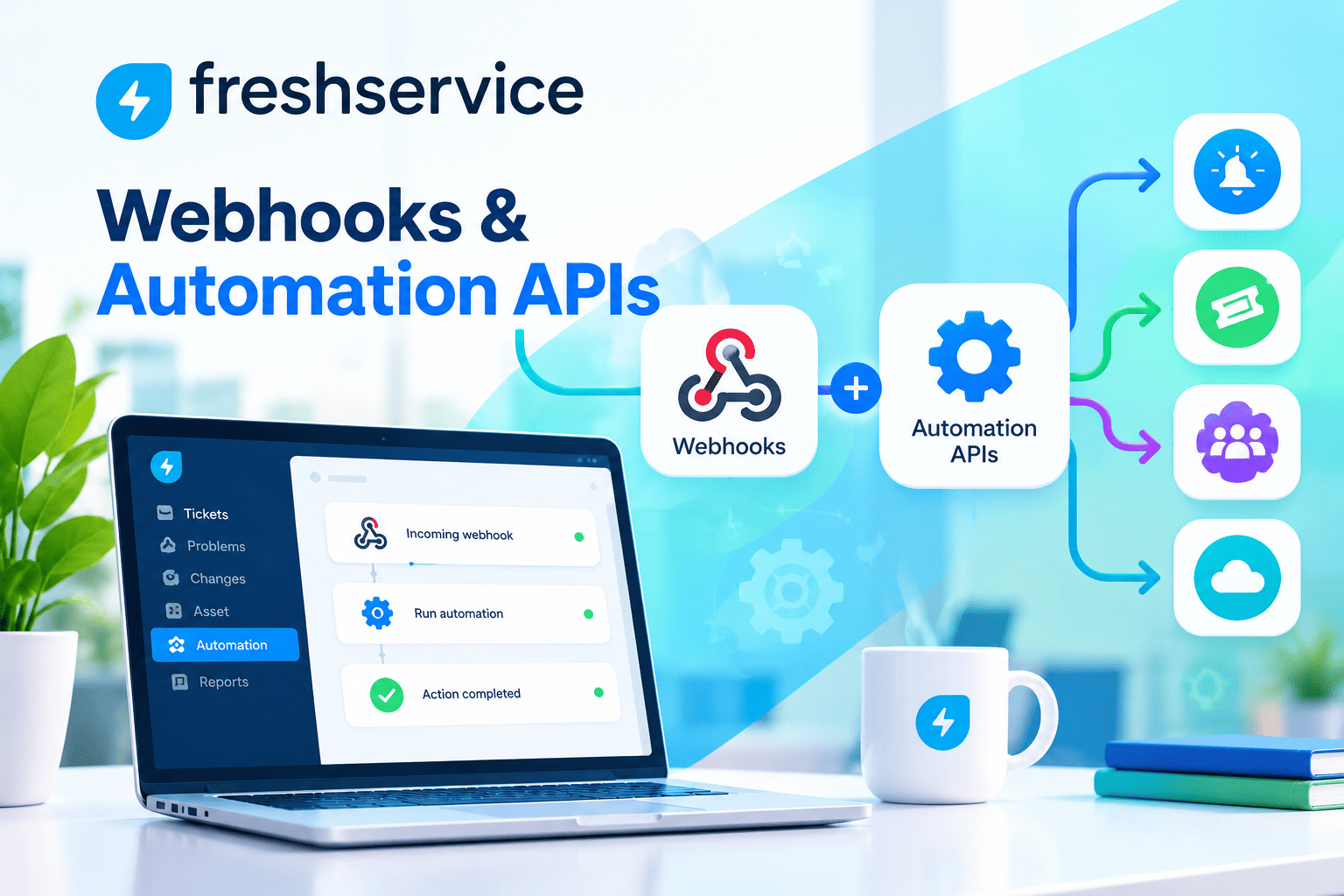
ManageEngine supports automation through its workflow automation builder within ServiceDesk Plus, enabling IT managers to build multi-step automated processes without coding. Freshservice extends this further with its Orchestration Center, which connects ITSM workflows to external systems — automatically provisioning access in Active Directory, Okta, or Slack when a ticket triggers the workflow.
Strategy 7: How Do You Measure ITSM Performance in a Hybrid Environment?
Optimization without measurement produces guesswork, not improvement. Hybrid ITSM teams need dashboards that provide real-time visibility into performance across locations, teams, and service categories.
Essential ITSM metrics for hybrid environments:
- Mean Time to Respond (MTTR) — How quickly does the team acknowledge incoming tickets?
- Mean Time to Resolve (MTTR) — How long does full resolution take, by category and location?
- First Contact Resolution Rate (FCR) — What percentage of tickets resolve without escalation?
- SLA Compliance Rate — What percentage of tickets meet SLA targets, by site and priority?
- Self-Service Deflection Rate — How many potential tickets does the self-service portal resolve?
- Agent Utilization — Are workloads distributed evenly, or do certain agents carry disproportionate volume?
- Customer Satisfaction Score (CSAT) — How do users rate their support experience across locations?
Both ManageEngine and Freshservice deliver built-in analytics dashboards covering these metrics, with the ability to filter by location, team, category, and time period — giving IT leaders the data they need to make evidence-based optimization decisions.
How Do ManageEngine ITSM and Freshservice Compare for Hybrid Environments?

Which platform fits your organization’s hybrid ITSM needs better?
| Feature | ManageEngine ServiceDesk Plus | Freshservice |
|---|---|---|
| Deployment Options | Cloud, On-premise, Hybrid | Cloud-only |
| AI Capabilities | Rule-based automation + Zia AI | Freddy AI (advanced ML-driven) |
| Asset Management | Deep — integrates with full ManageEngine suite | Built-in CMDB with visual dependency mapping |
| Change Management | Full ITIL-aligned CAB workflow | Full CAB workflow + AI risk scoring |
| Self-Service Portal | Yes — fully customizable | Yes — AI-powered article suggestions |
| Automation Builder | Workflow automation engine | Orchestration Center (connects to external apps) |
| Mobile App | Yes | Yes — highly rated |
| Multi-Site SLA Support | ✔ Yes | ✔ Yes |
| Remote Endpoint Integration | ✔ Native (Endpoint Central) | ! Via third-party integrations |
| ITIL Framework Alignment | Full ITIL 4 support | Full ITIL 4 support |
| Reporting & Analytics | Comprehensive — 150+ built-in reports | Strong — customizable dashboards |
| Pricing Model | Per technician + asset tiers | Per agent, tiered plans |
| Free Trial | ✔ 30 days | ✔ 21 days |
| Gartner Recognition | Challenger (Magic Quadrant 2023) | Leader (Magic Quadrant 2023) |
| Best Suited For | Enterprises needing deep IT ops integration | Organizations prioritizing ease of use and AI automation |
Summary: ManageEngine excels in organizations that already use its broader IT management ecosystem — particularly those needing on-premise deployment or deep endpoint management integration. Freshservice wins on AI-driven automation, user experience, and speed of deployment, making it especially strong for mid-market organizations scaling their hybrid ITSM practices quickly.
Conclusion: Is Your ITSM Strategy Ready for the Hybrid Future?
What separates high-performing hybrid IT teams from struggling ones?
The answer comes down to intentional optimization. High-performing hybrid IT teams do not simply move their existing ITSM processes online — they redesign those processes for the distributed, asynchronous, multi-location reality of modern work.
The seven strategies covered in this article — intelligent ticket routing, self-service portals, asset visibility, adaptive change management, location-aware SLAs, workflow automation, and performance measurement — form a comprehensive optimization framework that any organization can implement progressively.
ManageEngine ITSM and Freshservice both deliver the technical capabilities to execute this framework. ManageEngine’s deep integration with endpoint management and its on-premise deployment option make it particularly valuable for enterprises with complex infrastructure and data governance requirements. Freshservice’s AI-driven automation and intuitive interface accelerate adoption in organizations that prioritize speed and user experience.
Whichever platform fits your context, the implementation journey matters as much as the platform itself. Solution for Guru provides the expert guidance, configured deployments, and ongoing support that transform ITSM software into a genuine operational advantage — helping hybrid IT teams resolve incidents faster, support employees better, and focus their energy on strategic work rather than manual coordination.
The hybrid workplace is not a temporary phenomenon. Organizations that optimize their ITSM workflows for it today build the operational foundation for sustained performance, employee satisfaction, and IT team resilience for years to come.
Frequently Asked Questions
The highest-impact starting point for most organizations is self-service portal implementation combined with intelligent ticket routing. These two changes work together: the self-service portal deflects 20–40% of ticket volume by helping users resolve common issues independently, while intelligent routing ensures that tickets which do reach the IT team go immediately to the right person without manual triage. Together, they reduce response times and agent workload simultaneously. Both ManageEngine ServiceDesk Plus and Freshservice support rapid deployment of these capabilities, and Solution for Guru can configure both within weeks rather than months.
Security in hybrid ITSM environments involves both the ITSM platform itself and its integration with endpoint management tools. For platform-level security, both ManageEngine and Freshservice support role-based access control, multi-factor authentication, single sign-on (SSO), and comprehensive audit logging — meeting requirements for frameworks like ISO 27001, SOC 2, and HIPAA. For endpoint security, ManageEngine offers a native advantage through its integration with Endpoint Central and PAM360, enabling IT teams to enforce device compliance policies and manage privileged access directly from within their ITSM workflow.
Most organizations begin seeing measurable results within 60–90 days of completing a properly configured ITSM deployment. Early indicators typically include reduced ticket resolution times, lower first-response times, and measurable decreases in ticket volume attributable to self-service deflection. Full ROI — including the productivity value of automation, reduced manual effort, and improved employee satisfaction scores — typically materializes within 3–6 months for mid-sized organizations. Enterprises with more complex environments may take 6–12 months to realize full optimization value.
How Does Partnering with Solution for Guru Accelerate Your ITSM Optimization?
Why do organizations choose Solution for Guru over self-implementation?
Selecting the right ITSM platform solves only half the problem. The configuration, integration, workflow design, and change management that follow determine whether the platform delivers its promised value — or collects digital dust as frustrated teams revert to email and spreadsheets.
Solution for Guru bridges that gap. As an experienced technology solutions partner specializing in ManageEngine and Freshservice implementations, Solution for Guru helps organizations translate ITSM best practices into working, productive systems.
What specific benefits does Solution4Guru deliver?
1. Needs Assessment and Platform Selection
Solution for Guru begins every engagement by understanding your organization’s specific hybrid work context — team size, locations, existing tools, compliance requirements, and growth plans. This assessment drives an objective recommendation between ManageEngine, Freshservice, or another platform — prioritizing fit over vendor preference.
2. Rapid, Configured Deployment
Rather than deploying a generic out-of-the-box installation, Solution for Guru configures your ITSM platform around your actual workflows, service catalog, SLA structure, and escalation paths from day one — dramatically reducing the time between purchase and productive use.
3. Workflow Automation Design
Solution for Guru’s team maps your current manual processes, identifies automation opportunities, and builds the workflow rules, triggers, and integrations that eliminate repetitive work — delivering the efficiency gains described throughout this article.
4. Integration with Existing Systems
Hybrid IT environments run on interconnected tools — Active Directory, Slack, Microsoft Teams, monitoring platforms, and more. Solution for Guru integrates your ITSM platform with these systems so that tickets, alerts, and notifications flow automatically between tools without manual intervention.
5. Training and Adoption Support
A perfectly configured ITSM platform fails if teams do not use it properly. Solution for Guru delivers role-specific training for IT agents, managers, and end users — ensuring adoption across your entire hybrid workforce.
6. Ongoing Optimization and Support
As your organization grows and your hybrid environment evolves, Solution for Guru provides ongoing support to refine workflows, add integrations, and ensure your ITSM investment continues delivering measurable value.
Organizations that implement ITSM platforms with expert partners like Solution for Guru achieve full deployment in 40–60% less time than self-implementation projects, according to industry implementation benchmarks — and report significantly higher user adoption rates within the first 90 days.
Recommended:
- Breaking Down the ITSM Model: What Are the Core Processes, Roles, and Value Streams?
- Common ITSM Deployment Mistakes Businesses Make — and How to Avoid Them
- ITSM for DevOps Teams: Bridging Agile and Service Management
- Event-Driven ITSM: How Do You Connect Monitoring Alerts to Automated Ticketing?
- Integrating Monitoring Tools with ManageEngine or Freshservice for Proactive Support
- Freshservice Asset Management vs ManageEngine Asset Discovery
- On-Premise vs Cloud ITSM: Choosing Between ManageEngine and Freshservice Architectures
- Freshservice for Internal IT Support: What Problems Does It Solve?
- How Does Freshservice Simplify IT Service Management for Modern Organizations?
- How Do Businesses Integrate Slack and Microsoft Teams with ITSM Platforms?
- Automating Software License Tracking with ITSM Solutions: How Can You Take Control?
- Best Microsoft 365 Integrations for ManageEngine and Freshservice
- Integrating Endpoint Management Tools with ITSM Systems
- Aligning ITSM Processes with ISO 20000 Standards
- How Long Does an ITSM Implementation Really Take? Key Factors Explained
- ManageEngine vs Freshservice
- Top ITSM Best Practices Using ManageEngine