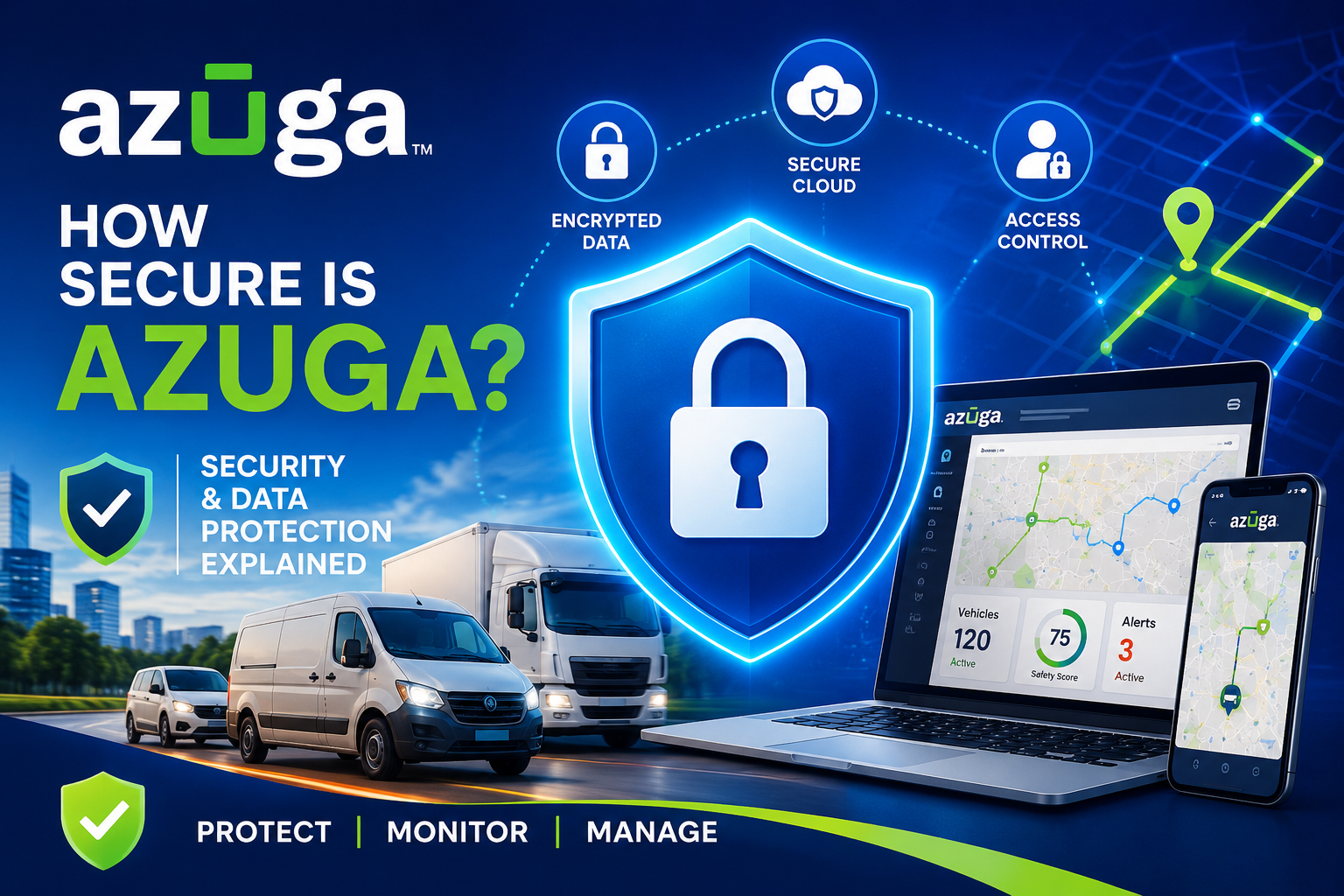
How Secure Is Azuga? Security and Data Protection Explained
Fleet managers who adopt GPS tracking and telematics naturally ask one question before they sign a contract: what happens to all this data once it leaves the vehicle? Location history, driver behavior scores, dashcam footage, and vehicle diagnostics are sensitive by nature, and a breach or misuse of that information can damage trust, invite legal exposure, and put drivers at risk. That’s why security is no longer a “nice to have” feature for telematics providers — it’s a core requirement.
This article looks closely at how Azuga – Fleet Management Software & GPS Fleet Tracking Solutions approaches security and data protection, from encryption and access controls to compliance and driver privacy. Whether you already use Azuga or you’re comparing it against other telematics vendors, this guide breaks down what the platform does to keep fleet data safe, and where you, as a fleet operator, still carry responsibility.
Table of contents
Quick Summary
- Azuga transmits telematics data over encrypted connections and stores it in secure, cloud-based infrastructure rather than on local, unprotected servers.
- Access to fleet data is role-based, meaning drivers, managers, and administrators only see the information relevant to their role.
- Dashcam footage and driver-behavior data are handled with privacy controls, including options like privacy mode for off-duty use.
- Azuga supports fleets operating under regulations such as GDPR and general industry-standard data protection practices, though exact certifications should always be confirmed directly with Azuga for your specific contract.
- Security is a shared responsibility: Azuga secures the platform and infrastructure, but fleet administrators must still manage user permissions, passwords, and internal policies correctly.
- Compared to some competitors, Azuga’s security model is described as solid and standard rather than the most feature-rich in the category, so it’s worth evaluating your own compliance needs before choosing a plan.
What Is Azuga and Why Does Its Security Matter?

Before diving into specific protections, it helps to understand what kind of company Azuga is and why fleets trust it with so much operational data in the first place.
What does Azuga actually do?
Azuga is a connected vehicle and fleet management platform that combines GPS tracking, driver safety scoring, dashcams, maintenance alerts, and fuel management into a single system. Fleets use it to monitor vehicle location, coach drivers on safer habits, reduce fuel waste, and stay compliant with regulatory requirements. Because Azuga now operates as part of Bridgestone Mobility, it also plays a role in insurance telematics programs, feeding driving data into underwriting and risk models for insurance partners.
Why is data security a bigger deal for fleet software than for typical business apps?
Fleet management software sits at the intersection of several sensitive data categories. It captures continuous GPS location, which reveals patterns about where people live, work, and travel. It records driver behavior, including speeding, harsh braking, and idling, which can affect employment decisions or insurance premiums. Many plans also include video footage from in-cab and road-facing cameras, which can capture drivers, passengers, and bystanders. Because this information touches employees, insurers, and sometimes third parties on the road, a security failure carries consequences beyond a typical software leak — it can affect physical safety, employment, and legal liability.
How Does Azuga Protect Data in Transit and at Rest?

The foundation of any telematics security program lies in how data moves from the vehicle to the cloud and how the platform stores it once it arrives.
How does data get from the vehicle to Azuga’s servers?
Azuga fleet devices plug into a vehicle’s OBD-II port or, in the case of cameras, connect through the vehicle’s power source. Once installed, the device gathers GPS coordinates, engine diagnostics, and driving behavior metrics, then transmits that information over the internet to Azuga’s servers. According to Azuga’s product materials, the platform encrypts this transmission to help prevent unauthorized parties from intercepting location and vehicle data as it travels from the device to the cloud.
Where is the data stored once it reaches Azuga?
Azuga relies on cloud-based storage for fleet data rather than housing everything on local servers at customer sites. Cloud storage, when properly configured, offers advantages such as redundancy, automated backups, and centralized security monitoring that would be difficult for individual fleets to replicate on their own. This approach also supports the platform’s compliance efforts, since cloud providers typically maintain their own layers of physical and network security on top of what Azuga configures at the application level.
What about dashcam footage specifically?
Video is arguably the most sensitive data type Azuga handles, because it can visually identify people. Azuga’s dashcam systems use encryption and secure storage specifically for video footage and associated driver information. In the event of a collision, the camera automatically records the incident, which can then serve as evidence for insurance claims or legal investigations. Fleet managers can also control who has access to this footage, restricting it to authorized personnel rather than leaving it open to the entire organization.
What Access Controls Does Azuga Use to Keep Data Restricted?
Encryption alone doesn’t stop misuse — access management determines who can actually view or export sensitive fleet data once it’s inside the platform.
Does Azuga use role-based permissions?
Yes. Azuga’s fleet portal is designed so different types of users see different slices of data. A driver typically has access to their own trip history, safety score, and rewards, while a fleet manager or administrator can see fleet-wide analytics, vehicle diagnostics, and reporting tools. This separation keeps sensitive information away from unauthorized users and limits the impact of a compromised account.
Can fleet administrators customize who sees what?
Administrators generally have tools to manage user accounts, assign roles, and, in the case of video, restrict camera footage access to specific authorized staff. This matters because not every employee in a company needs to view driving footage or exact GPS coordinates — usually only safety managers, HR in specific cases, or operations leads require that level of access. Properly configured role-based access is one of the simplest and most effective ways fleets can reduce internal data-exposure risk.
What responsibilities fall on the fleet operator instead of Azuga?
Even the strongest platform security can lose its effectiveness when customers use weak account practices. Fleets are responsible for:
| Responsibility | Why It Matters |
|---|---|
| Assigning accurate user roles | Prevents unnecessary exposure of sensitive data to staff who don’t need it |
| Enforcing strong, unique passwords | Reduces risk of account takeover through credential stuffing or guessing |
| Removing former employees’ access promptly | Closes a common gap that leads to unauthorized data access |
| Training staff on data handling policies | Ensures footage and reports aren’t shared inappropriately outside the organization |
| Reviewing account activity periodically | Helps catch unusual access patterns early |
What Security Features Protect the Azuga Mobile App and Portal?

Beyond the vehicle hardware, users interact with Azuga primarily through its web portal and mobile app. Therefore, fleets should also understand how Azuga protects these interfaces.
How does the FleetMobile app protect driver data?
The FleetMobile app is the main touchpoint drivers use to log trips, view safety scores, and check rewards. Because this app runs on personal or company smartphones, it needs safeguards that go beyond server-side encryption. Well-built fleet apps typically encrypt data as it moves between the app and backend. They also secure login sessions and protect against unauthorized access if someone loses or shares a phone. These protections matter because a compromised mobile device could otherwise expose live location data or trip history to someone outside the organization.
What happens if a device or login is lost or stolen?
If someone loses a phone with the FleetMobile app installed, administrators can typically revoke the user’s access through the Azuga portal and end the compromised session. Prompt account management plays an important role here. The platform supports quick lockouts, but fleet administrators must act as soon as they receive a loss report. Fleets should build this response step into their onboarding and offboarding checklists rather than treating it as an afterthought.
Are there safeguards against unauthorized changes inside the fleet portal?
Administrative actions inside the Azuga portal, such as adding users, adjusting geofences, or exporting reports, are generally tied to authenticated accounts with defined permission levels. This reduces the chance that a single compromised low-level account could alter fleet-wide settings. Still, fleets that handle particularly sensitive operations, such as those tracking high-value cargo, should ask Azuga about additional safeguards like activity logging or audit trails for administrative changes.
How Does Azuga Respond to Security Incidents?
Even well-designed platforms can face security incidents, so it’s worth understanding how a vendor is expected to respond if something goes wrong.
What should a fleet expect if Azuga experiences a data incident?
Most reputable SaaS and telematics vendors maintain formal incident response procedures that include detecting anomalies, containing the issue, notifying affected customers, and remediating the underlying cause. Azuga does not always publish the specific details of its internal incident response plan. Fleets operating under regulations such as GDPR should confirm breach notification timelines in their contracts. Regulators often require organizations to report breaches within a defined period, with GDPR commonly requiring notification within 72 hours.
How can a fleet reduce the impact of a potential incident?
Fleets don’t have to wait passively for a vendor’s response plan to kick in. Practical steps include limiting the number of administrator-level accounts, exporting and archiving critical reports independently rather than relying solely on the platform’s storage, and keeping an internal contact list for quickly reaching Azuga support if unusual activity is detected. These habits shrink the potential damage window regardless of how quickly the vendor responds.
Does hardware installation introduce additional risk?
Azuga’s tracking devices plug into a vehicle’s OBD-II port, which is a widely used and low-friction installation method. However, some security researchers have pointed out that OBD-II based devices can, in theory, be a target for tampering since they’re physically accessible inside the vehicle. Fleets concerned about physical tampering can mitigate this risk by periodically inspecting devices, monitoring for unexpected data gaps, and restricting vehicle access to authorized drivers only.
Does Azuga Comply With Data Protection Regulations?

Compliance frameworks give fleets a way to judge whether a vendor’s security claims are backed by external verification rather than marketing language alone.
What regulations are relevant to fleet telematics data?
Depending on where a fleet operates, several regulations may apply. In the European Union, the General Data Protection Regulation (GDPR) governs how personal data, including location data, must be collected, stored, and processed. In the United States, state-level privacy laws such as the California Consumer Privacy Act (CCPA) increasingly apply to employee and consumer data as well. Insurance telematics programs, which Azuga supports heavily through its Bridgestone Mobility connection, also typically require adherence to data-handling standards set by insurance regulators and partners.
Does Azuga publish independent security certifications?
Many enterprise SaaS vendors publish SOC 2 Type II reports, ISO 27001 certifications, or similar independent audits to prove their security controls hold up over time rather than just on paper. These frameworks evaluate criteria like security, availability, processing integrity, confidentiality, and privacy through formal third-party audits. If a fleet needs this level of documented assurance, for example, to meet an enterprise procurement process or an insurance partner’s requirements, administrators should ask Azuga’s sales or support team for the latest certification documents. Audit status can change over time, and public marketing pages may not always include the most current information.
How should a fleet verify compliance before signing a contract?
Rather than relying solely on general claims, fleet buyers can take a few concrete steps:
- Request Azuga’s current data processing agreement (DPA) if operating under GDPR or similar frameworks.
- Ask for the most recent SOC 2, ISO 27001, or equivalent audit report, if available.
- Clarify data retention periods for GPS history and video footage.
- Confirm where data centers are physically located, since data residency can affect regulatory obligations.
- Review the privacy policy for details on third-party data sharing, especially with insurance partners.
How Does Azuga Handle Driver Privacy?
Fleet tracking inevitably raises questions about employee privacy, and how a vendor balances oversight with fairness says a lot about its overall approach to data protection.
Can drivers control what’s tracked during personal time?
Azuga includes features intended to separate business use from personal use. Drivers using the FleetMobile app can tag trips as business or personal, which helps keep a clear boundary around when location tracking supports operational needs versus when it doesn’t. Camera systems also typically include a privacy mode, allowing off-duty drivers to disable video recording while resting in the vehicle, which limits unnecessary footage of drivers outside of work-related activity.
Does video monitoring feel invasive to drivers, and how does Azuga address that?
Video monitoring is often the most sensitive feature from a driver’s perspective, since it can feel like surveillance rather than support. Azuga positions its dashcam program as being on the driver’s side, using footage primarily to protect drivers in the event of an accident and to provide coaching data that helps them improve rather than simply catching mistakes. This approach works best when fleets clearly communicate their policies to drivers. Even well-designed privacy features can feel unfair when drivers do not understand how the fleet uses footage or who can access it.
What data do insurance partners see?
Because Azuga supports insurance telematics programs, driving data may be shared with insurance carriers as part of usage-based insurance (UBI) programs. Fleets should clarify with Azuga exactly what data flows to insurance partners, whether drivers must consent explicitly, and whether that sharing is optional or a required part of a given plan. Transparency here protects both the fleet and its drivers from surprises later.
How Does Azuga’s Security Compare to Other Fleet Tracking Platforms?
Understanding Azuga in isolation is useful, but fleet buyers often want to know how it stacks up against other major providers before making a final decision.
How does Azuga compare to Verizon Connect and Samsara on security-adjacent features?
Independent reviews note that competitors like Verizon Connect and Samsara offer certain features Azuga does not include by default, such as panic buttons, automatic crash reporting, and hardwired device installation rather than OBD-II plug-in connections. While these aren’t purely “security” features in the data-protection sense, they do relate to driver safety and incident response, which some fleets consider part of an overall security posture.
Is Azuga considered a budget option or a premium security option?
Azuga generally offers competitive pricing along with solid, industry-standard security practices, including encryption, secure access controls, and cloud storage. However, it does not offer the most extensive security feature set on the market. For fleets with strict compliance requirements, such as those in heavily regulated industries, it’s worth directly comparing documented certifications between Azuga and higher-tier competitors before making a final decision.
What should a fleet prioritize when comparing vendors on security grounds?
| Comparison Factor | What to Ask Each Vendor |
|---|---|
| Encryption standards | Is data encrypted both in transit and at rest? |
| Compliance certifications | Can they provide current SOC 2, ISO 27001, or GDPR documentation? |
| Access control granularity | Can permissions be customized by role, department, or location? |
| Video data handling | Who can access footage, and how long is it retained? |
| Incident response | What is the vendor’s process if a breach occurs? |
| Data residency | Where are servers physically located? |
What Steps Can Fleets Take to Strengthen Security Alongside Azuga?

No telematics platform, however well built, can guarantee security on its own. Fleets play an active role in keeping their data protected.
How should fleets manage user accounts responsibly?
Administrators should regularly audit who has access to the Azuga portal, remove accounts for former employees immediately, and enforce strong password practices. Multi-factor authentication, where available, adds another meaningful layer of protection against unauthorized logins, particularly for accounts with administrative privileges.
How should fleets set internal policies around video and location data?
Because footage and location history can contain sensitive information, fleets should create written policies that define who can request video, when staff can review footage, and how long the fleet retains records before deleting them. Clear policies reduce ambiguity, protect the company from misuse claims, and help maintain driver trust in the system.
Why does staff training matter as much as the software itself?
Even the most secure platform can lose its effectiveness when employees make simple mistakes, such as sharing login credentials, leaving sessions open on shared computers, or handling exported reports carelessly. Training staff in basic data-handling practices helps close this gap and prevents everyday mistakes from weakening Azuga’s technical protections.
How often should a fleet review its Azuga security setup?
Security isn’t a one-time setup task. As drivers join or leave, as roles change, and as new features roll out on the platform, permissions and policies can drift away from their original design. A periodic review, ideally quarterly for larger fleets, helps catch outdated access rights, unused accounts, and reporting habits that no longer match company policy. Pairing this review with a quick check of Azuga’s own release notes also helps fleets take advantage of new security features as they become available, rather than continuing to rely on default settings indefinitely.
Conclusion
Overall, Azuga – Fleet Management Software & GPS Fleet Tracking Solutions applies standard, industry-recognized security practices to protect fleet data: encrypted data transmission, cloud-based storage, role-based access controls, and privacy-conscious features like trip tagging and camera privacy mode. These measures address the main risks associated with GPS tracking and dashcam monitoring. They also give fleet managers greater confidence that sensitive data remains protected. However, Azuga’s security setup generally appears solid rather than exceptional compared with some premium competitors. Fleets with strict regulatory or enterprise compliance requirements should request current certification documents directly from Azuga before choosing a plan. Ultimately, strong security is a partnership: Azuga secures the platform and infrastructure, while fleet administrators are responsible for managing accounts, setting clear policies, and training staff to use the system responsibly.
If your organization is weighing Azuga against other platforms, or you need help evaluating a vendor’s security documentation, comparing compliance requirements, or integrating fleet software securely into your broader IT environment, working with an experienced technology partner can save time and reduce risk. Solution for Guru specializes in cybersecurity, data protection, and CRM/SaaS integrations, helping businesses evaluate and implement platforms like Azuga in a way that aligns with their compliance obligations and internal security standards. From vetting a vendor’s security claims to setting up role-based access correctly from day one, partnering with a team that understands both fleet technology and data protection can make the difference between a smooth rollout and a costly oversight.
Frequently Asked Questions
Azuga uses encrypted data transmission, cloud-based storage, and role-based access controls, which align with standard industry practices for telematics platforms. It’s reasonably safe for most fleets, though organizations with strict compliance requirements should still request specific certification documents and a data processing agreement before finalizing a contract.
Azuga supports insurance telematics programs through its Bridgestone Mobility connection, which may allow insurance partners to receive driving data as part of usage-based insurance programs. Fleets should contact Azuga directly to confirm whether this data sharing is optional, what information the programs include, and whether they require driver consent.
Yes, Azuga’s platform generally supports trip tagging to separate business from personal use, and its camera systems typically include a privacy mode that disables recording when the vehicle isn’t in active work use. Fleets should communicate these options clearly to drivers so the features are actually used as intended.
Fleets that switch vendors or end a contract should clarify data offboarding terms in advance. Teams often overlook this detail until they need to close an account. Fleets should expect the ability to export historical trip and video data before account closure, a defined timeline for data deletion, and written confirmation once the provider purges the records from active systems. Because these terms vary by contract, it’s worth requesting them in writing from Azuga rather than assuming standard practice applies automatically.
Recommended
- Who Should Use Azuga Fleet Management Software?
- Preventive Maintenance with Samsara
- How Verizon Connect Reduces Fleet Operating Costs
- Integrating Verizon Connect with ERP Systems
- Best Motive Integrations for Fleet Management
- How Does Samsara Work?
- Is Motive Worth the Investment? ROI for Fleet Operators
- How Motive Improves Dispatcher Efficiency
- How Motive Helps Reduce Fleet Operating Costs
- Azuga Review: Features, Pros, Cons, and Best Use Cases
- What Is Azuga Fleet Management Software? A Complete Guide
- Top Reasons Businesses Choose Motive Fleet Management
- Samsara Review: Features, Pros, Cons, and Best Use Cases
- What Is Samsara GPS Fleet Tracking Software?
- Verizon Connect Review: Features, Pros, Cons, and Best Use Cases
- What Is Verizon Connect Fleet Management Software?
- Motive Pricing Plans Explained: How Much Does Motive Cost?
- What Is Motive Fleet Management?
- Offline Tracking: How Do Devices Store Data Without Connectivity?