Best Motive Integrations for Fleet Management
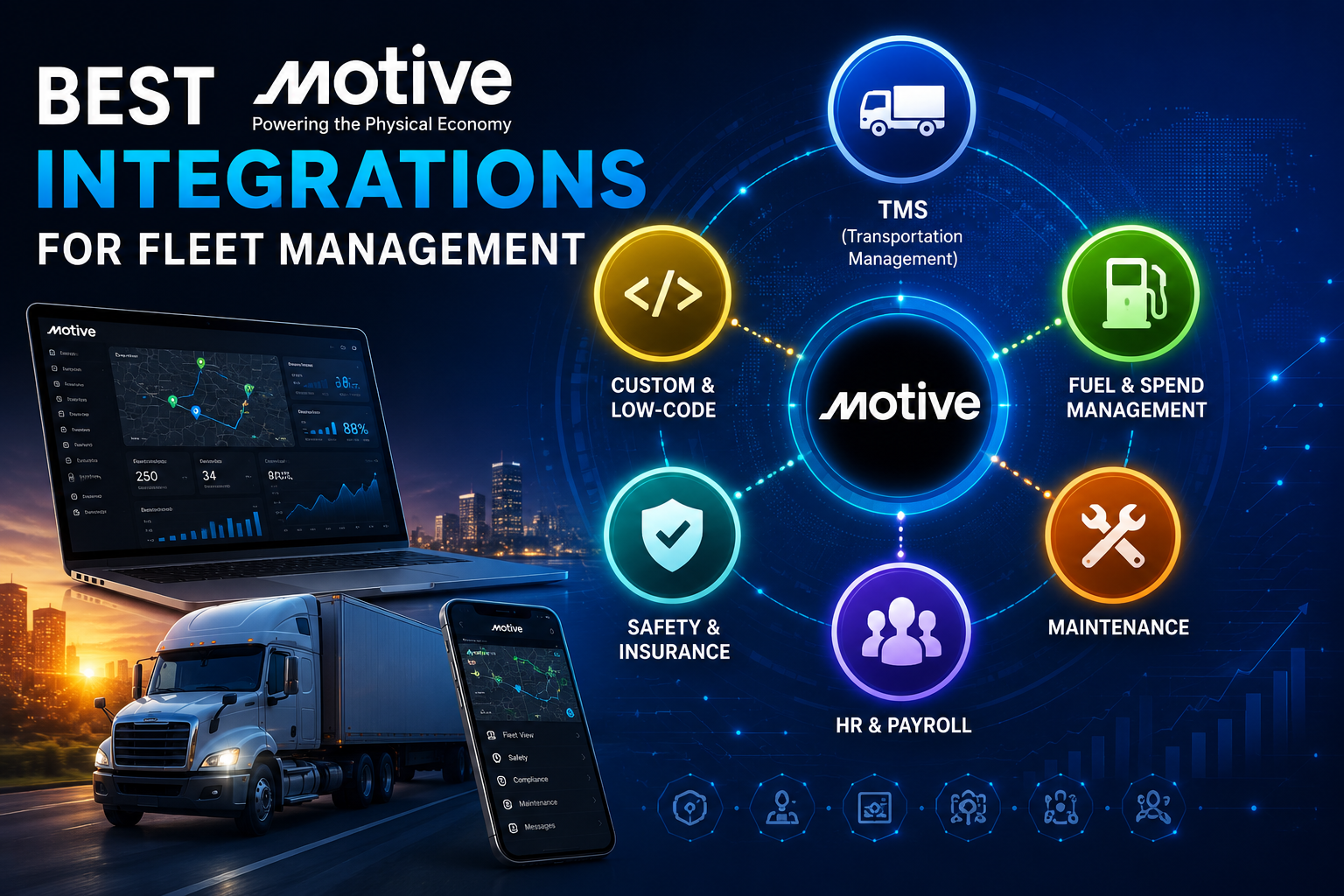
Fleet managers juggle dozens of moving parts every day: dispatch, driver hours, fuel spend, maintenance schedules, and compliance paperwork. Motive – GPS Fleet Tracking System & Solutions already brings real-time GPS tracking, ELD compliance, and AI dashcams into one dashboard. However, the platform becomes even more powerful once you connect it to the right third-party tools. This article reveals the best Motive integrations for fleet management, explains what each one actually does, and shows how to choose the combination that fits your operation.
Table of contents
Quick Summary
Before diving into details, here is a fast overview of the integration categories covered in this guide.
| Category | What It Solves | Example Partners |
|---|---|---|
| TMS (Transportation Management) | Dispatch, load tracking, ETAs | Truckpedia, Toro TMS, Axle, McLeod |
| Fuel & Spend Management | IFTA reporting, fuel fraud prevention | Motive Card, WEX, Fleetio |
| Maintenance | Preventive service, DVIR automation | Fleetio, Fullbay, Fiix CMMS |
| Safety & Insurance | Risk scoring, premium discounts | Sentry Insurance, Nirvana Safety |
| HR & Payroll | Driver onboarding, timekeeping | ADP, Digital Fleet |
| Custom & Low-Code | Flexible data pipelines | Pipedream, direct API access |
What Is Motive and Why Do Fleets Rely on It?

Motive, formerly known as KeepTruckin, has grown from a simple electronic logging device (ELD) provider into a full fleet management platform. Consequently, thousands of carriers now use it to manage safety, compliance, and spend from a single screen.
What Core Features Does Motive Offer?
At its core, Motive combines several building blocks fleets need daily:
- Real-time GPS tracking with a 1-3 second refresh rate
- FMCSA-registered ELD for Hours of Service compliance
- AI-powered dashcams that detect more than 20 unsafe driving events
- The Motive Card, which links fuel purchases directly to IFTA reporting
- Asset tracking hardware, including the Motive Beacon for trailers and equipment
Why Do Integrations Matter for Motive Users?
Even though Motive covers a lot of ground on its own, no single platform replaces every tool a fleet already relies on. Therefore, Motive built an App Marketplace with well over 100 integrations, ranging from dispatch software to insurance providers. As a result, fleets can keep their existing back-office systems while still benefiting from Motive’s telematics data. This flexibility is exactly what makes Motive integrations so valuable: instead of ripping out software you already trust, you simply connect it.
Furthermore, integrations solve a problem that grows worse as a fleet scales: data fragmentation. Without a connected system, a dispatcher checks one screen for location, a maintenance manager checks another for odometer readings, and an accountant checks a third for fuel spend. Each handoff between systems introduces delay and room for error. Once these platforms share data automatically, every department works from the same live numbers, which shortens decision-making time considerably.
How Does Motive Structure Its App Marketplace?
To make integrations easier to find, Motive organizes its marketplace into clear categories, including TMS, maintenance, fuel, Motive Cards, insurance, and HR tools. Each listing describes exactly what data flows between the two systems and how installation works, so fleet managers can evaluate fit before committing. Most installations follow a similar pattern: a manager searches the marketplace, clicks install, and either completes setup immediately or waits for Motive’s API support team to confirm the connection.
What Are the Best TMS Integrations for Motive?
Dispatchers lose hours every week when their transportation management system (TMS) and their ELD don’t talk to each other. Fortunately, several TMS platforms now pull Motive data automatically, eliminating manual check-ins.
How Do TMS Integrations Streamline Dispatch?
When a TMS connects to Motive’s API, dispatchers instantly see driver location, remaining Hours of Service, and load status without picking up the phone. For example, a 20-truck fleet running everything manually can burn 15 to 20 hours per week on tasks a proper integration automates. Because the data flows in real time, dispatchers can also predict delays and update customers proactively rather than reactively.
Which TMS Platforms Connect With Motive?
The table below highlights some of the most established options.
| TMS Platform | Key Strength | Best Fit For |
|---|---|---|
| Truckpedia | Deep, out-of-the-box Motive sync | 10-1,000+ truck carriers |
| Toro TMS | Automated ETAs and IFTA data capture | Mid-size fleets |
| Axle TMS | Basic GPS and HOS visibility | Owner-operators, small fleets |
| McLeod Software | Enterprise-grade dispatch and billing | Large enterprise fleets |
| Vektor TMS | Trailer tracking plus HOS in one workflow | Fleets managing mixed assets |
Notably, some TMS providers, such as FlexTMS, bundle dispatch, accounting, factoring, and fuel import together, so fleets get one connected system rather than several disconnected tools.
How Do You Know if a TMS Integration Is Real or Just a Checkbox?
Not every vendor that claims Motive compatibility offers the same depth of connection. Before signing a contract, ask each provider these questions:
- Does the integration pull live GPS and HOS data, or only periodic snapshots?
- Can dispatchers see driver availability without opening a second window?
- Does the connection support two-way syncing, or does data only flow in one direction?
- What happens to historical data if you later switch TMS providers?
Fleets that skip this evaluation often end up with two systems that technically “connect” but still require manual double-checking, which defeats the purpose of integrating in the first place.
How Do Fuel Card and Spend Management Integrations Work with Motive?

Fuel and maintenance costs typically account for nearly 75% of a fleet’s operating budget. Given that reality, integrations that connect fuel data to telematics deliver some of the fastest returns.
What Does the Motive Card Bring to Fuel Management?
The Motive Card ties every fuel purchase directly into the fleet dashboard. Because odometer readings and location data come from the same ELD hardware, the system can flag suspicious transactions and reduce fuel fraud. Additionally, IFTA reporting becomes automatic, so quarterly filing no longer requires piecing together receipts by hand.
Which Fuel and IFTA Integrations Are Worth Considering?
Beyond the Motive Card itself, several partners extend fuel and spend management further:
- Fleetio — imports every Motive Card transaction automatically, creating one source of truth for cost tracking and budgeting.
- WEX and similar fuel card networks — sync purchase data for fleets that already use an established fuel card provider.
- McLeod — pulls Motive Card purchases directly into enterprise accounting workflows.
Since fuel spend connects so closely to driver behavior, pairing this data with safety scores also helps managers see which habits, like idling or hard braking, are quietly driving up costs.
How Does Fuel Benchmarking Add Extra Value?
Beyond raw cost tracking, Motive’s Fuel Hub benchmarks a vehicle’s performance against a large network of similar vehicles. Consequently, a manager can quickly tell whether a truck’s fuel consumption sits within a normal range or signals a mechanical issue worth investigating. When this benchmarking data flows into a connected fuel or accounting platform, finance teams gain the same visibility without needing to log into the Motive dashboard separately.
What Should Fleets Watch Out For With Fuel Integrations?
While fuel integrations save time, they also involve sensitive payment data. Therefore, fleets should confirm that any connected platform meets standard security requirements before granting access, and should review which employees can view or export transaction-level detail. Taking this step early avoids compliance headaches later, particularly for fleets operating across multiple states with different tax reporting rules.
Which Maintenance Software Integrates Best with Motive?
Unexpected breakdowns cost far more than routine service, so linking maintenance software to real-time vehicle data prevents small issues from becoming expensive ones.
How Does Motive Data Improve Preventive Maintenance?
When a maintenance platform receives daily odometer readings and Diagnostic Trouble Codes (DTCs) straight from Motive, it can trigger service reminders automatically instead of waiting for a manager to notice a problem. Motive’s Driver Vehicle Inspection Reports (DVIRs) also feed directly into these systems, so defects get logged and assigned to a shop without extra data entry.
What Maintenance Partners Stand Out?
- Fleetio — builds preventive maintenance schedules and creates defect records automatically from Motive DVIRs and engine fault codes.
- Fullbay — delivers real-time telematics on customer and service trucks directly inside its shop management interface.
- Fiix CMMS — uses Motive’s real-time API to help fleets minimize downtime and boost compliance.
- FleetSoft — automates preventive maintenance routines using the same underlying vehicle data.
Because these tools all draw from the same Motive telematics feed, fleets avoid duplicate data entry across maintenance, compliance, and dispatch teams.
How Do These Integrations Change Daily Operations for a Maintenance Manager?
In practice, a maintenance manager using a connected platform starts the day with a prioritized list rather than a blank inspection log. Faults detected overnight already appear as open work orders, mileage-based reminders have already fired for vehicles approaching their service interval, and DVIR defects from the previous shift sit ready for review. As a result, the manager spends less time gathering information and more time actually resolving issues, which directly reduces vehicle downtime.
Should In-House Shops and Third-Party Vendors Use the Same Integration?
Interestingly, yes. Platforms like Fleetio support both in-house maintenance teams and outsourced repair shops within the same workflow. This matters because many fleets use a mix of both, sending routine service to an in-house bay while outsourcing specialized repairs. A shared integration keeps records consistent regardless of who performs the work, which simplifies warranty tracking and long-term cost analysis.
How Does Motive Support Safety and Insurance Integrations?

Insurance costs remain one of the largest line items for any commercial fleet, so integrations that turn safety data into savings deserve special attention.
Which Insurance Partners Reward Safe Driving Data?
Motive has partnered with providers like Sentry Insurance to help fleets lower commercial auto insurance costs. Fleets that choose to share ELD logs and dashcam footage can unlock savings of up to 5 percent. Since this data already exists inside Motive, there is no extra hardware or manual reporting required to participate.
How Do Safety Integrations Reduce Risk?
Tools such as Nirvana Safety analyze driver behavior more deeply, helping managers identify higher-risk drivers before an incident occurs. Meanwhile, Motive’s own AI dashcams detect more than 15 unsafe behaviors with high accuracy, and every high-confidence event routes straight to a manager for coaching. Because the scoring system also factors in road and weather conditions, the resulting safety scores hold up better during insurance reviews and legal disputes alike.
How Does Human Review Improve Trust in Safety Data?
One detail fleets often overlook is how flagged events get reviewed. High-confidence safety events route straight to a manager, while lower-confidence events go through Motive’s own Safety Team first, unless a fleet opts out of that human review step. This layered approach reduces false positives, so drivers trust the coaching they receive and managers spend less time disputing borderline incidents.
What Should Fleets Compare Before Sharing Data With an Insurance Partner?
Before opting into any insurance data-sharing program, compare the following:
| Consideration | Why It Matters |
|---|---|
| Discount percentage offered | Confirms the program is worth the trade-off |
| Data scope shared | Some programs use only ELD logs; others include dashcam footage |
| Contract length | Shorter terms allow easier reassessment later |
| Claims history requirements | Some insurers require a minimum safety score first |
Comparing these factors first prevents fleets from committing to a program that shares more data than necessary for the discount received.
What Other Integration Categories Should Fleet Managers Explore?
TMS, fuel, maintenance, and insurance cover the most common needs, but a few additional categories often get overlooked, even though they save meaningful time.
How Do HR and Payroll Integrations Fit In?
Integrations like ADP synchronize driver logs automatically, which speeds up payroll processing and reduces disputes over hours worked. Similarly, Digital Fleet streams real-time driver-vehicle pairing data into Motive, so drivers no longer need to log into the Motive Driver App manually just to register a trip.
What About Low-Code and Custom API Integrations?
For fleets with unique workflows, Pipedream offers a low-code platform that connects to Motive’s real-time API without requiring a full development team. This approach suits companies that need to route Motive data into internal dashboards, ERPs, or custom reporting tools that aren’t available as pre-built marketplace apps.
How Do Motive Integrations Strengthen Compliance and Reporting?

Regulatory compliance sits at the center of nearly every trucking operation, so it makes sense that many integrations exist specifically to reduce audit risk.
How Does Motive Simplify Hours of Service and IFTA Reporting?
Motive’s FMCSA-registered ELD already automates Hours of Service logging and produces audit-ready reports on its own. However, once that data feeds into a connected accounting or TMS platform, quarterly IFTA filing becomes largely automatic as well, since mileage and fuel data no longer need to be reconciled by hand. Consequently, compliance staff spend far less time chasing paperwork before a filing deadline.
What Reporting Capabilities Should Fleets Look For in a Connected Platform?
When evaluating a compliance-focused integration, prioritize platforms that offer:
- Automated alerts for approaching HOS violations
- Centralized storage for driver qualification files, MVRs, and drug testing records
- Exportable reports covering inspection history, vehicle utilization, and safety events
- Clear audit trails showing when records were created or modified
These capabilities matter most during a roadside inspection or a full compliance audit, when having organized, exportable records can significantly shorten the process.
How Should You Choose the Right Motive Integrations for Your Fleet?
Not every fleet needs every integration, so it helps to prioritize based on your biggest pain point first.
- If dispatch consumes too much manual effort, start with a TMS integration like Truckpedia or Toro TMS.
- If fuel costs keep climbing, pair the Motive Card with Fleetio or a similar fuel management tool.
- If unplanned downtime is frequent, connect a maintenance platform such as Fullbay or Fiix CMMS.
- If insurance premiums feel too high, explore Motive’s insurance partnerships to see whether shared safety data qualifies you for a discount.
- If your workflow is highly specific, consider a low-code option like Pipedream or work directly with Motive’s API team.
What Does a Realistic Rollout Timeline Look Like?
Trying to connect every category at once usually overwhelms a team and increases the chance of setup mistakes. Instead, a phased rollout tends to work better in practice:
- Week 1-2 — Connect the single integration tied to your biggest pain point, then confirm the data flowing in matches reality before moving on.
- Week 3-4 — Train dispatchers, drivers, or maintenance staff on the new workflow, since even a well-built integration fails if the team keeps using the old manual process alongside it.
- Month 2 — Add a second integration once the first one is running smoothly, rather than layering multiple new systems on staff simultaneously.
- Month 3 and beyond — Review reporting data to confirm the integration delivered the time or cost savings you expected, then decide whether additional categories are worth pursuing.
This step-by-step approach also makes it easier to isolate the source of a problem if something goes wrong, since you are not troubleshooting several new connections at once.
Conclusion
Motive integrations turn a strong standalone platform into a genuinely connected operation. Whether you need tighter dispatch coordination, automated IFTA reporting, smarter preventive maintenance, or lower insurance premiums, there is very likely a marketplace partner already built for that exact problem. Rather than treating Motive as an isolated compliance tool, fleets that connect it to their TMS, accounting, maintenance, and insurance systems unlock the full value of the telematics data they are already collecting every day.
Because Motive – GPS Fleet Tracking System & Solutions continues to expand its App Marketplace, fleets that invest time in the right integrations today position themselves for fewer manual tasks and better visibility tomorrow. The categories covered in this guide — TMS, fuel and spend management, maintenance, safety and insurance, HR, and custom API work — represent the areas where most fleets see the fastest and most measurable return. Ultimately, the goal is not to adopt every integration available, but to match each one to a specific operational gap your team already feels.
Frequently Asked Questions
Pricing varies by partner. Some integrations, such as basic TMS connections, come at no additional cost through Motive’s API, while certain third-party platforms charge their own subscription fees on top of their base software cost. Consequently, it’s worth confirming pricing directly with each partner before committing, and asking specifically whether the integration itself carries a separate fee or is bundled into an existing plan.
Motive’s solutions scale from fleets of five to ten vehicles up to large operations with thousands of trucks. Many integrations, including fuel card syncing and basic TMS connections, work well even for owner-operators, so fleet size should not be a barrier to getting started. In fact, smaller fleets sometimes benefit the most, since they typically lack a dedicated back-office team and rely heavily on automation to keep administrative work manageable.
Setup time depends on the complexity of the integration. Simple marketplace apps can often go live within a day or two, while custom API work or multi-system integrations may take longer, particularly when data from several platforms needs to be reconciled first. Working with an experienced technology partner generally shortens this timeline considerably, since they already understand common configuration pitfalls and can test the connection thoroughly before your team relies on it for daily operations.
How Can Solution for Guru Help You Implement Motive Integrations?
Choosing the right integrations is only half the job — connecting them correctly, mapping data fields, and training your team takes real technical work. This is where Solution for Guru adds value. The agency specializes in CRM, payroll, and SaaS platform integrations, and that expertise translates directly to fleet technology stacks.
Partnering with Solution for Guru brings several concrete benefits:
- Faster, cleaner setup — experienced developers configure API connections correctly the first time, reducing costly trial and error.
- Custom automation — beyond marketplace defaults, the team can build tailored workflows between Motive, your TMS, accounting software, and payroll systems.
- Ongoing technical support — as your fleet grows or switches tools, Solution for Guru adjusts integrations rather than forcing a full rebuild.
- Data security expertise — since fleet data includes sensitive driver and financial information, the team applies cybersecurity best practices throughout the integration process.
- Strategic guidance — beyond pure development, Solution for Guru advises on which integrations actually move the needle for your specific fleet size and industry.
In short, working with a dedicated technology partner turns a promising list of integrations into a system that runs smoothly every single day.
What Does the Onboarding Process With Solution for Guru Look Like?
Typically, the process begins with a short discovery conversation about which systems your fleet currently uses and which manual tasks cause the most frustration. From there, Solution for Guru maps out which Motive integrations address those pain points directly, rather than recommending a generic package. Once you approve the plan, the team handles the technical configuration, tests the data flow with your staff, and documents the setup so your internal team can maintain it going forward. Because the agency also works across CRM, payroll, and SaaS platforms, it can spot dependencies between systems that a fleet-only vendor might miss — for example, how a payroll change might affect driver settlement data pulled from Motive.
Recommended
- How Does Samsara Work?
- Is Motive Worth the Investment? ROI for Fleet Operators
- How Motive Improves Dispatcher Efficiency
- How Motive Helps Reduce Fleet Operating Costs
- Azuga Review: Features, Pros, Cons, and Best Use Cases
- What Is Azuga Fleet Management Software? A Complete Guide
- Top Reasons Businesses Choose Motive Fleet Management
- Samsara Review: Features, Pros, Cons, and Best Use Cases
- What Is Samsara GPS Fleet Tracking Software?
- Verizon Connect Review: Features, Pros, Cons, and Best Use Cases
- What Is Verizon Connect Fleet Management Software?
- Motive Pricing Plans Explained: How Much Does Motive Cost?
- What Is Motive Fleet Management?
- What Is the True Cost Breakdown of Fleet Tracking Systems?
- Offline Tracking: How Do Devices Store Data Without Connectivity?
- Real-Time Tracking vs Passive Tracking: What Are the Key Differences?
- How Vehicle Tracking Systems Reduce Commercial Auto Insurance Costs
- How Does GPS Tracking Work: Satellites, Signals, and Software?
- Can GPS Trackers Be Hacked? Security Risks Explained