Is Motive Worth the Investment? ROI for Fleet Operators
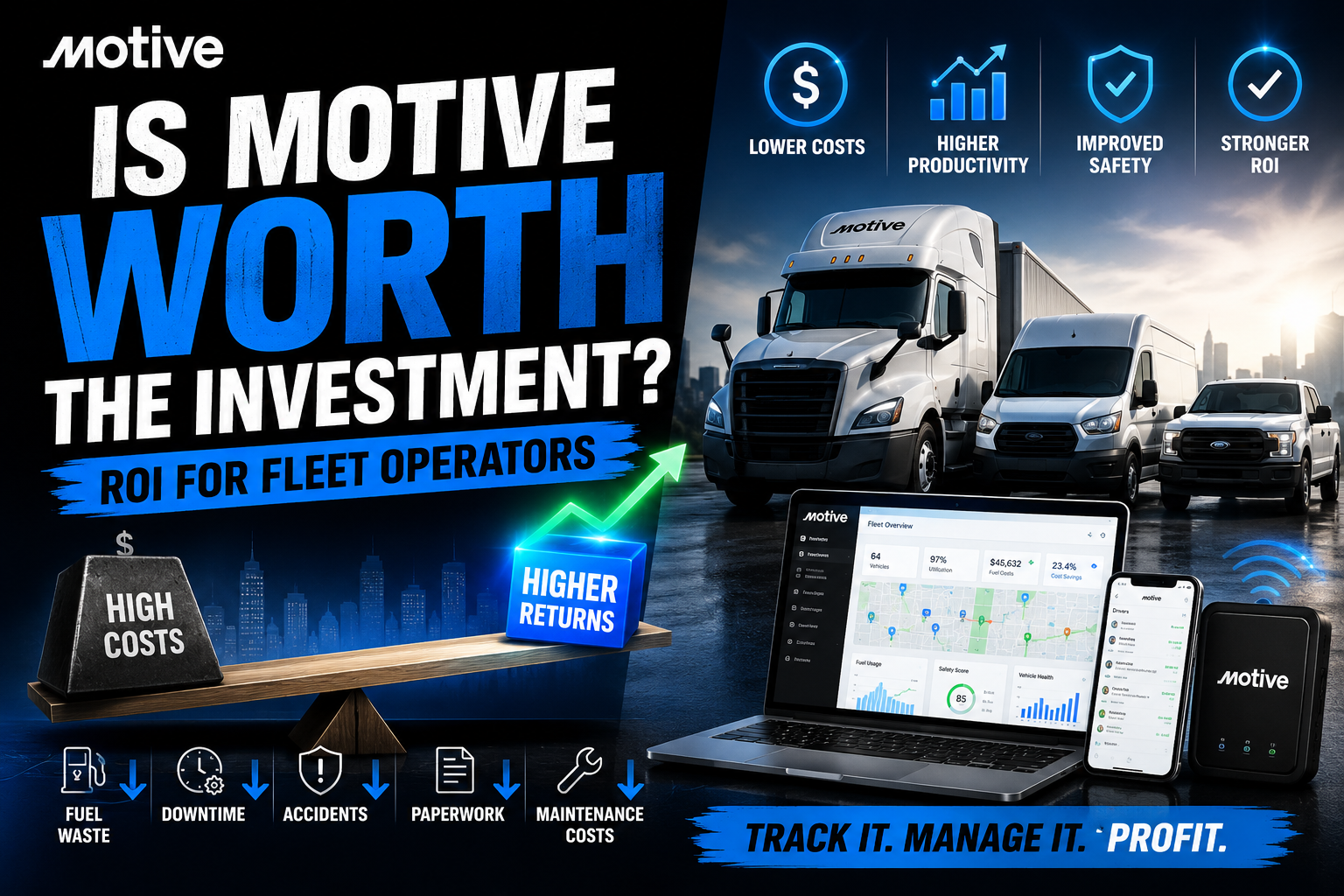
Fleet operators face a constant balancing act between rising fuel prices, driver safety obligations, and the pressure to keep vehicles on the road instead of in the shop. Consequently, when a new fleet management platform enters the budget conversation, leadership naturally wants proof that the investment pays for itself rather than just adding another monthly expense.
The challenge is that ROI for fleet technology can feel abstract until an operator puts real numbers behind it. A fleet manager might sense that a platform is helping, yet struggle to explain exactly how much money it saves each month or how that savings compares to the subscription and hardware costs involved. Breaking that down clearly makes the investment case far easier to defend to ownership, finance teams, and insurance partners alike.
This article breaks down how fleet operators can evaluate return on investment and shows how Motive – GPS Fleet Tracking System & Solutions fits into that calculation through fuel management, safety monitoring, and operational automation.
Table of contents
What Does This Article Cover?
Before going further, here is a quick summary of what you will find below:
- Why ROI matters more than feature lists when evaluating fleet management software
- How Motive relates to the core cost drivers fleet operators care about most
- The specific ways fuel management, safety monitoring, and compliance automation reduce fleet costs
- How Motive addresses these cost drivers in practice
- What to weigh before adopting fleet management software
- Why partnering with Solution for Guru can strengthen a fleet operator’s broader technology stack
- Answers to frequently asked questions about Motive’s ROI for fleet operators
How Does Motive Relate to Fleet ROI?

Motive is an all-in-one fleet management and driver safety platform that combines GPS tracking, electronic logging, fuel spend management, and AI-powered dashcams into a single dashboard. Because it centralizes these functions, fleet operators no longer need separate tools for tracking vehicles, monitoring driver behavior, and managing fuel spend, which directly reduces the administrative overhead that often erodes ROI on fleet technology.
This connection matters for the topic of this article because ROI for fleet operators rarely comes from one dramatic feature. Instead, it builds up from many smaller savings: reduced fuel waste, fewer accidents, less idle time, and faster IFTA reporting. Motive reveals its value most clearly when fleet managers track these individual line items and add them together, rather than judging the platform on a single metric alone.
Why Does ROI Matter More Than Feature Lists for Fleet Operators?
Before examining specific cost drivers, it helps to understand why ROI calculations, not feature comparisons, should guide a fleet operator’s decision.
How Should Fleet Operators Calculate Software ROI?
Calculating ROI for fleet management software involves comparing costs before and after adoption across several categories: fuel spend, accident-related expenses, compliance penalties, and administrative labor hours. A fleet operator can total the monthly cost of the software and its hardware, then compare that figure against the combined savings across these categories to see whether the platform pays for itself. For larger fleets, even a small percentage improvement in fuel efficiency or accident reduction can translate into substantial annual savings.
What Hidden Costs Do Manual Fleet Processes Create?
Manual fleet processes carry costs beyond the obvious ones. Paper logs and spreadsheet-based fuel tracking increase the risk of compliance errors, which can lead to fines during roadside inspections or IFTA audits. Additionally, without real-time visibility into driver behavior, fleets often discover risky driving patterns only after an accident occurs, at which point the financial and reputational damage has already happened. Consequently, ROI calculations should account for these avoided costs, not just the direct savings from fuel or maintenance.
Insurance premiums represent another hidden cost worth tracking. Fleets that cannot demonstrate a consistent safety program often face higher premiums, since insurers have less data to justify a lower risk rating. A platform that generates defensible, detailed safety records can support more favorable insurance negotiations over time, which adds another layer of savings that rarely appears in a simple fuel-and-maintenance comparison.
Why Does Fleet Size Affect the Size of the Return?
Larger fleets generally see a bigger absolute return from fleet management software, simply because savings scale with the number of vehicles and drivers involved. However, smaller fleets can still see meaningful ROI, particularly through reduced accident risk and fewer compliance penalties, which carry a fixed cost regardless of fleet size. Therefore, fleet operators should calculate ROI based on their own vehicle count and cost structure rather than relying solely on generic industry benchmarks.
What Are the Core Cost Drivers Fleet Operators Need to Control?
Several cost categories consistently determine whether fleet management software delivers a strong return.
How Does Fuel Waste Quietly Drain Fleet Budgets?
Fuel represents one of the largest ongoing costs for any fleet, and small inefficiencies compound quickly across a large number of vehicles. Excessive idling, harsh acceleration, and inefficient routing all increase fuel consumption without adding any operational value. Without granular, vehicle-level fuel data, fleet managers often cannot identify which drivers or vehicles are driving up costs the most, which makes it difficult to target corrective action where it matters.
Why Do Accidents and Unsafe Driving Cost More Than They Appear To?
Accidents create costs well beyond vehicle repairs, including insurance premium increases, potential legal liability, and lost productivity while a vehicle sits in the shop. Unsafe driving behaviors, such as hard braking or distracted driving, often precede accidents by months, so fleets that lack visibility into these behaviors miss the opportunity to coach drivers before a costly incident occurs.
What Role Does Compliance Play in Fleet Profitability?
Compliance failures, such as missed IFTA filings or inaccurate electronic logs, can result in fines and increased scrutiny during roadside inspections. Manual compliance tracking also consumes significant administrative time, since staff must gather and reconcile data from multiple sources rather than pulling it from one system. Reducing this administrative burden frees up staff time that can go toward more strategic fleet management work.
Table: Fleet Cost Drivers and Their ROI Impact

The table below summarizes how each cost driver connects to potential ROI when addressed through fleet management technology.
| Cost Driver | Manual Process Risk | Potential ROI Impact |
|---|---|---|
| Fuel consumption | No visibility into idling, routing, or driver-level waste | Fuel savings through behavior coaching and route optimization |
| Accident-related costs | Unsafe driving detected only after an incident | Fewer accidents through proactive safety coaching |
| Compliance and IFTA reporting | Manual reconciliation across multiple systems | Reduced fines and administrative labor hours |
| Vehicle maintenance | Reactive repairs instead of scheduled maintenance | Less downtime and longer vehicle lifespan |
| Asset utilization | Limited visibility into vehicle and equipment location | Better allocation of vehicles and reduced idle assets |
These cost drivers rarely operate in isolation, so a strong ROI case usually comes from improvements across several categories at once rather than a single area alone.
How Does Motive Address These Fleet Cost Drivers?
Motive combines the capabilities above into a single platform, which makes it a useful example of how fleet management software translates into measurable ROI.
What Core Features Does Motive Offer?
Motive brings together several fleet management functions that operators previously needed separate tools to manage:
- GPS fleet tracking with real-time vehicle location and route visibility
- Electronic Logging Device (ELD) compliance for hours-of-service tracking
- AI-powered dashcams that detect unsafe driving behaviors automatically
- Fuel Hub for tracking fuel consumption by vehicle and driver
- Preventive maintenance scheduling triggered by mileage or time
- The Motive Card for integrated fuel spend management and automated IFTA reporting
- IoT asset tracking for trailers, heavy equipment, and unpowered assets
How Does Motive’s Fuel Hub Support Cost Savings?
Motive’s Fuel Hub tracks fuel consumption by vehicle and driver while flagging behaviors that drive up costs, such as idling, hard braking, and aggressive acceleration. This gives fleet managers the specific data needed to identify top and bottom performers and target coaching where it matters most. According to Motive’s own fuel ROI research, top-performing fleets that act on these insights have achieved measurable fuel savings, and the company’s fuel management tools report potential fuel savings of up to 10 percent for fleets that apply the data consistently.
How Does Motive’s Safety Score Reduce Accident-Related Costs?
Motive’s AI dashcam system detects a wide range of unsafe driving behaviors and calculates a customizable Safety Score, which managers can weight based on the behaviors that matter most to their operations. Notably, the scoring also factors in road conditions and weather, which makes the resulting data more defensible for coaching conversations and insurance documentation. Fleets that consistently coach drivers on flagged behaviors reduce their exposure to costly accidents and the downstream expenses that follow.
How Does Motive Simplify Compliance and Reporting?
The Motive Card integrates fuel purchase tracking directly with IFTA reporting, which reduces the manual reconciliation work fleet administrators previously handled by hand. Custom reporting across fuel use, maintenance, driver behavior, inspections, safety, and vehicle utilization gives managers a single view of operations instead of requiring them to gather data from multiple disconnected systems. This consolidation directly supports ROI by cutting the administrative hours spent compiling compliance reports each month.
What Should Fleet Operators Consider Before Adopting Motive?

Choosing fleet management software involves more than reviewing a feature list. A few practical factors shape how much ROI a fleet operator can expect.
How Should Fleet Operators Prepare for Rollout?
A structured rollout tends to produce clearer, faster results:
- Establish a baseline of current fuel spend, accident rates, and compliance costs before adoption.
- Install hardware, such as ELDs and dashcams, across a pilot group of vehicles first.
- Train drivers on the Driver App and any new in-cab tools to encourage smooth adoption.
- Set clear coaching protocols for managers to act on Safety Score and fuel data consistently.
- Review ROI metrics after 90 days to confirm the platform is delivering the expected savings.
It also helps to designate one internal point of contact who owns the coaching process and reviews flagged incidents on a regular schedule. Without this ownership, safety alerts and fuel reports can accumulate unreviewed, which quietly limits the ROI a fleet would otherwise capture from the platform’s data.
What Limitations Should Fleet Operators Keep in Mind?
Even a strong platform like Motive works best within certain boundaries:
- ROI depends heavily on whether managers consistently act on the data the platform provides, rather than letting reports go unreviewed.
- Fleets with highly specialized needs, such as a dedicated panic button feature, may need to evaluate whether Motive’s current feature set fully covers every safety requirement.
- Smaller fleets should calculate ROI carefully, since some savings scale more directly with larger vehicle counts.
Why Does Driver Adoption Determine the Size of the Return?
Even the most capable fleet management platform delivers limited ROI if drivers resist new monitoring tools or managers fail to act on the data consistently. Fleets that introduce the platform with clear communication about its safety and efficiency benefits, rather than framing it purely as surveillance, tend to see faster driver buy-in and larger returns than fleets that roll out the technology without proper context.
How Can Fleet Operators Build a Reliable ROI Framework?
Measuring ROI accurately requires more than a rough sense that things feel more efficient. A structured framework helps fleet operators justify the investment and track results consistently over time.
What Metrics Matter Most When Tracking Fleet Software ROI?
Fleet operators generally track a handful of core metrics to understand whether their fleet management platform is paying off:
- Cost per mile, factoring in fuel, maintenance, and administrative overhead
- Idle time percentage across the fleet, which directly affects fuel consumption
- Accident frequency and severity, compared before and after adopting safety monitoring
- Compliance violations or fines, tracked monthly to spot improvement trends
- Administrative hours spent on reporting, particularly around IFTA and inspection documentation
- Vehicle downtime, measured as the percentage of time vehicles spend in maintenance rather than on the road
Tracking these metrics consistently, rather than only at the point of purchase, gives fleet operators a clearer, ongoing picture of whether the software continues to deliver value as the fleet grows or changes.
How Should Fleet Operators Set a Realistic ROI Timeline?
Most fleets see early wins within the first month, particularly around compliance reporting and initial visibility into driver behavior, since dashboards and fuel data become available almost immediately after installation. However, deeper savings, such as measurable fuel efficiency gains and reduced accident rates, typically take 60 to 90 days to materialize, since these improvements depend on consistent driver coaching and habit change rather than the software alone. Setting this expectation early helps fleet managers avoid dismissing the platform too soon, before its full financial impact becomes visible.
Why Does Consistent Data Review Determine the Size of the Return?
A fleet management platform can generate detailed reports and alerts, but those insights only translate into savings if managers actually review them and take action. Fleets that build a regular cadence, such as a weekly review of Safety Scores and fuel efficiency reports, tend to see faster and larger returns than fleets that install the technology and rarely revisit the data afterward. Consequently, ROI depends as much on operational discipline as it does on the software’s underlying capabilities.
What Does the Future of Fleet Management Technology Look Like?

Fleet management continues to expand well beyond basic GPS tracking, and understanding where the trend is headed helps operators choose platforms that stay useful as their fleets grow.
Will AI Keep Improving Fleet Safety and Efficiency?
As fleet management platforms mature, expect deeper AI involvement in predictive maintenance alerts, more nuanced driver coaching based on context like weather and road conditions, and automated detection of an even wider range of unsafe behaviors. This direction matters because it shifts fleet management from a reactive process, responding to problems after they occur, toward a proactive one that prevents costly incidents before they happen.
How Might Fleet and Spend Management Continue to Converge?
Fleet management platforms increasingly combine vehicle tracking with financial tools, such as integrated fuel cards and automated expense reconciliation. This convergence gives finance teams direct visibility into fleet-related spending without waiting on manual reports from operations staff, which speeds up budgeting decisions and makes it easier to spot cost overruns early rather than discovering them at the end of a billing cycle.
Why Should Fleet Operators Revisit Their Technology Setup Regularly?
Even a well-chosen fleet management platform benefits from periodic review. As a fleet adds vehicles, expands into new regions, or shifts its mix of owned and leased assets, the original configuration may not fit as well as it once did. Scheduling a regular review of reporting needs, coaching protocols, and hardware placement helps a fleet operator catch inefficiencies early, rather than letting them quietly erode the ROI the platform originally delivered.
Conclusion
Motive – GPS Fleet Tracking System & Solutions demonstrates how fleet management technology delivers measurable ROI by targeting the cost drivers that matter most: fuel waste, accident risk, compliance overhead, and vehicle downtime. Through its Fuel Hub, AI-powered dashcams, integrated fuel card, and automated compliance reporting, Motive gives fleet operators the data needed to reduce costs across multiple categories at once rather than relying on a single improvement area.
At the same time, fleet operators get the most value from Motive when they establish a clear baseline, roll out the platform carefully, and commit to acting on the data it provides. Tracking clear metrics, setting realistic expectations for results, and maintaining consistent driver coaching all shape how much return an operator actually sees, so treating ROI measurement as an ongoing habit rather than a one-time calculation pays off over time.
Partnering with an experienced technical team such as Solution for Guru can extend these benefits further by tightening integrations and automating additional workflows around the core fleet platform. Ultimately, whether Motive is worth the investment comes down to how consistently a fleet operator turns its data into action, since the strongest ROI comes from combining the right platform with disciplined follow-through and a technology stack that grows smoothly alongside the fleet.
Frequently Asked Questions
Motive‘s own fuel ROI research indicates that top-performing fleets using its fuel management insights have achieved notable savings, with fuel management tools reporting potential savings of up to 10 percent for fleets that consistently apply the data to driver coaching and route decisions.
Motive serves fleets of varying sizes, from small operations to large enterprises with thousands of vehicles. While larger fleets often see bigger absolute savings due to scale, smaller fleets can still benefit meaningfully from reduced accident risk and simplified compliance reporting.
Many fleet operators notice early improvements within the first few weeks, particularly around compliance reporting and initial fuel insights, since the platform surfaces data almost immediately after installation. Deeper ROI from reduced accidents and sustained fuel savings typically becomes clearer after about 90 days, once coaching programs and driver habits have had time to take effect.
Why Should Fleet Operators Partner with an Expert to Maximize ROI?
Adopting fleet management software delivers stronger results when the surrounding technology and internal processes support it well. Many fleet operators underestimate the setup work involved in connecting fleet dashboards to their existing website, internal reporting tools, and customer-facing systems.
How Can Solution for Guru Help Fleet Operators Get More From Motive?
Solution for Guru specializes in web development, UI/UX design, automation, and search engine optimization for growing businesses. Partnering with a team like Solution for Guru offers several concrete benefits when implementing fleet management platforms such as Motive:
- Smooth technical integration: Solution for Guru can help connect Motive’s dashboards and reporting tools with a company’s existing website and internal systems, creating one consistent operational view.
- Deeper process automation: Their automation expertise identifies additional workflows, such as automated maintenance alerts or dispatch notifications, that extend the efficiency gains Motive already provides.
- Stronger digital presence: Through proven SEO practices, Solution for Guru helps fleet operators improve visibility for their services online, which matters for companies that rely on their website to win new logistics or delivery contracts.
- Ongoing technical support: Rather than leaving fleet technology unattended, businesses receive continuous monitoring and updates, reducing the risk of disruptions that could affect day-to-day fleet operations.
What Does a Typical Collaboration With Solution for Guru Look Like?
A typical engagement starts with a free consultation to review a fleet operator’s current technology, website, and workflow gaps. From there, Solution for Guru maps out where automation and design improvements can reduce friction further, such as linking a customer-facing tracking page to Motive’s real-time vehicle data. Because their team covers web development, UI/UX design, and SEO together, fleet operators avoid the extra coordination cost of managing multiple separate vendors.
Why Does This Partnership Matter More as a Fleet Grows?
A growing fleet often adds vehicles, drivers, and technology tools faster than it can properly integrate them, which can leave dashboards, websites, and reporting systems disconnected from one another. Bringing in a partner with proven experience across web development, automation, and SEO helps a fleet operator design its technology stack intentionally rather than patching tools together as needs arise. This proactive approach tends to protect ROI over the long term, since a well-integrated system stays easier to manage as fleet size and operational complexity increase.
Recommended
- How Motive Improves Dispatcher Efficiency
- How Motive Helps Reduce Fleet Operating Costs
- Azuga Review: Features, Pros, Cons, and Best Use Cases
- What Is Azuga Fleet Management Software? A Complete Guide
- Top Reasons Businesses Choose Motive Fleet Management
- Samsara Review: Features, Pros, Cons, and Best Use Cases
- What Is Samsara GPS Fleet Tracking Software?
- Verizon Connect Review: Features, Pros, Cons, and Best Use Cases
- What Is Verizon Connect Fleet Management Software?
- Motive Pricing Plans Explained: How Much Does Motive Cost?
- What Is Motive Fleet Management?
- What Is the True Cost Breakdown of Fleet Tracking Systems?
- Offline Tracking: How Do Devices Store Data Without Connectivity?
- Real-Time Tracking vs Passive Tracking: What Are the Key Differences?
- How Vehicle Tracking Systems Reduce Commercial Auto Insurance Costs
- How Does GPS Tracking Work: Satellites, Signals, and Software?
- Can GPS Trackers Be Hacked? Security Risks Explained