How Does Samsara Work?
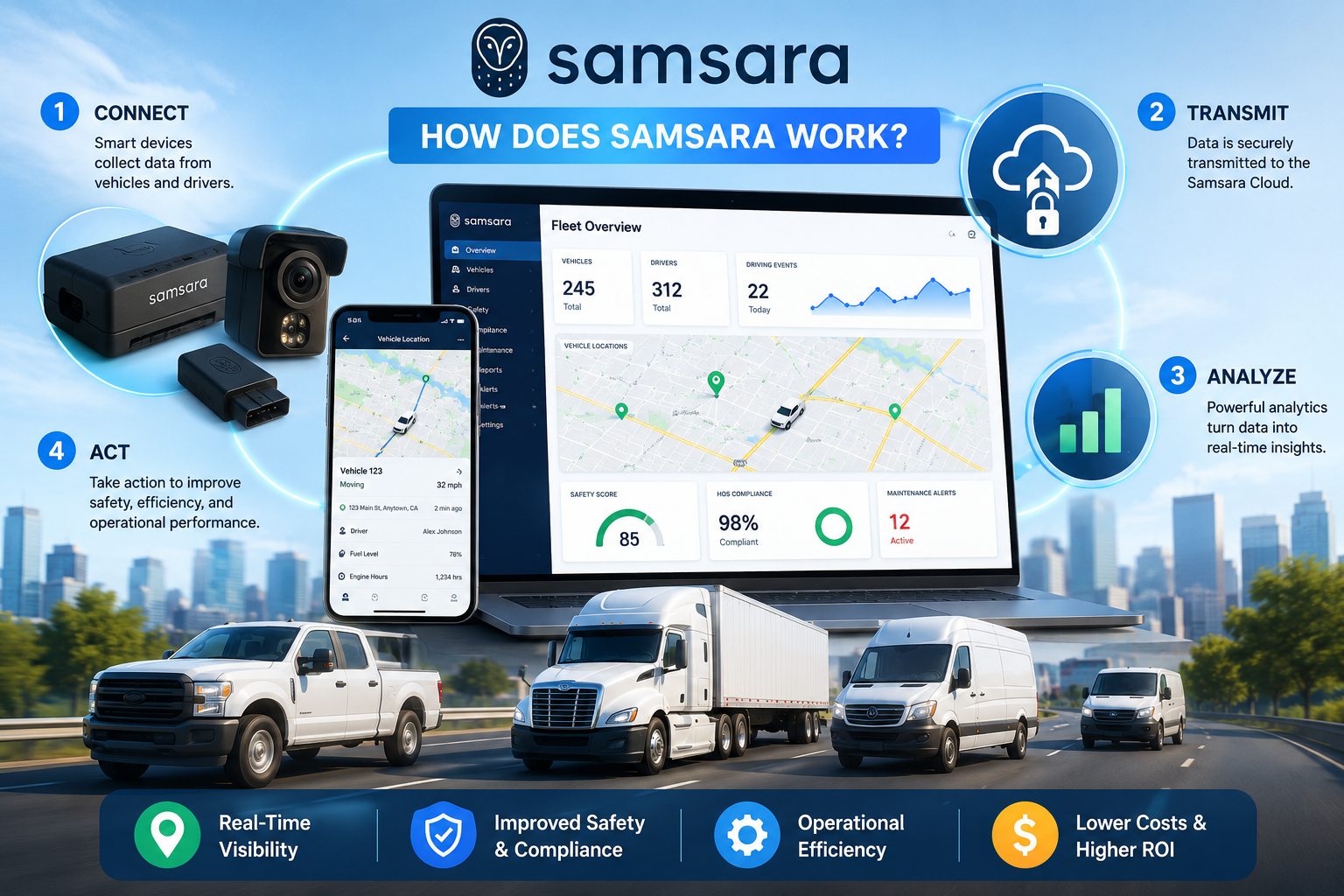
Fleet managers cannot watch every truck, trailer, and driver in person, yet they still need to know where assets are, how drivers behave on the road, and when a vehicle needs maintenance before it breaks down. Samsara solves this problem by turning physical operations into real-time digital data, replacing guesswork and manual check-ins with a continuous stream of information that managers can act on immediately. This article explains exactly how the platform works, from the hardware installed in a vehicle to the dashboard a manager checks each morning, so fleet operators of any size can understand what actually happens behind the scenes.
Table Of Contents
Quick Summary
- Samsara combines cellular hardware (Vehicle Gateways, dash cams, and sensors) with a cloud dashboard to deliver live GPS tracking, safety alerts, and compliance reporting.
- Installation is largely plug-and-play, since most gateways connect through a vehicle’s OBD-II or diagnostic port in minutes, without hardwiring.
- AI-powered dash cams detect unsafe driving behaviors, such as harsh braking, distracted driving, or following too closely, and send alerts to both drivers and managers.
- The platform extends beyond vehicles to trailers, equipment, and other mobile assets through battery-powered gateways and tags.
- Samsara – GPS Fleet Tracking Software integrates with more than 100 third-party tools, and businesses that want a smooth rollout often benefit from working with an experienced implementation partner such as Solution for Guru.
What Is Samsara, and How Does It Fit Into Fleet Management?

Samsara is an Internet of Things (IoT) platform that connects physical assets, primarily vehicles, trailers, and equipment, to a central cloud dashboard so managers can monitor operations in real time. Instead of relying on driver phone calls or manual paperwork, fleet operators get continuous data streams covering location, speed, engine health, and driver behavior.
Why Do Businesses Need GPS Fleet Tracking Software in the First Place?
Fleets lose money every time a vehicle sits idle, a driver takes an inefficient route, or a mechanical issue goes unnoticed until it causes a breakdown. Consequently, businesses that manage even a handful of vehicles benefit from software that shows exactly where every asset sits and how it performs throughout the day. Samsara – GPS Fleet Tracking Software addresses this need directly, since it was built specifically to give transportation, logistics, and construction companies continuous visibility into assets that would otherwise operate largely out of sight.
How Does Samsara Position Itself Among Competitors?
Samsara provides real-time visibility into physical operations through the Internet of Things, and businesses use it for fleet management and optimization, equipment monitoring, and vehicle telematics. Notably, Samsara has earned recognition as the most requested fleet platform among small businesses with fewer than 49 vehicles, along with a “Best for Small Business” distinction on recent fleet management rankings. This suggests the platform scales comfortably from small local fleets up to large, multi-state operations, which is one reason it shows up so often in comparisons across the fleet management category.
How Does the Hardware Side of Samsara Actually Work?
Samsara’s system starts with physical hardware installed on vehicles and assets. This hardware collects raw data and transmits it to the cloud, where the software turns it into actionable insights.
What Is the Vehicle Gateway, and What Does It Do?
The Vehicle Gateway acts as the central hub for each vehicle. It is an advanced sensor platform that captures real-time vehicle and driver data and provides live GPS tracking, and it enables live tracking, remote diagnostics, and FMCSA-registered ELD capabilities that give operators insights for dispatch, routing, fuel management, maintenance, and driver management. Importantly, the Gateway includes 4G LTE cellular connectivity with a built-in WiFi hotspot, which supports mobile apps, dash cameras, and HD video streaming.
How Does Installation Work in Practice?
Unlike older telematics systems that required professional hardwiring, Samsara emphasizes simplicity. After signing up and building a plan that fits specific needs and budget, fleets can install plug-and-play GPS tracking devices into vehicles’ OBD-II ports within minutes, since Samsara does not offer hardwired tracking devices. This matters because it means fleets do not need to schedule vehicles into a shop for installation; drivers or in-house staff can typically complete setup themselves.
How Rugged Is the Hardware, and Does It Hold Up in Harsh Conditions?
Samsara designs its gateways for demanding environments rather than casual use. The Vehicle Gateway features a rugged design tested for vibration, shock, moisture, and extreme temperatures, along with a flexible mounting system, smart diagnostics connectors, multi-colored LED status indicators, and a built-in “last gasp” feature that alerts the system if power is lost. As a result, fleets operating in construction, agriculture, or long-haul trucking can rely on the hardware even outside controlled conditions.
How Do Samsara’s Sensors and Cameras Extend the System?
Beyond the core Vehicle Gateway, Samsara layers additional sensors and cameras onto the platform, which lets it track far more than just a vehicle’s location.
How Do Sensors Connect to the Rest of the System?
Samsara sensors automatically connect with the closest compatible gateway, whether a Vehicle Gateway or an Asset Gateway, depending on the sensor type and which gateways are installed, and a single gateway can support multiple sensors to build a comprehensive view of an asset’s condition. Administrators can also pin a specific sensor to a particular gateway so that its readings appear tied to that asset in dashboard reports, rather than showing up as an unpaired signal.
What Role Do Dash Cameras Play?
Dash cameras add a visual layer of safety monitoring on top of location data. Samsara’s cameras use AI-powered safety detections to identify risks such as forward collisions, unsafe following distances, distracted driving, phone use, and failure to stop, then alert drivers in real time so they can self-correct before an incident occurs. In addition, the system automatically detects harsh braking, acceleration, turning, and crashes, which builds an evidence trail that helps with driver coaching and insurance claims alike.
How Does Samsara Track Trailers and Unpowered Assets?
Not every asset a fleet manages has an engine. Samsara offers GPS tracking to both powered and unpowered trailers and assets through dedicated asset management units, which upload data over WiFi or through the Vehicle Gateway using 4G, giving fleets visibility into trailer location, speed, temperature, and availability, with some models supporting anti-theft and door tracking. This extension turns Samsara – GPS Fleet Tracking Software into a broader asset-management system rather than a tool limited to vehicles alone.
How Does Samsara Turn Raw Data Into Useful Dashboard Insights?
Collecting data means little without a clear way to interpret it, so Samsara’s cloud dashboard plays a central role in translating raw signals into decisions a manager can act on immediately.
What Does Live Tracking Look Like for Fleet Managers?
The Samsara fleet map lets managers view trips using both a left-hand sidebar list and a map, so they can track live movement without switching between separate tools. Meanwhile, the platform shares route progress, automatic updates, transparent arrival times, and delay notifications, all supported by live tracking functionality. This gives dispatchers a single, current view of the entire fleet, rather than relying on drivers to call in updates manually.
How Does the Platform Generate Alerts and Safety Scores?
Samsara does not just show raw location data; it actively flags issues that need attention. The platform provides alerts related to idling, speeding, engine faults, battery levels, and geofence breaches, which helps maintain fleet safety and reliability. On the driver side, managers can track each driver’s safety score relative to others, allowing them to reward top performers, while alerts trigger automatically based on events like speeding or harsh braking. Additionally, the Safety Inbox tool displays a centralized view of automatically detected events, including safety and speeding occasions, based on incoming data.
How Does Samsara Support Compliance Reporting?
Compliance is often one of the most time-consuming parts of running a commercial fleet, and Samsara automates much of it. Samsara helps businesses comply with electronic logging device (ELD) regulations, International Fuel Tax Agreement (IFTA) specifications, hours of service (HoS) mandates, and driver’s vehicle inspection report (DVIR) laws. More specifically, the Samsara Driver App allows drivers to track their Hours of Service directly from an Android or iOS device, and the platform automatically compiles a report that stays available to share during a roadside inspection, while managers gain access to HOS data, sensor data, DVIRs, and documents on the same platform used by drivers.
How Does Samsara Handle Integrations and Third-Party Tools?
Because fleets rarely rely on a single software system, Samsara’s ability to connect with outside platforms plays a major role in how well it fits into an existing operation.
Which Systems Does Samsara Commonly Integrate With?
Samsara supports a wide integration ecosystem across multiple categories of business software:
| Integration Category | Example Tools |
|---|---|
| Fleet maintenance | Fleetio, Whip Around, AUTOsist |
| Routing and dispatch | Magnus TMS, Drivewyze, SpeedGauge |
| Mapping | ArcGIS |
| HR and workforce | ADP Workforce Now |
| Transit and school fleets | EDULOG, BusWhere |
| Connectivity | Verizon Connect, RoadFlex |
Samsara integrates with tools such as Fleetio, Magnus TMS, Drivewyze, RoadFlex, SpeedGauge, Whip Around, EDULOG, and Verizon Connect, and reviewers commonly mention these integrations in the context of fleet maintenance and tracking, while the platform also supports over 100 integrations across HR, mapping, routing, and fleet operations.
How Does Samsara Support Custom Integrations?
For fleets with more specialized needs, Samsara does not limit connectivity to its pre-built integrations alone. The system’s open API architecture allows integration with third-party systems and existing operational workflows, and Samsara maintains an extensive third-party marketplace with more than 350 apps from manufacturers such as Ford, Stellantis, and GM, along with fuel card providers, plus hundreds of maintenance, safety, coaching, compliance, and fuel management apps.This flexibility means IT and operations teams can build custom data pipelines between Samsara and whatever core business systems they already run.
How Much Does Samsara Cost, and How Is Pricing Structured?

Unlike some competitors that publish a flat per-vehicle rate, Samsara takes a more customized approach to pricing, which can make budgeting slightly less straightforward for new buyers.
Why Doesn’t Samsara Publish a Fixed Price?
As of mid-2026, Samsara’s pricing page does not display a per-vehicle price; instead, the company uses a fleet-size quote tool, meaning prospective customers must speak with sales to get an actual number. This approach lets Samsara tailor pricing to fleet size, hardware selection, and feature requirements, but it also means buyers cannot immediately compare costs the way they can with providers who publish transparent per-vehicle rates.
What Do Reviewers Say About Samsara’s Value for Money?
Feedback on pricing is mixed. Some reviewers feel Samsara offers good value for money due to robust features, helpful upgrades, and flexible payment plans, while others report high pricing, frequent increases, extra charges, and unclear information about upgrades and costs. Therefore, businesses evaluating the platform should request a detailed, itemized quote and ask directly about contract length, hardware costs, and any fees tied to adding cameras, sensors, or additional vehicles later.
What Should Buyers Ask For When Requesting a Quote?
To avoid surprises, it helps to request clarity on a few specific points before signing:
- Whether hardware (Vehicle Gateways, cameras, sensors) is included or billed separately
- The length of the contract term and any early termination costs
- Whether pricing changes based on the number of cameras or sensors added per vehicle
- What support and training are included during rollout
- How pricing scales if the fleet grows or shrinks mid-contract
How Does the Driver Experience Work Inside Samsara?

While managers interact mostly with the dashboard, drivers interact with Samsara primarily through a mobile app, and this side of the platform plays a large role in how well the system actually improves safety and compliance day to day.
What Can Drivers Do Through the Samsara App?
The Samsara Driver App gives drivers direct access to the same compliance and safety data that managers see, just tailored to their own trips. Drivers can track their Hours of Service directly from an Android or iOS tablet or phone, and the platform automatically compiles a report that stays available to share during a roadside inspection. Beyond compliance, the app also supports two-way messaging with dispatch, so drivers do not need to rely on separate phone calls or texts to receive route updates or answer questions from the office.
How Does In-Cab Coaching Work in Real Time?
One of the more distinctive parts of the driver experience comes from real-time, in-cab coaching. The dash cam’s AI detects unsafe behaviors such as forward collisions, unsafe following distances, distracted driving, and failure to stop, and it alerts drivers in the moment so they can self-correct before an incident occurs, rather than waiting for feedback after the fact. This immediate feedback loop differs from many older systems, which typically relied on managers reviewing footage well after a risky event had already happened.
Does Recording Raise Privacy Concerns for Drivers?
Because dash cams face both the road and the driver, privacy is a legitimate question many fleets address directly with internal policy. In practice, footage from before, during, and immediately after a safety event uploads automatically to a centralized safety inbox, and companies typically require drivers to review and sign a dash cam policy explaining exactly how footage will and will not be used. Live streaming capability exists on the platform, but many fleets choose not to activate that feature, relying instead on event-triggered recording rather than continuous live monitoring of the cabin. Clear internal policy, communicated before rollout, tends to ease driver concerns considerably.
What Are the Advantages and Trade-Offs of Using Samsara?

Every platform involves trade-offs, and understanding them in advance helps fleet managers set realistic expectations before adopting the system.
What Do Users Appreciate Most About Samsara?
Verified reviews point to a consistent set of strengths:
- Accurate, reliable tracking: Reviewers describe real-time tracking as accurate and reliable, essential for fleet oversight and accountability, and they appreciate the platform’s accuracy, historical trip data, and integration with Garmin devices.
- Hassle-free installation: The top features cited by reviewers include vehicle tracking, vehicle cameras, and a hassle-free installation process.
- Unified management across vehicle types: Samsara works with all types of vehicles, from cars and buses to trucks and specialized vehicles, allowing a single dashboard to unify management of mixed fleets and mobile assets.
- Strong safety tooling: Samsara includes a panic button and crash reporting function at no extra charge in the US, ensuring fast collision response, which not every fleet system offers.
What Should Buyers Be Cautious About?
Some limitations show up consistently in independent reviews as well:
- Opaque pricing: As noted, Samsara does not post a per-vehicle price, so buyers need a sales conversation to get real numbers.
- Occasional mapping issues: Some reviewers mention occasional mapping problems despite overall satisfaction with GPS accuracy.
- Long contract commitments: Samsara’s offering is often paired with multi-year contracts, and features like SD card access and permanent adhesive mounting can feel rigid, particularly for single-vehicle operators rather than larger fleets.
- Best suited to fleets, not individuals: Samsara is built for commercial fleets rather than casual users, and while it performs strongly for fleet managers, it can be a mismatch for owner-operators seeking a lighter, more flexible setup.
How Does Samsara Compare Against Simpler GPS Trackers?
Fleets weighing Samsara against more basic GPS tracking tools should understand that the platform intentionally goes further than location tracking alone. Samsara is a fleet operations management platform designed to assist industries such as transportation, logistics, and construction with GPS fleet tracking, ELD compliance, routing and dispatch, documents, reporting, and alerts, combining these functions in one system rather than requiring separate tools for each. A basic tracker might only show a dot on a map, whereas Samsara layers safety scoring, compliance automation, and maintenance diagnostics on top of that same location data. This breadth explains why the platform tends to appeal most to fleets that need a single operational hub rather than a narrow point solution.
Conclusion
Samsara works by combining rugged, plug-and-play hardware with a cloud-based dashboard that turns raw vehicle, driver, and asset data into real-time insights. From the Vehicle Gateway’s GPS and diagnostic data to AI-powered dash cams and dedicated asset trackers, the platform builds a complete picture of fleet operations that would be impossible to maintain manually. Strong integration options, wide vehicle-type support, and dependable safety tooling make Samsara – GPS Fleet Tracking Software a serious contender for businesses of nearly any fleet size, though buyers should approach pricing conversations carefully, since costs are not published upfront.
For organizations ready to adopt the platform, working with an experienced partner such as Solution for Guru can make the difference between a rollout that stalls on configuration issues and one that delivers clear, measurable improvements in safety, compliance, and efficiency from the very first month.
Frequently Asked Questions
In most cases, fleets can install Samsara hardware without professional help. After building a plan that fits a fleet’s needs, teams can install the plug-and-play GPS tracking devices into vehicles’ OBD-II ports within minutes, since Samsara does not offer hardwired tracking devices. More complex setups involving multiple cameras or asset sensors may take slightly longer but still follow the same general self-install approach.
Yes, Samsara extends tracking beyond powered vehicles. The platform offers GPS tracking to both powered and unpowered trailers and assets through dedicated asset management units that upload data over WiFi or through a Vehicle Gateway using 4G, providing visibility into trailer location, speed, temperature, and availability. This makes it possible to monitor an entire operation, not just the vehicles that drive it.
Why Doesn’t Samsara List Its Prices Publicly Like Some Competitors?
Samsara relies on a custom quoting process rather than a flat published rate. As of mid-2026, Samsara’s pricing page does not display a per-vehicle price, and the company instead uses a fleet-size quote tool that requires speaking with sales. Because pricing depends on fleet size, hardware selection, and desired features, businesses should request an itemized quote and clarify contract terms before committing.
Why Should Businesses Work With Solution for Guru When Implementing Samsara?
Understanding how Samsara works is only the first step. Getting real value from the platform depends on correct hardware selection, smooth integration with existing business systems, and a rollout plan that avoids disrupting daily operations.
What Does Solution for Guru Bring to a Samsara Rollout?
Solution for Guru is a technology solutions provider with experience across CRM, SaaS, and business system integrations, and its work already spans multiple fleet and operations platforms. Partnering with a team like this offers several concrete advantages when adopting Samsara – GPS Fleet Tracking Software:
- Accurate needs assessment: A partner can help fleets choose the right combination of Vehicle Gateways, cameras, and sensors instead of overpaying for unnecessary hardware or underprovisioning safety tools.
- Smoother API and third-party integration: Given Samsara’s open API and large third-party marketplace, an experienced integrator can connect the platform to existing dispatch, maintenance, or HR systems without costly trial and error.
- Negotiation support during quoting: Since Samsara’s pricing is not published, a knowledgeable partner can help fleets ask the right questions and avoid unclear upgrade costs down the line.
- Faster driver and staff onboarding: Rolling out new hardware and driver-facing apps across a fleet takes coordination, and a partner experienced in change management reduces resistance and speeds adoption.
Ultimately, the technology delivers the raw visibility, but the right implementation partner ensures a fleet captures the full operational and financial benefit of that visibility.
Recommended
- Is Motive Worth the Investment? ROI for Fleet Operators
- How Motive Improves Dispatcher Efficiency
- How Motive Helps Reduce Fleet Operating Costs
- Azuga Review: Features, Pros, Cons, and Best Use Cases
- What Is Azuga Fleet Management Software? A Complete Guide
- Top Reasons Businesses Choose Motive Fleet Management
- Samsara Review: Features, Pros, Cons, and Best Use Cases
- What Is Samsara GPS Fleet Tracking Software?
- Verizon Connect Review: Features, Pros, Cons, and Best Use Cases
- What Is Verizon Connect Fleet Management Software?
- Motive Pricing Plans Explained: How Much Does Motive Cost?
- What Is Motive Fleet Management?
- What Is the True Cost Breakdown of Fleet Tracking Systems?
- Offline Tracking: How Do Devices Store Data Without Connectivity?
- Real-Time Tracking vs Passive Tracking: What Are the Key Differences?
- How Vehicle Tracking Systems Reduce Commercial Auto Insurance Costs
- How Does GPS Tracking Work: Satellites, Signals, and Software?
- Can GPS Trackers Be Hacked? Security Risks Explained