Samsara vs Verizon Connect
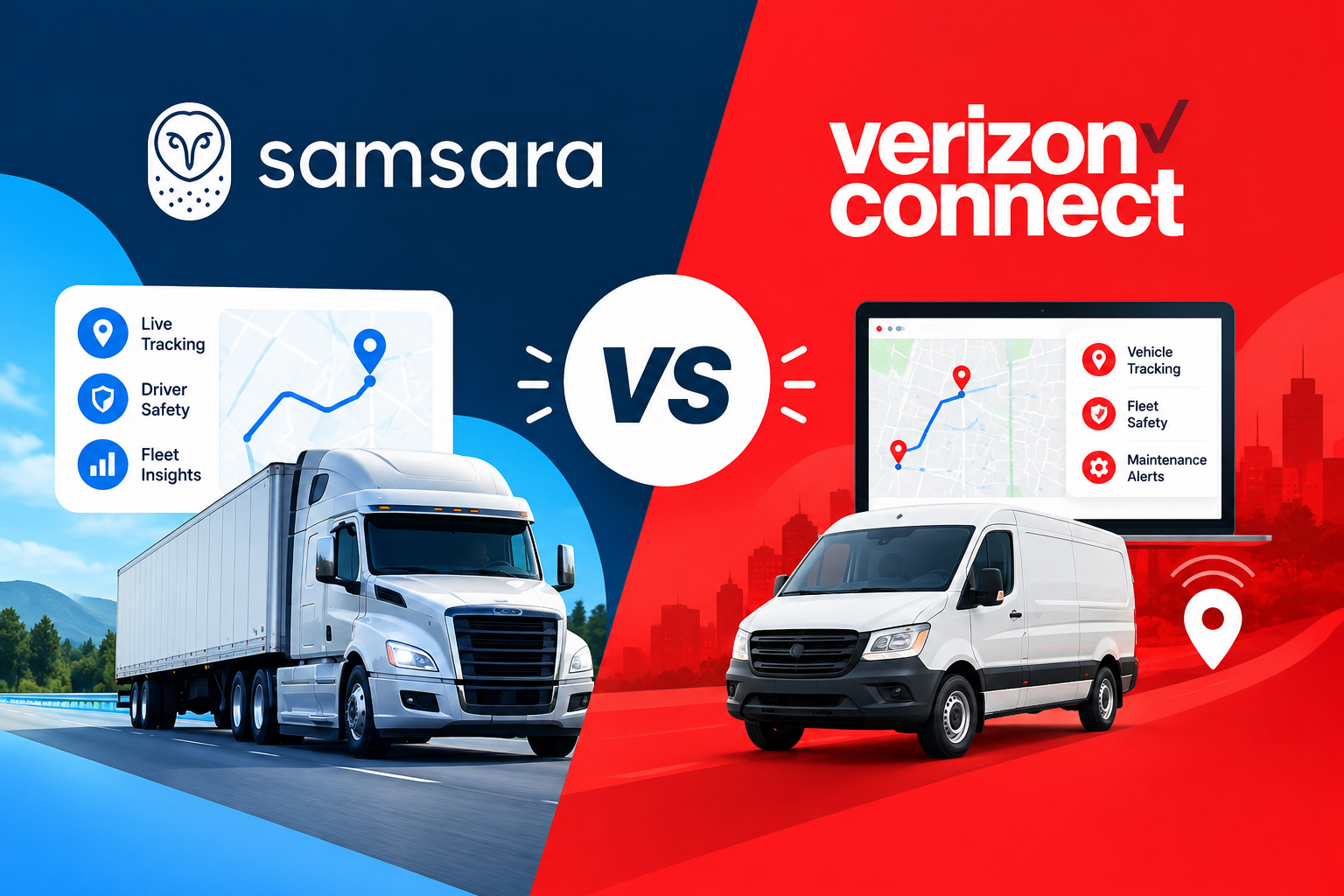
Choosing a fleet tracking platform is rarely just a software decision – it locks a business into a hardware ecosystem, a contract term, and a support relationship for years at a time. Two names dominate that conversation more than any others: Samsara and Verizon Connect. Both promise real-time GPS visibility, safety tools, and compliance support, yet the companies behind them come from very different backgrounds and take noticeably different approaches to the same problem. This article compares Samsara and Verizon Connect side by side, covering pricing, hardware, AI safety features, network reliability, integrations, and the kind of fleet each platform actually fits best, so a fleet manager can make the decision with more than a sales demo to go on.
Table of contents
Quick Summary
| Aspect |  |  |
| Founded | 2015, San Francisco | 2018, Atlanta (merger of Fleetmatics, Telogis, Verizon Telematics) |
| Typical pricing | $27-33 per vehicle/month | $20-45 per vehicle/month |
| Contract length | Often a 3-year minimum | Multi-year terms with early termination fees reported |
| AI dashcam | Included, AI-based | Available as an add-on, more rule-based |
| Location refresh rate | About every 5 seconds | 30 seconds to 2 minutes on some plans |
| Cellular network | Multi-carrier | Verizon network primary |
| User rating (Software Advice) | 4.5 out of 5 (1,008 reviews) | 3.2 out of 5 (945 reviews) |
How Are These Vehicle Tracking Companies Related to the Topic of This Article?
Both companies sit at the center of this comparison because they represent the two most common paths a fleet takes into telematics: a purpose-built technology startup on one side, and a telecom-backed platform built through acquisition on the other. Understanding each company’s origin explains a lot about how its product behaves today, from the way it prices contracts to which features come standard versus which arrive as an add-on.
Verizon Connect formed in 2018 when Verizon Communications merged its own Verizon Telematics division with two companies it had acquired, Fleetmatics and Telogis. Fleetmatics alone brought over 37,000 customers and roughly 737,000 subscribers into the combined business, while Telogis contributed enterprise-grade routing and workforce tools. That history means Verizon Connect inherited a mature, GPS-first product line built for small and medium fleets, then layered enterprise features and Verizon’s own cellular network on top. Today it operates with roughly 3,500 employees across 18 countries, and it markets itself as an all-in-one GPS tracking, dispatch, and compliance platform backed by telecom-grade network infrastructure.
Samsara took a different route. Founded in San Francisco in 2015 by Sanjit Biswas and John Bicket, the founders who previously built and sold the networking company Meraki to Cisco, Samsara built its platform hardware-first around IoT sensors before expanding into AI-powered dashcams, equipment monitoring, and driver workflow tools. The company went public on the New York Stock Exchange in December 2021, and it has since branded its full offering as the Connected Operations Cloud – positioning itself less as a GPS vendor and more as a broader operations platform for physical industries such as transportation, construction, and logistics. Both companies now compete directly for the same fleet management budget, which is exactly why this comparison matters to any business currently choosing between them.
What Is Samsara, and What Does Its Platform Include?

Samsara markets its offering as a Connected Operations Cloud rather than a simple GPS tracker, and the distinction matters. Instead of selling tracking as a standalone product, Samsara built an integrated stack of hardware and software: vehicle gateways, AI dashcams, equipment sensors, and a single cloud dashboard that ties all of it together. The platform expanded quickly after its early fleet-tracking days, adding AI-powered dashcams and equipment monitoring sensors between 2017 and 2021, which transformed the company from a telematics vendor into a broader connected operations business. By the time of its IPO, annual recurring revenue was approaching $500 million, and it has since grown past $1.75 billion, reaching GAAP profitability in fiscal 2026.
What Hardware and Software Make Up Samsara’s Platform?
Samsara’s core hardware lineup includes vehicle gateways for GPS and engine diagnostics, AI dashcams for driver safety monitoring, and asset trackers for trailers and equipment. On the software side, the platform layers safety scoring, route planning, maintenance alerts, and compliance tools such as electronic logging on top of that hardware. Because Samsara built its API and developer tools alongside the core platform rather than bolting them on afterward, fleets that need custom integrations, for instance connecting safety data to a field service management tool, generally find the process more straightforward than with older, acquisition-built platforms.
Who Uses Samsara Today?
Samsara serves fleets across transportation, construction, energy, utilities, public sector, and retail industries, with tens of thousands of customers across North America and Europe. The company holds the top ranking in the Fleet Management Software category on PeerSpot, and independent review site Software Advice records a 4.5 out of 5 average rating across more than 1,000 reviews. That popularity skews toward fleets that prioritize a modern interface and are comfortable investing in a broader safety and camera rollout rather than a bare-bones tracking tool.
How Has Samsara’s Business Grown Financially?
Samsara‘s growth trajectory matters to buyers because it signals how much ongoing investment the platform receives. The company crossed $800 million in annual recurring revenue in 2023, with more than 1,600 customers paying over $100,000 annually, and it has since grown past $1.75 billion in ARR while posting its first GAAP profitability in fiscal 2026. Net revenue retention has consistently stayed above 115%, meaning existing customers tend to expand their usage over time rather than shrink it. For a fleet evaluating long-term vendor stability, that financial trajectory suggests a company still investing heavily in product development rather than coasting on a mature, static offering.
What Is Verizon Connect, and What Does Its Platform Include?
Verizon Connect positions itself as a GPS-led fleet management platform built for businesses of every size, from small local service fleets to large mixed fleets that combine trucks and heavy equipment. Because the company formed through a merger of established players rather than a single product built from scratch, its platform reflects the strengths of each predecessor: Fleetmatics’ small-business fleet tools, Telogis’ enterprise routing and workforce software, and Verizon’s own network and hardware experience.
How Did Verizon Connect Come Together?
Verizon acquired Fleetmatics for about $2.4 billion in cash in 2016, shortly after acquiring Telogis, and folded both into its existing Verizon Telematics division. In March 2018, the company rebranded all three under a single name, Verizon Connect, unifying what had previously been three separate products into one platform. This acquisition-based path gave Verizon Connect immediate scale and an established customer base, though it also means the platform has had to unify several legacy codebases and support models rather than building everything around one original architecture.
What Core Modules Does Verizon Connect Offer?
Verizon Connect’s platform, branded Reveal, covers GPS vehicle tracking, dispatch and routing, fuel management, driver safety scoring, and compliance tools including ELD support. The company also offers add-on dashcams rather than including them standard, and it leans heavily on Verizon’s own cellular network for connectivity, which independent comparisons describe as unmatched in reliability, particularly in rural or lower-density service areas where other carriers’ coverage can be inconsistent.
How Does Verizon Connect Handle Compliance Needs?
Because Verizon Connect absorbed Fleetmatics, which had already registered its own Electronic Logging Device with the Federal Motor Carrier Safety Administration, the platform arrived with compliance credibility built in rather than bolted on later. Today it packages Hours of Service tracking, DVIR (Driver Vehicle Inspection Report) workflows, and IFTA fuel tax reporting alongside its core GPS tools, which appeals to fleets that want compliance and tracking managed inside a single vendor relationship instead of stitching together separate ELD and telematics providers.
How Do Samsara and Verizon Connect Compare on Pricing and Contracts?

Neither company publishes a simple, fixed price list, since both quote fleets individually based on vehicle count, hardware selection, and contract length. That said, independent research puts Samsara in a narrower band, roughly $27 to $33 per vehicle per month, while Verizon Connect‘s range runs wider, from about $20 to $45 per vehicle per month, depending on the modules a fleet selects. On contract terms, the two platforms behave similarly in one respect and differently in another: both commonly require multi-year commitments, often a three-year minimum, which locks a fleet in regardless of which platform it picks. However, several independent reviews describe Verizon Connect‘s contract behavior as more aggressive, citing a documented pattern of early termination fees and lock-in that surfaces only after a fleet is already committed.
What Should a Fleet Manager Ask Before Signing Either Contract?
- What is the exact contract length, and what triggers an automatic renewal?
- What are the early termination fees, and do they decrease over time?
- Which hardware and software modules are included in the quoted price, and which are add-ons?
- Is there a pilot period or a smaller trial rollout available before committing the full fleet?
How Does Total Cost of Ownership Compare Over Three Years?
Sticker price alone rarely tells the full story once a fleet accounts for hardware, add-ons, and support over a typical three-year contract. A twenty-five to one-hundred vehicle fleet choosing Samsara generally pays a narrower, more predictable range because the AI dashcam and core safety tools come bundled rather than priced separately. Verizon Connect‘s total cost can swing more widely across the same period, since features like dashcams, advanced routing, or additional compliance modules often carry their own line-item cost on top of the base subscription. Fleets comparing quotes should ask both vendors for a full three-year total, inclusive of every add-on the operation will realistically need, rather than comparing the advertised monthly starting price alone.
How Do the Two Platforms Compare on AI Safety and Dashcams?
Safety technology is where the two companies diverge the most clearly. Samsara built its AI dashcam around its founding vision, and the feature comes standard rather than as an optional add-on. The dashcam uses AI-based scoring to flag distracted driving, following distance, and other risk indicators in real time, and multiple independent comparisons describe Samsara’s safety technology as the more advanced, more frequently updated option between the two. Verizon Connect does offer dashcam hardware, but it ships as an add-on rather than a built-in feature, and its driver safety scoring relies more on rule-based thresholds than on AI-driven pattern recognition. For fleets where safety and driver coaching sit at the center of the buying decision, Samsara’s approach generally requires less setup to reach the same coverage level.
How Do Samsara and Verizon Connect Compare on Network Reliability and Coverage?
Verizon Connect‘s biggest structural advantage traces directly back to its parent company. Because the platform runs primarily on Verizon’s own cellular network, it benefits from consistent, telecom-grade coverage, especially valuable for fleets that operate in rural or lower-density territories where other carriers’ signal can be patchy. Samsara, in contrast, uses a multi-carrier approach, which generally performs well in most regions but can depend more heavily on whichever carrier has the strongest local signal in a given service area. Consequently, a fleet with heavy rural or remote operations may find Verizon Connect’s network story more reassuring on paper, though this advantage matters most for businesses genuinely operating outside major metro coverage areas.
How Do the Platforms Compare on Integrations and API Access?
Samsara built its developer tools, REST APIs and webhooks, alongside its core product, and independent comparisons consistently rate its API quality and integration depth higher than Verizon Connect‘s. Fleets that need to connect telematics data to a field service management tool, such as ServiceTitan or Jobber, generally report a smoother experience building on Samsara’s ecosystem. Verizon Connect does support integrations with common field service platforms as well, but its API is described as more moderate in flexibility, which can mean more custom development work for anything beyond the standard, pre-built connections.
Neither platform natively automates workflows like customer ETA text notifications; both require an added workflow or messaging layer, such as Twilio or SendGrid, to close that gap. For a fleet with an in-house developer or an implementation partner on hand, this difference matters less, since either platform’s API can eventually be made to work. For a business without dedicated technical resources, though, Samsara‘s more developer-friendly documentation tends to shorten the time between signing the contract and actually seeing the data flow into other business systems.
Which Platform Fits Which Type of Fleet?
Neither platform is objectively better for every business, since the two were built around different priorities. The right pick generally comes down to whether a fleet’s biggest need is a broader safety and camera rollout or a mature, GPS-led operating model with established routing and compliance workflows already familiar to the team.
| Fleet Priority | Better Fit |
| Broad safety rollout with AI dashcams included | Samsara |
| Rural or low-density service territory needing reliable cellular coverage | Verizon Connect |
| Deep API access for custom integrations | Samsara |
| Established routing, dispatch, and compliance workflows out of the box | Verizon Connect |
| Mixed fleet combining trucks and heavy equipment under one dashboard | Verizon Connect |
| Modern, frequently updated interface used daily by fleet managers | Samsara |
What About Fleets That Need Both Sets of Strengths?
Some fleets don’t fit neatly into either category, particularly larger operations running a mix of light service vehicles, heavy equipment, and safety-sensitive routes all at once. In that situation, the deciding factor often comes down to which weakness the business can tolerate more easily. A fleet that can live with a more moderate API and less advanced AI scoring, in exchange for stronger routing and telecom-grade coverage, generally leans toward Verizon Connect. A fleet that can manage without the deepest territory mapping, in exchange for best-in-class safety technology and integration flexibility, generally leans toward Samsara. Running a paid pilot with a small subset of vehicles on each platform, rather than relying on the sales demo alone, remains the most reliable way to settle a genuinely close call.
What Do Independent Analysts Say About Each Company’s Market Position?
Market-share data adds useful context beyond feature lists, since it reflects how buyers are actually voting with their budgets. As of April 2026, PeerSpot’s mindshare data places Samsara at 12.5% of the Fleet Management Software category, down from 19.9% a year earlier, while Verizon Connect sits at 8.0%, down from 11.8% over the same period. Both companies have lost ground, which signals a category that is fragmenting as newer entrants such as Motive, Geotab, and Azuga compete for the same fleets rather than one platform steadily consolidating the market. Samsara nonetheless holds the top overall ranking in the category, with Verizon Connect close behind in second place.
Separately, Tech.co’s 2026 survey of small businesses found Verizon Connect to be the most recognized name in the category, with a 38% market share among the businesses it surveyed, largely on the strength of its feature breadth, 24/7 support availability, and customizability. That finding doesn’t contradict the PeerSpot data so much as highlight a difference in what each source measures: raw brand recognition among small businesses versus engagement-based mindshare across a broader professional review audience. Taken together, both data sets confirm the same basic picture this article has described throughout – Samsara and Verizon Connect remain the two most prominent names fleets compare, even as their relative popularity shifts year over year.
What Do Verified User Reviews Say About Each Platform?
Independent review platforms tell a fairly consistent story across sources. Software Advice records Samsara at 4.5 out of 5 stars across 1,008 reviews, compared with 3.2 out of 5 across 945 reviews for Verizon Connect. PeerSpot similarly ranks Samsara first and Verizon Connect second in its Fleet Management Software category, although both platforms have seen their overall mindshare decline slightly over the past year as competition in the category has intensified. Several independent buyer’s guides also note a recurring theme in Verizon Connect feedback: a pattern of customer support complaints that shows up more often in reviews than the monthly pricing alone would suggest, which is worth factoring into total cost of ownership rather than sticker price.
How Do Samsara and Verizon Connect Compare Feature by Feature?
The table below consolidates the feature-level differences covered throughout this article into a single side-by-side reference.
| Feature | | |
| Real-time vehicle location | Yes, about every 5 seconds | Yes, 30 seconds to 2 minutes on some plans |
| AI dashcam system | Included standard | Available as an add-on |
| Driver safety scoring | AI-based | Rule-based |
| Route optimization | Moderate | Strong |
| Territory and mixed-asset mapping | Basic | Strong |
| Field service management integrations | ServiceTitan, Jobber, others via API | ServiceTitan and select others |
| Developer API quality | Strong (REST, webhooks) | Moderate |
| Mobile app quality | Highly rated | Moderate reviews |
| Cellular network | Multi-carrier | Verizon primary |
| Best known for | AI safety and a modern interface | Network reliability and mature routing/dispatch |
Conclusion
So which platform actually wins the Samsara vs Verizon Connect comparison? The honest answer is that it depends on what a fleet values most. Samsara leads on AI-powered safety, a more modern interface, and deeper API access, which makes it the stronger pick for fleets building a broader connected-operations strategy around cameras and driver coaching. Verizon Connect counters with a mature, GPS-first platform, strong routing and dispatch tools, and network reliability backed by Verizon’s own cellular infrastructure, which suits fleets that want an established, all-in-one operating model, particularly across rural territory or mixed asset types.
Either way, both platforms typically require a multi-year contract, so the smarter approach is to pilot a smaller portion of the fleet, confirm the fit in real operating conditions, and negotiate contract terms carefully before rolling either platform out fleet-wide. Whichever name ends up on the invoice, the underlying question stays the same: which set of trade-offs matches how this particular fleet actually operates day to day.
Frequently Asked Questions
Not necessarily. Samsara‘s typical range, about $27 to $33 per vehicle per month, sits inside Verizon Connect‘s wider $20 to $45 range. Verizon Connect can actually cost less at the entry level, though its upper tier can also run higher than Samsara depending on which modules a fleet adds, so the better comparison is always a full quote rather than the headline range alone.
Usually not without a cost. Both platforms typically require multi-year contracts, and Verizon Connect in particular has a documented pattern of early termination fees. Fleets considering a switch should review their contract’s termination clause and, where possible, negotiate a shorter pilot term for the new platform before fully committing, so the transition doesn’t create a gap in tracking or compliance coverage.
Yes, though Verizon Connect is more often cited as the stronger fit for mixed fleets that combine trucks, heavy equipment, and compliance needs under one dashboard. Samsara can track equipment as well through its asset trackers, but reviewers tend to favor it more for camera-centric, safety-led fleets than for heavy-equipment-heavy operations that need deep territory mapping.
Benefits of Cooperation With Solution for Guru
Choosing between Samsara and Verizon Connect is only half the challenge; getting either platform fully implemented, integrated with existing systems, and adopted by drivers is where many fleets stall. Solution for Guru works as a CRM and software implementation consultancy that helps businesses close exactly that gap. Instead of leaving a new telematics platform to run in isolation, Solution for Guru connects it to the CRM, dispatch, and reporting tools a business already relies on, so the data collected actually changes day-to-day decisions rather than sitting in an unused dashboard.

| Common Implementation Gap | How Solution for Guru Helps |
| Telematics data from Samsara or Verizon Connect lives separately from CRM and dispatch records | Integrates the chosen platform’s API directly into the business’s CRM, so safety and location data appear alongside customer and job records |
| Contract and pricing terms get accepted without a structured comparison | Helps evaluate vendor quotes, contract length, and total cost of ownership before signing |
| Drivers and dispatchers don’t fully adopt the new platform after rollout | Builds training workflows and dashboards tailored to how the team already works |
| Safety and route data isn’t reviewed until something goes wrong | Sets up automated alerts and reporting so trends surface proactively, not after an incident |
Businesses that want their choice between Samsara and Verizon Connect to translate into measurable operational gains can work with Solution for Guru to build the integrations, training, and reporting workflows that make either platform pay off well beyond the initial rollout.
Recommended
- How Motive Helps Reduce Insurance Costs
- How Verizon Connect Improves Fleet Productivity
- How Motive Detects Distracted Driving
- Managing Mixed Fleets with Verizon Connect
- How Verizon Connect Improves Driver Accountability
- How Motive Helps Schedule Preventive Maintenance
- How Samsara Improves Fleet Productivity
- How Fleet Managers Use Motive for Compliance Reporting
- How Motive Improves Dispatcher Efficiency
- How Motive Helps Reduce Fleet Operating Costs
- Azuga Review: Features, Pros, Cons, and Best Use Cases
- What Is Azuga Fleet Management Software? A Complete Guide
- Top Reasons Businesses Choose Motive Fleet Management
- Samsara Review: Features, Pros, Cons, and Best Use Cases
- What Is Samsara GPS Fleet Tracking Software?
- Verizon Connect Review: Features, Pros, Cons, and Best Use Cases
- What Is Verizon Connect Fleet Management Software?
- Motive Pricing Plans Explained: How Much Does Motive Cost?
- What Is Motive Fleet Management?
- Offline Tracking: How Do Devices Store Data Without Connectivity?