Sales Forecasting and Pipeline Management in Creatio CRM

Sales leaders rarely lose sleep over closing a single deal; they lose sleep over not knowing whether the quarter as a whole will land where the board expects it to. Without a clear view of what is actually moving through the pipeline, revenue projections turn into guesswork, and guesswork tends to fall apart the moment a few big deals slip. This is precisely the problem that modern CRM platforms are built to solve, and Creatio CRM has become one of the more capable options for sales teams that need both disciplined pipeline management and forecasting they can actually trust.
This article explains how sales forecasting and pipeline management work inside Creatio, why the two functions depend so heavily on each other, and how a technology partner can help a business configure the platform to get the most accurate results. Whether a sales team manages a handful of enterprise accounts or a high-volume pipeline of transactional deals, the underlying challenge remains the same: leadership needs numbers they can plan around, not numbers they have to mentally discount before presenting to the board. The sections that follow walk through exactly how Creatio addresses that challenge, feature by feature, before turning to the practical question of how a business gets the platform configured correctly from day one.
Table of contents
Quick Summary
Here is a brief overview of what this article covers:
- The core problem: inaccurate forecasts lead to poor resource planning, missed targets, and reactive decision-making.
- The Creatio approach: AI-powered forecasting combined with structured pipeline visualization gives sales leaders a real-time, data-driven view of expected revenue.
- The mechanics: forecasts draw on historical sales data, current pipeline stage, deal-level risk signals, and market trends, rather than static guesswork.
- The pipeline discipline: no-code workflow automation keeps deals moving through consistent stages, which is what makes the underlying forecast trustworthy in the first place.
- The trade-off: Creatio’s depth and customization can feel like more platform than a very small, simple sales team actually needs.
- The partner angle: working with a specialist like Solution for Guru helps businesses configure Creatio’s forecasting and pipeline tools correctly from the start.
How Does Creatio CRM Relate to Sales Forecasting and Pipeline Management?

Creatio CRM sits directly at the intersection of these two disciplines because its Sales module was purpose-built to manage the entire sales cycle, from lead qualification through opportunity management, forecasting, and contract closure. Rather than treating forecasting as a separate reporting exercise bolted onto a pipeline tool, Creatio ties the two together so that every stage change, every won or lost deal, and every historical pattern feeds directly into the forecasting engine.
This matters directly to the topic of this article because a forecast is only as reliable as the pipeline data feeding it. A CRM that lets deals sit in outdated stages, or that never enforces consistent data entry, will always produce forecasts built on shaky assumptions, no matter how sophisticated its prediction algorithms claim to be. Creatio addresses this by combining no-code workflow automation, structured pipeline visualization, and AI-driven forecasting into a single connected system. The sections below unpack exactly how each of these pieces works and how they reinforce one another.
Why Do Sales Forecasts Fail Without Strong Pipeline Discipline?
Before exploring Creatio’s specific tools, it helps to understand why forecasting so often goes wrong in the first place, since the root cause is rarely the forecasting math itself.
What Typically Undermines Forecast Accuracy?
Most inaccurate forecasts trace back to messy pipeline data rather than a flawed prediction model. Sales reps forget to update deal stages, opportunities linger in a stage long after they have effectively stalled, and probability percentages get entered once and never revisited as circumstances change. When a forecast pulls from data like this, it inherits every one of these inconsistencies, and leadership ends up making resourcing and hiring decisions based on numbers that were never accurate to begin with.
How Does Structured Pipeline Management Fix This at the Source?
Creatio addresses this problem structurally rather than relying purely on better algorithms layered on top of bad data. By enforcing consistent deal stages, automating stage-transition rules, and prompting reps to update opportunity details as part of their regular workflow, the platform keeps pipeline data current almost as a byproduct of normal sales activity. Consequently, the forecasting engine draws from data that reflects what is actually happening in the sales process, rather than a stale snapshot from weeks earlier.
How Does Creatio Structure the Sales Pipeline?
Pipeline management inside Creatio centers on giving sales teams and managers a clear, visual representation of every deal’s position in the sales process.
What Does the Pipeline View Actually Show?
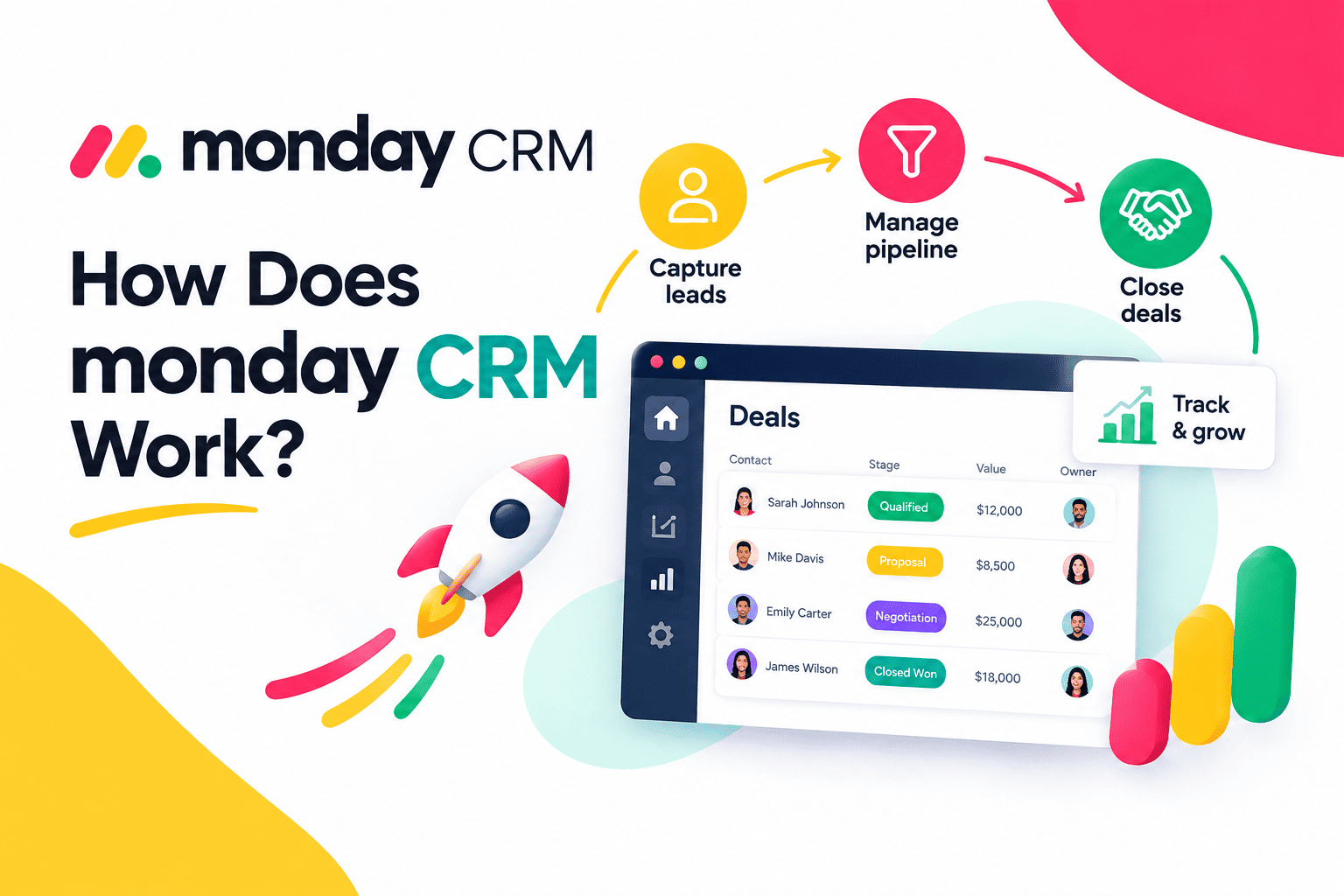
Creatio’s pipeline interface displays deals as cards moving across configurable stages, from initial qualification through proposal, negotiation, and close. Each card carries key details, such as deal value, expected close date, and assigned owner, which lets a sales manager scan the entire pipeline at a glance without opening individual records. Because reps can drag deals between stages directly within this view, updating pipeline status becomes a quick, natural part of daily work rather than a separate administrative task.
How Does the Platform Track Deal-Level Details?
Behind each pipeline card, Creatio maintains a full record of associated activities, communications, and documents tied to that opportunity. This creates a complete history that both the assigned rep and their manager can review, which matters enormously when a deal changes hands or when leadership needs to understand why a particular opportunity stalled. The table below summarizes the core elements that make up Creatio’s pipeline management approach.
| Pipeline Element | What It Tracks | Why It Matters for Forecasting |
|---|---|---|
| Deal stages | Where each opportunity sits in the sales process | Provides the structural backbone forecasts are built on |
| Deal value | Expected revenue from each opportunity | Feeds directly into weighted revenue projections |
| Expected close date | When a deal is likely to close | Determines which period a forecast attributes revenue to |
| Activity history | Calls, emails, meetings tied to a deal | Signals deal momentum or stagnation |
| Deal owner | Rep responsible for the opportunity | Supports rep-level and team-level forecast breakdowns |
How Does Creatio Generate Sales Forecasts?
Once pipeline data is structured and current, Creatio’s forecasting tools translate that information into projected revenue figures that sales leaders can actually rely on.
What Data Sources Feed the Forecasting Engine?
Creatio’s AI-driven forecasting draws on several data sources simultaneously, including historical sales performance, current pipeline composition, and broader market trends. Rather than relying on a single input, such as a rep’s self-reported confidence in closing a deal, the system cross-references multiple signals to produce a projection that accounts for patterns a human reviewer might overlook. This matters because individual reps often carry an optimism bias about their own deals, and blending that input with historical closing patterns produces a more grounded overall picture.
How Does AI Improve Forecast Precision Over Time?
The platform’s AI capabilities analyze deal progression and risk signals to continuously refine forecast accuracy, learning from how similar deals have historically moved through the pipeline and where they tend to stall or fall through. As more sales cycles complete and feed back into the system, the forecasting model has more historical pattern data to draw from, which generally improves precision over time rather than requiring a static formula that never adapts to a business’s actual sales patterns.
How Can Sales Leaders Customize the Forecasting Model?
Because every business closes deals differently, Creatio allows leaders to fine-tune which parameters the forecasting model weighs most heavily and which historical data sets it relies on. A business with long, complex enterprise sales cycles might weight different signals than one selling primarily through short, transactional deals, and this flexibility lets forecasting stay relevant across very different sales motions rather than forcing every business into the same rigid model.
What Specific Forecasting Views Does Creatio Provide?
Beyond generating a single revenue number, Creatio breaks forecasting down into several views that serve different planning needs across a sales organization.
- Team-level forecasts, aggregating pipeline data across an entire sales team to project total expected revenue for a given period.
- Individual rep forecasts, helping managers identify which reps are on pace to hit quota and which need coaching or pipeline support.
- Stage-weighted projections, applying different probability weightings based on how far a deal has progressed through the pipeline.
- Historical comparison views, showing how current pipeline health compares to the same period in prior quarters or years.
Because these views draw from the same underlying pipeline data, sales leaders can move fluidly between a high-level revenue projection and a granular look at exactly which deals and reps are driving that number, without switching between disconnected reports.
How Does Automation Support Both Pipeline Management and Forecasting?

Creatio’s no-code automation capabilities play a significant role in keeping both pipeline data and forecasts accurate without adding administrative burden to sales reps.
What Kinds of Tasks Does Creatio Automate?
The platform automates routine sales activities such as follow-up reminders, task assignments, approval routing, and quote generation. Because these workflows trigger automatically based on pipeline stage or deal criteria, reps spend less time on manual administrative work and more time actually advancing deals, which indirectly improves forecast reliability since active, well-managed deals tend to produce more predictable outcomes than neglected ones.
How Do AI Agents Extend This Automation Further?
Creatio’s built-in AI agents go a step further, handling tasks like CRM data enrichment, account monitoring, and meeting preparation. Before a sales call, for example, an AI agent can compile recent interactions, deal status, and relevant risk signals into a concise summary, letting the rep walk into the conversation prepared rather than scrambling to piece together context from scattered records. This kind of automation keeps pipeline data richer and more current, which again strengthens the quality of the forecasts built on top of it.
Where Does Creatio Reach Its Limits for Smaller or Simpler Sales Teams?
A fair assessment of any platform needs to acknowledge where it may be more than a particular business actually needs, and Creatio is no exception.
Independent reviews consistently note that Creatio’s depth and customization, while powerful, can feel like considerable overhead for a small team that simply needs a lightweight, out-of-the-box pipeline manager. The platform’s no-code approach to building custom workflows is genuinely flexible, but that same flexibility means a team without dedicated CRM administration resources may face a steeper initial setup process than a simpler point solution would require. Additionally, the breadth of Creatio’s ecosystem, spanning sales, marketing, and service modules, adds both cost and configuration complexity that a very small sales team might not fully utilize.
However, for mid-sized and larger sales organizations, particularly those with more complex sales cycles or a genuine need for cross-departmental process automation, this same depth becomes a strength rather than a burden. The key question for any business evaluating Creatio is not whether the platform is capable, but whether the organization’s sales process is complex enough to benefit from that capability, and whether it has the resources to configure it properly.
Which Industries Get the Most Value From Creatio’s Forecasting Tools?
While Creatio serves a broad range of businesses, certain industries tend to extract particularly strong forecasting value from the platform’s combination of automation and AI-driven predictions.
How Do Manufacturing and Distribution Businesses Use Pipeline Forecasting?
Manufacturing and distribution companies often deal with long sales cycles involving multiple stakeholders, custom quoting, and order fulfillment timelines that stretch well beyond a typical transactional sale. For these businesses, Creatio’s ability to forecast revenue based on existing pipeline data and historical order patterns helps leadership plan production schedules and allocate resources well ahead of when customer orders actually arrive, rather than reacting after demand materializes. This forward-looking visibility matters enormously in industries where production lead times cannot simply be compressed on short notice.
How Do Technology and Software Companies Apply These Tools Differently?
Technology and software companies, which represent a significant share of Creatio’s customer base, tend to use forecasting to manage more complex, multi-touch sales cycles involving technical evaluations, procurement approvals, and contract negotiations. Because these deals often stall or accelerate based on factors outside a rep’s direct control, such as a prospect’s internal budget cycle, Creatio’s risk-signal analysis helps sales leaders distinguish between deals that are genuinely progressing and those quietly losing momentum, even when the deal stage on paper has not changed.
How Do Financial Services Firms Benefit From Structured Pipeline Data?
Financial services firms, which also make up a meaningful portion of Creatio’s user base, benefit from the platform’s ability to maintain detailed activity histories and compliance-relevant documentation alongside pipeline tracking. Beyond forecasting accuracy, this structured record-keeping supports the kind of audit trail many regulated businesses need to maintain, giving these firms a dual benefit from the same underlying pipeline discipline that also strengthens their revenue projections.
What Common Pipeline Management Mistakes Undermine Forecast Accuracy?

Even with strong tools in place, certain recurring habits can quietly erode forecast reliability if a sales organization does not actively guard against them.
Why Does Deal Stage Inflation Distort Forecasts?
One of the most common issues involves reps marking deals further along in the pipeline than they actually are, often to make their individual performance look stronger in team reviews. This habit, sometimes called stage inflation, causes the forecasting engine to weight those deals with a higher probability of closing than reality supports, which can lead to an inflated overall revenue projection that later falls short. Sales managers who periodically audit deal stages against actual activity history, such as recent communications and next steps, can catch this pattern before it distorts a quarterly forecast significantly.
How Does Neglecting Stalled Deals Affect Pipeline Health?
A related problem involves deals that quietly stall without ever getting marked as lost, sitting indefinitely in an active pipeline stage long after realistic momentum has stopped. These stalled deals inflate the apparent size of the pipeline without contributing any real closing probability, which skews both team-level and individual forecasts. Creatio’s activity tracking helps surface these stalled opportunities by highlighting deals with no recent engagement, giving managers a practical way to clean up the pipeline before it distorts forecasting accuracy.
Why Does Inconsistent Deal Sizing Create Forecasting Noise?
Finally, inconsistent or overly optimistic deal value estimates, particularly for opportunities still in early qualification stages, introduce noise into revenue projections. Encouraging reps to base estimated deal size on comparable historical deals rather than a prospect’s initial, often aspirational budget conversation helps keep this input more grounded, which strengthens the reliability of the resulting forecast across the entire pipeline.
How Should Sales Leaders Approach Implementation to Maximize Forecast Accuracy?

Getting real value out of Creatio’s forecasting tools depends heavily on how thoughtfully a team approaches the initial setup and ongoing usage habits.
What Setup Decisions Matter Most Early On?
Defining pipeline stages that genuinely reflect a business’s actual sales process, rather than adopting a generic default template, has an outsized impact on forecast quality down the line. Similarly, deciding early on which data points reps are required to update at each stage transition helps prevent the kind of stale, incomplete pipeline data that undermines forecasting no matter how sophisticated the underlying algorithm is.
How Do Ongoing Habits Affect Long-Term Forecast Reliability?
Beyond initial configuration, forecast accuracy depends on reps consistently updating deal information as opportunities progress, and on managers regularly reviewing pipeline health rather than only checking in at the end of a quarter. Because Creatio’s forecasting model improves as more historical data accumulates, teams that maintain disciplined data entry from the start build a more reliable forecasting foundation faster than teams that treat CRM updates as an afterthought.
Conclusion
Accurate sales forecasting is not a separate skill from disciplined pipeline management; it is a direct byproduct of it. Creatio CRM recognizes this relationship by combining structured, visual pipeline tracking with AI-driven forecasting that draws on historical performance, current deal data, and market trends. The platform’s no-code automation and AI agents keep pipeline data current with minimal manual effort, which in turn keeps the resulting forecasts grounded in reality rather than guesswork.
While Creatio’s depth may be more than a very small, simple sales team requires, mid-sized and larger organizations with more complex sales cycles consistently find that this depth translates into forecasts they can actually plan around, rather than numbers they have to second-guess every quarter. Ultimately, the businesses that get the most value from the platform are the ones that treat pipeline discipline and forecast accuracy as two sides of the same effort, rather than separate problems to solve independently.
What Are the Benefits of Partnering With Solution for Guru?
Configuring Creatio’s pipeline stages, automation rules, and forecasting parameters correctly takes real expertise, and this is where Solution for Guru adds significant value for sales organizations adopting the platform.
Solution for Guru specializes in CRM, SaaS, and system integrations, which means the team can help a business configure Creatio’s pipeline structure to match its actual sales process, rather than relying on generic default settings that rarely fit a specific business perfectly. Beyond initial setup, the team can connect Creatio with other systems already running the business, such as marketing platforms, financial software, or customer support tools, ensuring pipeline and forecast data stays consistent across the entire organization.
Working with Solution for Guru offers several concrete advantages:
- Correct initial configuration of pipeline stages, automation rules, and forecasting parameters tailored to a business’s actual sales cycle.
- Custom integrations between Creatio and existing marketing, finance, or support platforms.
- Migration support for businesses moving from spreadsheets or another CRM into Creatio.
- Ongoing optimization, refining forecasting models and workflow automation as a business’s sales process evolves.
- Team training, helping sales reps and managers adopt the platform’s tools consistently, which is essential for maintaining accurate forecasts over time.
Because every sales organization has a different mix of deal complexity, team size, and existing tools, a tailored setup consistently produces more reliable forecasts than a generic, self-managed rollout. Partnering with a team that understands both the technical and sales process sides of this work helps a business start generating trustworthy forecasts faster and with fewer costly missteps.
Frequently Asked Questions
A simple pipeline value total adds up the dollar value of every open deal without accounting for how likely each one actually is to close, which tends to significantly overstate expected revenue. Creatio’s forecasting instead applies stage-based probability weighting and analyzes historical deal progression and risk signals, producing a projection that reflects realistic likelihood of closure rather than an inflated best-case scenario.
Creatio can certainly handle basic pipeline tracking, but its real strength lies in the depth of customization and automation it offers, which may represent more platform than a very small, simple sales team actually needs. Teams without dedicated CRM administration resources sometimes find the initial setup process more involved than a lighter, out-of-the-box pipeline tool would require, though partnering with an implementation specialist can meaningfully reduce that setup burden.
Forecast reliability tends to improve progressively as more historical sales cycles complete within the system, since the AI-driven model draws on accumulated pipeline and closing data to refine its predictions. While teams often see useful directional forecasts within the first few weeks of consistent pipeline updates, forecast precision generally continues to strengthen over several sales cycles as the platform builds a deeper historical pattern to learn from.
Recommended:
- Pipedrive Sales Dashboard: How to Track Performance
- Pipedrive Automation Triggers and Actions Explained
- Pipedrive AI vs Traditional CRM Automation: What’s the Difference?
- ERP and ITSM Integration: Improving Operational Visibility Across Departments
- Integrating Endpoint Management Tools with Freshservice
- ManageEngine Asset Management (ITAM): Why Businesses Trust It to Control Their IT Assets
- Why Mid-Sized Companies Choose Freshservice Over Enterprise ITSM Platforms
- Best Reporting and Analytics Dashboards for IT Operations Teams in Freshservice
- How ITSM Platforms Support IT Compliance and Audit Readiness
- How ITSM Tools Support Internal IT Risk Management
- How AI Is Changing ITSM Workflows in Freshservice?
- How ITSM Platforms Like Freshservice Support Digital Transformation
- Freshservice CMDB Explained: Structure, Relationships, and Best Practices
- Freshservice for Remote and Hybrid Work Environments
- Automating Employee Onboarding and Offboarding with Freshservice
- ManageEngine ServiceDesk Plus for Mid-Size Business: Is It the Right ITSM Fit?
- ManageEngine ITSM: Standard vs Professional vs Enterprise — Which Edition Fits Your Team?
- ManageEngine SLA Management: How Does It Help IT Teams Meet Every Deadline?
- Freshservice for Growing Companies: When Is the Right Time to Upgrade ITSM?