Azuga vs Motive: Feature-by-Feature Comparison
Choosing a GPS fleet tracking platform affects nearly every part of a fleet’s daily operations, from dispatch accuracy to driver safety and compliance reporting. Two names come up constantly in that search: Azuga and Motive. Both promise real-time visibility, safer drivers, and lower operating costs, yet they take noticeably different approaches to get there. This article compares them feature by feature, so fleet managers can see exactly where each platform excels before making a decision.
Table of contents
What Will This Comparison Cover? A Quick Summary
Before getting into the details, here’s a snapshot of what this article walks through.
| Section | What You’ll Learn |
|---|---|
| What are Azuga and Motive? | How each platform fits into the fleet tracking topic |
| Comparison table | A side-by-side look at core features |
| GPS tracking & routing | How real-time visibility differs between platforms |
| Driver safety tools | How dashcams and scoring systems compare |
| Maintenance & diagnostics | How each platform handles vehicle health |
| Compliance & ELD | How Hours of Service tracking is handled |
| Pricing & contracts | What to expect before requesting a quote |
| FAQs | Fast answers to common questions |
In short, both platforms cover the fleet tracking essentials, but Azuga leans toward driver engagement and fuel-focused tools, while Motive leans toward AI-driven safety monitoring and compliance depth.
What Are Azuga and Motive, and How Do They Relate to This Comparison?
Azuga, marketed as Fleet Management Software & GPS Fleet Tracking Solutions, positions itself around real-time GPS monitoring combined with driver behavior scoring and a gamified rewards system. The platform tracks speeding, harsh braking, rapid acceleration, and idling, then turns that data into driver scorecards designed to encourage safer habits through recognition rather than punishment alone. Azuga also places a strong emphasis on fuel management, offering consumption analysis and automated low-fuel alerts, which makes it a popular choice among fleets watching operating costs closely.
Motive, described as a GPS Fleet Tracking System & Solutions provider, takes a more AI-heavy approach. Formerly known as KeepTruckin, Motive built its reputation on electronic logging device (ELD) compliance before expanding into a full fleet management suite. Its standout feature is the AI Dashcam Plus, which runs dozens of AI models simultaneously to detect unsafe driving behavior, backed by a large human review team that verifies flagged events before they reach fleet managers.
This is exactly where the topic of this article comes into focus. Both Azuga and Motive solve the same fundamental problem, tracking vehicles and improving driver safety, but they solve it with different priorities. Azuga’s roots lie in driver engagement and fuel efficiency, while Motive’s roots lie in compliance and AI-powered safety monitoring. Understanding these differences at a feature level helps fleet managers match the right platform to their specific operational priorities.
How Do Azuga and Motive Compare Feature by Feature?
The table below lines up the core capabilities of both platforms so you can see the differences at a glance.
| Feature |  |  |
|---|---|---|
| Real-time GPS tracking | Yes, with interactive live map | Yes, with 1–3 second refresh rate |
| Driver behavior scoring | Scorecards with gamified rewards | AI-driven scorecards with human-reviewed events |
| Dashcams | Dual-facing AI dashcams available | AI Dashcam Plus with 30+ simultaneous AI models |
| Vehicle diagnostics | OBD-II based engine health alerts | Fault-code diagnostics and preventive maintenance alerts |
| Fuel management | Fuel consumption analysis, low-fuel alerts | Spend management tools, fuel-related reporting |
| Compliance/ELD | Hours of Service tracking included | Strong ELD heritage, DOT audit support |
| Geofencing | Yes | Yes |
| Asset tracking | Bluetooth beacons, solar and long-life trackers | Asset utilization tracking, equipment monitoring |
| Integrations | 20+ integrations (Fleetio, Power BI, ServiceTitan, etc.) | 90+ integrations (FourKites, Drivewyze, AscendTMS, etc.) |
| Contract terms | Historically requires longer-term contracts | Custom pricing, no published free trial |
| Best suited for | Fleets prioritizing driver engagement and fuel savings | Fleets prioritizing AI safety monitoring and DOT compliance |
While the two platforms overlap on the basics, the table shows a clear pattern: Motive tends to offer deeper integration and diagnostic depth, whereas Azuga tends to differentiate through fuel tools and driver rewards.
How Do Azuga and Motive Handle Real-Time GPS Tracking and Routing?
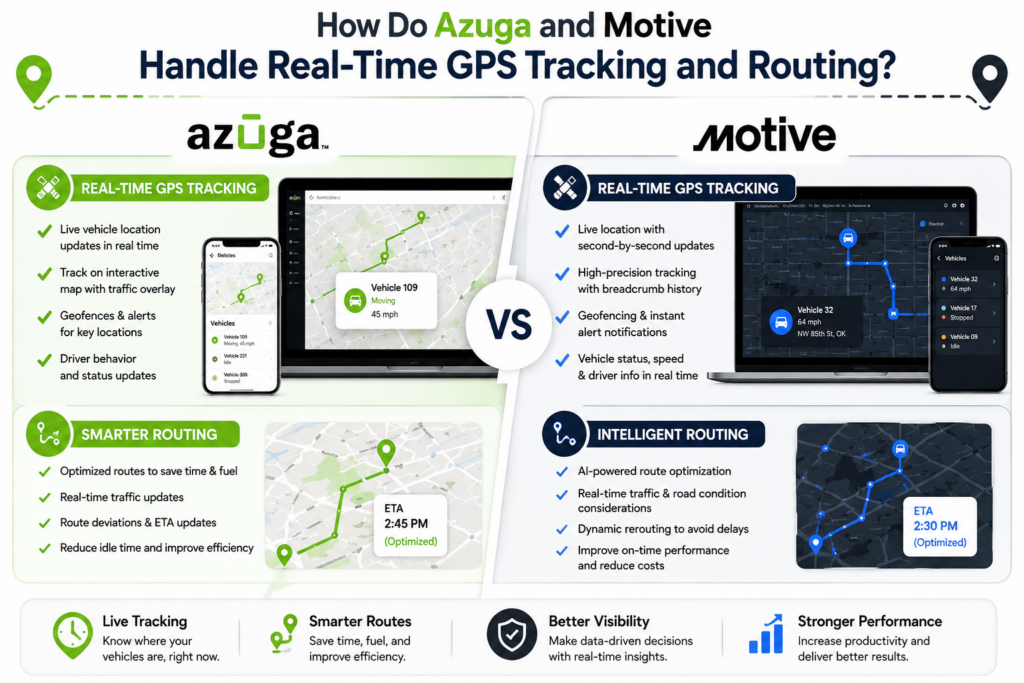
Both platforms build their foundation on real-time GPS visibility, but they approach the details differently.
How Does Azuga’s GPS Tracking Work?
Azuga’s fleet tracking system gives managers a live, interactive map showing vehicle locations, which supports faster dispatch decisions and helps reduce unnecessary mileage. Route history logging also lets managers review past trips, which proves useful for investigating delays or confirming service completion at a job site. Because Azuga’s interface leans toward simplicity, many users highlight how quickly they were able to get comfortable using the platform after onboarding.
How Does Motive’s GPS Tracking Work?
Motive advertises a notably fast refresh rate, updating vehicle location data every one to three seconds, which gives fleet managers a near-instantaneous view of vehicle status. This level of accuracy pairs well with Motive’s dispatch and route optimization tools, helping companies respond quickly when a delivery window shifts or a driver needs to be rerouted. Motive also automatically pairs drivers, vehicles, trailers, and equipment, giving managers a consolidated view of an entire operation rather than tracking each asset separately.
How Do Their Driver Safety Tools Compare?

Driver safety sits at the center of both platforms’ value proposition, though each takes a different route to get there.
How Does Azuga Approach Driver Safety?
Azuga focuses heavily on behavior-based scoring, tracking metrics like harsh braking, rapid acceleration, and speeding, then translating this data into scorecards. Rather than relying purely on penalties, Azuga incorporates gamification, rewarding safer drivers to encourage voluntary behavior change. The platform also monitors distracted driving, including texting and calling while in motion, which addresses a factor involved in a notable share of fleet accidents.
How Does Motive Approach Driver Safety?
Motive leans into artificial intelligence more aggressively, using its AI Dashcam Plus to detect behaviors such as close following, drowsiness, and phone use in real time. What sets Motive apart is its human review layer: the company states its safety team includes more than 400 experts who verify AI-flagged events before fleet managers see them, reducing false positives and adding context that automated detection alone might miss.
Which Approach Fits Which Type of Fleet?
Fleets that want to build a positive safety culture through recognition and engagement may lean toward Azuga’s gamified scoring system. Meanwhile, fleets operating in high-risk environments, such as long-haul trucking, where accurate incident documentation matters for insurance and liability, may find Motive’s AI-plus-human-review model gives them more confidence in the accuracy of flagged events.
How Do Azuga and Motive Handle Maintenance and Vehicle Diagnostics?
Keeping vehicles on the road without unexpected breakdowns is a core promise of both platforms, though their diagnostic depth differs slightly.
What Does Azuga Offer for Vehicle Health Monitoring?
Azuga accesses onboard diagnostics (OBD-II) data to detect engine issues and sends timely alerts before small problems become costly repairs. This proactive approach supports scheduled maintenance planning, which helps extend vehicle lifespan and reduces the chance of an unexpected breakdown disrupting a route.
What Does Motive Offer for Vehicle Health Monitoring?
Motive automates preventive maintenance alerts triggered by mileage or time, and it also supports fault-code diagnostics for more precise troubleshooting. This combination gives fleet managers both a scheduled maintenance cadence and real-time fault detection, which can be particularly valuable for larger fleets managing dozens or hundreds of vehicles simultaneously.
How Do They Compare on Compliance and Electronic Logging?
For fleets operating under Hours of Service (HOS) regulations, compliance tooling often becomes the deciding factor between platforms.
How Does Azuga Support Compliance?
Azuga includes built-in compliance management, assisting with Hours of Service tracking and general regulatory adherence, which helps fleets avoid penalties and prepare more easily for audits. This functionality integrates with the same platform used for GPS tracking and driver scoring, so managers don’t need to jump between separate systems.
How Does Motive Support Compliance?
Motive’s roots as an ELD provider give it particularly strong compliance credentials. The platform automates driver log recording, supports DOT audit checks with violation alerts, and provides automatic log audit procedures, all of which reduce the manual work drivers and administrators would otherwise need to handle. For fleets where compliance is a top priority, Motive’s longer history in this specific space often gives it an edge.
How Do Azuga and Motive Compare on Integrations and Ecosystem?
Fleet platforms rarely operate in isolation, so integration depth matters for companies already using dispatch, maintenance, or accounting software.
What Does Azuga’s Integration Ecosystem Look Like?
Azuga connects to more than 20 third-party tools, including Fleetio, Microsoft Power BI, ServiceTitan, and Route4Me. This covers key categories like maintenance tracking, business intelligence reporting, and field service management, giving fleets enough flexibility to connect Azuga’s data with the other systems they already rely on.
What Does Motive’s Integration Ecosystem Look Like?
Motive offers a considerably larger integration catalog, connecting with over 90 third-party tools such as FourKites, Drivewyze, AscendTMS, and Descartes MacroPoint. This broader ecosystem leans toward transportation management, load visibility, and logbook access, which tends to appeal more to larger trucking and logistics operations juggling multiple software systems across dispatch and compliance.
How Do Azuga and Motive Compare on Pricing and Contracts?

Neither Azuga nor Motive publishes detailed pricing publicly, so fleets typically need to request a custom quote from each vendor.
What Should Fleets Expect From Azuga’s Pricing Model?
Azuga has historically required longer-term contracts, with some reviews noting a mandatory multi-year commitment. Fleets considering Azuga should ask directly about contract length and any early termination terms before signing, since this detail isn’t always obvious during the initial sales conversation.
What Should Fleets Expect From Motive’s Pricing Model?
Motive offers tiered plans, generally structured around Starter, Pro, and Enterprise levels, with each tier adding more advanced features such as Wi-Fi availability and IFTA reporting. However, Motive doesn’t appear to offer a free trial, so fleets typically need to go through a demo before committing.
Conclusion
Ultimately, both Azuga and Motive, as established GPS Fleet Tracking System providers, deliver the core capabilities fleets expect: real-time location tracking, driver behavior monitoring, maintenance alerts, and compliance support. However, the right choice depends on what a fleet values most. Azuga, positioned as a Fleet Management Software & GPS Fleet Tracking Solutions provider, stands out for its driver engagement tools, fuel management depth, and straightforward interface, making it appealing to fleets that want to build a positive safety culture alongside cost control. Motive, meanwhile, distinguishes itself through AI-powered dashcams backed by human review, a strong compliance heritage, and a wider integration ecosystem, making it a strong fit for fleets that prioritize safety accuracy and regulatory precision. Before deciding between Azuga and Motive, fleet managers should request demos from both, confirm contract terms upfront, and weigh which platform’s strengths align most closely with their operational priorities.
Frequently Asked Questions
Both platforms serve small fleets, but Azuga’s more straightforward interface and fuel-focused tools tend to appeal to smaller operations looking for quick onboarding and cost savings. Motive can also work well for smaller fleets, though its broader feature set may include capabilities that aren’t necessary until a fleet scales further.
Neither Azuga nor Motive appears to offer a widely advertised free trial. Both companies generally direct interested fleets toward a demo or a custom quote, so it’s worth requesting a hands-on demonstration before making a purchasing decision.
Motive generally holds an edge here, since it originated as an electronic logging device provider and has continued to build out DOT audit support and violation alerts. Azuga also supports Hours of Service tracking, but fleets with heavy compliance needs often find Motive’s longer track record in this area reassuring.
Recommended
- Azuga vs Samsara: Which Fleet Management Platform Is Better?
- How Secure Is Azuga? Security and Data Protection Explained
- Who Should Use Azuga Fleet Management Software?
- Preventive Maintenance with Samsara
- How Verizon Connect Reduces Fleet Operating Costs
- Integrating Verizon Connect with ERP Systems
- Best Motive Integrations for Fleet Management
- How Does Samsara Work?
- Is Motive Worth the Investment? ROI for Fleet Operators
- How Motive Improves Dispatcher Efficiency
- How Motive Helps Reduce Fleet Operating Costs
- Azuga Review: Features, Pros, Cons, and Best Use Cases
- What Is Azuga Fleet Management Software? A Complete Guide
- Top Reasons Businesses Choose Motive Fleet Management
- Samsara Review: Features, Pros, Cons, and Best Use Cases
- What Is Samsara GPS Fleet Tracking Software?
- Verizon Connect Review: Features, Pros, Cons, and Best Use Cases