Reducing Vehicle Downtime with Verizon Connect
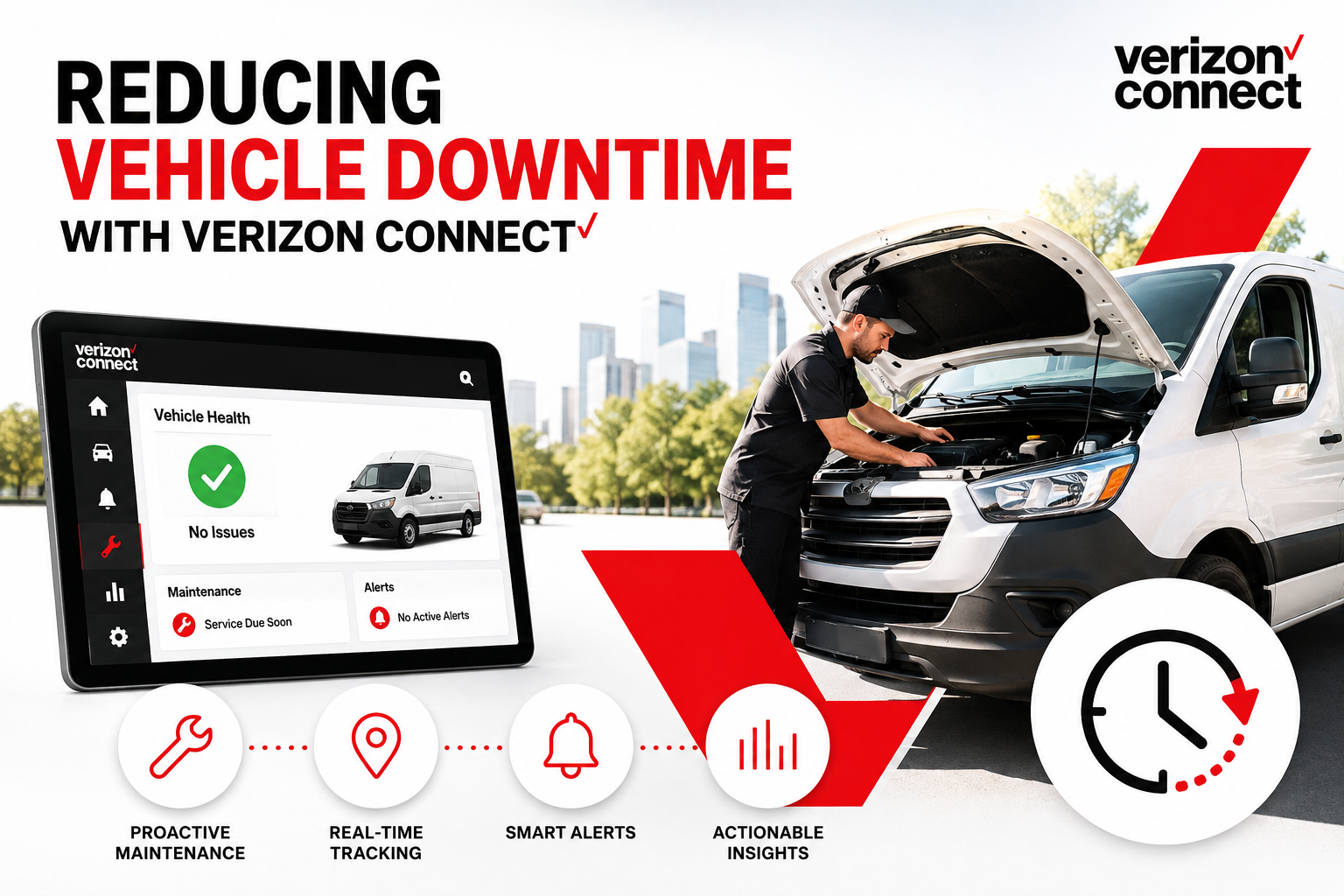
Every hour a work vehicle sits idle in a repair shop is an hour it isn’t generating revenue. For fleet-dependent businesses, unplanned downtime doesn’t just cost the price of a repair — it disrupts delivery schedules, delays field service appointments, and quietly erodes customer trust. Yet many fleets still operate reactively, addressing vehicle problems only after they’ve already caused a breakdown.
This article explains how connected fleet management technology closes that gap, what specific tools make the biggest difference, and how businesses can shift from reactive repairs to a proactive maintenance model that keeps vehicles on the road.
Table of contents
Quick Summary
- Unplanned vehicle downtime costs businesses more than the repair itself — it also damages customer trust and creates secondary expenses like overtime and rental vehicles.
- The “downtime gap” is the critical period between fault detection and when a vehicle actually gets back on the road, and closing it requires real-time visibility.
- Verizon Connect: Fleet Management Software and Solutions provides diagnostic trouble code alerts, automated maintenance reminders, and digital inspection tools that shift fleets from reactive to proactive maintenance.
- Proactive maintenance programs reduce downtime, lower repair costs, and extend vehicle lifespan.
- Maintenance software integrations extend these capabilities further, automating scheduling and centralizing vehicle health data.
- Solution For Guru helps fleets configure and optimize their telematics and maintenance workflows so proactive maintenance actually becomes routine practice, not just available technology.
Verizon Connect: Fleet Management Software and Solutions — How Does It Relate to This Topic?

Verizon Connect: Fleet Management Software and Solutions sits at the center of this topic because reducing vehicle downtime is one of the platform’s core, explicitly stated purposes. The company builds its fleet management tools specifically around giving managers the visibility needed to catch mechanical issues before they escalate into breakdowns.
What Does Verizon Connect Offer Specifically for Downtime Reduction?
According to Verizon’s own product documentation, fleet managers can schedule reminders for preventive service and get alerts for diagnostic trouble codes to help reduce vehicle downtime, while also getting a near real-time, 360-degree view of daily fleet operations that helps reduce costs, increase productivity, and stay on top of vehicle maintenance.
Why Does This Matter Beyond Basic Tracking?
Fleet tracking alone tells you where a vehicle is. Verizon Connect goes further by combining location data with vehicle health data, letting fleet managers manage vehicle health and prevent unexpected downtime with digital inspection forms, automatic service reminders, and instant diagnostic trouble codes. This combination is what actually enables a shift from reactive to proactive maintenance, rather than simply making it easier to locate a broken-down vehicle after the fact.
Why Does Vehicle Downtime Cost More Than Most Businesses Assume?

Before diving into solutions, it’s worth understanding exactly why downtime is such a costly problem — because the visible repair bill is often only part of the real expense.
What Is the “Downtime Gap,” and Why Does It Matter?
Verizon Connect frames this concept directly: fleet maintenance management software helps managers see vehicle health and close the “downtime gap” — the critical period between fault detection and when the vehicle can get back on the road. This gap represents lost time that compounds the longer it goes unaddressed.
What Hidden Costs Accumulate During That Gap?
According to Verizon Connect, this gap is where a business loses profitability by damaging customer trust and incurring secondary expenses like driver overtime or replacement vehicle rentals. These costs rarely show up on the repair invoice itself, which is exactly why they’re so often underestimated when businesses evaluate the true cost of downtime.
Why Do Reactive Maintenance Practices Make This Worse?
Much of this loss stems from how many fleets still operate. Verizon Connect notes that these losses often stem from reactive maintenance practices that fix problems only after they occur. Waiting for a breakdown to trigger action means the vehicle is already out of service by the time anyone responds, guaranteeing at least some downtime rather than preventing it.
How Does Downtime Affect Businesses Differently by Industry?
The specific impact of downtime varies depending on what a fleet actually does. A last-mile delivery business measures downtime in missed delivery windows and dissatisfied customers waiting on packages. A field service company measures it in canceled or delayed appointments that push back an entire day’s schedule. A construction fleet measures it in idle crews unable to work because equipment transport vehicles are unavailable. Regardless of industry, the underlying pattern is the same: an idle vehicle doesn’t just sit still, it actively disrupts whatever operational plan depended on it being available.
How Does Proactive Maintenance Differ from Reactive Repairs?
Understanding the distinction between these two approaches makes it clear why shifting models produces such a meaningful reduction in downtime.
What Defines a Reactive Maintenance Approach?
A reactive approach addresses vehicle issues only after they cause a visible problem — a warning light, a strange noise, or an outright breakdown. By the time action is taken, the vehicle is often already unusable, and the resulting repair tends to be more extensive and expensive than it would have been if caught earlier.
What Defines a Proactive Maintenance Approach?
A proactive approach relies on continuous monitoring and scheduled service intervals to catch potential problems before they cause a failure. Verizon Connect describes this shift plainly: by integrating real-time diagnostics, a fleet can move from simply reacting to problems to a proactive model that saves on costs and protects its reputation for reliability.
What Concrete Benefits Come from Making This Shift?
Verizon Connect outlines several measurable advantages of proactive maintenance. With this approach, fleets can significantly reduce downtime from unexpected failures, lower maintenance costs by shifting from expensive reactive repairs to planned, proactive servicing, and increase asset lifespan, delaying costly replacements and lowering total cost of ownership.
How Do These Two Approaches Compare Side by Side?
| Factor | Reactive Maintenance | Proactive Maintenance |
|---|---|---|
| When issues get addressed | After a failure occurs | Before failure, based on early signals |
| Typical repair cost | Higher, often urgent/emergency-priced | Lower, planned and scheduled |
| Downtime impact | Vehicle already out of service | Minimized through early intervention |
| Vehicle lifespan | Shortened by unaddressed wear | Extended through consistent care |
| Predictability | Low — breakdowns happen unexpectedly | High — service scheduled in advance |
How Do Diagnostic Trouble Codes Support Downtime Reduction?

Diagnostic trouble codes, commonly known as DTCs, are one of the most direct tools fleet managers use to catch mechanical issues early, and Verizon Connect builds substantial functionality around them.
What Exactly Is a Diagnostic Trouble Code?
A DTC is a signal generated by a vehicle’s onboard computer system when it detects a fault, ranging from a minor sensor issue to a serious mechanical problem. These codes give fleet managers a data-driven starting point instead of relying on a driver noticing something feels off.
How Does Verizon Connect Deliver DTC Alerts?
Through its telematics integration, Verizon Connect provides alerts the moment a diagnostic trouble code is generated, allowing fleet managers to act immediately rather than discovering a problem only after a driver reports it or a vehicle fails to start. This immediate visibility is central to closing the downtime gap described earlier.
Are DTCs Alone Enough to Prevent Downtime?
Not entirely, and Verizon Connect is candid about this limitation. The company notes that DTCs will always have a place in fleet diagnostics, but they are, by design, reactive, since they tell you when the failure has already occurred. The real opportunity, according to Verizon Connect, lies in developing preventive maintenance workflows that reduce how often these diagnostic trouble codes appear in the first place. DTCs work best as one layer within a broader proactive strategy, not as a standalone solution.
How Do Automated Service Reminders Prevent Missed Maintenance?
Beyond reacting to diagnostic alerts, consistent scheduled maintenance is what actually prevents many issues from developing into DTC-triggering failures in the first place.
Why Do Manual Maintenance Schedules Often Fail?
Tracking service intervals manually across a fleet of vehicles — each with different mileage, usage patterns, and service histories — is genuinely difficult to sustain. It’s easy for a single vehicle’s oil change or brake inspection to slip through the cracks when nothing automatically flags it as due.
How Does Verizon Connect Automate This Process?
Verizon Connect removes this manual burden directly. Fleet managers can schedule reminders for preventive service that trigger automatically based on time or mileage thresholds, ensuring vehicles get serviced on a consistent schedule rather than whenever someone happens to remember.
What Does This Look Like When Combined with Digital Inspections?
Automated reminders work even better alongside digital inspection processes. Verizon Connect’s platform supports digital inspection forms alongside its automatic service reminders, giving fleet managers a documented, structured record of vehicle condition that complements the scheduled maintenance itself, rather than relying on informal paper checklists that are easy to lose or skip.
How Does Verizon Connect’s Marketplace Extend Maintenance Capabilities?
Verizon Connect’s core platform integrates with a range of specialized maintenance software partners, extending its downtime-reduction capabilities even further for fleets with more complex needs.
What Does the Simply Fleet Integration Offer?
One example is the Simply Fleet integration, which Verizon Connect describes as simplifying maintenance by automating scheduling and regular vehicle health checks, where odometer readings and system alerts help identify problems early to avoid expensive repairs and unnecessary downtime. This integration specifically emphasizes diagnostic code monitoring that provides daily engine fault alerts, allowing immediate action on potential vehicle issues and scheduling of work orders.
What Broader Maintenance Ecosystem Does Verizon Connect Support?
Verizon Connect’s marketplace includes multiple maintenance-focused partners beyond a single integration. Its ecosystem includes tools like Fleetio, which automates and unifies vehicle health data, helping to power proactive maintenance and operational workflows that minimize downtime and maximize fleet performance, alongside partners like Collective Data, AssetWorks, and Driveroo for specialized inspection and asset-tracking needs.
Why Does This Matter for Fleets with Unique Requirements?
No single maintenance workflow fits every fleet. A public sector fleet, a construction fleet with heavy equipment, and a last-mile delivery fleet all face different maintenance priorities. Verizon Connect’s marketplace approach means fleets can layer specialized tools onto its core platform rather than being limited to a one-size-fits-all maintenance module.
How Do Public Sector and Municipal Fleets Benefit Specifically?
Public sector operations often face unique compliance and reporting requirements alongside their maintenance needs. Verizon Connect’s marketplace addresses this directly, with partners offering solutions built to reduce downtime and improve visibility with fleet maintenance software built for public sector operations. This kind of purpose-built integration matters because generic maintenance tools don’t always account for the specific documentation and asset-tracking standards public agencies must follow.
How Do Integrations Simplify Preventative Maintenance Tracking?
Some marketplace partners focus specifically on removing the manual burden from maintenance recordkeeping. For example, the Collective Data integration removes the manual process of preventative maintenance tracking, putting asset information such as history and location at a fleet manager’s fingertips. This kind of centralization matters because scattered maintenance records — spreadsheets in one place, paper logs in another — make it far harder to spot the patterns that proactive maintenance depends on.
What Happens When a Vehicle Does Go Down Despite Proactive Measures?

Even the best proactive maintenance program can’t eliminate every breakdown entirely. What happens next matters just as much as prevention.
What Support Exists for Vehicles That Break Down Unexpectedly?
Verizon Connect’s ecosystem addresses this scenario directly, noting that fleets can’t afford unexpected downtime on the road, and emergency roadside assistance offers quick, cost-effective coverage, whether the need is fuel delivery or a flat tire. This ensures that even when proactive measures don’t fully prevent an issue, the response time to get the vehicle moving again stays as short as possible.
How Does Data from an Incident Feed Back into Future Prevention?
Every unplanned downtime event carries useful information. Reviewing what triggered the incident — whether a missed service interval, an undetected wear pattern, or an unusual driving behavior — helps fleet managers refine their proactive maintenance thresholds going forward, closing the specific gap that allowed the issue to occur in the first place.
Why Does This Make Downtime Reduction an Ongoing Process?
Downtime reduction isn’t a one-time setup; it’s a continuous cycle of monitoring, adjusting, and refining. Fleets that treat their maintenance software as something to configure once and forget tend to see diminishing returns, while those that regularly review alert thresholds and service intervals against actual fleet performance keep improving over time.
How Does Reduced Downtime Translate into Broader Business Value?
Downtime reduction isn’t just an operational nicety — it connects directly to measurable financial and reputational outcomes that matter to the broader business.
How Does Downtime Reduction Affect Total Cost of Ownership?
Fewer breakdowns and more predictable maintenance scheduling directly extend vehicle lifespan, which delays the significant capital expense of fleet replacement. Verizon Connect’s guidance on engine diagnostics notes that GPS fleet tracking solutions help reduce fleet maintenance costs and vehicle downtime while cutting back on excessive vehicle wear and tear, lowering total cost of ownership.
How Does Downtime Reduction Affect Customer Relationships?
Businesses that consistently meet delivery windows and service appointments build a reputation for reliability that’s difficult to quantify but easy to lose. Every avoided breakdown is, in effect, an avoided disruption to a customer commitment, which compounds into stronger long-term relationships over time.
What Broader Operational Metrics Improve Alongside Downtime?
| Metric | How Downtime Reduction Improves It |
|---|---|
| Vehicle lifespan | Fewer unaddressed issues mean less accumulated wear |
| Repair costs | Planned service costs less than emergency repairs |
| Driver overtime | Fewer breakdown-related schedule disruptions |
| Customer satisfaction | More consistent, reliable service delivery |
| Fleet utilization | More vehicles available and road-ready at any given time |
How Does Driver Behavior Connect to Vehicle Downtime?

Mechanical monitoring is only part of the downtime picture. How a vehicle gets driven day to day also has a direct bearing on how often it needs unplanned repairs.
How Does Harsh Driving Contribute to Vehicle Wear?
Aggressive acceleration, hard braking, and sharp cornering all place additional stress on a vehicle’s mechanical systems, accelerating wear on brakes, tires, and drivetrain components well beyond what normal driving produces. Over time, this added wear increases the likelihood of a component failing unexpectedly, even on a vehicle that otherwise receives regular scheduled maintenance.
How Does Verizon Connect Address Harsh Driving?
Verizon Connect’s platform helps fleet managers gamify driver coaching with transparent scorecards that measure and benchmark harsh braking, cornering, and acceleration. This visibility turns an abstract concern about driving habits into concrete, trackable data that managers can use to coach specific drivers before their habits translate into costly repairs.
Why Does Video Evidence Add Another Layer of Insight?
Beyond scorecards, Verizon Connect also supports video-based visibility into driving events. The platform allows managers to view video clips of harsh driving events within minutes of them happening, with harsh driving classifications that help promote driver safety and coach drivers, along with unbiased footage that can help mitigate risk and liability. Combining this footage with coaching conversations gives drivers concrete context for how their habits are impacting the vehicles they operate, which tends to produce more lasting behavior change than statistics alone.
How Does Reduced Harsh Driving Translate into Less Downtime?
Fleets that actively coach drivers on smoother acceleration and braking typically see reduced wear-related maintenance needs over time, meaning fewer unplanned service visits stemming from avoidable mechanical stress. This makes driver coaching a genuine downtime-reduction lever, not just a safety initiative running in parallel to maintenance efforts.
How Do Fleets Build a Complete Downtime Reduction Program?
Individual tools like DTC alerts and service reminders work best when they’re woven into a coordinated program, rather than used in isolation.
What Are the Core Building Blocks of a Downtime Reduction Program?
An effective program typically layers several elements together: automated preventive maintenance scheduling, real-time diagnostic monitoring, digital inspection routines, and driver behavior coaching. Each piece addresses a different contributor to downtime, and together they cover both the mechanical and human factors that lead to unplanned vehicle outages.
How Should Fleets Prioritize These Elements When Starting Out?
Fleets new to proactive maintenance often see the fastest initial results from combining automated service reminders with DTC alerts, since these two elements directly target the most common causes of preventable breakdowns. Digital inspections and driver coaching can layer in afterward, once the core maintenance rhythm is established and the team has adjusted to working with real-time vehicle data.
What Ongoing Habits Keep a Downtime Reduction Program Effective?
- Review DTC alert history regularly to spot recurring issues across specific vehicles or vehicle types.
- Adjust preventive maintenance intervals based on actual usage patterns rather than generic manufacturer defaults alone.
- Use driver scorecards in regular coaching conversations, not just as a passive dashboard.
- Revisit digital inspection checklists periodically to ensure they still reflect the fleet’s current vehicle mix and operating conditions.
How Does Fleet Size Change This Approach?
Smaller fleets can often manage this program with fairly light oversight, since a single fleet manager can realistically review data across a handful of vehicles. Larger fleets benefit from more structured processes and, in many cases, additional automation or integration with specialized maintenance software partners to keep the volume of data manageable and genuinely actionable rather than overwhelming.
Conclusion
Vehicle downtime rarely announces itself with a single obvious cause — it builds from small, unaddressed issues that eventually force a vehicle off the road, often at the worst possible moment. Verizon Connect: Fleet Management Software and Solutions addresses this problem at its root by combining diagnostic trouble code alerts, automated preventive service reminders, digital inspection tools, and a marketplace of specialized maintenance integrations, giving fleet managers the real-time visibility needed to close the downtime gap before it costs the business.
Shifting from reactive to proactive maintenance isn’t automatic just because the technology is available — it requires configuring alert thresholds correctly, integrating the right maintenance partners for a fleet’s specific needs, and building consistent habits around reviewing the data these tools provide. This is where Solution For Guru adds meaningful value. The team helps fleets set up their Verizon Connect environment thoughtfully, ensuring service reminders, diagnostic alerts, and inspection workflows actually reflect how a fleet operates day to day. For businesses that want fewer vehicles sitting idle and more staying reliably on the road, partnering with Solution For Guru turns Verizon Connect’s downtime-reduction tools into a consistent operational advantage.

Frequently Asked Questions
Verizon Connect delivers diagnostic trouble code alerts as soon as a vehicle’s onboard system detects and transmits a fault, allowing fleet managers to respond well before the issue escalates into a full breakdown. Combined with automated preventive service reminders, this gives managers visibility into vehicle health continuously, not just when something has already gone wrong.
Yes. Beyond its core diagnostic and reminder features, Verizon Connect: Fleet Management Software and Solutions integrates with specialized maintenance software partners like Simply Fleet, Fleetio, and AssetWorks, letting fleets with unique operational requirements layer additional maintenance functionality onto the core platform.
Yes. Because Verizon Connect supports a shift from reactive repairs to planned, proactive servicing, fleets typically see lower repair costs alongside reduced downtime, since addressing small issues early is generally far less expensive than responding to a full breakdown after the fact.
Recommended
- Azuga vs Motive: Feature-by-Feature Comparison
- Azuga vs Samsara: Which Fleet Management Platform Is Better?
- How Secure Is Azuga? Security and Data Protection Explained
- Who Should Use Azuga Fleet Management Software?
- Preventive Maintenance with Samsara
- How Verizon Connect Reduces Fleet Operating Costs
- Integrating Verizon Connect with ERP Systems
- Best Motive Integrations for Fleet Management
- How Does Samsara Work?
- Is Motive Worth the Investment? ROI for Fleet Operators
- How Motive Improves Dispatcher Efficiency
- How Motive Helps Reduce Fleet Operating Costs
- Azuga Review: Features, Pros, Cons, and Best Use Cases
- What Is Azuga Fleet Management Software? A Complete Guide
- Top Reasons Businesses Choose Motive Fleet Management
- Samsara Review: Features, Pros, Cons, and Best Use Cases
- What Is Samsara GPS Fleet Tracking Software?
- Verizon Connect Review: Features, Pros, Cons, and Best Use Cases