How Motive Helps Reduce Vehicle Theft

Vehicle and cargo theft costs fleet operators billions of dollars every year, and the losses go far beyond the price tag of a stolen truck. Missed deliveries, higher insurance premiums, and damaged customer trust all follow in the wake of a single theft incident. In construction, transportation, and energy industries especially, a single stolen truck or trailer can stall an entire project timeline while replacement equipment is sourced and insurance claims work their way through the process.
Fortunately, modern telematics has changed the equation. With connected GPS hardware, live alerts, and remote controls, fleets no longer have to simply hope their vehicles stay put overnight. Instead of discovering a theft the next morning, dispatchers can now watch unauthorized movement unfold in real time and take action before the vehicle gets far. This shift, from reactive to proactive security, is at the heart of why so many fleet operators are re-evaluating how they protect their assets.
This article looks at how Motive – GPS Fleet Tracking System & Solutions helps fleet managers reduce vehicle theft through real-time visibility, geofencing, engine immobilization, and rapid recovery tools. We’ll also explain how partnering with an experienced integration team, such as Solution for Guru, can help your business get the most out of this technology.
Table of contents
What Will You Learn in This Article?
Before diving into the details, here is a quick summary of what this guide covers so you can jump to the section that matters most to you.
| Topic | What You’ll Learn |
|---|---|
| Why theft happens | Common vulnerabilities in fleet operations that thieves exploit |
| GPS tracking | How live location data deters and helps solve theft cases |
| Geofencing | How virtual boundaries trigger instant alerts |
| Engine immobilization | How dispatchers can remotely disable a vehicle |
| Asset tracking | How trailers and equipment stay protected, even without an engine |
| Recovery | How faster location data supports law enforcement |
| Comparison | How Motive stacks up against traditional anti-theft tools |
| Implementation | How Solution for Guru helps you roll out Motive successfully |
Throughout this guide, we’ll reference Motive – GPS Fleet Tracking System & Solutions, a platform built specifically to give fleet managers full visibility over vehicles, trailers, and equipment. Let’s explore exactly how it helps reduce theft.
Why Is Vehicle Theft Such a Costly Problem for Fleets?
Fleet theft is not a rare event. Trucks, trailers, and heavy equipment are attractive targets because they are valuable, often left unattended for long stretches, and can be resold or stripped for parts quickly.
How Much Does Theft Really Cost a Fleet Business?
Beyond the immediate loss of the vehicle or cargo, businesses also face rising insurance premiums, contractual penalties for late deliveries, and downtime while a replacement vehicle is sourced. For smaller fleets, a single theft incident can disrupt operations for weeks. Additionally, many insurers now require documented theft-prevention measures before offering favorable rates, which means technology investment can directly translate into lower operating costs.
Where Are Fleet Vehicles Most Vulnerable?
Thieves typically strike in three scenarios: overnight parking in unsecured lots, job sites where equipment sits idle for days, and moments when drivers step away during deliveries. Consequently, fleets need protection that works around the clock, not just during business hours. This is exactly the gap that connected GPS platforms are designed to close.
Which Types of Vehicles and Equipment Are Targeted Most?
Not every asset carries the same level of risk. Heavy-duty pickups, cargo vans, and trailers loaded with tools or materials tend to attract the most attention because they are relatively easy to move and resell quickly. Unpowered assets, such as generators, compressors, and storage trailers left on job sites, are also common targets since they usually receive far less day-to-day supervision than vehicles that return to a central yard. Understanding which assets are most at risk helps fleet managers prioritize where to focus their monitoring efforts first.
How Does GPS Tracking Help Prevent Vehicle Theft?
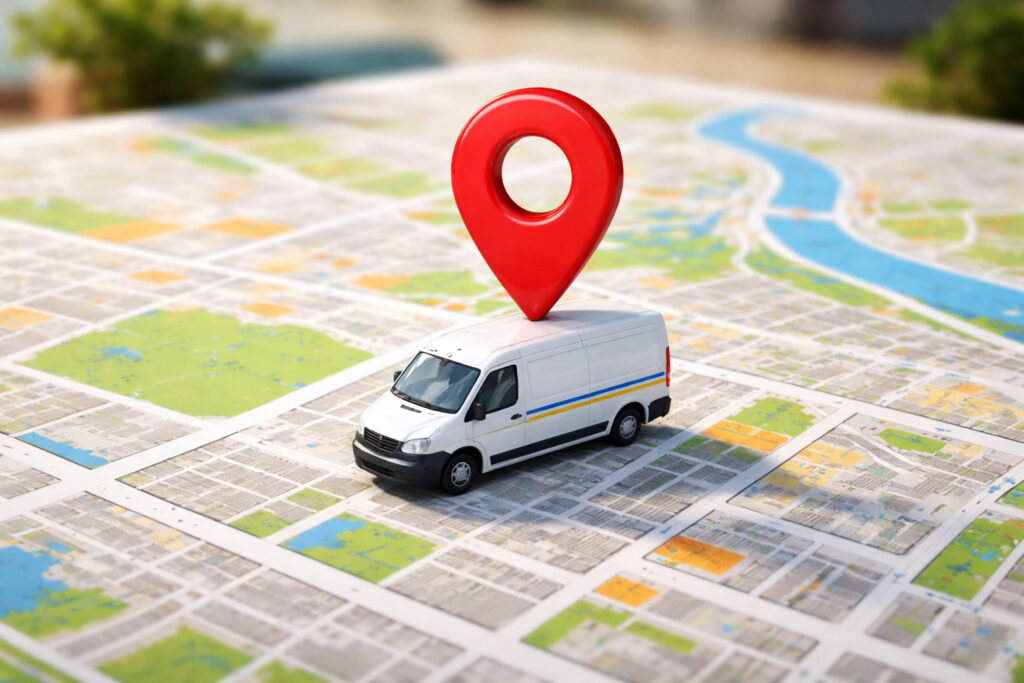
At its core, theft prevention starts with visibility. If a fleet manager cannot see where a vehicle is at any given moment, there is no way to detect suspicious movement before it becomes a full-blown loss.
What Is Real-Time Location Tracking?
Real-time tracking continuously transmits a vehicle’s GPS coordinates to a central dashboard. Instead of only knowing a truck’s last scheduled stop, managers can see live movement, speed, and direction. As a result, unusual activity, such as a vehicle moving in the middle of the night, stands out immediately rather than being discovered the next morning.
Why Does Constant Visibility Discourage Thieves?
Thieves generally prefer targets that offer easy escape and slow detection. When a fleet publicly demonstrates that its vehicles carry tracking hardware, through decals or visible units, it becomes a less appealing target. Furthermore, even without visible warnings, the presence of tracking data means recovery is faster, which reduces the overall payoff for stealing the vehicle in the first place.
How Does This Tie Back to Motive?
Motive – GPS Fleet Tracking System & Solutions gives fleet carriers live visibility into the location, utilization, and health of their vehicles and equipment, all from a single dashboard. Because the platform updates location data continuously, dispatchers can respond to unexpected movement within minutes rather than hours, which significantly narrows the window thieves rely on.
How Do Geofences Add an Extra Layer of Protection?

Geofencing takes location tracking a step further by turning passive data into an active alert system.
What Exactly Is a Geofence?
A geofence is a virtual boundary drawn around a specific location, such as a job site, warehouse yard, or delivery zone. Managers can create these boundaries around a single street address or an entire region, depending on operational needs.
How Do Alerts Work When a Vehicle Crosses a Geofence?
Once a geofence is set, the system automatically sends a notification the moment a vehicle or piece of equipment enters or exits that boundary. The alert typically includes the time, date, geofence name, and asset ID, so managers immediately understand what happened and where. If a truck leaves a secured yard outside of scheduled hours, dispatchers are notified right away and can investigate before the vehicle gets far.
Why Are Geofences Especially Useful for Overnight Parking?
Most theft occurs overnight or on weekends, when staff are not physically present to notice anything wrong. Geofencing effectively replaces a human night watchman. Instead of hoping nothing happens, fleet managers receive proof, in the form of a timestamped alert, the instant unauthorized movement begins. This proactive visibility is one of the clearest ways Motive helps reduce vehicle theft before it fully unfolds.
Can Motive Remotely Disable a Vehicle to Stop a Theft in Progress?

Detection alone is valuable, but the ability to act on that information is what actually stops a theft from succeeding.
What Is Engine Immobilization?
Engine immobilization allows an authorized dispatcher to remotely disable a vehicle’s engine when unauthorized use is suspected. Rather than simply watching a stolen truck drive away, the fleet manager can intervene directly, preventing the thief from getting far with the vehicle or its cargo.
When Should a Fleet Use This Feature?
This capability is most useful in scenarios where a vehicle moves outside of scheduled hours, exits a geofenced area unexpectedly, or is reported missing by a driver. Because the feature works remotely, fleet managers do not need to be near the vehicle to act. They simply need access to the platform and a confirmed reason to believe the vehicle is being misused.
How Does This Reduce Losses in Practice?
Instead of cargo, equipment, and the vehicle itself disappearing entirely, immobilization narrows the outcome to a stalled vehicle that can be recovered close to where it was taken. One fleet manager described the difference clearly, noting that after adopting this kind of monitoring, every stolen vehicle was recovered, often within hours, rather than being lost for good.
How Does Asset Tracking Protect Trailers and Equipment Without Engines?
Not everything that gets stolen has an engine. Trailers, generators, and heavy equipment are just as vulnerable, and they cannot be immobilized the way a powered vehicle can.
What Makes Trailers and Equipment Different Targets?
Unpowered assets are often left at job sites for days or weeks at a time, which gives thieves a much longer window of opportunity compared to a vehicle that returns to a secured lot each night. Because these assets lack an ignition system, theft prevention has to rely entirely on location awareness rather than remote shutdown.
How Does Battery-Powered Tracking Solve This Problem?
Motive addresses this gap with battery-powered Asset Gateway hardware that delivers location and telematics data independently of a vehicle’s engine. If an asset is moved unexpectedly, the system generates a real-time alert so managers know immediately rather than discovering the loss during the next scheduled audit.
What About Dormancy Alerts?
Dormancy alerts flag when a trailer has been idle for an unusually long period, which can indicate it has been abandoned, forgotten, or is sitting somewhere it should not be. These reports, available as downloadable PDF or CSV files, also help operations teams streamline asset audits and reduce the manual effort of manually checking on every piece of equipment.
Does Faster Recovery Actually Make a Difference After a Theft Occurs?
Even with strong preventive measures, no system eliminates theft attempts entirely. What changes is how quickly a fleet can respond and recover its property.
How Does GPS Data Support Law Enforcement?
When a theft does occur, real-time location data gives law enforcement a precise, continuously updating trail to follow. Rather than relying on witness accounts or security camera footage from a single location, officers can be directed to the vehicle’s current position, which dramatically increases the odds of recovery before the vehicle is stripped, resold, or moved across state lines.
Why Does Speed Matter So Much in Recovery?
Every hour a stolen vehicle goes untracked increases the likelihood it will be dismantled or hidden. Consequently, the speed at which a fleet manager can hand off accurate location data to authorities often determines whether the vehicle is recovered intact or not at all. Systems that update location minute-by-minute give a significant advantage over older tracking methods that only refresh every few hours.
What Does This Mean for Insurance and Claims?
Documented recovery efforts and location histories also support insurance claims, providing evidence of due diligence and, in successful recovery cases, potentially reducing the payout amount and associated premium increases. Fleets that can show a consistent theft-prevention strategy are often viewed more favorably by insurers over time.
What Other Security Features Does Motive Offer Fleet Managers?

Beyond the core tools already discussed, the platform includes several additional features that work together as a layered security system.
| Feature | How It Helps Reduce Theft |
|---|---|
| Automated driver-vehicle pairing | Instantly shows which driver is using which vehicle or trailer, making unauthorized use easier to spot |
| Live location sharing | Provides accurate ETAs and confirms vehicles are following expected routes |
| Historical trip data | Lets managers review past movement patterns to identify anomalies |
| GPS mode for older equipment | Extends tracking, safety, and security features to vehicles without built-in telematics |
| Fleet dashboard reporting | Centralizes alerts, audits, and theft-related data in one place |
Taken together, these features mean theft prevention is not dependent on a single tool. Instead, Motive – GPS Fleet Tracking System & Solutions layers detection, alerting, and response into one connected system, so gaps in one area are often covered by another.
How Does Motive Help Catch Unauthorized Use, Not Just Outright Theft?
Theft is not always a stranger breaking into a locked yard. In many fleets, the more common risk is unauthorized use, when a vehicle is driven somewhere it should not be, outside of approved hours, or by someone other than the assigned driver.
How Does Driver-Vehicle Pairing Reveal Suspicious Activity?
Automated pairing shows dispatchers exactly which driver is associated with which vehicle or trailer at any given moment. If a vehicle moves without a paired driver logged in, or if the pairing does not match the scheduled assignment, that mismatch is an immediate signal worth investigating. This makes it much harder for unauthorized use to go unnoticed, since the system flags inconsistencies automatically rather than relying on someone to notice them manually.
Why Does After-Hours Monitoring Matter So Much?
Most legitimate business activity happens within predictable hours. When a vehicle starts moving well outside its normal operating schedule, whether that is late at night, on a weekend, or on a day the vehicle was not scheduled for a route, it is a strong indicator that something is wrong. Combining scheduled hour awareness with geofence alerts gives fleet managers a second layer of confirmation before deciding whether to intervene, which helps avoid false alarms while still catching real threats quickly.
How Does This Protect the Business Beyond Just Theft?
Catching unauthorized use early does not only prevent theft. It also protects the business from liability if a misused vehicle is involved in an accident, helps control fuel and maintenance costs tied to unapproved trips, and reinforces accountability across the driver team. In this way, the same tools that reduce vehicle theft also strengthen overall fleet governance.
How Does Motive Compare to Traditional Anti-Theft Methods?
Many fleets still rely on older approaches, such as physical locks, security guards, or basic alarm systems. While these methods have value, they come with clear limitations when compared to a connected telematics platform.
| Method | Real-Time Alerts | Remote Response | Works for Trailers/Equipment | Supports Recovery |
|---|---|---|---|---|
| Physical locks | No | No | Limited | No |
| Security guards | Only if present | No | Yes | Limited |
| Basic alarms | Yes, but local only | No | Limited | No |
| Motive GPS platform | Yes, sent instantly | Yes, engine immobilization | Yes, via Asset Gateway | Yes, live tracking |
As the table shows, traditional methods generally address only one part of the theft-prevention puzzle. A lock can slow a thief down, but it does nothing to alert a manager or help recover the vehicle afterward. A connected system, on the other hand, addresses detection, response, and recovery simultaneously, which is why more fleets are shifting toward telematics-based security.
What Business Benefits Come From Reducing Vehicle Theft?

Preventing theft is not only about avoiding a single bad incident. It also creates measurable, ongoing benefits across the business.
How Does Theft Prevention Affect Insurance Costs?
Insurers increasingly reward fleets that demonstrate active theft-prevention measures with lower premiums, since documented tracking and immobilization capabilities reduce the insurer’s own risk exposure. Over time, these savings can offset a meaningful portion of the technology investment.
How Does It Improve Overall Fleet Utilization?
Interestingly, the same tools used to prevent theft also improve day-to-day operations. Live location data, automated pairing, and historical trip reporting help managers optimize routes, reduce idle time, and get more value out of every vehicle and asset, regardless of whether theft is ever attempted.
Why Does This Build Customer Trust?
Finally, fewer theft incidents mean fewer missed deliveries and service disruptions. Customers notice reliability, and a fleet that consistently meets its commitments builds a stronger reputation, which often translates into repeat business and stronger contracts.
What Steps Should a Fleet Take to Get Started With Theft Prevention?
Adopting a new security system can feel overwhelming, but the rollout process is generally straightforward when approached in clear stages.
- Audit current vulnerabilities. Identify which vehicles, trailers, and equipment are most exposed, and note where they are typically parked or stored overnight.
- Install GPS and asset-tracking hardware. Equip powered vehicles with connected telematics devices and unpowered assets with battery-powered tracking units.
- Configure geofences around key locations. Draw virtual boundaries around yards, warehouses, and active job sites so unauthorized movement triggers an immediate alert.
- Set up alert routing. Decide who on the team receives real-time notifications and how quickly they are expected to respond.
- Train dispatchers on remote response tools. Make sure staff understand how and when to use engine immobilization so it is used correctly if a theft is suspected.
- Review reports regularly. Use dormancy alerts and historical trip data to catch smaller anomalies before they become larger problems.
Why Does a Phased Rollout Work Better Than an All-at-Once Approach?
Rolling out tracking hardware and alert workflows in phases, starting with the highest-risk vehicles and locations, allows a team to fine-tune geofence boundaries and alert thresholds before scaling to the entire fleet. This reduces the number of false alarms and helps staff build confidence in the system, which ultimately leads to faster, more consistent responses once the rollout is complete.
Why Should Your Fleet Invest in Motive’s Anti-Theft Technology?
Vehicle and equipment theft is an ongoing risk for any business that operates a fleet, but it does not have to be an unmanageable one. Through real-time GPS tracking, geofencing, engine immobilization, and dedicated asset tracking, Motive – GPS Fleet Tracking System & Solutions gives fleet managers the visibility and control needed to detect suspicious activity early and respond before losses become permanent. Rather than reacting after a vehicle disappears, fleets equipped with this technology can act within minutes, often recovering assets the same day.
Just as importantly, these same tools also strengthen daily operations, reduce insurance costs, and improve customer trust, making theft prevention a smart investment well beyond the security benefits alone. For fleets that have relied on locks, guards, or basic alarms in the past, moving to a connected platform represents a meaningful upgrade, not just in how quickly a theft is detected, but in how effectively it can be stopped before real losses occur.
Frequently Asked Questions
No system can guarantee that a theft attempt will never happen. However, Motive significantly reduces the likelihood of a successful theft by combining real-time alerts, geofencing, and remote engine immobilization, giving fleet managers the ability to detect and respond to suspicious activity before a vehicle or asset is lost for good.
Yes. Unpowered assets cannot be immobilized. To track trailers and equipment independently, Motive uses battery-powered Asset Gateway hardware. The system sends real-time alerts when an asset moves outside an approved location or remains idle for an unusually long time.
Not necessarily, but proper configuration makes a significant difference in how effective the system is. Partnering with an experienced integration team, such as Solution for Guru, helps ensure geofences, alerts, and reporting tools are set up correctly from the start, so your fleet gets the maximum protective benefit right away.
How Can Solution for Guru Help You Implement Motive’s Technology?
Choosing the right telematics platform is only the first step. Configuring geofences correctly, setting up alert workflows, and integrating the system with existing fleet software takes technical expertise that many businesses do not have in-house. This is where partnering with Solution for Guru makes a measurable difference.
What Does Solution for Guru Bring to the Table?
Solution for Guru specializes in web development, CRM and SaaS integrations, and technology consulting, helping businesses across industries connect and optimize the platforms they rely on. Their team works with a wide range of business software providers, giving them the experience needed to help fleets configure Motive’s tools around their specific operational needs, rather than relying on generic default settings.
How Does Expert Integration Improve Results?
A poorly configured geofence or a missed alert setting can mean the difference between catching a theft in progress and finding out about it the next morning. Working with a team like Solution for Guru ensures that tracking, alerting, and reporting tools are set up correctly from day one, so your fleet gets the full protective value of the platform without a lengthy trial-and-error period.
What Long-Term Value Does This Partnership Offer?
Beyond initial setup, technology needs change as a fleet grows. Solution for Guru’s broader expertise in automation and system integration means your Motive deployment can scale alongside your business, whether that means adding new vehicles, connecting additional software tools, or refining workflows based on real-world usage data.
Recommended
- How Predictive Maintenance Works in Motive
- Reducing Vehicle Downtime with Verizon Connect
- Azuga vs Motive: Feature-by-Feature Comparison
- Azuga vs Samsara: Which Fleet Management Platform Is Better?
- How Secure Is Azuga? Security and Data Protection Explained
- Who Should Use Azuga Fleet Management Software?
- Preventive Maintenance with Samsara
- How Verizon Connect Reduces Fleet Operating Costs
- Integrating Verizon Connect with ERP Systems
- Best Motive Integrations for Fleet Management
- How Does Samsara Work?
- Is Motive Worth the Investment? ROI for Fleet Operators
- How Motive Improves Dispatcher Efficiency
- How Motive Helps Reduce Fleet Operating Costs
- Azuga Review: Features, Pros, Cons, and Best Use Cases
- What Is Azuga Fleet Management Software? A Complete Guide
- Top Reasons Businesses Choose Motive Fleet Management
- Samsara Review: Features, Pros, Cons, and Best Use Cases
- What Is Samsara GPS Fleet Tracking Software?
- Verizon Connect Review: Features, Pros, Cons, and Best Use Cases